Agricultural alternatives for phosphorus nutrition of corn plants
DOI:
https://doi.org/10.29312/remexca.v17i7.4159Keywords:
Zea mays, competition, native, phosphorusAbstract
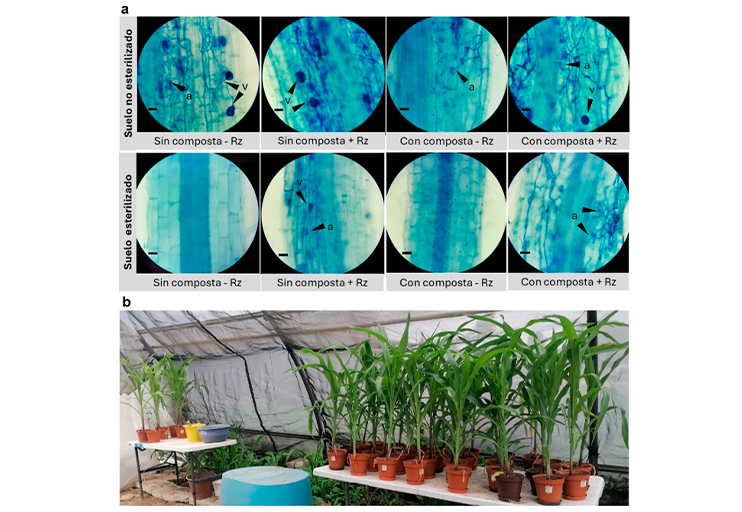
This study explored combining compost from the organic fraction of municipal solid waste with a consortium of arbuscular mycorrhizal fungi to improve phosphorus nutrition in corn (Zea mays L.) plants and consequently, their growth. The objectives were: to assess the abundance and composition of spores of a consortium of arbuscular mycorrhizal fungi in this type of compost, to determine the colonization capacity of these spores and to evaluate the joint application of compost and an inoculant composed of 12 species of a consortium of arbuscular mycorrhizal fungi on the phosphorus content and growth of corn plants. The experiment was conducted in Mexico City in 2024 under greenhouse conditions for 53 days, with plant growth in unsterilized and sterilized soil, with and without compost, and with and without inoculant from a consortium of arbuscular mycorrhizal fungi. The compost contained an average of 5 090 spores kg-1 and three taxa from a consortium of arbuscular mycorrhizal fungi; however, these did not colonize the plants’ roots. Colonization by a consortium of arbuscular mycorrhizal fungi decreased due to the compost. The joint application of compost and inoculant with a consortium of arbuscular mycorrhizal fungi increased the cumulative phosphorus of the plants grown in sterilized soil, but not that of the plants in unsterilized soil. The joint application had a neutral effect on plant growth. In conclusion, the compost from the organic fraction of municipal solid waste, enriched with a consortium of arbuscular mycorrhizal fungi, did not improve phosphorus content or plant growth in the presence of a consortium of native arbuscular mycorrhizal fungi.
Downloads
References
Acoltzi-Conde, M. C.; Chimal-Sánchez, E.; Tovar-Soto, A. and Díaz-Reyes, J. 2024. Arbuscular mycorrhizal fungi consortia in six vegetable crops in the Tepeaca Valley, Puebla, Mexico. Terra Latinoamericana. 42:1-11 https://doi.org/10.28940/terra.v42i0.1783.
Bohórquez-Sandoval, L. J.; García-Molano, J. F.; Pascual-Valero, J. A. and Ros-Muñoz, M. 2024. A comprehensive review on organic waste compost as an effective phosphorus source for sustainable agriculture. International Journal of Recycling of Organic Waste in Agriculture. 13(4):1-16. https://doi.org/10.57647/ijrowa-ybbx-kp03.
Boruah, T. and Deka, H. 2023. Biological indicators for assessing the maturity of the vermicomposted products of citronella bagasse and paper mill sludge mixture. Biomass Conversion and Biorefinery. 13(3):1999-2005. https://doi.org/10.1007/s13399-020-01228-5.
Cavagnaro, T. R. 2014. Impacts of compost application on the formation and functioning of arbuscular mycorrhizas. Soil Biology and Biochemistry. 78:38-44. https://doi.org/10.1016/j.soilbio.2014.07.007.
Cavagnaro, T. R. 2015. Chapter five-biologically regulated nutrient supply systems: compost and arbuscular mycorrhizas-a review. Advances in Agronomy. Sparks, D. L. (ed.). Academic Press. Newark, Delaware, USA. 293-321 pp. https://doi.org/10.1016/bs.agron.2014.09.005.
Chaudhary, V. B.; Nolimal, S.; Sosa‐Hernández, M. A.; Egan, C. and Kastens, J. 2020. Trait‐based aerial dispersal of arbuscular mycorrhizal fungi. New Phytologist. 228(1):238-252. https://doi.org/10.1111/nph.16667.
de Boer, M. A.; Wolzak, L. and Slootweg, J. C. 2019. Phosphorus: reserves, production, and applications. In: phosphorus recovery and recycling. Ohtake, H. and Tsuneda, S. (Eds.). Springer Singapore. 75-100 pp. https://doi.org/10.1007/978-981-10-8031-9-5.
Doydora, S.; Gatiboni, L.; Grieger, K.; Hesterberg, D.; Jones, J. L.; McLamore, E. S.; Peters, R.; Sozzani, R.; Van den Broeck, L. and Duckworth, O. W. 2020. Accessing legacy phosphorus in soils. Soil Systems. 4(4):1-22. https://doi.org/10.3390/soilsystems4040074.
FAOSTAT. 2024. Food and Agriculture Organization of the United Nations. Crops and livestock products. https://www.fao.org/faostat/en/#data/TCL.
Gou, X.; Kong, W.; Sadowsky, M. J.; Chang, X.; Qiu, L.; Liu, W.; Shao, M. and Wei, X. 2024. Global responses of soil bacteria and fungi to inoculation with arbuscular mycorrhizal fungi. Catena. 237:107817. https://doi.org/10.1016/j.catena.2024.107817.
Hu, W.; Wei, S.; Chen, H.; and Tang, M. 2020. Effect of sterilization on arbuscular mycorrhizal fungal activity and soil nutrient status. Journal of Soil Science and Plant Nutrition. 20(2):684-689. https://doi.org/10.1007/s42729-019-00156-2.
Lima, J. L. R.; Felix, J. R. B.; Vieira, H. S.; Nobre, C. P.; Leroy, J. A. S.; Fiuza, P. O. and Goto, B. T. 2024. Recovering arbuscular mycorrhizal fungi (AMF) from decomposing litter: an unusual approach. New Zealand Journal of Botany. 62(4):609-625. https://doi.org/10.1080/0028825X.2023.2232332.
Mohammadi, K.; Khalesro, S.; Sohrabi, Y. and Heidari, G. 2011. A review: beneficial effects of the mycorrhizal fungi for plant growth. Journal of Applied Environmental and Biological Sciences. 1(9):310-319. https://www.researchgate.net/publication/235617686-A-Review-Beneficial-Effects-of-the-Mycorrhizal-Fungi-for-Plant-Growth.
Sedema. 2012. Norma ambiental para el Distrito Federal NADF-020-AMB-2011 que establece los requerimientos mínimos para la producción de composta a partir de la fracción orgánica de los residuos sólidos urbanos, agrícolas, pecuarios y forestales, así como las especificaciones mínimas de calidad de la composta producida o distribuida en el Distrito Federal. http://data.sedema.cdmx.gob.mx/padla/images/stories/normatividaddf/nadf-020-ambt-2011.pdf.
Olsen, S. R. and Sommers, L. E. 1982. Phosphorus. In: methods of soil analysis. Part 2. Chemical and microbiological properties-agronomy monograph no. 9. ASA-SSSA. 403-430 pp.
Pulleman, M. M.; de Boer, W.; Giller, K. E. and Kuyper, T. W. 2022. Soil biodiversity and nature-mimicry in agriculture; the power of metaphor? Outlook on Agriculture. 51(1):75-90. https://doi.org/10.1177/00307270221080180.
Qin, Z.; Peng, Y.; Yang, G.; Feng, G.; Christie, P.; Zhou, J.; Zhang, J.; Li, X. and Gai, J. 2022. Relationship between phosphorus uptake via indigenous arbuscular mycorrhizal fungi and crop response: A 32P-labeling study. Applied Soil Ecology. 180:104624. https://doi.org/10.1016/j.apsoil.2022.104624.
Roth, R. and Paszkowski, U. 2017. Plant carbon nourishment of arbuscular mycorrhizal fungi. Current Opinion in Plant Biology. 39:50-56. https://doi.org/10.1016/j.pbi.2017.05.008.
Salmeron-Santiago, I. A.; Martínez-Trujillo, M.; Valdez-Alarcón, J. J.; Pedraza-Santos, M. E.; Santoyo, G.; Pozo, M. J. and Chávez-Bárcenas, A. T. 2021. An updated review on the modulation of carbon partitioning and allocation in arbuscular mycorrhizal plants. Microorganisms. 10(1):1-20. https://doi.org/10.3390/microorganisms10010075.
Sangabriel-Conde, W.; Negrete-Yankelevich, S.; Maldonado-Mendoza, I. E. and Trejo-Aguilar, D. 2014. Native maize landraces from Los Tuxtlas, Mexico show varying mycorrhizal dependency for P uptake. Biology and Fertility of Soils. 50(2):405-414. https://doi.org/10.1007/s00374-013-0847-x.
Sayara, T.; Basheer-Salimia, R.; Hawamde, F. and Sánchez, A. 2020. Recycling of organic wastes through composting: process performance and compost application in agriculture. Agronomy. 10(11):1838. https://doi.org/10.3390/agronomy10111838.
SEMARNAT. 2020. Secretaría de medio ambiente y recursos naturales. Diagnóstico básico para la gestión integral de los residuos. Informe técnico. https://www.gob.mx/cms/uploads/attachment/file/554385/DBGIR-15-mayo-2020.pdf.
Tamburini, G.; Bommarco, R.; Wanger, T. C.; Kremen, C.; van der Heijden, M. G. A.; Liebman, M. and Hallin, S. 2020. Agricultural diversification promotes multiple ecosystem services without compromising yield. Science Advances. 6(45):eaba1715. https://doi.org/10.1126/sciadv.aba1715.
Villar, I.; Alves, D. and Mato, S. 2016. Seafood-processing sludge composting: changes to microbial communities and physico-chemical parameters of static treatment versus for turning during the maturation stage. Plos One. 11(12):e0168590. https://doi.org/10.1371/journal.pone.0168590.
Xiao, Y.; Zhao, Z.; Chen, L. and Li, Y. 2020. Arbuscular mycorrhizal fungi and organic manure have synergistic effects on Trifolium repens in Cd-contaminated sterilized soil but not in natural soil. Applied Soil Ecology. 149:103485. https://doi.org/10.1016/j.apsoil.2019.103485.
Zhang, G. Y.; Zhang, L. P.; Wei, M. F.; Liu, Z.; Fan, Q. L.; Shen, Q. R.; and Xu, G. H. 2011. Effect of arbuscular mycorrhizal fungi, organic fertilizer and soil sterilization on maize growth. Acta Ecologica Sinica. 31(4):192-196. https://doi.org/10.1016/j.chnaes.2011.04.005.
Zou, T.; Zhang, X. and Davidson, E. A. 2022. Global trends of cropland phosphorus use and sustainability challenges. Nature. 611(7934):81-87. https://doi.org/10.1038/s41586-022-05220-z.
Downloads
Published
Issue
Section
License
Copyright (c) 2026 Revista Mexicana de Ciencias Agrícolas

This work is licensed under a Creative Commons Attribution-NonCommercial 4.0 International License.
The authors who publish in Revista Mexicana de Ciencias Agrícolas accept the following conditions:
In accordance with copyright laws, Revista Mexicana de Ciencias Agrícolas recognizes and respects the authors’ moral right and ownership of property rights which will be transferred to the journal for dissemination in open access. Invariably, all the authors have to sign a letter of transfer of property rights and of originality of the article to Instituto Nacional de Investigaciones Forestales, Agrícolas y Pecuarias (INIFAP) [National Institute of Forestry, Agricultural and Livestock Research]. The author(s) must pay a fee for the reception of articles before proceeding to editorial review.
All the texts published by Revista Mexicana de Ciencias Agrícolas —with no exception— are distributed under a Creative Commons License Attribution-NonCommercial 4.0 International (CC BY-NC 4.0), which allows third parties to use the publication as long as the work’s authorship and its first publication in this journal are mentioned.
The author(s) can enter into independent and additional contractual agreements for the nonexclusive distribution of the version of the article published in Revista Mexicana de Ciencias Agrícolas (for example include it into an institutional repository or publish it in a book) as long as it is clearly and explicitly indicated that the work was published for the first time in Revista Mexicana de Ciencias Agrícolas.
For all the above, the authors shall send the Letter-transfer of Property Rights for the first publication duly filled in and signed by the author(s). This form must be sent as a PDF file to: revista_atm@yahoo.com.mx; cienciasagricola@inifap.gob.mx; remexca2017@gmail.
This work is licensed under a Creative Commons Attribution-Noncommercial 4.0 International license.