Viability and germination of Haematoxylum campechianum L. seeds as a function of temperature and storage period
DOI:
https://doi.org/10.29312/remexca.v17i3.4102Keywords:
Haematoxylum campechianum L., forest, physiology, seedAbstract
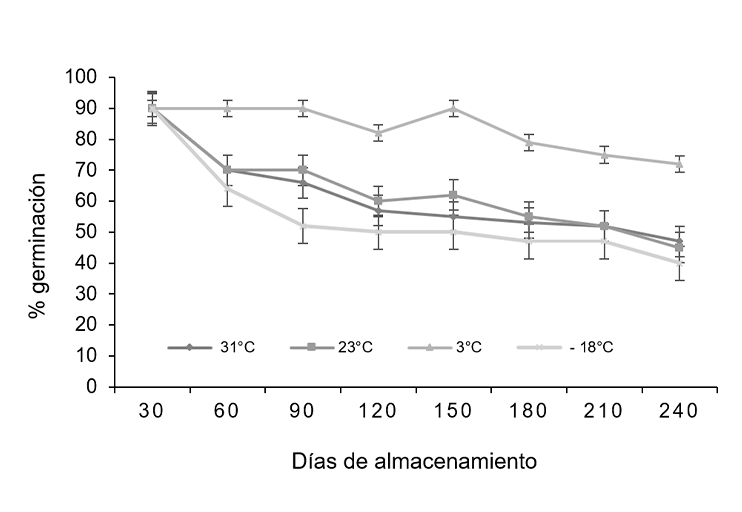
Haematoxylum campechianum L., known as palo de Campeche or palo de tinte and as éek, tooso boon che’ or palo among the Mayans, has high commercial value and grows as a wild plant in the Yucatan Peninsula; this species is a taxon distributed in the region, with historical, patrimonial and economic value due to its commercialization as a raw material to extract natural dyes. The objectives of this research were to determine the morphometry, viability and germination of palo de tinte seeds in Campeche as a function of temperature and storage period in order to increase their forest use potential. Seeds were collected in the municipality of Escárcega, Campeche, in March 2024. Germination and viability (tetrazolium test) tests were performed every 30 days for eight months at different temperatures (-18 °C, 3 °C, 23 °C, and room temperature ≈ 31 °C). Significant differences (p< 0.05) were found in the percentage of germination (% G) as a function of storage time, where the highest percentage of germination (90%) was at the temperature of 3 °C. Viability was maintained for 180 days, then gradually decreased; based on the characteristics found, it is inferred that H. campechianum seeds are classified as intermediate.
Downloads
References
Agustín-Sandoval, W. G.; Espinosa-Zaragoza, S.; Avendaño-Arrazate, C. H.; Reyes-Reyes, A. L.; Ramírez-González, S. I.; López-Báez, O.; Andrade-Rodríguez, M. y Rangel-Zaragoza, J. L. 2017. Calidad de semillas de primavera (Roseodendron donnell-smithii Miranda syn Tabebuia donnell-smithii Rose). Agroproductividad. 10(3):81-86. https://revista-agroproductividad.org/index.php/agroproductividad/article/view/974.
Busso, C. A.; Torres, Y. A.; Ithurrart, L. S. and Richards, J. H. 2015. The TTC-technique might not appropriately test the physiological stage of plant tissues. Russian Journal of Plant Physiology. 62(4):551-556. https://doi. org/10.1134/S1021443715040068.
Chablé-Vega, M. A.; Plasencia-Vázquez, A. H.; García-González, A.; Ferrer-Sánchez, Y.; Riverón-Giró F. B. y Zamora-Crescencio P. 2019. Distribución, densidad y estructura dasométrica de Haematoxylum campechianum y Haematoxylum calakmulense en Campeche, México. Ecosistemas y Recursos Agropecuarios. 6(16):65-77. https://doi.org/10.19136/era.a6n16.1784.
Contreras, A. C. 2010. La biodiversidad perdida: el caso de los colorantes. In: Durán, R. y M. Méndez Ed. Biodiversidad y desarrollo humano en Yucatán. Centro de Investigación Científica de Yucatán, AC. Programa de Pequeñas Donaciones-Fondo para el Medio Ambiente Mundial, Comisión Nacional para el Conocimiento y Uso de la Biodiversidad. Secretaría de Desarrollo Urbano y Medio Ambiente. Mérida, México. 368-372 pp.
Contreras-Cruz, L. F. 2023. Diseños experimentales aplicados a la agronomía usando R y SAS. Universidad Autónoma Chapingo. 21-28 pp. https://www.researchgate.net/publication/368661056-Libro-Disenos-Experimentales-2023.
Ding, Y. F.; Cheng, Y. H. and Song, S. Q. 2008. Changes in extreme high-temperature tolerance and activities of antioxidant enzymes of sacred lotus seeds. Science in China. Series C, Life Sciences. 51(9):842-53. doi: 10.1007/s11427-008-0107-8.
Duke, J. A. 2008. Duke ́s handbook of medicinal plants of Latin America. CRC Press. Boca Raton, USA. 343 p.
Ellis, R. H. and Hong, T. D. 2007. Seed longevity moisture content relationships in hermetic and open storage. Seed Science and Technology. 35(2):423-431. Doi: 10.15258/sst.2007.35.2.17.
Espitia-Camacho, M. H.; Araméndiz-Tatis, C. y Cardona-Ayala. 2017. Características morfométricas, anatómicas y viabilidad de semillas de Cedrela odorata L. y Cariniana pyriformis Miers. Agronomía Mesoamericana. 28(3):605-617. Doi: https://doi.org/http://dx.doi.org/10.15517/ ma.v28i3.26287.
Euan-Tun, J. L.; González-Durán, E.; Ramírez-Benítez, J. E.; Zamora-Crescencio, P.; Vargas-Contreras, J. A.; Rodríguez-Robles, U.; Enríquez-Hernández, J. K.; Caamal-Velázquez, J. H. and Aragón-Gastélum, J. L. 2021. Storage time effect on the germination of Haematoxylum campechianum L. (Fabaceae), in Campeche, Mexico. Madera y Bosques. 27(3):1-13. doi: 10.21829/myb.2021.2732263.
FAO. 2025. Evaluación de los recursos forestales mundiales 2025. Rome. https://doi.org/10.4060/cd6709es.
Flechas-Bejarano, N. y Medina-Rivera, R. 2021. Efecto del almacenamiento en la viabilidad, germinación y vigor de semillas de Coffea arabica L. Revista Cenicafé. 72(2):e72206. https://publicaciones.cenicafe.org/index.php/cenicafe/article/view/156.
Galíndez, G.; Malagrina, G. M.; Ceccato, D. V.; Ledesma, T. T.; Lindow, L. T. y Ortega, B. F. P. 2015. Dormición física y conservación ex situ de semillas de Amburana cearensis y Myroxylon peruiferum (Fabaceae). Boletín de la Sociedad Argentina de Botánica. 50(2):153-161. Doi: 10.31055/1851.2372.v50.n2.11660.
García, E. 2004. Modificaciones al sistema de clasificación climática de köppen. Instituto de geografía, Universidad Autónoma Nacional de México. Series Libro, Número 6. ISB-UNAM. 90 p. ISBN 970-32-1010-4.
Hay, R. F.; Rezaei, S.; Wolkis, D. and McGill, C. 2023. Seed Science and Technology. 51(2):267-285. https://doi.org/10.15258/sst.2023.51.2.11.
Hong, T. D. y Ellis, R. H. 1996. A protocol to determine seed storage behavior. IPGRI Technical Bulletin No. 1. (J. M. M. Engels and J. Toll, vol. eds.) International Plant Genetic Resources Institute. Rome, Italy. 62 p.
ISTA. 2024. International rules for seed testing. Richtiarkade 18, CH-8304 Wallisellen, Switzerdland. https://www.seedtest.org/en/international-rules-for-seed-testing-rubric-3.html.
Magdaleno-Hernández, E.; Magdaleno-Hernández, A.; Mejía-Contreras, A.; Martínez-Saldaña, T.; Jiménez-Velázquez, M. A.; Sánchez-Escudero, J. y García-Cué, J. L. 2020. Evaluación de la calidad física y fisiológica de semilla de maíz nativo. Agricultura, Sociedad y Desarrollo. 17(3):569-581. https://doi.org/10.22231/asyd.v17i3.1372.
Niembro, A. R. 2002. Haematoxylum campechianum L. In: Vozzo, J. A. Ed. Tropical tree seed manual. Part 2 Species Descriptions. USDA Forest Service. Washington, DC. USA. 497-499 pp.
Peng, T.; Wu, J. R.; Tong, L. J.; Li, M. Y.; Chen, F. and Leng, Y. X. 2014. Identification of DW532 as a novel anti-tumor agent targeting both kinases and tubulin. Acta Pharmacologica Sinica. 35(7):916-928. Doi: 10.1038/aps.2014.33.
Pennington, T. D. y Sarukhán, J. K. 1998. Árboles tropicales de México: manual para la identificación de las principales especies. Universidad Nacional Autónoma de México, Fondo de Cultura Económica. México. 521 p.
Pérez-Mendoza, C. 2018. Conservación de semillas de algodón nativo (Gossypium spp.): análisis físico, fisiológico y bioquímico. Tesis de Doctorado. Programa de postgrado en recursos genéticos y productividad. Colegio de Postgraduados, Campus Montecillo. Texcoco, Estado de México, México. 178 p.
Plasencia-Vázquez, A. H.; Pascale-Villegas, M. C.; Ferrer-Sánchez, Y. y Zamora-Crescencio, P. 2017. Distribución histórica de las especies del género Haematoxylum (Leguminosae) en la Península de Yucatán, México, basada en ejemplares de herbario. Acta Botánica Mexicana. 119:51-68. https://doi.org/10.21829/abm119.2017.1231.
Plasencia-Vázquez, A. H.; Serrano-Rodríguez, A. y Ferrer-Sánchez, Y. 2025. Climate change effect on Haematoxylum campechianum and Haematoxylum calakmulense (Fabaceae): are we losing our natural heritage in south-eastern Mexico? Ecology and Evolution. 15(10):1-15. https://doi.org/10.1002/ece3.72223.
Portuguez, M. P.; Rodríguez-Ruiz, A. M.; Porras-Martínez, C. and González-Lutz, M. I. 2020. Effect of temperature and scarification over the germination of Ischaemum rugosum Salisb. Agronomía Mesoamericana. 31(2):491-498. https://doi.org/10.15517/am.v31i2.38417.
Rao, N. K.; Hanson, J.; Dulloo, M. E.; Ghosh, K.; Novell, D. y Larinde, M. 2007. Manual para el manejo de semillas en bancos de germoplasma. No. 8. Bioversity International. Roma, ITA. 56-91 pp. https://hdl.handle.net/10568/1946.
Roberts, E. H. 1973. Predicting the storage life of seeds. Seed Science and Technology. 1(3):499-514. Doi: 10.4236/ajps.2014.517269.
Santillán-Fernández, A.; Castañeda-Alonso, S. S.; Carrillo-Ávila, E.; Tadeo-Noble, A. E.; Bautista-Ortega, J.; Vera-López, J. E. y Alatorre-Cobos, F.; 2023. Morfometría y viabilidad de semillas de Brosimum alicastrum Sw. en Campeche. Revista Mexicana de Ciencias Forestales. 14(77):31-55. DOI: 10.29298/rmcf.v14i77.1345.
SEMARNAT. 2017. La importancia que tienen los Bosques Tropicales. https://www.gob.mx/conanp/articulos/la-importancia-que-tienen-los-bosques-tropicales.
Vadillo, G. G.; Suni, M. L. y Cano, A. A. 2004. Viabilidad y germinación de semillas de Puya raimondii Harmsv (Bromeliaceae). Rev. Peru. Biol. 11(1):71-78. Doi: 10.15381/rpb.v11i1.2435.
Vallejos-Salazar, J.; Badilla-Valverde, Y.; Picado-Valverde, F y Murillo-Gamboa, O. 2010. Metodología para la selección e incorporación de árboles plus en programas de mejoramiento genético forestal. Agronomía Costarricense. 34(1):105-119. https://doi.org/10.15517/rac.v34i1.6704.
Velázquez, H. 2014. Estudio fisiológico en familias prolíficas de un lote de producción de semilla de la variedad de maíz. Tesis de maestría profesional, especialidad en granos y semillas. Universidad Autónoma Agraria Antonio Narro. Saltillo, Coahuila. 70 p. http://repositorio.uaaan.mx:8080/xmlui/handle/123456789/7476.
Vester, H. F. M.; Lawrence, D. J.; Eastman, J. R.; Turner, B. I.; Calme, S. Dickson, R.; Pozo, C. T. and Sangermano, F. 2007. Land change in the southern Yucatán and calakmul biosphere reserve: effects on habitat and biodiversity. Ecological Applications. 17(4):989-1003. https://doi.org/10.1890/05-1106.
Downloads
Published
Issue
Section
License
Copyright (c) 2026 Revista Mexicana de Ciencias Agrícolas

This work is licensed under a Creative Commons Attribution-NonCommercial 4.0 International License.
The authors who publish in Revista Mexicana de Ciencias Agrícolas accept the following conditions:
In accordance with copyright laws, Revista Mexicana de Ciencias Agrícolas recognizes and respects the authors’ moral right and ownership of property rights which will be transferred to the journal for dissemination in open access. Invariably, all the authors have to sign a letter of transfer of property rights and of originality of the article to Instituto Nacional de Investigaciones Forestales, Agrícolas y Pecuarias (INIFAP) [National Institute of Forestry, Agricultural and Livestock Research]. The author(s) must pay a fee for the reception of articles before proceeding to editorial review.
All the texts published by Revista Mexicana de Ciencias Agrícolas —with no exception— are distributed under a Creative Commons License Attribution-NonCommercial 4.0 International (CC BY-NC 4.0), which allows third parties to use the publication as long as the work’s authorship and its first publication in this journal are mentioned.
The author(s) can enter into independent and additional contractual agreements for the nonexclusive distribution of the version of the article published in Revista Mexicana de Ciencias Agrícolas (for example include it into an institutional repository or publish it in a book) as long as it is clearly and explicitly indicated that the work was published for the first time in Revista Mexicana de Ciencias Agrícolas.
For all the above, the authors shall send the Letter-transfer of Property Rights for the first publication duly filled in and signed by the author(s). This form must be sent as a PDF file to: revista_atm@yahoo.com.mx; cienciasagricola@inifap.gob.mx; remexca2017@gmail.
This work is licensed under a Creative Commons Attribution-Noncommercial 4.0 International license.