Granulometry and proximate analysis of flour from different organs of spring onion
DOI:
https://doi.org/10.29312/remexca.v17i3.4073Keywords:
physicochemical characterization, utilization, vegetable flourAbstract
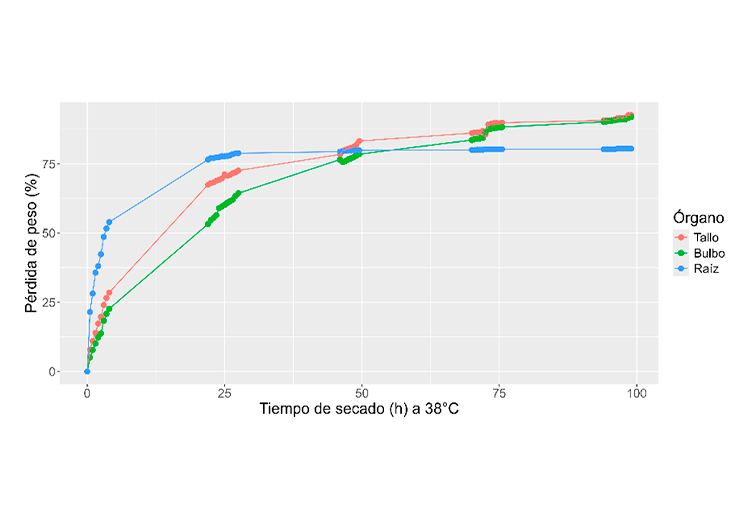
The study was conducted from 2023 to 2024 in order to fully utilize spring onion (Allium cepa L.) due to its nutraceutical and functional value and the need to generate agro-industrial ingredients from plant byproducts. Flours were made from roots, bulbs and stem/leaves and they were subjected to proximate and granulometric analyses. The samples used were dehydrated at 38 °C by convection, and then ground to obtain the flours. Granulometry, moisture, ash, protein, lipids and carbohydrates were determined using official techniques. The results obtained showed significant differences (p< 0.05). Roots and stem/leaves showed the lowest lipid content (1-4.1%) and high fiber content (30.1% and 35.2%), respectively; bulbs presented the highest concentration of lipids (7.5%) and roots presented the highest amount of ash (11.4%). The three flours had a moisture content lower than the 7% required by Mexican regulations (0.7-5.2%). Therefore, the spring onion (Allium cepa L.) can be utilized in its entirety by producing added-value flours with applications in the food industry, thereby reducing the amount of residues obtained by reducing waste and generating an additional source of income for producers and self-sustaining value chains.
Downloads
References
Alam, M. M. and Islam, M. N. 2015. Study on water sorption isotherm of summer onion. Bangladesh. Journal of Agricultural Research. 40(1):35-51.
AOAC. 2005. Association of Official Analytical Chemists. Official methods of analysis. method 923.03: ash of flour. AOAC International. 18ª Ed. Gaithersburg, Maryland, USA. Ch 32. 2 p.
AOAC. 2005. Association of Official Analytical Chemists. Official Methods of Analysis. Method 925.10: solids (total) and moisture in flour. AOAC International. 18ª Ed. Gaithersburg, Maryland, USA. Ch. 32. 1 p.
AOAC. 2005. Association of Official Analytical Chemists. Official Methods of Analysis. Method 920.39: fat (crude) in food. AOAC International. 18ª Ed. Gaithersburg, Maryland, USA. Ch. 4. 5 p.
AOAC. 2005. Association of Official Analytical Chemists. Official Methods of Analysis. Method 985.29: Total Dietary Fiber in Foods. AOAC International. 18ª Ed. Gaithersburg, Maryland, USA. Ch. 45. 4 p.
Badui-Dergal, S. 2006. Química de los alimentos. 4ª Ed. Pearson Education. México. 738 p.
Baéz, J.; Marra, G.; Olt, V.; Fernández-Fernández, A. M. and Medrano, A. 2023. Potential of onion byproducts as a sustainable source of dietary fiber and antioxidant compounds for its application as a functional ingredient. Biology and Life Sciences Forum. 26(1):67-72. https://doi.org/10.3390/Foods2023-15046.
Balakrishnaraja, R.; Swetha, V.; Srivigneswar, S.; Sakthi-Priyaa, S. S. and Gowrishanka, L. 2021. Formulation and development of functionally enriched onion (Allium cepa) bread. Materials Today: Proceedings. 47(1):1835-1841. https://doi.org/10.1016/j.matpr.2021.03.249.
Bamba, B. B. S.; Komenan, A. C. A.; Kouassi, K. K. P. and Soro, D. 2020. Effects of onion bulb processing conditions on drying characteristics, physicochemical and functional properties profile of onion (Allium cepa L.) powder. Journal of Food Sciencie. 85(10):3346-3354. https://doi.org/10.1111/1750-3841.15415.
Bedrníček, J.; Jirotková, D.; Kadlec, J.; Laknerová, I.; Vrchotová, N.; Tříska, J.; Samková, E. and Smetana, P. 2020. Thermal stability and bioavailability of bioactive compounds after baking of bread enriched with different onion by-products. Food Chemistry. 319(1):1-9. https://doi.org/10.1016/j.foodchem.2020.126562.
Bello, M.; Olabanji, I. O. and Abdul-Hammed, M. 2013. Characterization of domestic onion wastes and bulb (Allium cepa L.): Fatty acids and metal contents. International Food Research Journal. 20(5):2153-2158.
Brewster, J. L. 2008. Onions and other vegetable alliums. 2nd Ed. Cab International. UK. 411 p.
Borrego, J. V. M. 1989. Horticultura herbácea especial. Mundi-Prensa. España. 704 p.
Everardo-Zamora, P. 2016. El cultivo de la cebolla. Serie guías producción de hortalizas. 15(1):1-7.
FAO. 2025. Food and Agriculture Organization of the United Nations. FAOSTAT. https://www.fao.org/faostat/es/#data.
Fellows, P. J. 2000. Physical properties of foods and food processing systems. 2nd Ed. Woodhead Publishing Limited y CRC Press LLC. Washington, DC. 467 p.
Fennema, O. R.; Parkin, K. L. y Damodaran, S. 2019. Química de los alimentos. 4ª Ed. Acribia. Zaragoza, España. 1249 p.
Gawlik-Dziki, U.; Świeca, M.; Dziki, D.; Baraniak, B.; Tomiło, J. and Czyz, J. 2013. Quality and antioxidant properties of breads enriched with dry onion (Allium cepa L.) skin. Food Chemistry. 138(2-3):1621-1628. https://doi.org/10.1016/j.foodchem.2012.09.151.
Griffiths, G.; Trueman, L.; Crowther, T.; Thomas, B. and Smith, B. 2002. Onions - A global benefit to health. Phytotherapy Research. 16(7):603-615. https://doi.org/10.1002/ptr.1222. https://doi.org/10.1002/ptr.1222.
Jaime, L.; Mollá, E.; Fernández, A.; Martín-Cabrejas, M. A.; López-Andréu, F. J. and Esteban, R. M. 2002. Structural carbohydrate differences and potential source of dietary fiber of onion (Allium cepa L.) tissues. Journal of Agricultural and Food Chemistry. 50(1):122-128. http://doi.org/10.1021/jf010797t.
Kakkar, S.; Tandon, R. and Tandon, N. 2021. Utilizing fruits and vegetables waste as functional food: a review. Plant Cell Biotechnology and Molecular Biology. 22(17):41-58.
Koménan A. C. A.; Bamba, B. S. B.; N’gouin, J. A.; Akré M. S. H. and Soro Y. R. 2020. Effects of drying methods and onion bulb variety on physicochemical and functional properties of onion powder. Asian Food Science Journal. 19(4):42-54.
Labuza, T. P. and Tannenbaum, S. R. 1972. Nutrient losses during drying and storage of dehydrated foods. CRC Critical Reviews in Food Technology. 3(2):217-240.
Montes, A. y Holle, M. 1970. Descripción de algunos cultivos olerícolas. Universidad Nacional Agraria-La Molina. 101 p.
Pareek, S.; Sagar, N. A.; Sharma, S. and Kumar, V. 2018. Onion (Allium cepa L.). Fruit and Vegetable Phytochemicals: Chemistry and Human Health. Yahia, E. M Ed. 2nd. ed. John Wiley & Sons Ltd. Kundli, Sonepat, Haryana, India. 1145-1161. pp.
Ros-Berruezo, G. F.; Periago-Gastón, M. J.; y Pérez-Conesa, D. 2010. Legumbres, verduras y productos hortícolas. Tratado de nutrición. 2(1):139-166.
Sagar, N. A. and Pareek, A. 2021. Fortification of multigrain flour with onion skin powder as a natural preservative: Effect on quality and shelf life of the bread. Food Bioscience. 41(1):1-9. https://doi.org/10.1016/j.fbio.2021.100992.
SCFI. 1978. Secretaría de Comercio y Fomento Industrial NMX-F-312-1978. Alimentos. Determinación de azúcares reductores por el método volumétrico de Lane-Eynon. México.
SCFI. 1980. Secretaría de Comercio y Fomento Industrial. NOM-068-S-1980. Alimentos. Determinación de proteínas. México.
Siddiq, M.; Roidoung, S.; Sogi, D. S. and Dolan, K. D. 2013. Total phenolics, antioxidant properties and quality of fresh-cut onions (Allium cepa L.) treated with mild-heat. Food Chemistry. 136(2):803-806.
Wang, C.; Wang, Y.; Wang, N. and Ren, J. 2025. Influence of Onion Peel Extract on the Dough Characteristics of High-Gluten Wheat Flour and the Quality of Bread. Foods. 14(9):16-18. https://doi.org/10.3390/foods14091618.
Downloads
Published
Issue
Section
License
Copyright (c) 2026 Revista Mexicana de Ciencias Agrícolas

This work is licensed under a Creative Commons Attribution-NonCommercial 4.0 International License.
The authors who publish in Revista Mexicana de Ciencias Agrícolas accept the following conditions:
In accordance with copyright laws, Revista Mexicana de Ciencias Agrícolas recognizes and respects the authors’ moral right and ownership of property rights which will be transferred to the journal for dissemination in open access. Invariably, all the authors have to sign a letter of transfer of property rights and of originality of the article to Instituto Nacional de Investigaciones Forestales, Agrícolas y Pecuarias (INIFAP) [National Institute of Forestry, Agricultural and Livestock Research]. The author(s) must pay a fee for the reception of articles before proceeding to editorial review.
All the texts published by Revista Mexicana de Ciencias Agrícolas —with no exception— are distributed under a Creative Commons License Attribution-NonCommercial 4.0 International (CC BY-NC 4.0), which allows third parties to use the publication as long as the work’s authorship and its first publication in this journal are mentioned.
The author(s) can enter into independent and additional contractual agreements for the nonexclusive distribution of the version of the article published in Revista Mexicana de Ciencias Agrícolas (for example include it into an institutional repository or publish it in a book) as long as it is clearly and explicitly indicated that the work was published for the first time in Revista Mexicana de Ciencias Agrícolas.
For all the above, the authors shall send the Letter-transfer of Property Rights for the first publication duly filled in and signed by the author(s). This form must be sent as a PDF file to: revista_atm@yahoo.com.mx; cienciasagricola@inifap.gob.mx; remexca2017@gmail.
This work is licensed under a Creative Commons Attribution-Noncommercial 4.0 International license.