Effect of pollen carriers on cherimoya production in the Andean region
DOI:
https://doi.org/10.29312/remexca.v17i4.3989Keywords:
Annona cherimola, Lycopodium clavatum, chuño flour, corn flour, wheat flourAbstract
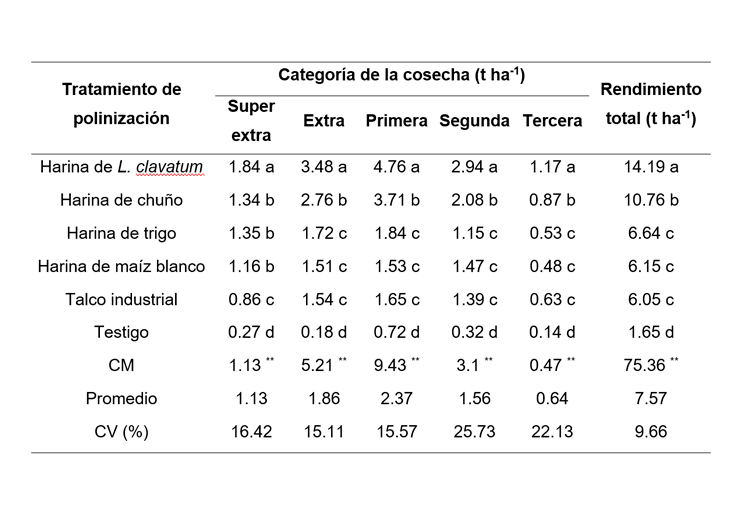
The research aimed to evaluate the effect of pollen carriers on cherimoya (Annona cherimola Mill.) production through the use of assisted pollination under conditions of the high Andean zone of the Lima region, Peru. The design used was a randomized complete block design with six treatments and three replications. The treatments were: T1) pollen carrier with chuño flour (potato starch); T2) pollen carrier with Lycopodium clavatum flour; T3) pollen carrier with white corn flour; T4) pollen carrier with wheat flour; T5) pollen carrier with industrial talc; and T6) natural pollination (control). Each experimental unit consisted of three trees arranged in a 48 m2 area. The variables evaluated were the number of fruits set per tree, yield by fruit category (t ha-1), and total yield (t ha-1). The averages were compared using the Scott-Knott test at 5% level. It was found that treatment with L. clavatum flour significantly outperformed all other treatments, obtaining more fruits set per tree, higher total yield, and higher yield in each of the categories considered; it was followed in importance by chuño flour. The control treatment produced the lowest values for the set of characteristics evaluated and was statistically lower (p< 0.05) than the other treatments. It is concluded that assisted pollination with pollen carriers significantly increases cherimoya production, with treatments with L. clavatum flour and chuño flour standing out.
Downloads
References
Apolonio, I.; Franco, O.; Morales, E. J. y González, A. 2015. Influencia de la fuente de polen y su efectividad en la calidad de frutos de chirimoya (Annona cherimola Mill.). Agronomía Costarricense. 39(1):61-69. https://www.scielo.sa.cr/pdf/ac/v39n1/a05v39n1.pdf.
Bernzen, A.; Sohns, F.; Jia, Y. and Braun, B. 2023. Crop diversification as a household livelihood strategy under environmental stress. Factors contributing to the adoption of crop diversification in shrimp cultivation and agricultural crop farming zones of coastal Bangladesh. Land Use Policy. 132:106796. https://doi.org/10.1016/j.landusepol.2023.106796. DOI: https://doi.org/10.1016/j.landusepol.2023.106796
Broussard, M. A.; Coates, M. and Martinsen, P.; 2023. Artificial pollination technologies: a review. Agronomy. 13(5):1351. https://doi.org/10.3390/agronomy13051351. DOI: https://doi.org/10.3390/agronomy13051351
Cabrera, C. E. y De la O, A. P. 2023. La agricultura familiar en el Perú: brechas, retos y oportunidades. FAO. Roma. 11-15 pp. https://openknowledge.fao.org/server/api/core/bitstreams/616d575b-9f56-46c9-84c2-deed0dd119e4/content.
Damme, P. V. and Scheldeman, X. 1999. Promoting cultivation of cherimoya in Latin America. En: Non-wood Forest Products and Income Generation. Ed. SA. Dembner. A. Perlis. FAO. 2-4 pp. https://www.fao.org/4/x2450e/x2450e09.htm#:~:text=In%20Latinet al20America%20cherimoya%20is,and%20irrigation%2C%20commercial%20organization%20and.
Flores, D. 2013. Cultivo de chirimoyo. Manual práctico para productores. Swiss Contact. 31-33 pp. https://drive.google.com/file/d/10-wcZaAUsxxeSke3ahIP9w1TYtYbSL86/view.
García, R. 2017. Innovación tecnológica para la polinización artificial de la chirimoya en el municipio de Mizque. Desarrollo Rural y Territorial. 23-36 pp. http://ddigital.umss.edu/bitstream/123456789/10843/1/garcia%20beatriz%20trabajo%20final-polinizacion.pdf.
Gonzáles, F. y Maldonado, A. 2014. Identificación in situ de ecotipos de chirimoya (Annona cherimola Mill.) con aptitudes potencialmente comerciales en el distrito de Churubamba-Huánuco. Investigación Valdizana. 1(8):9-17. https://www.redalyc.org/pdf/5860/586061890002.pdf.
Gonzáles, M. E. 2013. Chirimoya (Annona cherimola Miller.) frutal tropical y subtropical de valores promisorios. Cultivos Tropicales. 34(3):52-63. https://www.redalyc.org/articulo.oa?id=193227533008.
Gonzáles, M.; Baeza, E.; Lao, J. L. and Cuevas, J. 2006. Pollen load affects fruit set, size, and shape in cherimoya. Scientia Horticulturae. 110(1):51-56. https://doi.org/10.1016/j.scienta.2006.06.015. DOI: https://doi.org/10.1016/j.scienta.2006.06.015
Heredia, L. H. 2022. Evaluación de bionutrientes en el rendimiento de Chirimoyo (Annona cherimola Mill.) variedad Cumbe en Huaycho (tesis de pregrado). http://repositorio.unjfsc.edu.pe/handle/20.500.14067/6377.
Jalikop, S. H. and Kumar, R. 2007. Pseudo-xenic effect of allied Annona spp. pollen in hand pollination of cv ‘Arka Sahan’ [(A. cherimola × A. squamosa) × A. squamosa]. HortScience. 42(7):1534-1538. https://www.doi.org/10.21273/hortsci.42.7.1534. DOI: https://doi.org/10.21273/HORTSCI.42.7.1534
Kahn, T. L. 1998. Pollination: theory & practice. En: The CCA Cherimoya handbook. 8-10 pp. https://ucanr.edu/sites/default/files/2024-06/398853.pdf.
Larranaga, N.; Agustín, J. A.; Albertazzi, F.; Fontecha, G. Vásquez-Castillo, W.; Cautín, R.; Quiroz, E.; Ragonezi, C. and Hormaza, J. I. 2024. Underutilized fruit crops at a crossroads: the case of Annona cherimola-from pre-Columbian to present times. Horticulturae. 10(6):53. https://doi.org/10.3390/horticulturae10060531. DOI: https://doi.org/10.3390/horticulturae10060531
Merino, R. E. 2019. Estudio de pre factibilidad de los productos derivados de la chirimoya. Tesis de pregrado, Pontificia Universidad Católica del Perú https://tesis.pucp.edu.pe/server/api/core/bitstreams/805a12db-479e-45e1-978f-bbea72ffc168/content.
Pereira, M. C. T.; Crane, J. H.; Montas, W.; Nietsche, S. and Vendrame, W. A. 2014. Effects of storage length and flowering stage of pollen influence its viability, fruit set and fruit quality in ‘Red’ and ‘Lessard Thai’ sugar apple (Annona squamosa) and ‘Gefner’ atemoya (A. cherimola × A. squamosa). Scientia Horticulturae. 17;55-60. https://doi.org/10.1016/j.scienta.2014.08.004. DOI: https://doi.org/10.1016/j.scienta.2014.08.004
Pinillos, V. and Cueva, J. 2007. Artificial pollination in tree crop production. In: Horticultural Reviews, Volume 34. Ed. Jules Janick John Wiley & Sons https://www.researchgate.net/publication/230035325-artificial-pollination-in-tree-crop-production. DOI: https://doi.org/10.1002/9780470380147.ch4
Pritchard, K. D. and Edwards, W. 2006. Supplementary pollination in the production of custard apples (Annona sp.) the effect of pollen source. The Journal of Horticultural Science and Biotechnology. 81(1):78-83. https://doi.org/10.1080/14620316.2006.11512032. DOI: https://doi.org/10.1080/14620316.2006.11512032
Rayter, D. G. 2008. Guía de aplicación de arquitectura bioclimática en locales educativos. Ministerio de Educación, Lima. 12-18 pp. https://repositorio.minedu.gob.pe/handle/20.500.12799/10636.
Richardson, A. C. and Anderson, P. A. 1996. Hand pollination effects on the set and development of cherimoya (Annona cherimola) fruit in a humid climate. Scientia Horticulturae. 65(4):273-281. https://doi.org/10.1016/0304-4238(96)00878-3. DOI: https://doi.org/10.1016/0304-4238(96)00878-3
Tineo, J. I. 2018. Manejo técnico del cultivo de chirimoyo en valles interandinos. Instituto Nacional de Innovación Agraria. Lima. 45-49 pp. https://repositorio.inia.gob.pe/bitstream/20.500.12955/1779/1/manejo%20t%c3%a9cnico%20del%20cultivo%20de%20chirimoyo%20en%20valles%20interandinos.pdf.
Vásquez, W. A.; Viteri, P. F.; Viera, W. F.; Tamayo, E. A.; Mejía, P. R.; Racines, M. A.; Merino, J. L.; Noboa, M. A.; Cartagena, Y. E. y Meléndez, M. R. 2023. El chirimoyo (Annona cherimola Mill.): producción en los valles interandinos de Ecuador. UDLA Ediciones 76-80 pp. https://repositorio.iniap.gob.ec/bitstream/41000/6317/1/El%20Chirimoyo.pdf
Wurz, A. Grass, I. and Tscharntke, T. 2021. Hand pollination of global crops- A systematic review. Basic and Applied Ecology. 56:299-321. https://doi.org/10.1016/j.baae.2021.08.008. DOI: https://doi.org/10.1016/j.baae.2021.08.008
Zamora-Pinedo, H. 2022. Simulation of assisted entotophilic pollination process in Shanusi oil plantations to plan future production scenarios. Revista Científica de Sistemas e Informática. 2(1):e133. https://doi.org/10.51252/rcsi.v2i1.133. DOI: https://doi.org/10.51252/rcsi.v2i1.133
Downloads
Published
Issue
Section
License
Copyright (c) 2026 Revista Mexicana de Ciencias Agrícolas

This work is licensed under a Creative Commons Attribution-NonCommercial 4.0 International License.
The authors who publish in Revista Mexicana de Ciencias Agrícolas accept the following conditions:
In accordance with copyright laws, Revista Mexicana de Ciencias Agrícolas recognizes and respects the authors’ moral right and ownership of property rights which will be transferred to the journal for dissemination in open access. Invariably, all the authors have to sign a letter of transfer of property rights and of originality of the article to Instituto Nacional de Investigaciones Forestales, Agrícolas y Pecuarias (INIFAP) [National Institute of Forestry, Agricultural and Livestock Research]. The author(s) must pay a fee for the reception of articles before proceeding to editorial review.
All the texts published by Revista Mexicana de Ciencias Agrícolas —with no exception— are distributed under a Creative Commons License Attribution-NonCommercial 4.0 International (CC BY-NC 4.0), which allows third parties to use the publication as long as the work’s authorship and its first publication in this journal are mentioned.
The author(s) can enter into independent and additional contractual agreements for the nonexclusive distribution of the version of the article published in Revista Mexicana de Ciencias Agrícolas (for example include it into an institutional repository or publish it in a book) as long as it is clearly and explicitly indicated that the work was published for the first time in Revista Mexicana de Ciencias Agrícolas.
For all the above, the authors shall send the Letter-transfer of Property Rights for the first publication duly filled in and signed by the author(s). This form must be sent as a PDF file to: revista_atm@yahoo.com.mx; cienciasagricola@inifap.gob.mx; remexca2017@gmail.
This work is licensed under a Creative Commons Attribution-Noncommercial 4.0 International license.