Potential of cocoa husk waste for the paper industry
DOI:
https://doi.org/10.29312/remexca.v16i8.3833Keywords:
agribusiness, biomass, byproducts, cultivarsAbstract
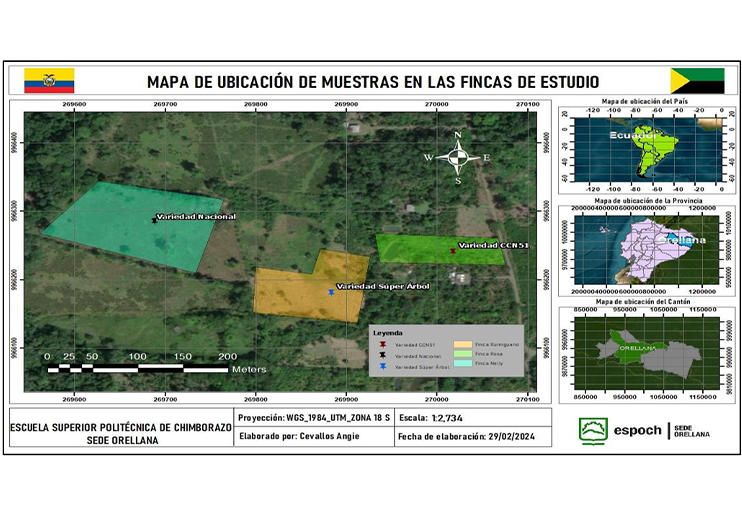
The study evaluated the lignin and cellulose contents in the waste of three varieties of cocoa grown in the cantón of Francisco de Orellana (Ecuador)- Nacional, CCN-51, and Super Árbol- in order to explore their potential as an input for the production of kraft paper. The collection was carried out on farms of the Asopriabet association, and the chemical analyses were developed at the National Institute of Agricultural Research, applying standardized methodologies (TAPPI T-222 and Kürschner-Hoffer). The results showed that CCN-51 had the highest lignin content (45.13%), while Nacional showed the highest percentage of cellulose (28.57%). Nevertheless, the differences between varieties were not statistically significant. It was concluded that, despite this, the potential of this waste as an alternative raw material is supported, suggesting complementary studies that include crop variability, physical characterization of the pulp and production pilot tests to validate its industrial applicability.
Downloads
References
Bajpai, P. 2015. Basic overview of pulp and paper manufacturing process. In: Bajpai, P. Ed. Green chemistry and sustainability in pulp and paper industry. Springer International Publishing. 11-39 pp. https://doi.org/10.1007/978-3-319-18744-0-2.
Balea, A.; Fuente, E.; Monte, M. C.; Merayo, N.; Campano, C.; Negro, C. and Blanco, A. 2020. Industrial application of nanocelluloses in papermaking: a review of challenges, technical solutions, and market perspectives. Molecules. 25(3):526-531.
Cabezas-Andrade, D.; Jiménez-Gutiérrez, M. Y.; Torres-Castillo, R. M. and Bustamante-Cuenca, J. C. 2024. Huella de carbono en residuos postcosecha de Theobroma cacao L. y la economía circular. Agroecología Global. Revista Electrónica de Ciencias del Agro y Mar. 6(11):4-20. https://doi.org/10.35381/a.g.v6i11.4143.
Cevallos, A. G. 2024. Evaluación de las propiedades físicas y mecánicas del papel kraft obtenido a partir de la biomasa lignocelulósica de la cascarilla de cacao (Theobroma cacao L.) tras someterse a un proceso de blanqueo con peróxido de hidrógeno. Tesis de grado, ESPOCH. http://dspace.espoch.edu.ec/handle/123456789/22667.
Daud, Z.; Awang, H.; Mohd, A. S.; Mohd, M. Z. and Mohd, A. 2014. Cocoa pod husk and corn stalk: alternative paper fibres study on chemical characterization and morphological structures. Advanced Materials Research. 911:331-335. https://doi.org/10.4028/www.scientific.net/AMR.911.331.
De-Corato, U.; De-Bari, I.; Viola, E. and Pugliese, M. 2018. Assessing the main opportunities of integrated biorefining from agro-bioenergy co/by products and agroindustrial residues into high-value added products associated to some emerging markets: a review. Renewable and Sustainable Energy Reviews. 88:326-346.
Dey, T.; Bhattacharjee, T.; Nag, P.; Ghati, A. and Kuila, A. 2021. Valorization of agro-waste into value added products for sustainable development. Bioresource Technology Reports. 16:100834.
Enawgaw, H.; Tesfaye, T.; Yilma, K. T. and Limeneh, D. Y. 2023. Multiple utilization ways of corn by-products for biomaterial production with bio refinery concept; a review. Materials Circular Economy. 5(1):7-15.
GADM Francisco de Orellana. 2023. Plan de desarrollo y ordenamiento territorial del cantón Francisco de Orellana. GADM Francisco de Orellana.
García-Briones, A. R.; Pico-Pico, B. F. and Jaimez, R. 2021. La cadena de producción del cacao en Ecuador: resiliencia en los diferentes actores de la producción. Revista Digital Novasinergia. 4(2):152-172. https://doi.org/10.37135/ns.01.08.10.
Gil-Martín, E.; Forbes-Hernández, T.; Romero, A.; Cianciosi, D.; Giampieri, F. and Battino, M. 2022. Influence of the extraction method on the recovery of bioactive phenolic compounds from food industry by-products. Food Chemistry. 378:131918.
Gómez-García, R.; Campos, D. A.; Aguilar, C. N.; Madureira, A. R. and Pintado, M. 2021. Valorisation of food agro-industrial by-products: from the past to the present and perspectives. Journal of Environmental Management. 299:113571.
Grzyb, A.; Wolna-Maruwka, A. and Niewiadomska, A. 2020. Environmental Factors Affecting the Mineralization of Crop Residues. Agronomy. 10(12):1951-1958.
Gutiérrez-Macías, P.; Mirón-Mérida, V. A.; Rodríguez-Nava, C. O. and Barragán-Huerta, B. E. 2021. Chapter 13 Cocoa: beyond chocolate, a promising material for potential value-added products. In: Bhat, R. Ed. Valorization of Agri-Food Wastes and By-Products. 267-288 pp.
Hailemariam, T. T. and Woldeyes, B. 2024. Production and characterization of pulp and paper from flax straw. Scientific Reports. 14(1):24300-24308. https://doi.org/10.1038/s41598-024-74096-y.
Hameed, A.; Hussain, S. A. and Suleria, H. A. R. 2020. Coffee bean related agroecological factors affecting coffee. Eds. Co-Evolution of Secondary Metabolites. 641-705 pp.
Hawanis, H. S. N.; Ilyas, R. A.; Jalil, R.; Ibrahim, R.; Majid, R. A. and Hamid, N. H. 2024. Insights into lignocellulosic fiber feedstock and its impact on pulp and paper manufacturing: a comprehensive review. Sustainable Materials and Technologies. 40:e00922.
Jagadeesan, R.; Suyambulingam, I.; Divakaran, D. and Siengchin, S. 2023. Novel sesame oil cake biomass waste derived cellulose micro-fillers reinforced with basalt/banana fibre-based hybrid polymeric composite for lightweight applications. Biomass Conversion and Biorefinery. 13(5):4443-4458.
Jakob, M.; Mahendran, A. R.; Gindl-Altmutter, W.; Bliem, P.; Konnerth, J.; Müller, U. and Veigel, S. 2022. The strength and stiffness of oriented wood and cellulose-fibre materials: A review. Progress in Materials Science. 125:100916.
Kapun, T.; Karlovits, I. and Dimitrov, K. 2024. Cocoa husk biomass conversion for application in fibre packaging. Biomass Conversion and Biorefinery. 14(10):11165-11173. https://doi.org/10.1007/s13399-022-03330-2.
Koul, B.; Yakoob, M. and Sah, M. P. 2022. Agricultural waste management strategies for environmental sustainability. Environmental Research. 206:112285.
Kumar, B. M. and Kunhamu, T. K. 2022. Nature-based solutions in agriculture: a review of the coconut (Cocos nucifera L.) based farming systems in Kerala, the land of coconut trees. Nature-Based Solutions. 2:100012.
Kürschner, K. and Hoffer, A. 1931. Eine neue quantitative cellulosebestimmung. Chemiker-Zeitung. 17:161-168.
Mayakannan, S.; Raj, J. B.; Raja, V. L. and Nagaraj, M. 2023. Effectiveness of silicon nanoparticles on the mechanical, wear, and physical characteristics of PALF/sisal fiber based polymer hybrid nanocomposites. Biomass Conversion and Biorefinery. 13(14):13291-13305.
Megra, M. B.; Bachheti, R. K.; Tadesse, M. G. and Worku, L. A. 2022. Evaluation of pulp and papermaking properties of Melia azedarach. Forests. 13(2):1-10. https://doi.org/10.3390/f13020263.
Plakantonaki, S.; Roussis, I.; Bilalis, D. and Priniotakis, G. 2023. Dietary fiber from plant-based food wastes: a comprehensive approach to cereal, fruit, and vegetable waste valorization. Processes. 11(5):1580-1587.
Ramos-Ramos, T. P.; Guevara-Llerena, D. J.; Sarduy-Pereira, L. B. and Diéguez-Santana, K. 2020. Producción más limpia y ecoeficiencia en el procesado del cacao: un caso de estudio en Ecuador. Revista Investigación y Desarrollo. 20(1):1-10. https://doi.org/10.23881/idupbo.020.1-10i.
Rempelos, L.; Almuayrifi, M. S. B.; Baranski, M.; Tetard-Jones, C.; Barkla, B.; Cakmak, I.; Ozturk, L.; Cooper, J.; Volakakis, N.; Hall, G.; Zhao, B.; Rose, T. J.; Wang, J.; Kalee, H. A.; Sufar, E.; Hasanalieya, G.; Bilsborrow, P. and Leifert, C. 2020. The effect of agronomic factors on crop health and performance of winter wheat varieties bred for the conventional and the low input farming sector. Field Crops Research. 254:107822.
Romruen, O.; Karbowiak, T.; Tongdeesoontorn, W.; Shiekh, K. A. and Rawdkuen, S. 2022. Extraction and characterization of cellulose from agricultural by-products of chiang rai province. Thailand. Polymers. 14(9):1830-1837.
Saravia-Matus, S. L.; Rodríguez, A. G. and Saravia, J. A. 2020. Determinants of certified organic cocoa production: evidence from the province of Guayas, Ecuador. Organic Agriculture. 10(1):23-34.
Siqueira, M. U.; Contin, B.; Fernandes, P. R. B.; Ruschel-Soares, R.; Siqueira, P. U. and Baruque-Ramos, J. 2022. Brazilian agro industrial wastes as potential textile and other raw materials: a sustainable approach. Materials Circular Economy. 4(1):9-17.
TAPPI. 2022a. T211 Om-02 cenizas en madera, pulpa, papel y cartón: combustión a 525 °C. Asociación técnica de la industria de pulpa y papel. Atlanta, GA, EE. UU.
Villacis, A.; Alwang, J.; and Barrera, V. 2022. Cacao value chains and credence attributes: lessons from Ecuador. Journal of Agribusiness in Developing and Emerging Economies. 12(4):549-566.
Viteri, S. I. 2022. Evaluación del proceso de fermentación en las variedades de cacao nacional y súper árbol (Theobroma cacao L.) en las condiciones climáticas del cantón Joya de los Sachas, provincia de Orellana. Tesis de grado, ESPOCH. http://dspace.espoch.edu.ec/handle/123456789/16536.
Downloads
Published
Issue
Section
License
Copyright (c) 2025 Revista Mexicana de Ciencias Agrícolas

This work is licensed under a Creative Commons Attribution-NonCommercial 4.0 International License.
The authors who publish in Revista Mexicana de Ciencias Agrícolas accept the following conditions:
In accordance with copyright laws, Revista Mexicana de Ciencias Agrícolas recognizes and respects the authors’ moral right and ownership of property rights which will be transferred to the journal for dissemination in open access. Invariably, all the authors have to sign a letter of transfer of property rights and of originality of the article to Instituto Nacional de Investigaciones Forestales, Agrícolas y Pecuarias (INIFAP) [National Institute of Forestry, Agricultural and Livestock Research]. The author(s) must pay a fee for the reception of articles before proceeding to editorial review.
All the texts published by Revista Mexicana de Ciencias Agrícolas —with no exception— are distributed under a Creative Commons License Attribution-NonCommercial 4.0 International (CC BY-NC 4.0), which allows third parties to use the publication as long as the work’s authorship and its first publication in this journal are mentioned.
The author(s) can enter into independent and additional contractual agreements for the nonexclusive distribution of the version of the article published in Revista Mexicana de Ciencias Agrícolas (for example include it into an institutional repository or publish it in a book) as long as it is clearly and explicitly indicated that the work was published for the first time in Revista Mexicana de Ciencias Agrícolas.
For all the above, the authors shall send the Letter-transfer of Property Rights for the first publication duly filled in and signed by the author(s). This form must be sent as a PDF file to: revista_atm@yahoo.com.mx; cienciasagricola@inifap.gob.mx; remexca2017@gmail.
This work is licensed under a Creative Commons Attribution-Noncommercial 4.0 International license.