Optimizing nitrogen ratios for blueberry cultivated under saline medium
DOI:
https://doi.org/10.29312/remexca.v16i8.4138Keywords:
Vaccinium corymbosum L., ammonium, nitrate, stress, quality, yieldAbstract
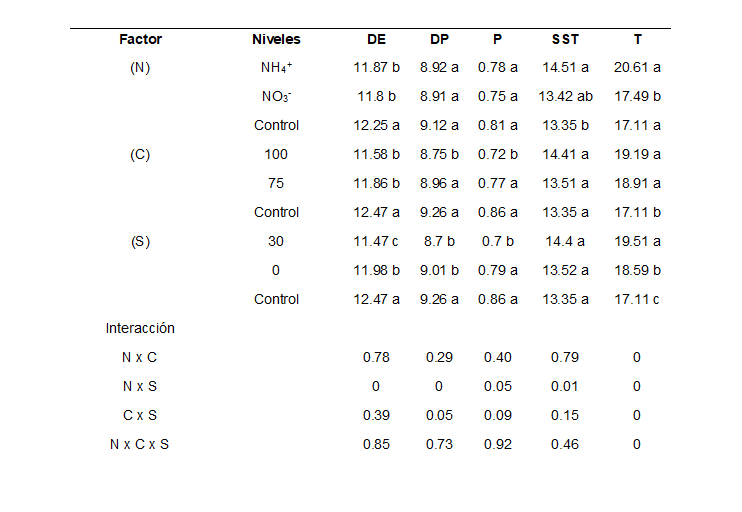
Blueberry (Vaccinium corymbosum L.) production in Mexico is expanding rapidly, yet nitrogen management and salinity stress remain major challenges. This study evaluated the effects of ammonium (NH4+) and nitrate (NO3-) fertilization, with or without sodium chloride (NaCl, 30 mM), on growth, yield, and fruit quality of ‘Biloxi’ blueberry grown in coconut fiber substrate. A completely randomized 3x3 factorial design plus control was applied, varying nitrogen source, concentration (75% and 100%), and salinity. NH4+ significantly increased biomass (121.2%), flower production (316%), fruit number (231%) and yield (162.7%) compared with NO3-. A 100% N rate enhanced shoots (19.5%) and fruit count (43.4%) but reduced fruit size. Salinity reduced fruit number (-70.3%) and yield (-53.1%) without affecting vegetative growth. Significant interactions among nitrogen source, concentration and salinity influenced flowering, quality and agronomic traits. Results indicate NH4+ based fertilization improves blueberry productivity under saline conditions, supporting more efficient nitrogen management strategies.
Downloads
References
Ali, A. 2020. Nitrate assimilation pathway in higher plants: critical role in nitrogen signaling and utilization. Plant Science Today. 7(2):182-192 https://doi.org/10.14719/PST.2020.7.2.637.
Alt, D. S.; Doyle, J. W. and Malladi, A. 2017. Nitrogen-source preference in blueberry (Vaccinium sp.): enhanced shoot nitrogen assimilation in response to direct supply of nitrate. J. Plant Physiol. 216(1):79-87. https://doi.org/10.1016/j.jplph.2017.05.014.
Anwar, A.; Zheng, J.; Chen, C.; Chen, M.; Xue, Y.; Wang, J.; Su, W.; Chen, R. and Song, S. 2024. Effects of NH4+-N: NO3−-N ratio on growth, nutrient uptake and production of blueberries (Vaccinium spp.) under soilless culture. Front Plant Sci. 15(1438811):1-16. https://doi.org/10.3389/fpls.2024.1438811.
Arias, M. I.; Nario, A.; Rojas, K.; Blanc, P. and Bonomelli, C. 2024. Newly established blueberry plants: the role of inorganic nitrogen forms in nitrogen and calcium absorption. Horticulturae. 10(11):1-11. https://doi.org/10.3390/horticulturae10111168.
Atta, K.; Mondal, S.; Gorai, S.; Singh, A. P.; Kumari, A.; Ghosh, T.; Roy, A.; Hembram, S.; Gaikwad, D. J.; Mondal, S.; Bhattacharya, S.; Jha, U. C. and Jespersen, D. 2023. Impacts of salinity stress on crop plants: improving salt tolerance through genetic and molecular dissection. Front Plant Sci. 14(1241736):1-21. https://doi.org/10.3389/fpls.2023.1241736.
Berger, A.; Boscari, A.; Horta-Araújo, N.; Maucourt, M.; Hanchi, M.; Bernillon, S.; Rolin, D.; Puppo, A. and Brouquisse, R. 2020. Plant nitrate reductases regulate nitric oxide production and nitrogen-fixing metabolism during the medicago truncatula-sinorhizobium meliloti symbiosis. Front Plant Sci. 11(1313):1-16. https://doi.org/10.3389/fpls.2020.01313.
Cárdenas-Navarro, R.; Luna-Béjar, J. A.; Castellanos-Morales, V. C.; Bravo-Hernández, N. L. and López-Pérez, L. 2024. Effect of the concentration and ionic form of nitrogen (N) on photosynthesis, growth and fruit production of blueberry (Vaccinium corymbosum L.). Biotecnia. 26(e2325):9. https://doi.org/10.18633/biotecnia.v26.2325.
Denaxa, N. K.; Nomikou, A.; Malamos, N.; Liveri, E.; Roussos, P. A. and Papasotiropoulos, V. 2022. Salinity effect on plant growth parameters and fruit bioactive compounds of two strawberry cultivars, coupled with environmental conditions monitoring. Agronomy. 12(10):1-20. https://doi.org/10.3390/agronomy12102279.
Doyle, J. W.; Nambeesan, S. U. and Malladi, A., 2021. Physiology of nitrogen and calcium nutrition in blueberry (Vaccinium sp.). Agronomy. 11(4):765:1-25. https://doi.org/10.3390/agronomy11040765.
Duan, Y.; Yang, H.; Wei, Z.; Yang, H.; Fan, S.; Wu, W.; Lyu, L. and Li, W. 2023. Effects of different nitrogen forms on blackberry fruit quality. Foods. 12(2)1-18. https://doi.org/10.3390/foods12122318.
Fang, Y.; Nunez, G. H.; Silva, M. N.; Phillips, D. A. and Munoz, P. R. 2020a. A review for Southern Highbush Blueberry alternative production systems. Agronomy. 10(10):1-15. https://doi.org/10.3390/agronomy10101531.
Farvardin, A.; González‐Hernández, A. I.; Llorens, E.; García‐Agustín, P.; Scalschi, L. and Vicedo, B. 2020. The apoplast: a key player in plant survival. Antioxidants. 9(7):1-25. https://doi.org/10.3390/antiox9070604.
Ferrão, L. F. V.; Benevenuto, J.; Oliveira, I. B.; Cellon, C.; Olmstead, J.; Kirst, M.; Resende, M. F. R. and Munoz, P. 2018. Insights into the genetic basis of blueberry fruit-related traits using diploid and polyploid models in a was context. Front Ecol. Evol. 6(107):1-16. https://doi.org/10.3389/fevo.2018.00107.
Frías-Ortega, C. E.; Alejo-Santiago, G.; Bugarín-Montoya, R.; Aburto-González, C. A.; Juárez-Rosete, C. R.; Urbina-Sánchez, E. y Sánchez-Hernández, E. 2020. Concentración de la solución nutritiva y su relación con la producción y calidad de arándano azul. Ciencia Tecnología Agropecuaria. 21(3):1-14. https://doi.org/10.21930/RCTA.
Hirzel, J.; Muñoz, V. P.; Moya-Elizondo, E.; Lagos, O.; Balbontín, C. and Uribe, H. 2024. Use of increasing rates of ammonia nitrogen in pot-grown blueberries and its effect on fruit yield and macronutrient concentration in leaves. Chil. J. Agric. Res. 84(3):454-466. https://doi.org/10.4067/S0718-58392024000300454.
Jiang, Y.; Zeng, Q.; Wei, J.; Jiang, J.; Li, Y.; Chen, J. and Yu, H. 2019. Growth, fruit yield, photosynthetic characteristics, and leaf microelement concentration of two blueberry cultivars under different long term soil pH treatments. Agronomy. 9(7):1-13. https://doi.org/10.3390/horticulturae10111168.
Kesawat, M. S.; Satheesh, N.; Kherawat, B. S.; Kumar, A.; Kim, H. U.; Chung, S. M. and Kumar, M. 2023. Regulation of reactive oxygen species during salt stress in plants and their crosstalk with other signaling molecules current perspectives and future directions. Plants. 12(4):1-37. https://doi.org/10.3390/plants12040864.
Krishna, P.; Pandey, G.; Thomas, R. and Parks, S. 2023. Improving blueberry fruit nutritional quality through physiological and genetic interventions: a review of current research and future directions. Antioxidants. 12(4):810-830. https://doi.org/10.3390/antiox12040810.
Leal-Ayala, O. G.; Sandoval-Villa, M.; Trejo-Téllez, L. I.; Sandoval-Rangel, A.; Fuente, M.C. and Benavides-Mendoza, A. 2021. Nitrogen form and root division modifies the nutrimental and biomolecules concentration in blueberry (Vaccinium corymbosum L.). Not. Bot. Horti. Agrobot. Cluj. Napoca. 49(1):1-12. https://doi.org/10.15835/nbha49111998.
Machado, R. M. A.; Bryla, D. R. and Vargas, O. 2014. Effects of salinity induced by ammonium sulfate fertilizer on root and shoot growth of highbush blueberry. Acta Hortic. 1017(49):407-414. https://doi.org/10.17660/ActaHortic.2014.1017.49.
Meléndez-Jácome, M. R.; Flor-Romero, L. E.; Sandoval-Pacheco, M. E.; Vasquez-Castillo, W. A. and Racines-Oliva, M. A. 2021. Vaccinium spp. karyotypic and phylogenetic characteristics, nutritional composition, edaphoclimatic conditions, biotic factors and beneficial microorganisms in the rhizosphere. Scientia Agropecuaria. 12(1):109-120. https://doi.org/10.17268/sci.agropecu.2021.013.
Molnar, S.; Clapa, D.; Pop, V. C.; Hã‚rèša, M.; Andrecan, F. A. and Bunea, C. I. 2024. Investigation of salinity tolerance to different cultivars of highbush blueberry (Vaccinium corymbosum L.) grown in vitro. Not. Bot. Horti. Agrobot. Cluj. Napoca. 52(1):13691:1-17. https://doi.org/10.15835/nbha52113691.
Nazir, F.; Mahajan, M.; Khatoon, S.; Albaqami, M.; Ashfaque, F.; Chhillar, H.; Chopra, P. and Khan, M. I. R. 2023. Sustaining nitrogen dynamics: a critical aspect for improving salt tolerance in plants. Front Plant Sci. 14(108796):1-18. https://doi.org/10.3389/fpls.2023.1087946.
Santiago, J. P. and Sharkey, T. D. 2019. Pollen development at high temperature and role of carbon and nitrogen metabolites. Plant Cell Environ. 42(10):1-17. https://doi.org/10.1111/pce.13576.
Sellami, S.; Le-Hir, R.; Thorpe, M. R.; Vilaine, F.; Wolff, N.; Brini, F. and Dinant, S. 2019. Salinity affects sugar homeostasis and vascular anatomy in the stem of the arabidopsis thaliana inflorescence. Int. J. Mol. Sci. 20(13):3167-1-19 https://doi.org/10.3390/ijms20133167.
Shilpha, J.; Song, J. and Jeong, B. R. 2023. Ammonium phytotoxicity and tolerance: an insight into ammonium nutrition to improve crop productivity. Agronomy. 13(6):11-23. https://doi.org/10.3390/agronomy13061487.
Trejo-Pech, C. O.; Rodríguez-Magaña, A.; Briseño-Ramírez, H. and Ahumada, R. 2024. A Monte Carlo simulation case study on blueberries from Mexico. International Food and Agribusiness Management Review. 27(2):359-377. https://doi.org/10.22434/ifamr2023.0052.
Wu, H. 2018. Plant salt tolerance and Na+ sensing and transport. Crop Journal. 6(3):215-225. https://doi.org/10.1016/j.cj.2018.01.003.
Yang, Y.; Huang, Z.; Wu, Y.; Wu, W.; Lyu, L. and Li, W., 2023. Effects of nitrogen application level on the physiological characteristics, yield and fruit quality of blackberry. Sci Hortic. 313. 111915. https://doi.org/10.1016/j.scienta.2023.111915.
Zhang, X.; Li, S.; An, X.; Song, Z.; Zhu, Y.; Tan, Y.; Guo, X. and Wang, D. 2023. Effects of nitrogen, phosphorus and potassium formula fertilization on the yield and berry quality of blueberry. PLoS One. 20(1):1-13. e0318032. https://doi.org/10.1371/journal.pone.0283137.
Published
How to Cite
Issue
Section
License
Copyright (c) 2025 Revista Mexicana de Ciencias Agrícolas

This work is licensed under a Creative Commons Attribution-NonCommercial 4.0 International License.
The authors who publish in Revista Mexicana de Ciencias Agrícolas accept the following conditions:
In accordance with copyright laws, Revista Mexicana de Ciencias Agrícolas recognizes and respects the authors’ moral right and ownership of property rights which will be transferred to the journal for dissemination in open access. Invariably, all the authors have to sign a letter of transfer of property rights and of originality of the article to Instituto Nacional de Investigaciones Forestales, Agrícolas y Pecuarias (INIFAP) [National Institute of Forestry, Agricultural and Livestock Research]. The author(s) must pay a fee for the reception of articles before proceeding to editorial review.
All the texts published by Revista Mexicana de Ciencias Agrícolas —with no exception— are distributed under a Creative Commons License Attribution-NonCommercial 4.0 International (CC BY-NC 4.0), which allows third parties to use the publication as long as the work’s authorship and its first publication in this journal are mentioned.
The author(s) can enter into independent and additional contractual agreements for the nonexclusive distribution of the version of the article published in Revista Mexicana de Ciencias Agrícolas (for example include it into an institutional repository or publish it in a book) as long as it is clearly and explicitly indicated that the work was published for the first time in Revista Mexicana de Ciencias Agrícolas.
For all the above, the authors shall send the Letter-transfer of Property Rights for the first publication duly filled in and signed by the author(s). This form must be sent as a PDF file to: revista_atm@yahoo.com.mx; cienciasagricola@inifap.gob.mx; remexca2017@gmail.
This work is licensed under a Creative Commons Attribution-Noncommercial 4.0 International license.