Unified analysis of the technical efficiency of sugar production in Mexico
DOI:
https://doi.org/10.29312/remexca.v17i1.3958Keywords:
data envelopment analysis, resource and input management, stochastic frontier, technical inefficiencyAbstract
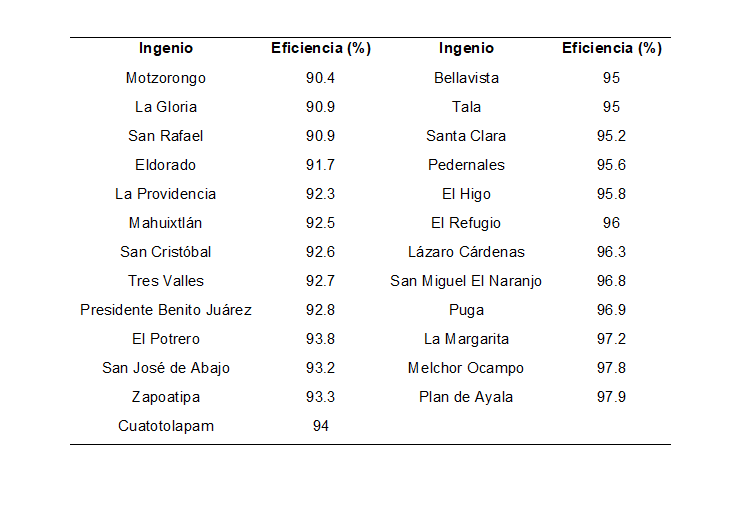
In Mexico, sugarcane is an important crop because it is the primary input for sugar production and impacts employment generation in 15 states and 272 municipalities. This study aimed to estimate the technical efficiency of sugar mills of the 2022-2023 harvest in the production of standard sugar. The methodology used was the stochastic nonparametric envelopment of data (StoNED) analysis, which unifies the approaches of data envelopment analysis and stochastic frontier analysis. The results showed the existence of heterogeneity in the relative technical efficiency of sugar production across the mills. Five groups of mills were identified: a) ten mills with optimal efficiency; b) 25 mills with high relative efficiency; c) four mills at the threshold of high relative efficiency; d) five mills with potential for improvement; and e) a mill in a critical situation due to its high technical inefficiency (26%), which was El Carmen. The average efficiency of agribusiness was 96%. It is concluded that there is a regularity in the behavior of the El Carmen and El Mante mills as two decision-making units, which, given their high inefficiency in the production of standard sugar, due to causes attributable to their management and production practices, could stop operating temporarily or permanently.
Downloads
References
Aldaz, N. and Millán, J. A. 2003. Análisis Malmquist y DEA intertemporal de las agriculturas de la Unión Europea. Economía Agraria y Recursos Naturales. 3(6):45-64. https://recyt.fecyt.es/index.php/ECAGRN/article/view/14440.
Andor, M. and Hesse, F. 2014. The StoNED age: departure into a new era of efficiency analysis? A Monte Carlo comparison of StoNED and the ‘oldies’ (SFA and DEA). Journal of Productivity Analysis. 41(1):85-109. Doi: https://doi.org/10.1007/s11123-013-0354-y.
Bogetoft, P. and Otto, L. 2025. Benchmarking: benchmark and frontier analysis using DEA and SFA (version 0.33) [package de R]. R Foundation for Statistical Computing. 48-59 pp. https://CRAN.R-project.org/package=Benchmarking.
CNIAA. 2024. Cámara nacional de las industrias alcoholera y azucarera. El manual azucarero mexicano. Compañía Editorial del Manual Azucarero. 177-394 pp. https://www.manualazucarero.com.
CONADESUCA. 2024. Comité nacional para el desarrollo sustentable de la caña de azúcar. 11 informe estadístico del sector agroindustrial de la caña de azúcar en México, zafras 2014-2015/2023-2024. 2-10 pp. https://www.siiba.conadesuca.gob.mx/siiaca/docext/11vo-Informe-Estadistico.pdfhttps://doi.org/10.1016/0304-4076(82)90004-5.
CONADESUCA. 2025. Comité nacional para el desarrollo sustentable de la caña de azúcar balance nacional de edulcorantes. Ciclo 2024/2025. 1-5 pp. https://www.gob.mx/cms/uploads/attachment/file/977417/2doBal-est-24-25-2.5-meses-.pdf.
Escobedo, C. O. A. y Valdivia, A. R. 2019. Análisis de la eficiencia técnica de la agroindustria de la caña de azúcar en México con el análisis envolvente de datos. Revista Mexicana de Economía Agrícola y de los Recursos Naturales. 12(1):72-91. http://dicea.chapingo.mx/wp-content/uploads/2019/07/ENERO-JUNIO-2019.pdf.
INEGI. 2020. Instituto Nacional de Estadística y Geografía. Encuesta Nacional Agropecuaria 2019. https://www.inegi.org.mx/programas/ena/2019/#Tabulados.
Johnson, A. L. and Kuosmanen, T. 2011. A bridge too far? The state of the art in combining the virtues of stochastic frontier analysis and data envelopment analysis. Operations Research. 59(6):1355-1371. https://doi.org/10.1287/opre.1110.0962.
Jondrow, J.; Lovell, C. A. K.; Materov, I. S. and Schmidt, P. 1982. On the estimation of technical inefficiency in the stochastic frontier production function model. Journal of Econometrics. 19(2-3):233-238. Doi: https://doi.org/10.1016/0304-4076(82)90004-5.
Kuosmanen, T. and Kortelainen, M. 2012. Stochastic non-smooth envelopment of data: semiparametric frontier estimation subject to shape constraints. Journal of Productivity Analysis. 38(1):11-28. Doi: https://doi.org/10.1007/s11123-010-0201-3.
Kuosmanen, T.; Johnson, A. and Saastamoinen, A. 2015. Stochastic nonparametric approach to efficiency analysis: a unified framework. In: Zhu, J. Ed. Data Envelopment Analysis. Springer. 191-244 pp. Doi: 10.1007/978-1-4899-7553-9-7.
Muyanga, M. and Jayne, T. S. 2019. Revisiting the farm size-productivity relationship base on a relatively wide range of farm sizes: evidence from Kenya. American Journal of Agricultural Economics. 101(4):1140-1163. Doi: https://doi.org/10.1093/ajae/aaz003.
Omotilewa, O. J.; Jayne, T. S.; Muyanga, M.; Aromolaran, A. B.; Liverpool, T. L. S. and Awokus, T. 2021. A revisit of farm size and productivity: empirical evidence from a wide range of farm sizes in Nigeria. World Development. 146:1-15. Doi: https://doi.org/10.1016/j.worlddev.2021.105592.
Ortega, D. A.; Flores, S. M. and Aguilar, R. A. N. 2025. Stochastic frontier analysis and agricultural typologies: applied to Mexico’s sugarcane industry. Regional Science Policy & Practice. 17(4):1-18. Doi: https://doi.org/10.1016/j.rspp.2025.100173.
Sandoval, R. F.; Cuevas, A. C. M.; Montiel, B. B. M. y Altamirano, C. J. R. 2025. Evaluación del rendimiento agroindustrial del azúcar de los ingenios azucareros de México. Revista Mexicana de Ciencias Agrícolas. 16(5):1-10. Doi: https://doi.org/.
Santiago, Z. I. M.; Martínez, D. M. Á.; Cuevas, A. C. M.; Valdivia, A. R.; García, H. M. I. y Hernández, T. J. 2021. Productividad y cambio tecnológico en la agroindustria de la caña de azúcar en México. Revista Mexicana de Ciencias Agrícolas. 12(6):1005-1017. Doi: https://doi.org/10.29312/remexca.v12i6.2692.
Santillán, F. A.; García, L. R.; Vásquez, B. N.; Santoyo, C. V. H.; Melgar, M. M.; Pereira, W.; Larrahondo, A. J. E. y Merino, G. A. 2017. Impacto de la sustitución del azúcar de caña por edulcorantes de alta intensidad en México. Universidad Autónoma Chapingo (UACH). 125-126 pp. https://ciestaam.edu.mx/publicaciones2018/libros/edulcorantes.pdf.
UNC-CNPR. 2024. Unión Nacional de Cañeros, AC. Confederación nacional de propietarios rurales. Estadísticas de la agroindustria de la caña de azúcar 2013-2022. Ciudad de México, México. 21vª. Edición. 190-297 pp.
Published
How to Cite
Issue
Section
License
Copyright (c) 2026 Revista Mexicana de Ciencias Agrícolas

This work is licensed under a Creative Commons Attribution-NonCommercial 4.0 International License.
The authors who publish in Revista Mexicana de Ciencias Agrícolas accept the following conditions:
In accordance with copyright laws, Revista Mexicana de Ciencias Agrícolas recognizes and respects the authors’ moral right and ownership of property rights which will be transferred to the journal for dissemination in open access. Invariably, all the authors have to sign a letter of transfer of property rights and of originality of the article to Instituto Nacional de Investigaciones Forestales, Agrícolas y Pecuarias (INIFAP) [National Institute of Forestry, Agricultural and Livestock Research]. The author(s) must pay a fee for the reception of articles before proceeding to editorial review.
All the texts published by Revista Mexicana de Ciencias Agrícolas —with no exception— are distributed under a Creative Commons License Attribution-NonCommercial 4.0 International (CC BY-NC 4.0), which allows third parties to use the publication as long as the work’s authorship and its first publication in this journal are mentioned.
The author(s) can enter into independent and additional contractual agreements for the nonexclusive distribution of the version of the article published in Revista Mexicana de Ciencias Agrícolas (for example include it into an institutional repository or publish it in a book) as long as it is clearly and explicitly indicated that the work was published for the first time in Revista Mexicana de Ciencias Agrícolas.
For all the above, the authors shall send the Letter-transfer of Property Rights for the first publication duly filled in and signed by the author(s). This form must be sent as a PDF file to: revista_atm@yahoo.com.mx; cienciasagricola@inifap.gob.mx; remexca2017@gmail.
This work is licensed under a Creative Commons Attribution-Noncommercial 4.0 International license.