Tomato response to reduced doses of mineral fertilization with microbial biostimulant in a high tunnel
DOI:
https://doi.org/10.29312/remexca.v16i8.3925Keywords:
Bacteria, Vegetables, Low inputAbstract
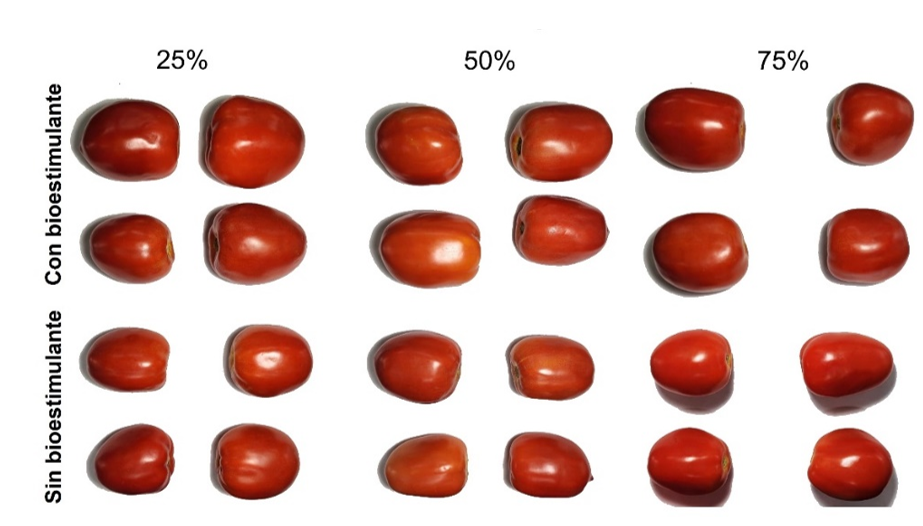
The tomato is one of the most important crops in Mexico, requiring considerable amounts of nitrogen, phosphorus and potassium to achieve optimal yields. Mineral doses are increasingly overused, which is inefficient, and much of it is released into the environment, causing contamination of bodies of water and soil. The research aimed to evaluate the effect of low doses of mineral fertilization combined with a microbial biostimulant on the weight and dimensions of tomato fruits and production per plant. The work was conducted in Úrsulo Galván, Veracruz, in the autumn-winter-spring cycle (2023-2024) under protected conditions using a high tunnel. The study employed a biostimulant formulated with five bacterial strains (Bacillus subtilis FDMC1, Stenotrophomonas sp. JAG2, Bacillus wiedmannii JAG3, Priestia megaterium JAFV4, and P. megaterium AERM5) and a minimum chemical fertilization with NPK (165-120-90) at different percentages (100%, 75%, 50% and 25%) with and without biostimulant, except for 100%, which was a control without biostimulant. A randomized complete block design was used and 240 plants were established using a planting frame of one plant every 25 cm in a triangular pattern. The reduced doses of fertilization, without applications of biostimulants, significantly affected the yield and quality of tomato fruits. The applications of the biostimulant with small doses of chemical fertilization at 50% and 75% significantly increased the production and dimensions of tomato fruits. The applications of the biostimulant resulted in a saving of 25% in chemical fertilization, which achieved production and quality of tomato fruits equal to that achieved with 100% fertilization.
Downloads
References
Adame-García, J.; Murillo-Cuevas, F. D.; Cabrera-Mireles, H.; Villegas-Narváez, J.; Rivera-Meza, A. E. y Vásquez-Hernández, A. 2023. Efecto de bioestimulantes microbianos en frutos de chile morrón y jitomate producidos en macrotúnel. Biotecnia. 25(1):81-87. https://doi.org/10.18633/biotecnia.v25i1.1772.
Blake, C.; Christensen, M. N. and Kovács, Á. T. 2021. Molecular aspects of plant growth promotion and protection by Bacillus subtilis. Molecular Plant-Microbe Interactions. 34(1):15-25. https://doi.org/10.1094/MPMI-08-20-0225-CR.
Bentamra, Z.; Medjedded, H.; Nemmiche, S.; Benkhelifa, M. and Santos, D. R. 2023. Effect of NPK fertilizer on the biochemical response of tomatoes (Solanum lycopersicum L.). Notulae Scientia Biologicae. 15(3):11516-11516. https://doi.org/10.55779/nsb15311516.
Burcea, M.; Cretu, D.; Musat, M. and Gidea, M. 2016. Study regarding the influence of NPK fertilizers on the total nitrogen content from tomato (Lycopersicum esculentum). Romanian Biotechnological Letters. 21(1):11144.
Cano, M. A. 2011. Interacción de microorganismos benéficos en plantas: micorrizas, Trichoderma spp. y Pseudomonas spp. Una revisión. Revista UDCA Actualidad & Divulgación Científica. 14(2):15-31.
Caulier, S.; Nannan, C.; Gillis, A.; Licciardi, F.; Bragard, C. and Mahillon, J. 2019. Overview of the antimicrobial compounds produced by members of the Bacillus subtilis group. Frontiers in Microbiology. 302(10):1-19. https://doi.org/10.3389/fmicb.2019.00302.
Chafai, W.; Haddioui, K.; Serghini-Caid, H.; Labazi, H.; AlZain, M. N.; Noman, O.; Parvez, M. K.; Addi, M. and Khalid, A. 2023. Impact of arbuscular mycorrhizal fungal strains isolated from soil on the growth, yield, and fruit quality of tomato plants under different fertilization regimens. Horticulturae. 9(9):1-18. https://doi.org/10.3390/horticulturae9090973.
Díaz-Vázquez, F. A.; Benavides-Mendoza, A.; Robledo-Torres, V.; Juárez-Maldonado, A.; García-León, Á. y Sandoval-Rangel, A. 2023. Influencia de cuatro concentraciones de solución Steiner sobre los nutrientes en la solución del suelo y productividad en tomate (Solanum lycopersicum L.). Terra Latinoamericana. 41:1-12. https://doi.org/10.28940/terra.v41i0.1646.
Espinosa-Palomeque, B.; Cano-Ríos, P.; Salas-Pérez, L.; García-Hernández, J. L.; Preciado-Rangel, P.; Sáenz-Mata, J. and Reyes-Carrillo, J. L. 2019. Bioinoculantes y concentración de la solución nutritiva sobre la producción y calidad de tomate. Biotecnia. 21(3):100-107. https://doi.org/10.18633/biotecnia.v21i3.1038.
Espinosa, P. B.; Moreno, R. A.; Cano, R. P.; Álvarez, R. V. D. P.; Sáenz, M. J.; Sánchez, G. H. y González, R. G. 2017. Inoculación de rizobacterias promotoras del crecimiento vegetal en tomate (Solanum lycopersicum L.) cv. afrodita en invernadero. Terra Latinoamericana. 35(2):169-178. https://doi.org/10.29312/remexca.v13i28.3278.
Galindo, L. A. G.; Rivas, A. C.; Meléndez, J. P. and Mayorquín, N. 2020. Alternativas microbiológicas para la remediación de suelos y aguas contaminados con fertilizantes nitrogenados. Scientia et Technica. 25(1):172-183.
INAP. 2013. Instituto Nacional de Administración Pública. Diagnósticos Municipales PACMA, entidad: Veracruz de Ignacio de la Llave, Municipio: Úrsulo Galván. Instituto Nacional de Administración Pública. México 49 p.
Katsenios, N.; Andreou, V.; Sparangis, P.; Djordjevic, N.; Giannoglou, M.; Chanioti, S.; Stergiou, P.; Xanthou M. Z.; Kakabouki I.; Vlachakis, D.; Djordjevic S.; George, K. and Efthimiadou, A. 2021. Evaluation of plant growth promoting bacteria strains on growth, yield and quality of industrial tomato. Microorganisms. 9(10):1-17. https://doi.org/10.3390/microorganisms9102099.
Kaushal, P.; Ali, N.; Saini, S.; Pati, P. K. and Pati, A. M. 2023. Physiological and molecular insight of microbial biostimulants for sustainable agriculture. Frontiers in Plant Science. 14:1-17. https://doi.org/10.3389/fpls.2023.1041413.
Kumar, A.; Rithesh, L.; Kumar, V.; Raghuvanshi, N.; Chaudhary, K.; Abhineet and Pandey, A. K. 2023. Stenotrophomonas in diversified cropping systems: friend or foe? Frontiers in Microbiology. 14:1-16. https://doi.org/10.3389/fmicb.2023.1214680.
Lara, T. I. B.; González, F. G.; Canales, J. M. V. and León-Andrade, M. 2022. Efectos del comercio internacional en la especialización y competitividad de jitomate (Solanum lycopersicum Mill.) en México (1980-2016). Paradigma económico. Revista de Economía Regional y Sectorial. 14(1):181-206.
Lephatsi, M. M.; Meyer, V.; Piater, L. A.; Dubery, I. A. and Tugizimana, F. 2021. Plant responses to abiotic stresses and rhizobacterial biostimulants: Metabolomics and epigenetics perspectives. Metabolites. 11(7):1-31. https://doi.org/10.3390/metabo11070457.
Mena-Violante, H. G.; Cruz-Hernández, A.; Paredes-López, O.; Gómez-Lim, M. Á. and Olalde-Portugal, V. 2009. Fruit texture related changes and enhanced shelf-life through tomato root inoculation with Bacillus subtilis BEB-13BS. Agrociencia. 43(6):559-567.
Nedorost, L. y Pokluda, R. 2012. Effects of arbuscular mycorrhizal fungi on tomato yield and nutrient uptake under different fertilization levels. Acta Universitatis Agriculturae et Silviculturae Mendelianae Brunensis. 60(8):181-186.
Novello, G.; Bona, E.; Nasuelli, M.; Massa, N.; Sudiro, C.; Campana, D. C.; Gorrasi, S.; Hochart, M. L.; Altissimo, A.; Vuolo, F. and Gamalero, E. 2024. The impact of nitrogen-fixing bacteria-based biostimulant alone or in combination with commercial inoculum on tomato native rhizosphere microbiota and production: an open-field trial. Biology. 13(6):1-19. https://doi.org/10.3390/biology13060400.
Palacio-Rodríguez, R.; Nava-Reyes, B.; Sánchez-Galván, H.; Quezada-Rivera, J. J. and Sáenz-Mata, J. 2022. Efecto de la inoculación de rizobacterias promotoras del crecimiento vegetal de tomate en condiciones de casa sombra comercial. Revista Mexicana de Ciencias Agrícolas. 13(28):231-242. https://doi.org/10.29312/remexca.v13i28.3278.
Sánchez-Sánchez, A.; Hernández, V.; Hellín, P.; Jiménez-Pérez, M.; Rodríguez-Burruezo, A.; Fenoll, J. and Flores, P. 2022. Impact of low input management and microbial biostimulants on yields of traditional pepper varieties. AgroLife Scientific Journal. 11(1):196-203. https://doi.org/10.17930/agl2022123.
Shi, L.; Zhu, X.; Qian, T.; Du, J.; Du, Y. and Ye, J. 2023. Mechanism of salt tolerance and plant growth promotion in Priestia megaterium ZS-3 revealed by cellular metabolism and whole-genome studies. International Journal of Molecular Sciences. 24(21):1-18. https://doi.org/10.3390/ijms242115751.
SIAP. 2023. Servicio de Información Agroalimentaria y Pesquera. Avance de siembras y cosechas. Producción mensual agrícola. Resumen nacional por cultivo. https://nube.siap.gob.mx/avance-agricola/.
Torres, P.; Altier, N.; Beyhaut, E.; Fresia, P.; Garaycochea, S. and Abreo, E. 2024. Phenotypic, genomic and in planta characterization of Bacillus sensu lato for their phosphorus biofertilization and plant growth promotion features in soybean. Microbiological Research. 280:1-11. https://doi.org/10.1016/j.micres.2023.127566.
Published
How to Cite
Issue
Section
License
Copyright (c) 2025 Revista Mexicana de Ciencias Agrícolas

This work is licensed under a Creative Commons Attribution-NonCommercial 4.0 International License.
The authors who publish in Revista Mexicana de Ciencias Agrícolas accept the following conditions:
In accordance with copyright laws, Revista Mexicana de Ciencias Agrícolas recognizes and respects the authors’ moral right and ownership of property rights which will be transferred to the journal for dissemination in open access. Invariably, all the authors have to sign a letter of transfer of property rights and of originality of the article to Instituto Nacional de Investigaciones Forestales, Agrícolas y Pecuarias (INIFAP) [National Institute of Forestry, Agricultural and Livestock Research]. The author(s) must pay a fee for the reception of articles before proceeding to editorial review.
All the texts published by Revista Mexicana de Ciencias Agrícolas —with no exception— are distributed under a Creative Commons License Attribution-NonCommercial 4.0 International (CC BY-NC 4.0), which allows third parties to use the publication as long as the work’s authorship and its first publication in this journal are mentioned.
The author(s) can enter into independent and additional contractual agreements for the nonexclusive distribution of the version of the article published in Revista Mexicana de Ciencias Agrícolas (for example include it into an institutional repository or publish it in a book) as long as it is clearly and explicitly indicated that the work was published for the first time in Revista Mexicana de Ciencias Agrícolas.
For all the above, the authors shall send the Letter-transfer of Property Rights for the first publication duly filled in and signed by the author(s). This form must be sent as a PDF file to: revista_atm@yahoo.com.mx; cienciasagricola@inifap.gob.mx; remexca2017@gmail.
This work is licensed under a Creative Commons Attribution-Noncommercial 4.0 International license.