Quitosano para el control de Lasiodiplodia y Rhizopus en Carica papaya L.
DOI:
https://doi.org/10.29312/remexca.v16i8.3781Palabras clave:
inhibición micelial, patógenos fúngicos, poscosechaResumen
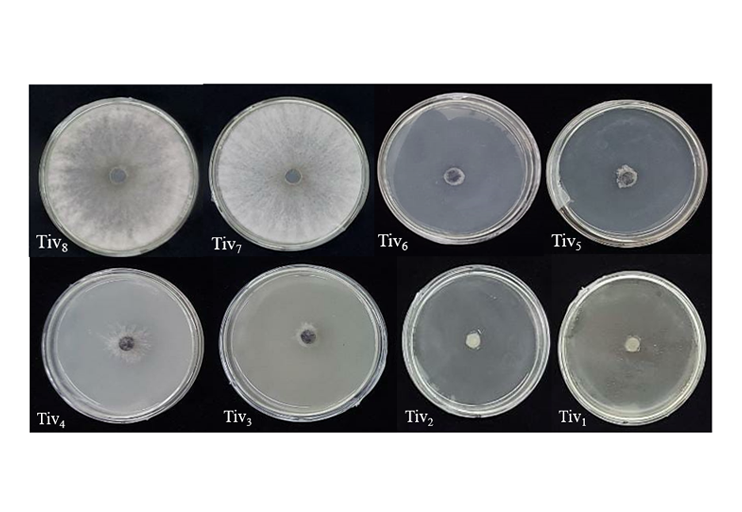
El objetivo del estudio fue evaluar el efecto del quitosano en el control de L. theobromae y R. stolonifer, hongos asociados a enfermedades poscosecha en papaya. Se realizaron ensayos in vitro e in vivo con diferentes concentraciones de quitosano y un fungicida de referencia. Las variables evaluadas incluyeron el porcentaje de inhibición del crecimiento micelial, el área de la lesión y la severidad de la enfermedad. Las concentraciones de quitosano entre 0.75% y 1% mostraron alta eficacia contra ambos patógenos, con niveles de inhibición comparables al fungicida sintético, sin diferencias estadísticas significativas en la mayoría de los tratamientos.
Descargas
Citas
Bibliografía
Ayón, L. E.; Uriarte-Gastelum, Y. G.; Camacho-Díaz, B. H.; Tapia-Maruri, D.; López-López, M. E.; López-Velázquez, J. G. and Vega-García, M. O. 2022. Antifungal activity of chitosan and mint essential oil coating on the development of Colletotrichum gloeosporioides in papaya using macroscopic and microscopic analysis. Food and Bioprocess Technology. 15(2):368-378.
Chowdappa, P. P.; Gowda, S. S.; Chethana, C. S. and Madhura, S. S. 2020. Antifungal activity of chitosan-silver nanoparticle composite against Colletotrichum gloeosporioides associated with mango anthracnose. African Journal of Microbiology Research. 14(10):1803-1812.
Cuong, H. N.; Minh, N. C.; Hoa, N. V.; Van, G. Z.; Hieu D. H.; Van, N. V. and Nam, P. V. 2022. Antifungal activity of squid pen chitosan nanoparticles against three fungal pathogens in various citrus fruits in vitro and in vivo. Coatings. 12(2):235.
Edirisinghe, M. V.; Ali, A. V.; Maqbool, M. E. and Alderson, P. G. 2014. Chitosan controls postharvest anthracnose in bell pepper by activating defense-related enzymes. Journal of Food Science and Technology. 51(12):4078-4083.
El-Araby, A.; Janati, W. C.; Ullah, R. A.; Uddin, N. S. and Bari, A. B. 2024. Antifungal efficacy of chitosan extracted from shrimp shell on strawberry (Fragaria × ananassa) postharvest spoilage fungi. Heliyon. 10(7):1-10.
Gomes, A. C. A.; Costa-Lima, M.; Oliveira, K. Á. R.; Santos-Lima, M.; Magnani, M. A. Câmara, M. P. S. and Souza, E. L. 2020. Coatings with chitosan and phenolic-rich extract from acerola (Malpighia emarginata DC.) or jabuticaba (Plinia jaboticaba (Vell.) Berg) processing by-product to control rot caused by Lasiodiplodia spp. in papaya (Carica papaya L.) fruit. Int J Food Microbiol. 331(2020):108694.
Heng-Tan, G.; Ali, A. A. and Siddiqui, Y. E. 2023. Major fungal postharvest diseases of papaya: current and prospective diagnosis methods. 174(2023):106399-10.
Hernández, A. N.; Hernández, M. M.; Velázquez, M. G.; Guerra, M. G. y Melo, G. E. 2007. Actividad antifúngica del quitosano en el control de Rhizopus stolonifer (Ehrenb.: Fr.) Vuill. y Mucor spp. Revista Mexicana de Fitopatología. 25(2):109-113.
Islam, S. S.; Bhuiyan, M. R. and Islam, M. N. 2017. Chitin and chitosan: structure, properties and applications in biomedical engineering. Journal of Polymers and the Environment. 25(3):854-866.
Karpova, N. V.; Shagdarova, B. S.; Lunkov, A. E.; Il’ina, A. F. and Varlamov, V. B. 2021. Antifungal action of chitosan in combination with fungicides in vitro and chitosan conjugate with gallic acid on tomatoes against Botrytis cinerea. Biotechnology Letters. 43(8):1565-1574.
Kong, M. V.; Chen, X. G.; Xing, K. A., and Park, H. J. 2021. Antimicrobial properties of chitosan and mode of action: a state-of-the-art review. International Journal of Food Microbiology. 1(144):51-63.
Pervin, S. A.; Islam, M. S.; Khan, M. H. H. and Molla, M. M. 2020. Influence of chitosan on postharvest quality and storability of papaya (Carica papaya L.) fruit. BOU Journal of Agriculture and Rural Development. 12(2):33-42.
Poznanski, P. G; Hameed, A. F. and Orczyk, W. G. 2023. Chitosan and chitosan nanoparticles: parameters enhancing antifungal activity. Molecules. 28(7):2996-2999.
Romanazzi, G. G.; Feliziani, E. E.; Baños, S. B. and Sivakumar, D. D. 2017. Shelf life extension of fresh fruit and vegetables by chitosan treatment. Critical reviews in food Science and Nutrition. 57(3):579-601.
Samithri, Y. A. S.; Karunanayake, K. O. L. C. and Kulasinghe, A. A. 2020. In vitro study of selected essential oils against Colletotrichum sp. and Lasiodiplodia sp. causing postharvest diseases in papaya. Ceylon Journal of Science. 49(5):389-396.
Silva, K. G.; Cavalcanti, M. T.; Martins, L. P.; Alves, R. C.; Lucena, F. A.; Santos, M. S. A.; Silva, S. X.; Costa, F. B.; Moreira, I. S. and Pereira, E. M. 2023. Coatings based on gelatin and chitosan in the conservation of papaya (Carica papaya L.) minimally processed. Horticulturae. 9(7):729-736.
Singh, H. H.; Bhasin, J. K.; Dash, K. J. and Shams, R. E.; Shaikh, A. M. and Béla, K. K 2024. Effect of chitosan-based edible coating in management of post-harvest losses in papaya: a comprehensive review. Applied Food Research. 4(3):100456-100459.
Torres-Rodríguez, J. A.; Reyes-Pérez, J. J.; Ramos, L. T. L.; Gonzalo-Matute, L.; Rueda-Puente, E. O. and Hernández-Montiel, L. G. 2025. Chitosan as a postharvest alternative for the control of Phytophthora capsici in bell pepper fruits. Science. 7(2):37-45.
Uclaray, C. C.; Vidallon, M. L.; Almeda, R. A.; Cumagun, C. J.; Reyes, C. T. and Rodríguez, E. B. 2022. Encapsulation of wild oregano, Plectranthus amboinicus (Lour.) Spreng, phenolic extract in baker’s yeast for the postharvest control of anthracnose in papaya. Journal of the Science of Food and Agriculture. 102(11):4657-4667.
Descargas
Publicado
Cómo citar
Número
Sección
Licencia
Derechos de autor 2025 Revista Mexicana de Ciencias Agrícolas

Esta obra está bajo una licencia internacional Creative Commons Atribución-NoComercial 4.0.
Los autores(as) que publiquen en Revista Mexicana de Ciencias Agrícolas aceptan las siguientes condiciones:
De acuerdo con la legislación de derechos de autor, Revista Mexicana de Ciencias Agrícolas reconoce y respeta el derecho moral de los autores(as), así como la titularidad del derecho patrimonial, el cual será cedido a la revista para su difusión en acceso abierto.
Los autores(as) deben de pagar una cuota por recepción de artículos antes de pasar por dictamen editorial. En caso de que la colaboración sea aceptada, el autor debe de parar la traducción de su texto al inglés.
Todos los textos publicados por Revista Mexicana de Ciencias Agrícolas -sin excepción- se distribuyen amparados bajo la licencia Creative Commons 4.0 atribución-no comercial (CC BY-NC 4.0 internacional), que permite a terceros utilizar lo publicado siempre que mencionen la autoría del trabajo y a la primera publicación en esta revista.
Los autores/as pueden realizar otros acuerdos contractuales independientes y adicionales para la distribución no exclusiva de la versión del artículo publicado en Revista Mexicana de Ciencias Agrícolas (por ejemplo incluirlo en un repositorio institucional o darlo a conocer en otros medios en papel o electrónicos) siempre que indique clara y explícitamente que el trabajo se publicó por primera vez en Revista Mexicana de Ciencias Agrícolas.
Para todo lo anterior, los autores(as) deben remitir el formato de carta-cesión de la propiedad de los derechos de la primera publicación debidamente requisitado y firmado por los autores(as). Este formato debe ser remitido en archivo PDF al correo: revista_atm@yahoo.com.mx; revistaagricola@inifap.gob.mx.
Esta obra está bajo una licencia de Creative Commons Reconocimiento-No Comercial 4.0 Internacional.