Chitosan for controlling Lasiodiplodia and Rhizopus in Carica papaya L.
DOI:
https://doi.org/10.29312/remexca.v16i8.3781Keywords:
fungal pathogens, mycelial inhibition, postharvestAbstract
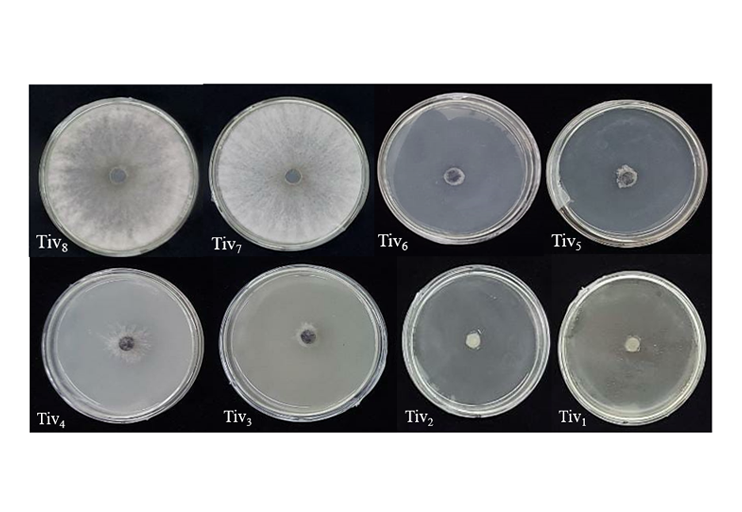
The study aimed to evaluate the effect of chitosan on controlling L. theobromae and R. stolonifer, fungi associated with postharvest diseases in papaya. In vitro and in vivo tests were conducted using different concentrations of chitosan and reference fungicide. The variables evaluated included the percentage of mycelial growth inhibition, the lesion area, and the disease severity. Chitosan concentrations between 0.75% and 1% showed high efficacy against both pathogens, with inhibition levels comparable to those of the synthetic fungicide, with no statistically significant differences in most treatments.
Downloads
References
Bibliografía
Ayón, L. E.; Uriarte-Gastelum, Y. G.; Camacho-Díaz, B. H.; Tapia-Maruri, D.; López-López, M. E.; López-Velázquez, J. G. and Vega-García, M. O. 2022. Antifungal activity of chitosan and mint essential oil coating on the development of Colletotrichum gloeosporioides in papaya using macroscopic and microscopic analysis. Food and Bioprocess Technology. 15(2):368-378.
Chowdappa, P. P.; Gowda, S. S.; Chethana, C. S. and Madhura, S. S. 2020. Antifungal activity of chitosan-silver nanoparticle composite against Colletotrichum gloeosporioides associated with mango anthracnose. African Journal of Microbiology Research. 14(10):1803-1812.
Cuong, H. N.; Minh, N. C.; Hoa, N. V.; Van, G. Z.; Hieu D. H.; Van, N. V. and Nam, P. V. 2022. Antifungal activity of squid pen chitosan nanoparticles against three fungal pathogens in various citrus fruits in vitro and in vivo. Coatings. 12(2):235.
Edirisinghe, M. V.; Ali, A. V.; Maqbool, M. E. and Alderson, P. G. 2014. Chitosan controls postharvest anthracnose in bell pepper by activating defense-related enzymes. Journal of Food Science and Technology. 51(12):4078-4083.
El-Araby, A.; Janati, W. C.; Ullah, R. A.; Uddin, N. S. and Bari, A. B. 2024. Antifungal efficacy of chitosan extracted from shrimp shell on strawberry (Fragaria × ananassa) postharvest spoilage fungi. Heliyon. 10(7):1-10.
Gomes, A. C. A.; Costa-Lima, M.; Oliveira, K. Á. R.; Santos-Lima, M.; Magnani, M. A. Câmara, M. P. S. and Souza, E. L. 2020. Coatings with chitosan and phenolic-rich extract from acerola (Malpighia emarginata DC.) or jabuticaba (Plinia jaboticaba (Vell.) Berg) processing by-product to control rot caused by Lasiodiplodia spp. in papaya (Carica papaya L.) fruit. Int J Food Microbiol. 331(2020):108694.
Heng-Tan, G.; Ali, A. A. and Siddiqui, Y. E. 2023. Major fungal postharvest diseases of papaya: current and prospective diagnosis methods. 174(2023):106399-10.
Hernández, A. N.; Hernández, M. M.; Velázquez, M. G.; Guerra, M. G. y Melo, G. E. 2007. Actividad antifúngica del quitosano en el control de Rhizopus stolonifer (Ehrenb.: Fr.) Vuill. y Mucor spp. Revista Mexicana de Fitopatología. 25(2):109-113.
Islam, S. S.; Bhuiyan, M. R. and Islam, M. N. 2017. Chitin and chitosan: structure, properties and applications in biomedical engineering. Journal of Polymers and the Environment. 25(3):854-866.
Karpova, N. V.; Shagdarova, B. S.; Lunkov, A. E.; Il’ina, A. F. and Varlamov, V. B. 2021. Antifungal action of chitosan in combination with fungicides in vitro and chitosan conjugate with gallic acid on tomatoes against Botrytis cinerea. Biotechnology Letters. 43(8):1565-1574.
Kong, M. V.; Chen, X. G.; Xing, K. A., and Park, H. J. 2021. Antimicrobial properties of chitosan and mode of action: a state-of-the-art review. International Journal of Food Microbiology. 1(144):51-63.
Pervin, S. A.; Islam, M. S.; Khan, M. H. H. and Molla, M. M. 2020. Influence of chitosan on postharvest quality and storability of papaya (Carica papaya L.) fruit. BOU Journal of Agriculture and Rural Development. 12(2):33-42.
Poznanski, P. G; Hameed, A. F. and Orczyk, W. G. 2023. Chitosan and chitosan nanoparticles: parameters enhancing antifungal activity. Molecules. 28(7):2996-2999.
Romanazzi, G. G.; Feliziani, E. E.; Baños, S. B. and Sivakumar, D. D. 2017. Shelf life extension of fresh fruit and vegetables by chitosan treatment. Critical reviews in food Science and Nutrition. 57(3):579-601.
Samithri, Y. A. S.; Karunanayake, K. O. L. C. and Kulasinghe, A. A. 2020. In vitro study of selected essential oils against Colletotrichum sp. and Lasiodiplodia sp. causing postharvest diseases in papaya. Ceylon Journal of Science. 49(5):389-396.
Silva, K. G.; Cavalcanti, M. T.; Martins, L. P.; Alves, R. C.; Lucena, F. A.; Santos, M. S. A.; Silva, S. X.; Costa, F. B.; Moreira, I. S. and Pereira, E. M. 2023. Coatings based on gelatin and chitosan in the conservation of papaya (Carica papaya L.) minimally processed. Horticulturae. 9(7):729-736.
Singh, H. H.; Bhasin, J. K.; Dash, K. J. and Shams, R. E.; Shaikh, A. M. and Béla, K. K 2024. Effect of chitosan-based edible coating in management of post-harvest losses in papaya: a comprehensive review. Applied Food Research. 4(3):100456-100459.
Torres-Rodríguez, J. A.; Reyes-Pérez, J. J.; Ramos, L. T. L.; Gonzalo-Matute, L.; Rueda-Puente, E. O. and Hernández-Montiel, L. G. 2025. Chitosan as a postharvest alternative for the control of Phytophthora capsici in bell pepper fruits. Science. 7(2):37-45.
Uclaray, C. C.; Vidallon, M. L.; Almeda, R. A.; Cumagun, C. J.; Reyes, C. T. and Rodríguez, E. B. 2022. Encapsulation of wild oregano, Plectranthus amboinicus (Lour.) Spreng, phenolic extract in baker’s yeast for the postharvest control of anthracnose in papaya. Journal of the Science of Food and Agriculture. 102(11):4657-4667.
Published
How to Cite
Issue
Section
License
Copyright (c) 2025 Revista Mexicana de Ciencias Agrícolas

This work is licensed under a Creative Commons Attribution-NonCommercial 4.0 International License.
The authors who publish in Revista Mexicana de Ciencias Agrícolas accept the following conditions:
In accordance with copyright laws, Revista Mexicana de Ciencias Agrícolas recognizes and respects the authors’ moral right and ownership of property rights which will be transferred to the journal for dissemination in open access. Invariably, all the authors have to sign a letter of transfer of property rights and of originality of the article to Instituto Nacional de Investigaciones Forestales, Agrícolas y Pecuarias (INIFAP) [National Institute of Forestry, Agricultural and Livestock Research]. The author(s) must pay a fee for the reception of articles before proceeding to editorial review.
All the texts published by Revista Mexicana de Ciencias Agrícolas —with no exception— are distributed under a Creative Commons License Attribution-NonCommercial 4.0 International (CC BY-NC 4.0), which allows third parties to use the publication as long as the work’s authorship and its first publication in this journal are mentioned.
The author(s) can enter into independent and additional contractual agreements for the nonexclusive distribution of the version of the article published in Revista Mexicana de Ciencias Agrícolas (for example include it into an institutional repository or publish it in a book) as long as it is clearly and explicitly indicated that the work was published for the first time in Revista Mexicana de Ciencias Agrícolas.
For all the above, the authors shall send the Letter-transfer of Property Rights for the first publication duly filled in and signed by the author(s). This form must be sent as a PDF file to: revista_atm@yahoo.com.mx; cienciasagricola@inifap.gob.mx; remexca2017@gmail.
This work is licensed under a Creative Commons Attribution-Noncommercial 4.0 International license.