Production of specialty peppers under different protected agriculture systems
DOI:
https://doi.org/10.29312/remexca.v17i1.4013Keywords:
Capsicum annuum L., greenhouses, productionAbstract
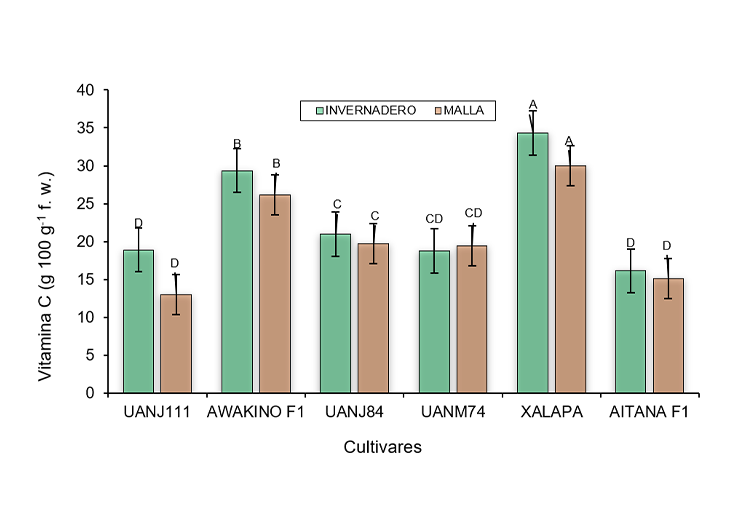
Peppers are a species of great importance globally; due to their nutritional contribution, the demand for this product has increased, and as a result, lines called ‘specialties’ have now been created. Another effect of the demand for this product, together with the new challenges presented by climate change, is the increased use of protected agriculture in all its forms; this research aimed to evaluate the production of specialty peppers under different production systems. The work consisted of using various cultivars subjected to two production environments (greenhouse and shade net). Six cultivars were used and subjected to two production systems. In conclusion, it is mentioned that the Uanj111, Uanm74, and Uanj84 cultivars adapt very well to any production system without reducing their quality.
Downloads
References
Blanco-Valdés, Y. 2019. Importancia de la calidad de la luz entre las plantas arvenses-cultivo. Instituto Nacional de Ciencias Agrícolas. Cultivos Tropicales. Ediciones INCA. 40(4):e09.
Castillo-González, A. M.; Ortiz-Mendoza, E.; Valdez-Aguilar, L. A.; Avitia, G. E.; García- Mateos M. R. y Ybarra-Moncada, M. C. Crecimiento, rendimiento y calidad de chile habanero bajo condiciones de malla sombra de diferentes colores. Growth, yield and quality of habanero chili grown under shade nets of different colors. Tecnociencia Chihuahua. 19(1):e1662.
Cedeño Guerra, J. L.; Héctor Ardisana, E. F.; Torres-García A.; Fosado-Téllez, O. 2020. Respuestas del crecimiento y el rendimiento en pimiento (Capsicum annuum L.) híbrido Nathalie a un lixiviado de vermicompost bovino. La Técnica. Revista de las Agrociencias. Universidad Técnica de Manabí, Ecuador. 1-10 pp.
Escamirosa-Tinoco, C.; Martínez-Gutiérrez, G. A.; Morales, I.; Aquino-Bolaños, T.; Cortés-Martínez, C. I. y Cruz-Andrés, O. R. 2021. Rendimiento de chile de agua bajo diferentes cubiertas de macrotúnel. Revista Fitotecnia Mexicana. 44(3):333-340. https://doi.org/10.35196/rfm.2021.3.333.
FAO. 2018. Organización de las Naciones Unidas para la Agricultura y la Alimentación. El futuro de la alimentación y la agricultura Vías alternativas hacia el 2050.
FAO. 2022. Organización de las Naciones Unidas para la Agricultura y la Alimentación.
Hernández-Hernández, B. N.; Mario-Alberto, T. C.; Engelberto-Sandoval, C.; María- Nieves, R. M.; Oswaldo-Rey, T. G. y Valeriano, P. O. B. 2021. Crecimiento, rendimiento y calidad de chile poblano cultivado en hidroponía bajo invernadero. Revista Mexicana de Ciencias Agrícolas. 12(6):1043-56. https://doi.org/10.29312/remexca.v12i6.2755.
INIFAP. 2006. Instituto Nacional de Investigaciones Forestales, Agrícolas y Pecuarias (INIFAP). Tecnología de producción de chile seco. Centro de Investigación Regional Norte Centro, Campo Experimental Zacatecas. Libro técnico núm. 5. 232 p. https://zacatecas.inifap.gob.mx/publicaciones/Tecnologia-de-produccion-de-chile-seco.pdf.
Liu, C.; Wan, H.; Yang, Y.; Ye, Q.; Zhou, G.; Wang, X.; Ahammed, G. J. y Cheng, Y. 2022. La irradiación con luz Led poscosecha afecta la firmeza, las sustancias bioactivas y la composición de aminoácidos en el chile (Capsicum annum L.). Foods.11:4-9. https://doi.org/10.3390/foods11172712.
Mendoza-Elos, M.; Zamudio-Álvarez, L. F.; Cervantes-Ortiz, F.; Chable-Moreno, F.; Frías-Pizano, J. y Gámez-Vázquez, A. J. 2020. Rendimiento de semilla y calidad de fruto de chile habanero con fertilización química y orgánica. Revista Mexicana de Ciencias Agrícolas. 11(8):1749-1761. https://doi.org/10.29312/remexca.v11i8.1960.
SADER- AMHPAC. 2023. Secretaría de Agricultura y Desarrollo Rural. Producción agrícola: agricultura protegida. https://www.gob.mx/siap/acciones-y-programas/produccion-agricola-33119.
SADER. 2022. Secretaría de Agricultura y Desarrollo Rural. Agricultura protegida ubica a México entre los principales productores de frutas y hortalizas. https://www.gob.mx/agricultura/prensa/agricultura-protegida-ubica-a-mexico-entre-los-principales-productores-de-frutas-y-hortalizas.
SADER. 2022. Secretaría de Agricultura y Desarrollo Rural. México, principal exportador mundial de pimientos frescos: Agricultura. https://www.gob.mx/agricultura/prensa/mexicoprincipalexportadormundialdepimientosfrescosagricultura#:~:text=Agricultura%20destac%C3%B3%20que%2C%20en%20el,participaci%C3%B3n%20de%2023.6%20por%20ciento.
Segovia-Lerma, A. y Romero-Mozqueda, Á. Y. 2014. Mejoramiento genético para rendimiento en chile (Capsicum annuum L.) para consumo en seco en la región centro-sur del estado Chihuahua, México. Revista Científica Biológico Agropecuaria Tuxpan. 2(3):414-427.
SIAP. 2023. Avance de siembras y cosechas. https://nube.siap.gob.mx/avance-agricola/.
Steiner, A. A. 1984. The universal nutrient solution. In: Proc. International Congress on Soilless Culture. Wageningen, The Netherlands. 6th. Ed. 633-650 pp.
Surnar, L. B.; Kharawade, S. B. and Chandore, H. D. 2025. Effect of irrigation and fertigation levels on growth and yield of chilli (Capsicum annuum L.). Agriculture Association of Textile Chemical and Critical Reviews Journal. 84-93 pp. https://aatcc.peerjournals.net/.
Vázquez-Díaz, D. A.; Salas-Pérez, L.; González-Fuentes, J. A.; de la Cruz-Lázaro, E.; Sánchez-Chávez, E. y Preciado-Rangel, P. 2020. Commercial and nutraceutical quality Jalapeño pepper affected by salicylic and acid levels. Interciencia. 45(9):423-427.
Vázquez-Vázquez, C.; García-Hernández, J. L.; Salazar-Sosa, E.; López-Martínez, J. D.; Valdez-Cepeda, R. D.; Orona-Castillo, I. y Preciado-Rangel, P. 2011. Aplicación de estiércol solarizado al suelo y la producción de chile jalapeño (Capsicum annuum L.). Revista Chapingo. Serie Horticultura. 17(esp1):69-74.
Zhang, J.; Wang, Ch.; Wang, J.; Yang, Y.; Han, K.; Bakpa, E. P.; Li, J.; Lyu, J.; Yu, J. and Xie, J. 2023. Comprehensive fruit quality assessment and identification of aroma-active compounds in green pepper (Capsicum annuum L.). Front Nutr. 10(9):5-13. Doi:10.3389/fnut.2022.1027605.
Published
How to Cite
Issue
Section
License
Copyright (c) 2026 Revista Mexicana de Ciencias Agrícolas

This work is licensed under a Creative Commons Attribution-NonCommercial 4.0 International License.
The authors who publish in Revista Mexicana de Ciencias Agrícolas accept the following conditions:
In accordance with copyright laws, Revista Mexicana de Ciencias Agrícolas recognizes and respects the authors’ moral right and ownership of property rights which will be transferred to the journal for dissemination in open access. Invariably, all the authors have to sign a letter of transfer of property rights and of originality of the article to Instituto Nacional de Investigaciones Forestales, Agrícolas y Pecuarias (INIFAP) [National Institute of Forestry, Agricultural and Livestock Research]. The author(s) must pay a fee for the reception of articles before proceeding to editorial review.
All the texts published by Revista Mexicana de Ciencias Agrícolas —with no exception— are distributed under a Creative Commons License Attribution-NonCommercial 4.0 International (CC BY-NC 4.0), which allows third parties to use the publication as long as the work’s authorship and its first publication in this journal are mentioned.
The author(s) can enter into independent and additional contractual agreements for the nonexclusive distribution of the version of the article published in Revista Mexicana de Ciencias Agrícolas (for example include it into an institutional repository or publish it in a book) as long as it is clearly and explicitly indicated that the work was published for the first time in Revista Mexicana de Ciencias Agrícolas.
For all the above, the authors shall send the Letter-transfer of Property Rights for the first publication duly filled in and signed by the author(s). This form must be sent as a PDF file to: revista_atm@yahoo.com.mx; cienciasagricola@inifap.gob.mx; remexca2017@gmail.
This work is licensed under a Creative Commons Attribution-Noncommercial 4.0 International license.