Bromatological profile of undifferentiated and prematurely sprouted garlic in Zacatecas
DOI:
https://doi.org/10.29312/remexca.v17i1.3975Keywords:
drought, energy, forage alternative, garlic, proteinAbstract
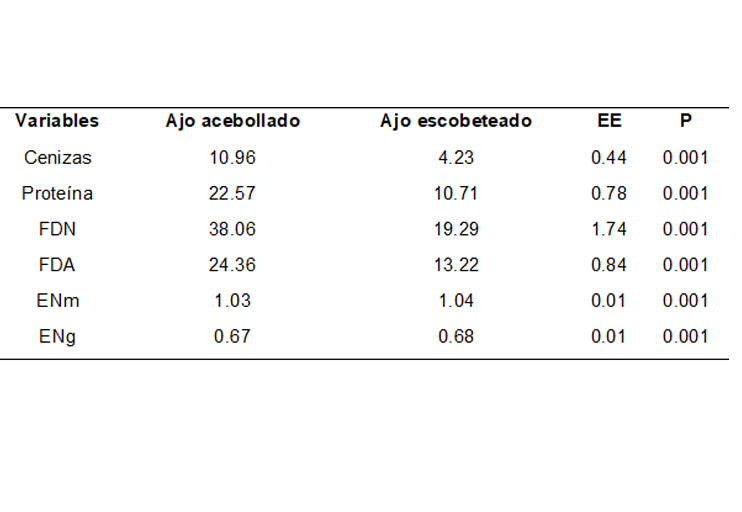
The objective was to determine the nutritional profile of undifferentiated and prematurely sprouted garlic in a semi-arid climate of Zacatecas, Mexico. The garlic was obtained from a farm located in Calera de Víctor Rosales, Zacatecas, Mexico. Ten randomly selected samples of each garlic type were used. The variables determined were ash, crude protein, neutral detergent fiber (NDF, % DM), acid detergent fiber (ADF, % DM), net energy for maintenance (Mcal kg-1), and net energy for gain (Mcal kg-1). Crude protein was 22.6 vs 10.7, NDF averaged 38.1 vs 19.3, ADF 24.4 vs 13.2, NEm 0.74 vs 0.87 and NEg 0.47 vs 0.58; respectively, for undifferentiated garlic and prematurely sprouted garlic. It was concluded that undifferentiated garlic and prematurely sprouted garlic provide a sufficient amount of protein to be used in supplementation programs and contain energy amounts to meet maintenance requirements and moderate gain rates in small ruminants.
Downloads
References
Abusuwar, A. O. and Ahmed, E. O. 2010. Seasonal variability in nutritive value of ruminant diets under open grazing system in the semi-arid rangeland of Sudan (South Darfur State). Agriculture and Biology Journal of North America. 1(3):243-249. https://doi.org/10.5251/abjna.2010.1.3.243.249
Chen, C.; Cai, J.; Liu, S. Q.; Qiu, G. L.; Wu, X. G.; Zhang, W.; Chen, C.; Qi, W.; Wu, Y. and Liu Z. 2019. Comparative study on the composition of four different varieties of garlic. PeerJ. 7:e6442. https://doi.org/10.7717/peerj.6442.
Drszczyk, J. E.; Kopec, A.; Bucki, P.; Ambroszczyk, A. M. and Skowera, B. 2019. The enhancing effect of plants growth biostimulants in garlic cultivation on the chemical composition and level of bioactive compounds in the garlic leaves, stems and bulbs. Not. Bot. Horti. Agrobo. 47(1):81-91. https://doi.org/10.15835/nbha47111074.
Juárez, S. K. G.; Díaz, G. E. J.; Méndez, L. M. D.; Pina, C. M. S.; Pérez, S. A. D. y Sánchez, M. M. A. 2019. Efecto de extractos crudos de ajo (Allium sativum) sobre el desarrollo in vitro de Aspergillus parasiticus y Aspergillus Níger. Polibotánica. 47:99-111.
Kewan, K. Z.; Ali, M. M.; Ahmed, B. M.; El-Kolty, S. A. and Nayel, U. A. 2021. The effect of yeast (Saccharomyces cerevisiae), garlic (Allium sativum) and their combination as feed additives in finishing diets on the performance, ruminal fermentation, and immune status of lambs. Egypt. J. Nutr. Feeds. 24(1):55-76. https://doi.org/10.21608/EJNF.2021.170304.
Kongmun, P.; Wanapat, M.; Pakdee, P.; Navanukraw, C. and Yu, Z. 2011. Manipulation of rumen fermentation and ecology of swamp buffalo by coconut oil and garlic powder supplementation. Livest. Sci. 135(1):84-92. https://doi.org/10.1016/j.livsci.2010.06.131.
Lee, J. S.; Kang, S.; Kim, M. J.; Han, S. G. and Lee, H. G. 2020. Dietary supplementation with combined extracts from garlic (Allium sativum), brown seaweed (Undaria pinnatifida), and pinecone (Pinus koraiensis) improves milk production in Holstein cows under heat stress conditions. Asian-Australasian Journal of Animal Science. 33(1):11-19. https://doi.org/10.5713/ajas.19.0536.
Li, H. G. and Fen, X. L. 2019. Studies on degradation characteristics of four unconventional feed ingredients in rumen. Modern Animal Husbandry. 10:7-15. Doi: cnki: sun: dayz.0.2019-10-007.
Macias, V. L. M.; Robles, E. F. J. y Velásquez, V. R. 2000. Guía para que los productores de ajo seleccionen su semilla. Instituto Nacional de Investigaciones Forestales, Agrícolas y Pecuarias (INIFAP)-Campo Experimental Pabellón Aguascalientes, Aguascalientes, México. Folleto para productores núm. 27.12 p.
Medina, G. G.; Casas, F. J. I.; Rodríguez, M. V. M. y Ramírez, C. N. Y. Z. 2023. Estadísticas climatológicas horarias del estado de Zacatecas (Periodo 2002‑2022). Instituto Nacional de Investigaciones Forestales, Agrícolas y Pecuarias (INIFAP)-Centro de Investigación Regional Norte Centro-Campo Experimental Zacatecas, Calera, Zacatecas, México. Publicación esp. núm. 24. 803 p.
NRC. 1989. National Research Council. Nutrient requirements of dairy cattle. 6th rev. Ed. Natl. Acad. Sci., Washington, DC. 108-142 pp. https://doi.org/10.17226/11654.
NRC. 2007. National Research Council. Nutrient requirements of small ruminants: sheep, goats, cervids, and new world camelids. Washington, DC. The National Academies Press. 97-132 pp. https://doi.org/10.17226/11654.
Olmedo, F. T. 2003. Curso producción de ajo. Universidad Arturo Prat. Chile. In: http://www.unap.cl/.
Panthee, A.; Matsuno, A.; Al‑Mamun, M. and Sano, H. 2017. Effect of feeding garlic leaves on rumen fermentation, methane emission, plasma glucose kinetics, and nitrogen utilization in sheep. J. Anim. Sci. Technol. 59(14):14-23. https://doi.org/10.1186/s40781-017-0139-3.
Qiu, Z.; Zheng, Z.; Zhang, B.; Sun‑Waterhouse, D. and Qiao, X. 2020. Formation, nutritional value, and enhancement of characteristic components in black garlic: a review for maximizing the goodness to humans. Compr. Rev. Food Sci. Food Saf. 19(2):801-834. https://doi.org/10.1111/1541-4337.12529.
Redoy, M. R. A.; Shuvo, A. A. S.; Cheng, L. and Al‑Mamun, M. 2020. Effect of herbal supplementation on growth, immunity, rumen histology, serum antioxidants and meat quality of sheep. Animal. 14(11):2433-2441. https://doi.org/10.1017/S1751731120001196.
Reveles‑Hernández, M.; Velásquez‑Valle, R. y Bravo‑Lozano, A. G. 2009. Tecnología para cultivar ajo en Zacatecas. Instituto Nacional de Investigaciones Forestales, Agrícolas y Pecuarias (INIFAP)-Centro de Investigación Regional Norte Centro-Campo Experimental Zacatecas, Calera, Zacatecas, México. Libro técnico núm. 11. 272 p.
Rouf, R.; Uddin, S. J.; Sarker, D. K.; Islam, M. T.; Ali, E. S.; Shilpi, J. A.; Nahar, L.; Tiralongo, E. and Sarker, S. D. 2020. Antiviral potential of garlic (Allium sativum) and its organosulfur compounds: a systematic update of pre‑clinical and clinical data. Trends Food Sci. Technol. 104:219-234. https://doi.org/10.1016/j.tifs.2020.08.006.
Saluzzo, J. A. 2003. Nutrición nitrogenada, crecimiento y rendimiento de ajo (Allium sativum) en respuesta a la fertilización nitrogenada en el SE de Buenos Aires, Argentina. Agroscientia. 20:50-63.
SAS Institute. 2011. Base SAS® 9.3 Software. SAS Institute Inc., Cary, North Carolina, USA.
SIAP. 2022. Servicio de Información Agroalimentaria y Pesquera. Anuario estadístico de la producción agrícola. Secretaría de Agricultura y Desarrollo Regional (SADER). https://nube.siap.gob.mx/cierreagricola/.
Vieira, R. L.; Silva, A. L.; Zaffari, G. R.; Steinmacher, D. A.; Freitas, H. P. and Guerra, M. P. 2015. Efficient elimination of virus complex from garlic (Allium sativum L.) by cryotherapy of shoot tips. Acta Physiol Plant. 37:1733-1746. https://doi.org/10.1007/s11738-014-1733.
Wang, F.; Hu, M.; Zhu, H.; Yang, C.; Xia, H.; Yang, X.; Yang, L. and Sun, G. 2021a. MyD88 determines the protective effects of fish oil and perilla oil against metabolic disorders and inflammation in adipose tissue from mice fed a high‑fat diet. Nutr. Diabetes. 11:23. https://doi.org/10.1038/s41387-021-00159-y.
Wang, J. L.; Wei, Y. H.; Wu, X. Q. and Zhao, G. Q. 2021b. Comparative study on rumen degradation characteristics of different parts of garlic by-products and common roughages for dairy cows. Anim Nutr. 7(4):5708-5716. https://doi.org/10.3969/j.issn.1006-267x.2021.10.030.
Wang, S. W.; Li, X. W. and Chen, Q. X. 2013. Effects of garlic skin on growth, physiological and biochemical indexes of sheep. China Herbivore Sci. 33(6): 39-42. https://doi.org/10.3969/j.issn.2095-3887.2013.06.010.
Published
How to Cite
Issue
Section
License
Copyright (c) 2026 Revista Mexicana de Ciencias Agrícolas

This work is licensed under a Creative Commons Attribution-NonCommercial 4.0 International License.
The authors who publish in Revista Mexicana de Ciencias Agrícolas accept the following conditions:
In accordance with copyright laws, Revista Mexicana de Ciencias Agrícolas recognizes and respects the authors’ moral right and ownership of property rights which will be transferred to the journal for dissemination in open access. Invariably, all the authors have to sign a letter of transfer of property rights and of originality of the article to Instituto Nacional de Investigaciones Forestales, Agrícolas y Pecuarias (INIFAP) [National Institute of Forestry, Agricultural and Livestock Research]. The author(s) must pay a fee for the reception of articles before proceeding to editorial review.
All the texts published by Revista Mexicana de Ciencias Agrícolas —with no exception— are distributed under a Creative Commons License Attribution-NonCommercial 4.0 International (CC BY-NC 4.0), which allows third parties to use the publication as long as the work’s authorship and its first publication in this journal are mentioned.
The author(s) can enter into independent and additional contractual agreements for the nonexclusive distribution of the version of the article published in Revista Mexicana de Ciencias Agrícolas (for example include it into an institutional repository or publish it in a book) as long as it is clearly and explicitly indicated that the work was published for the first time in Revista Mexicana de Ciencias Agrícolas.
For all the above, the authors shall send the Letter-transfer of Property Rights for the first publication duly filled in and signed by the author(s). This form must be sent as a PDF file to: revista_atm@yahoo.com.mx; cienciasagricola@inifap.gob.mx; remexca2017@gmail.
This work is licensed under a Creative Commons Attribution-Noncommercial 4.0 International license.