Tomato yield and resistance to Meloidogyne incognita (Kofoid and White) Chitwood using mycorrhizae
DOI:
https://doi.org/10.29312/remexca.v17i1.3973Keywords:
Meloidogyne incógnita, Solanum lycopersicum, fruit weight, mycorrhizaeAbstract
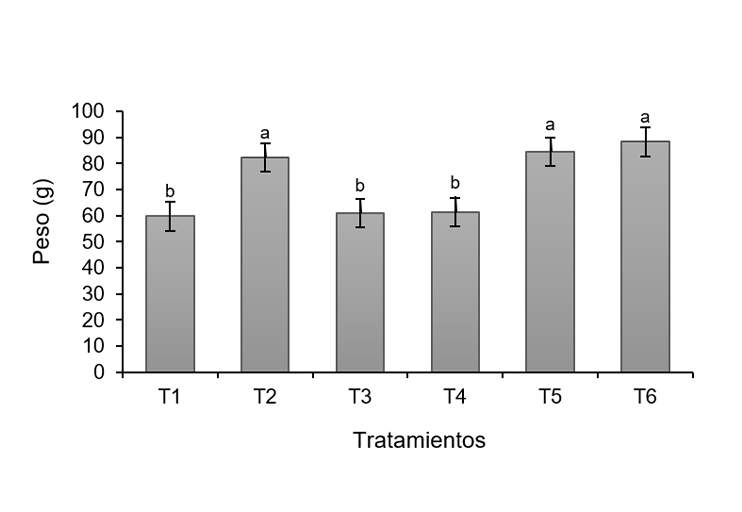
This study evaluated the impact of five different doses of a commercial mycorrhizal consortium on tomato (Solanum lycopersicum L.) yield and its effect on plant resistance to nematodes of the genus Meloidogyne incognita. The following items were assessed biweekly: vegetative variables: plant height, number, length and width of leaves; reproductive variables: number and distance between clusters; and production variables: number of fruits, weight, length and yield of fruits; from 7 to 230 days after transplanting (dat). In addition, the effect on resistance was evaluated by performing taxonomic identification, quantifying nematodes, and determining the percentage of mycorrhization at 90, 160 and 230 dat. The analysis of variance indicated significant differences (p≤ 0.05) for the production variables: harvest yield, fruit length, and fruit weight; as well as for the quantification of nematodes and the mycorrhization percentage at the dose of 15 g L-1. The 10-fold higher dose of the mycorrhizal consortium significantly increased yield (12.65 kg plant-1), fruit weight (64 g) and fruit length (6.3 cm), as well as the percentage of mycorrhization (88.85%) and reduced root colonization by Meloidogyne incognita (3%) compared to the control.
Downloads
References
Bibliografía
Alvarado-Carrillo, M.; Díaz-Franco, A. y Peña-Río, M. A. 2014. Productividad de tomate mediante micorriza arbuscular en agricultura protegida. Revista Mexicana de Ciencias Agrícolas. 5(3):513-518. https://doi.org/10.29312/REMEXCA.V5I3.954.
Arias, Y.; González, I.; Rodríguez, M.; Rosales, C.; Suárez, Z.; y Peteira, B. 2009. Aspectos generales de la interacción tomate (Solanum lycopersicon L.) - Meloidogyne incognita. Revista Protección Vegetal 24(1):1-13 http://scielo.sld.cu/pdf/rpv/v24n1/rpv01109.pdf.
Berruti, A.; Lumini, E.; Balestrini, R. and Bianciotto, V. 2016. Arbuscular mycorrhizal fungi as natural biofertilizers: let’s benefit from past successes. Frontiers in Microbiology. 6(1559):1-13. https://doi.org/10.3389/fmicb.2015.01559.
Carrillo-Saucedo, S. M.; Puente-Rivera, J.; Montes-Recinas, S. y Cruz-Ortega, R. 2022. Las micorrizas como una herramienta para la restauración ecológica. Acta Botánica Mexicana. 129:1-27 e1932. https://doi.org/10.21829/abm129.2022.1932.
Elian, H. D. B,; Djamndo, D. M.; Touckia, G. I.; Ngonda, C.; Ngalambo, E. and Gueret, E. 2022. Evaluation of the effect of arbuscular mycorrhizal fungi on the growth of tomato (Lycopersicum esculentum Mill.) grown in Bangui (Central African Republic) under controlled conditions. International Journal of Agriculture and Nutrition. 4(1):21-27. https://doi.org/10.33545/26646064.2022.v4.i1a.49.
García-Sánchez, C.; Becerril-Román, A. E.; Jaén-Contreras, D.; Hernández-Melchor, D.J.; López-Morales, F. and Gaytán-Acuña, E. A. Influence of Funneliformis mosseae in the growth and accumulation of dry biomass in Dalia plants. Agro Productividad. 155-161 pp. https://doi. org/10.32854/agrop.v16i1.2443.
Gill, N. S. and Verma, M. L. 2018. Nutrient uptake and yield of cherry tomato under NPK fertilization. Journal of Pharmacognosy and Phytochemistry. 7(3):2076-2082. https://www.phytojournal.com/archives/2018.v7.i3.4500/nutrient-uptake-and-yield-of-cherry-tomato-under-npk-fertilization.
Guzmán-Piedrahita, O. A.; Zamorano-Montañez, C. y López-Nicora, H. D. 2020. Interacciones fisiológicas de plantas con nematodos fitoparásitos: una revisión. Boletín Científico. Centro de Museos. Museo de Historia Natural. 24(2):190-205.https://doi.org/10.17151/bccm.2020.24.2.13.
Harrier, L. A. and Watson, C. A. 2004. The potential role of arbuscular mycorrhizal (AM) fungi in the bioprotection of plants against soil-borne pathogens in organic and/or other sustainable farming systems. Pest Management Science. 60(2):149-57. https://doi.org/10.1002/PS.820.
Hernández-Santiago, R.; Prado-Vera, I.; Vargas-Hernández, M.; Rodríguez-Guzmán, E. D.; Gómez-Rodríguez, O. and Ferrera-Cerrato, R. 2024. Integrated management of Nacobbus aberrans (Tylenchida: Pratylenchidae) in tomato under organic production in greenhouses. Nematropica. 54:71-86. https://journals.flvc.org/nematropica/article/view/136825.
Hunt, D. J. and Handoo, Z. A. 2012. Root-knot nematodes. In: Manzanilla-López, R. H. and Marbán-Mendoza, N. Ed. Practical plant nematology. Biblioteca básica de agricultura. Ciudad de México, México. Mundi Prensa. 359-410 pp.
Lichtenthaler, H. K. and Babani, F. 2005. Light adaptation and senescence of the photosynthetic apparatus. Changes in pigment composition, chlorophyll fluorescence parameters and photosynthetic activity. Photosynthesis Research. 85(1):1-17. https://link.springer.com/chapter/10.1007/978-1-4020-3218-9-28.
Molinari, S.; Akbarimotlagh, M. and Leonetti, P. 2022. Tomato root colonization by exogenously inoculated arbuscular mycorrhizal fungi induces resistance against root-knot nematodes in a dose-dependent manner. International Journal of Molecular Sciences. 23(16):1-12. https://doi.org/10.3390/ijms23168920.
MycoApply®. 2020. Technical data sheet: mycoapply soluble MAXX. https://mycorrhizae.com.
Orona-Castillo, I.; Toro-Sánchez, C. L.; Fortis-Hernández, M.; Preciado-Rangel, P.; Espinoza-Arellano, J. J.; Rueda-Puente, E.; Flores-Vázquez, M. y Cano-Ríos, P. 2022. Indicadores técnico-económicos de la producción del cultivo de tomate bajo agricultura protegida en la Comarca Lagunera, México. Revista de Ciencias Biológicas y de la Salud 24(3):70-76. https://elicit.com/notebook/ffd53c50-2890-48a5-91e8-a3415c1b6e87#183f6e1c1f6a04ac24bf49628bf1d368.
Ramírez, S. R.; Sánchez-Lucio, R.; Zelaya-Molina, L. X.; Chávez-Díaz, I. F.; Cruz-Cárdenas, C. I. y Valdivia-Bernal, R. 2021. Germinación y vigor de semillas de especies hortícolas inoculadas con biofertilizantes y soluciones salinas. Revista Mexicana de Ciencias Agrícolas. 12(7):1199-1208. https://doi.org/10.29312/remexca.v12i7.2539.
Roussis, I.; Beslemes, D.; Kosma, C.; Triantafyllidis, V.; Zotos, A.; Tigka, E.; Mavroeidis, A.; Karydogianni, S.; Kouneli, V.; Travlos, I. and Kakabouki, I. 2022. The influence of arbuscular mycorrhizal fungus Rhizophagus irregularis on the growth and quality of processing tomato (Lycopersicon esculentum Mill.) Seedlings. Sustainability. 14(15):1-12. https://doi.org/10.3390/su14159001.
Sharma, I. P. and Sharma, A. K. 2015. Root knot nematodes (Meloidogyne incognita) suppression through pre-colonized arbuscular mycorrhiza (Glomus intraradices) in tomato-PT3. Sci Agric. 12(1): 52-57. Doi:10.15192/PSCP.SA.2015.12.1.5257.
Smith, S. E. and Read, D. J. 2008. Mycorrhizal symbiosis 3rd Ed. Academic Press. 787 p. Doi:10.2136/sssaj2008.0015br.
Sousa, C. D.; Soares, A. C.; Coimbra, J. L.; Garrido, M. D. y Machado, G. D. 2010. Fungos micorrízicos arbusculares no controle de Meloidogyne incognita em mudas de tomateiro. Revista Caatinga. 23(1):15-20. https://periodicos.ufersa.edu.br/caatinga/article/view/1336/pdf.
Todeschini, V.; AitLahmidi, N.; Mazzucco, E.; Marsano, F.; Gosetti, F.; Robotti, E.; Bona, E.; Massa, N.; Bonneau, L.; Marengo, E.; Wipf, D.; Berta, G. and Lingua, G. 2018. Impact of beneficial microorganisms on strawberry growth, fruit production, nutritional quality, and volatilome. Frontiers in Plant Science. 9(1611):1-22. Doi:10.3389/fpls.2018.01611.
Vázquez-Hernández, M. V.; Arévalo-Galarza, M. L. C.; Jaen-Contreras, D.; Escamilla-García, J. y Luna- Esquivel, G. 2020. Calidad y almacenamiento de frutos de papaya procedentes de plantas inoculadas con Glomus mosseae. Revista Mexicana de Ciencias Agrícolas. 11(5):1163-1170. https://doi.org/10.29312/remexca.v11i5.2280.
Volpe, V.; Chitarra, W.; Cascone, P.; Volpe, M. G.; Bartolini, P.; Moneti, G.; Pieraccini, G.; Serio, C.; Maserti, B.; Guerrieri, E. and Balestrini, R. 2018. The association with two different arbuscular mycorrhizal fungi differently affects water stress tolerance in tomato. Frontiers in Plant Science. 9(1480):1-16. Doi:10.3389/fpls.2018.0148.
Published
How to Cite
Issue
Section
License
Copyright (c) 2026 Revista Mexicana de Ciencias Agrícolas

This work is licensed under a Creative Commons Attribution-NonCommercial 4.0 International License.
The authors who publish in Revista Mexicana de Ciencias Agrícolas accept the following conditions:
In accordance with copyright laws, Revista Mexicana de Ciencias Agrícolas recognizes and respects the authors’ moral right and ownership of property rights which will be transferred to the journal for dissemination in open access. Invariably, all the authors have to sign a letter of transfer of property rights and of originality of the article to Instituto Nacional de Investigaciones Forestales, Agrícolas y Pecuarias (INIFAP) [National Institute of Forestry, Agricultural and Livestock Research]. The author(s) must pay a fee for the reception of articles before proceeding to editorial review.
All the texts published by Revista Mexicana de Ciencias Agrícolas —with no exception— are distributed under a Creative Commons License Attribution-NonCommercial 4.0 International (CC BY-NC 4.0), which allows third parties to use the publication as long as the work’s authorship and its first publication in this journal are mentioned.
The author(s) can enter into independent and additional contractual agreements for the nonexclusive distribution of the version of the article published in Revista Mexicana de Ciencias Agrícolas (for example include it into an institutional repository or publish it in a book) as long as it is clearly and explicitly indicated that the work was published for the first time in Revista Mexicana de Ciencias Agrícolas.
For all the above, the authors shall send the Letter-transfer of Property Rights for the first publication duly filled in and signed by the author(s). This form must be sent as a PDF file to: revista_atm@yahoo.com.mx; cienciasagricola@inifap.gob.mx; remexca2017@gmail.
This work is licensed under a Creative Commons Attribution-Noncommercial 4.0 International license.