Production systems and soil fertility of Hass avocado in Oaxaca
DOI:
https://doi.org/10.29312/remexca.v17i1.3939Keywords:
agroecological management, climate change, inorganic fertilization, production systemsAbstract
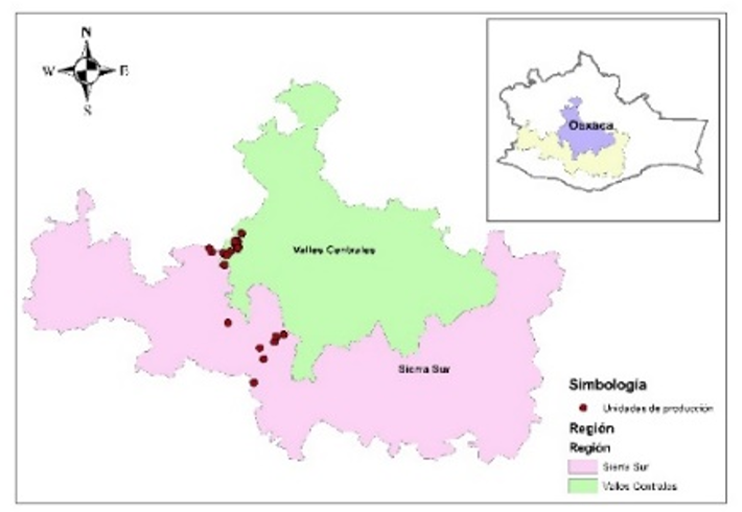
Avocado production has experienced remarkable growth in recent decades, positioning itself as an important agricultural activity in Mexico. The increase in productivity is threatened by multiple factors that intervene in production, including adverse climatic conditions derived from climate change; therefore, proposing alternatives that may have a lower environmental impact is of great importance. The objective was to study production systems with respect to fertilization management, their effects on soil conditions, and their relationship with yield in Hass avocado production units in the state of Oaxaca. Twenty-eight production units were studied in the Sierra Sur region in Villa Sola de Vega and in the Valles Centrales region in Zaachila; they presented three types of production systems: agroecological (organic fertilization), conventional (synthetic fertilizers) and combined (alternation between both). Soil sampling was carried out for fertility analysis in accordance with NOM-021-RECNAT and yield was estimated. Analysis of variance indicated statistically significant differences in iron (Fe) content and yield only. The best results in terms of improving soil fertility were obtained under agroecological management, whereas the highest yields were recorded in units with combined management. There was a significant positive correlation of Ca with BD, pH, EC, N, Na, and Fe. Agroecological management significantly improved soil properties; however, during the production cycle analyzed, no increase in yield was obtained.
Downloads
References
Acevedo, I.; Sánchez, A. and Mendoza, B. 2020. Evaluation of the level of soil degradation in two productive systems in the Quibor depression. I. Multivariate analysis. Bioagro. 33(1):59-66. https://revistas.uclave.org/index.php/bioagro/article/view/3023.
Álvarez-Sánchez, E.; Vázquez-Alarcón, A.; Castellanos, J. Z. y Cueto-Wong, J. 2006. Efectividad biológica de abonos orgánicos en el crecimiento de trigo. Terra Latinoamericana. 24(2):261-268. https://www.redalyc.org/pdf/573/57311108013.pdf.
Antonio-Luis, M. C. y Palacios-Torres, R. E. 2024. Presence of Heilipus lauri in the zone at Mixe Medio, Oaxaca, México. Southwestern Entomologist. 49(3):1004-1008. https://doi.org/10.3958/059.049.0322.
Campos, M. J. L.; Álvarez, S. M. E.; Maldonado, T. R. y Vargas, G. A. 2020. Aplicación de abonos orgánicos en el rendimiento y desarrollo radicular en el cultivo de aguacate. Revista Mexicana de Ciencias Agrícolas. 11(2):263-274. https://doi.org/10.29312/remexca.v11i2.2301.
Cristóbal-Acevedo, D.; Álvarez-Sánchez, M. E.; Hernández-Acosta, E.; y Améndola-Massiotti, R. 2011. Concentración de nitrógeno en suelo por efecto de manejo orgánico y convencional. Terra Latinoamericana. 29(3):325-332. https://www.scielo.org.mx/pdf/tl/v29n3/2395-8030-tl-29-03-00325.pdf.
Diario Oficial de la Federación. 2016. México: SEGOB. Rodríguez-Garay, F. A.; Camacho-Tamayo, J. H. y Rubiano-Sanabria. Variabilidad espacial de los atributos químicos del suelo en el rendimiento y calidad de café. Ciencia y Tecnología Agropecuaria. 17(2):237-254. http://www.scielo.org.co/scielo.php?script=sci-arttext&pid=S0122-87062016000200008&lng=en&tlng=es.
Ford, N. A.; Spagnuolo, P.; Kraft, J. and Bauer, E. 2023. Nutritional composition of hass avocado pulp. Foods. 12(13):2516. https://doi.org/10.3390/foods1213251.
García-Martínez, R.; Cortés-Flores, J. I.; López-Jiménez, A.; Etchevers-Barra, J. D.; Carrillo-Salazar, J. A. y Saucedo-Veloz, C. 2021. Rendimiento, calidad y comportamiento poscosecha de frutos de aguacate-Hass de huertos con diferente fertilización. Revista Mexicana de Ciencias Agrícolas. 12(2):205-218. https://doi.org/10.29312/remexca.v12i2.2232.
Garrido-Ramírez, E. R.; Noriega-Cantú, D. H.; Gutiérrez- Valle, A.; González-Mateos, R.; Pereyda-Hernández, J.; Domínguez-Márquez, V. M.; López-Estrada, M. E.; Alarcón-Cruz, N.; Valentín-Benigno, A. y Leyva-Mayo, A. 2018. Áreas potenciales para el cultivo de Aguacate (Persea americana L.) cultivas “Hass” en el estado de Guerrero, México. Agro Productividad. 6(5):52-57. https://revista-agroproductividad.org/index.php/agroproductividad/article/view/484.
González, M.; Ríos, D.; Peña, R. K.; García, E.; Acevedo, M.; Cartes, E. y Sánchez, O. M. 2020. Efecto de la concentración de fósforo y calcio sobre atributos morfo-fisiológicos y potencial de crecimiento radical en plantas de Aextoxicon punctatum producidas a raíz cubierta en la etapa de endurecimiento. Bosque (Valdivia). 41(2):137-146. https://dx.doi.org/10.4067/S0717-92002020000200137.
INEGI. 2010. Instituto Nacional de Estadística y Geografía. Compendio de información geográfica municipal 2010. Villa Sola de Vega Oaxaca, Clave geoestadística 20277, México. 10 p. http://www3.inegi.org.mx/contenidos/app/mexicocifras/datos-geograficos/20/20277.pdf).
INEGI. 2023. Instituto Nacional de Estadística y Geografía. Información de México para niños.https://cuentame.inegi.org.mx/monografias/informacion/oax/territorio/clima.aspx#:~:text=La%20temperatura%20media%20anual%20del,m%C3%A1s%20apreciada%20a%20nivel%20internacional.&text=*Referido%20al%20total%20de%20la,consulta%20en%20el%20Sitio%20INEGI.
Lopez-Amaya, K. L. 2022. Evaluación de la dinámica de agua en Hydrus-1D para tres suelos de ladera cultivados con aguacate Hass (Persea americana). Investigación e Innovación en Ingenierías. 10(1):75-98. https://doi.org/10.17081/invinno.10.1.4811.
López-Mtz, J. D.; Estrada, A. D.; Rubin, E. M. y Cepeda, R. D. V. 2001. Abonos orgánicos y su efecto en propiedades físicas y químicas del suelo y rendimiento en maíz. Terra Latinoamericana. 19(4):293-299. https://doi.org/10.54167/tch.v4i1.719.
Méndez-García, T.; Palacios-Mayorga, S. y Rodríguez-Domínguez, L. 2008. Análisis de suelo, foliar y de calidad del agua para el cultivo del aguacatero. Terra Latinoamericana. 26(1):75-84. http://www.scielo.org.mx/scielo.php?script=sci-arttext&pid=S0187-57792008000100010&lng=es&tlng=es.
SADER. 2024. Secretaría de Agricultura y Desarrollo Rural. El aguacate: oro verde de la Agricultura Mexicana. Secretaria de Agricultura y Desarrollo Rural. https://www.gob.mx/agricultura/articulos/elaguacateoroverdedelaagriculturamexicana#:~:text=La%20producci%C3%B3n%20de%20aguacate%20es,Contesta%20nuestra%20encuesta%20de%20satisfacci%C3%B3n.
Saldaña, D. M. G. y Cota Y. R. 2022. Principales efectos socioambientales del cultivo agroindustrial de aguacate en San Gabriel, Jalisco. Contexto latinoamericano. HorizonTes Territoriales. 2(4):1-28. https://doi.org/10.31644/HT.02.04.2022.A19.
SAS. 2002. Institute Inc. The SAS System for Windows 9.0. Cary, North Carolina, USA. 421 p.
SEMARNAT. 2002. Secretaría de Medio Ambiente y Recursos Naturales. Norma Oficial Mexicana NOM-021 SEMARNAT-2000 antes NOM021-RECNAT-2000. Que establece las especificaciones de fertilidad, salinidad y clasificación de suelos. Estudio, muestreo y análisis.
SIAP. 2024. Servicio de información Agroalimentario y Pesca. Atlas Agroalimentario 2024. SAGARPA, México. Primera edición. 236 p. https://nube.agricultura.gob.mx/avance-agricola/.
Trinidad, S. A. y Velasco, V. J. 2016. Importancia de la materia orgánica en el suelo. Agro productividad. 9(8):52-58. https://revista-agroproductividad.org/index.php/agroproductividad/article/view/802.
Zanor, G. A.; López-Pérez, M. E.; Martínez -Yáñez, R.; Ramírez-Santoyo, L. F.; Gutiérrez-Vargas, S. y León-Galván, M. F. 2018. Mejoramiento de las propiedades físicas y químicas de un suelo agrícola mezclado con lombricompostas de dos efluentes de biodigestor. Ingeniería, Investigación y Tecnología. 19(4):1-10. https://doi.org/10.22201/fi.25940732e.2018.19n4.036.
Published
How to Cite
Issue
Section
License
Copyright (c) 2026 Revista Mexicana de Ciencias Agrícolas

This work is licensed under a Creative Commons Attribution-NonCommercial 4.0 International License.
The authors who publish in Revista Mexicana de Ciencias Agrícolas accept the following conditions:
In accordance with copyright laws, Revista Mexicana de Ciencias Agrícolas recognizes and respects the authors’ moral right and ownership of property rights which will be transferred to the journal for dissemination in open access. Invariably, all the authors have to sign a letter of transfer of property rights and of originality of the article to Instituto Nacional de Investigaciones Forestales, Agrícolas y Pecuarias (INIFAP) [National Institute of Forestry, Agricultural and Livestock Research]. The author(s) must pay a fee for the reception of articles before proceeding to editorial review.
All the texts published by Revista Mexicana de Ciencias Agrícolas —with no exception— are distributed under a Creative Commons License Attribution-NonCommercial 4.0 International (CC BY-NC 4.0), which allows third parties to use the publication as long as the work’s authorship and its first publication in this journal are mentioned.
The author(s) can enter into independent and additional contractual agreements for the nonexclusive distribution of the version of the article published in Revista Mexicana de Ciencias Agrícolas (for example include it into an institutional repository or publish it in a book) as long as it is clearly and explicitly indicated that the work was published for the first time in Revista Mexicana de Ciencias Agrícolas.
For all the above, the authors shall send the Letter-transfer of Property Rights for the first publication duly filled in and signed by the author(s). This form must be sent as a PDF file to: revista_atm@yahoo.com.mx; cienciasagricola@inifap.gob.mx; remexca2017@gmail.
This work is licensed under a Creative Commons Attribution-Noncommercial 4.0 International license.