Marketing study of a natural sweetener derived from stevia
DOI:
https://doi.org/10.29312/remexca.v16i8.3924Keywords:
Stevia rebaudiana, non-caloric supplement, stevia dosage, stevia consumptionAbstract
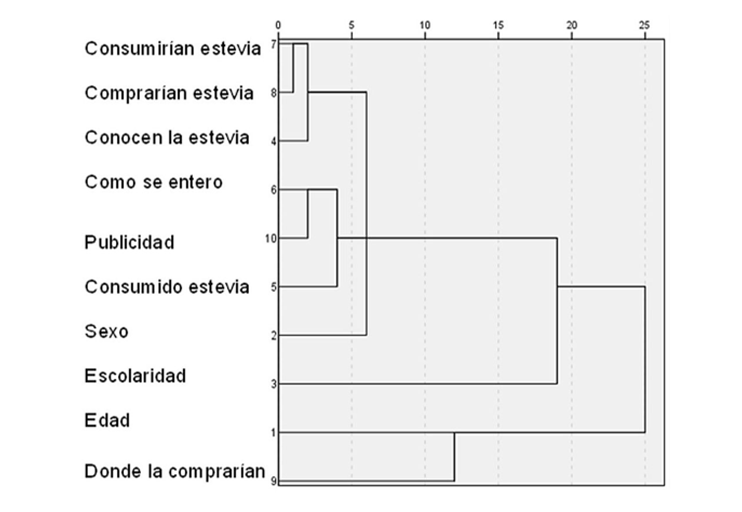
The stevia (Stevia rebaudiana Bertoni) plant is a natural non-nutritive non-caloric sweetener with various beneficial properties, among which its hypoglycemic, caloric and anxiolytic activities stand out. In Mexico, type 2 diabetes mellitus and obesity are some of the main public health problems. The objective of this study was to determine the feasibility of marketing an infusion made with dried and ground stevia leaves to people with type 2 diabetes mellitus and people with obesity in the locality of Córdoba, Veracruz, in 2022. To this end, a cross-tabulation was carried out with three variables (they would buy a stevia infusion, sex and age), and the market was segmented through a cluster analysis; likewise, the stevia infusion was made in the food science laboratory of the College of Postgraduates-Córdoba Campus and offered in 0.25 and 0.5 g filter bags for doses of 250 and 500 ml cups. As a result, 14% of both people with diabetes and people with obesity mentioned that they have knowledge about stevia and 6 and 3% of both groups have tried the plant. In conclusion, the general public had limited knowledge about the stevia plant; nevertheless, there is a potential demand for stevia infusion; therefore, the proposal to develop a stevia infusion for marketing to the target audience is viable.
Downloads
References
Ahmad, U. and Ahmad, R. S. 2018. Anti diabetic property of aqueous extract of Stevia rebaudiana Bertoni leaves in Streptozotocin induced diabetes in albino rats. BioMed Central. 18(1):1-11.
Ainapur, S. D.; Lakshmidevamma, T. N. and Maruthi-Prasad, B. N. 2025. Genetic Improvement of Stevia (Stevia rebaudiana Bertoni): a potential calorie free natural sweetener. Sugar Tech. 27(3):635-653. https://doi.org/10.1007/s12355-025-01543-z.
Anton, S. D.; Martin, C. K.; Han, H.; Coulon, S.; Willian, C. T.; Geiseiman, P. and Williamson D. A. 2010. Effects of stevia, aspartame, and sucrose on food intake, satiety, and postprandial glucose and insulin levels. Appetite. 55(1):27-43.
Baltazar-Bernal, O. 2022. Endulzante natural a base de stevia. Patente mexicana número MX/a/2017/000229. Instituto mexicano de la propiedad industrial (IMPI).
da Silva, T. F. O.; Ferrarezi, A. A. and Silva-Santos, É. 2025. Bioactivities and biotechnological tools for obtaining bioactive metabolites from Stevia rebaudiana. Food Science and Biotechnology. 34:1679-1697. https://doi.org/10.1007/s10068-024-01776-w.
FMD. 2021. Federación Mexicana de diabetes. Veracruz se encuentra dentro de los primeros lugares en obesidad y diabetes. http://fmdiabetes.org/veracruz-se-encuentra-dentro-de-los-primeros-lugares-en-obesidad-y-diabetes/.
Gilabert, J. y Encinas, T. 2014. De la stevia al E-960: un dulce camino. Ciencia y tecnología de los alimentos. Universidad Complutense de Madrid. Reduca. Recursos educativos. Serie Congresos Alumnos. 6(1):305-311.
González-Moralejo, A. S. 2011. Aproximación a la comprensión de un endulzante natural alternativo, la Stevia rebaudiana Bertoni: producción, consumo y demanda potencial. Agroalimentaria. 17(32):57-69.
Gupta E.; Purwar, S.; Sundaram, S. and Rai K. G. 2013. Nutritional and therapeutic values of Stevia rebaudiana: a review. Journal of Medicinal Plants Research. 7(46):3343-3353.
INEGI. 2025. Instituto Nacional de Estadística y Geografía. Estadísticas de mortalidad. https://www.inegi.org.mx/contenidos/saladeprensa/boletines/2025/edr/edr2024enjunRR.pdf.
Kamarulzaman H. N.; Jamal, K.; Vikayan, G. and Jalil, M. S. 2014. Will consumers purchase stevia as a sugar substitute? An exploratory study on consumer acceptance. Journal of Food Products Marketing. 20(sup1):122-139.
Lemus-Mondaca, R.; Vega-Gálvez, A.; Zura-Bravo, L. and Ah-Hen K. 2012. Stevia rebaudiana Bertoni, source of a high-potency natural sweetener: a comprehensive review on the biochemical, nutritional and functional aspects. Food Chemistry. 132(3):1121-1132.
Mahajan, M.; Naveen, P. and Pal, P. K. 2024. Agronomical and biotechnological strategies for modulating biosynthesis of steviol glycosides of Stevia rebaudiana Bertoni. Journal of Applied Research on Medicinal and Aromatic Plants. 43:100580.
Marín, W. 2004. Sondeo de mercado de la estevia. Instituto de Investigaciones de recursos biológicos Alexander von Humboldt, Bogotá, Colombia. https://www.researchgate.net/profile/Wilmer-Marin/publication/285597491-Sondeo-de-mercado-de-la-Estevia/links/5661b58e08ae15e7462d0487/Sondeo-de-mercado-de-la-Estevia.pdf
Mishra, N. 2011. An Analysis of antidiabetic activity of Stevia rebaudiana extract on diabetic patient. Journal of Natural Sciences Research. 1(3):1-9.
Mogra, R. and Dashora, V. 2009. Exploring the Use of Stevia rebaudiana as a sweetener in comparison with other sweeteners. Journal of Human Ecology. 25(2):117-120.
Muñoz-Labrador, A.; Hernández-Hernández, O. and Moreno, F. J. 2023. A review of the state of sweeteners science: the natural versus artificial non caloric sweeteners debate. Stevia rebaudiana and Siraitia grosvenorii into the spotlight. Critical Reviews in Biotechnology. 44(6):1080-1102. https://doi.org/10.1080/07388551.2023.2254929.
Patil, A. 2025. Mercado global de estevia: tamaño, participación y pronóstico de crecimiento 2025-2032. Persistence Market Research. https://www.persistencemarketresearch.com/market-research/stevia-market.asp.
Salvador-Reyes, R.; Sotelo-Herrera, M. y Paucar-Menacho, L. 2014. Estudio de la stevia (Stevia rebaudiana Bertoni) como edulcorante natural y su uso en beneficio de la salud. Scientia Agropecuaria. 5(3):157-163.
Samuel, P.; Ayoob, K. T.; Magnuson, B. A.; Wölwer-Rieck, U.; Jeppesen, P. B.; Rogers, P. J.; Rowland, I. and Mathews R. 2018. Stevia leaf to stevia sweetener: exploring its science, benefits, and future potential. Journal of Nutrition. 148(7):1186S-1205S. https://doi.org/10.1093/jn/nxy102.
Thomas, J. E. and Glade, M. J. 2010. Stevia: I’s not just about calories. The Open Obesity Journal. 2:101-109.
UNICEF. 2023. Fondo de las Naciones Unidas para la Infancia. Salud y nutrición. http://www.unicef.org/mexico/spanish/17047.htm.
Xu, X.; Wei, Q.; Guo, J.; Zhang, J.; Yang, Y.; Wang, L.; Huang, Z. and Dong, C. 2024. Identification of geographic, climatic, and soil factors dominating Stevia rebaudiana yield and quality. Industrial Crops and Products. 214:118556.
Zaidan, U. H.; Mohamad, Z. N.; Amran, N. A.; Shamsi, S. and Gani, S. S. A. 2019. Biochemical evaluation of phenolic compounds and steviol glycoside from Stevia rebaudiana extracts associated with in vitro antidiabetic potential. Biocatalysis and Agricultural Biotechnology. 18:101049.
Published
How to Cite
Issue
Section
License
Copyright (c) 2025 Revista Mexicana de Ciencias Agrícolas

This work is licensed under a Creative Commons Attribution-NonCommercial 4.0 International License.
The authors who publish in Revista Mexicana de Ciencias Agrícolas accept the following conditions:
In accordance with copyright laws, Revista Mexicana de Ciencias Agrícolas recognizes and respects the authors’ moral right and ownership of property rights which will be transferred to the journal for dissemination in open access. Invariably, all the authors have to sign a letter of transfer of property rights and of originality of the article to Instituto Nacional de Investigaciones Forestales, Agrícolas y Pecuarias (INIFAP) [National Institute of Forestry, Agricultural and Livestock Research]. The author(s) must pay a fee for the reception of articles before proceeding to editorial review.
All the texts published by Revista Mexicana de Ciencias Agrícolas —with no exception— are distributed under a Creative Commons License Attribution-NonCommercial 4.0 International (CC BY-NC 4.0), which allows third parties to use the publication as long as the work’s authorship and its first publication in this journal are mentioned.
The author(s) can enter into independent and additional contractual agreements for the nonexclusive distribution of the version of the article published in Revista Mexicana de Ciencias Agrícolas (for example include it into an institutional repository or publish it in a book) as long as it is clearly and explicitly indicated that the work was published for the first time in Revista Mexicana de Ciencias Agrícolas.
For all the above, the authors shall send the Letter-transfer of Property Rights for the first publication duly filled in and signed by the author(s). This form must be sent as a PDF file to: revista_atm@yahoo.com.mx; cienciasagricola@inifap.gob.mx; remexca2017@gmail.
This work is licensed under a Creative Commons Attribution-Noncommercial 4.0 International license.