Comparación de métodos analíticos para la determinación de materia orgánica en suelo con residuos de café
DOI:
https://doi.org/10.29312/remexca.v16i8.3913Palabras clave:
análisis de suelo, calcinación, fertilidad, normatividad mexicanaResumen
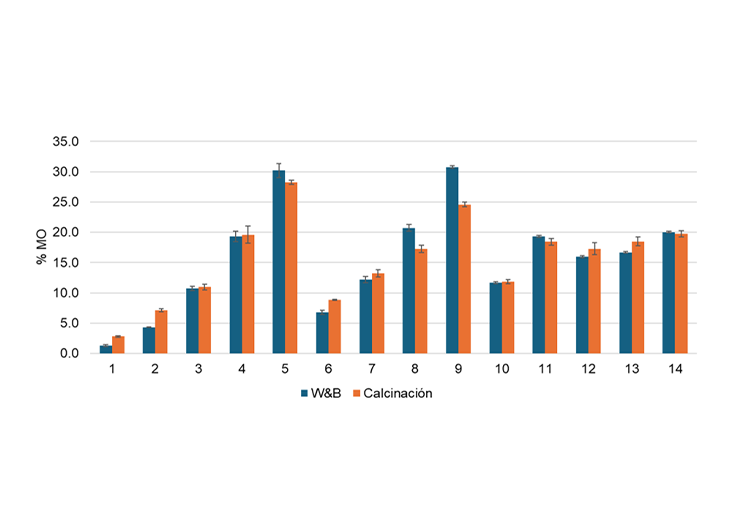
La materia orgánica es un indicador de la calidad y fertilidad del suelo, influye directamente en sus propiedades físicas, químicas y biológicas. Su análisis es fundamentar para la producción agrícola y forestal. El método de Walkley-Black, es el estándar establecido en la normativa mexicana, aunque presenta desventajas ambientales al utilizar reactivos químicos tóxicos con características particulares de manejo. Por esta razón, se propone como alternativa el método de calcinación, que cuantifica directamente el contenido de materia orgánica en el suelo, mediante la determinación de la pérdida de peso de una muestra al someterse a altas temperaturas. En este estudio se compararon ambos métodos en muestras de suelos enriquecidos con residuo sólido de café y con composta elaborada de rsc/estiércol bovino. Los datos fueron analizados estadísticamente para evaluar la equivalencia entre los métodos. Los resultados mostraron una alta correlación (r= 0.951) y ausencia de diferencias significativas (p= 0.94), lo que respalda la viabilidad de utilizar el método de calcinación como alternativa al método Walkley-Black por la alta correlación en los valores de materia orgánica al ser analizados por los dos métodos analíticos. Se sugiere la posibilidad de modificar la normativa vigente para incorporar el método de calcinación, ofreciendo una opción segura y ecológica para determinar materia orgánica en el suelo.
Descargas
Citas
Abella, S. R. and Zimmer, B. W. 2007. Estimating organic carbon from loss‐on‐ignition in northern Arizona forest soils. Soil Science Society of America Journal. 71(2):545-550.
Arévalo, G. E.; Sánchez-Amaya, J. M. y Guillen-Marquina, I. 2022. Estudio del contenido materia orgánica por dos métodos analíticos en suelos de Honduras. Revista de Ciencias Ambientales. 57(1):1-13.
Bautista, J. I. y Hernández, J. J. A. 2021. Determinación del carbono orgánico por el método químico y por calcinación. Ingeniería y Región. 26:20-28.
DesMarais, T. L. y Costa, M. 2019. Mechanisms of chromium-induced toxicity. Current Opinion in Toxicology. 14:1-7.
Eyherabide, M.; Saínz, R. H.; Hernán, B. P. y Echeverría, H. E. 2014. Comparación de métodos para determinar carbono orgánico en suelo. Ciencia del suelo. 32(1):13-19.
La Manna, L.; Buduba, C.; Alonso, V.; Davel, M.; Puentes, C. y Irisarri, J. 2007. Comparación de métodos analíticos para determinar materia orgánica en suelos de la región andino-patagónica: efectos de la vegetación y el tipo de suelo. Ciencia del Suelo. 25(2):179-188.
NOM-021-RECNAT-2000. Norma Oficial Mexicana. Secretaría de Medio Ambiente y Recursos Naturales (SEMARNAT). Establece las especificaciones de fertilidad, salinidad y clasificación de suelos. Estudios, Muestreo y Análisis.
Pribyl, D. W. 2010. A critical review of the conventional SOC to SOM conversion factor. Geoderma. 156(3-4):75-83.
Roper, W. R.; Robarge, W. P.; Osmond, D. L. and Heitman, J. L. 2019. Comparing four methods of measuring soil organic matter in North Carolina soils. Soil Science Society of America Journal. 83(2):466-474.
Ruiz, D. M.; Cori, C. E. C; Sosa, F.; Aular, L. M.; Mora, R.; Castillo, L. C.; Ortega, B.; Castillo E.; Ramírez-Iglesias, E.; Rodríguez, J.; León, M.; Sequera, C. S.; Tovar, M. R.; Martínez, A.; Reverón, A. M. and Gámez, F. 2023. Comparison of methods for analyzing organic matter in organic materials. Brazilian Journal of Animal and Environmental Research. 6(3):2331-2341.
Walkley, A. and Black, I. A. 1934. An examination of degtjareff method for determining soil organic matter and a proposed modification of the chromic acid titration method. Soil Sci. 37(1):29-38.
Descargas
Publicado
Cómo citar
Número
Sección
Licencia
Derechos de autor 2025 Revista Mexicana de Ciencias Agrícolas

Esta obra está bajo una licencia internacional Creative Commons Atribución-NoComercial 4.0.
Los autores(as) que publiquen en Revista Mexicana de Ciencias Agrícolas aceptan las siguientes condiciones:
De acuerdo con la legislación de derechos de autor, Revista Mexicana de Ciencias Agrícolas reconoce y respeta el derecho moral de los autores(as), así como la titularidad del derecho patrimonial, el cual será cedido a la revista para su difusión en acceso abierto.
Los autores(as) deben de pagar una cuota por recepción de artículos antes de pasar por dictamen editorial. En caso de que la colaboración sea aceptada, el autor debe de parar la traducción de su texto al inglés.
Todos los textos publicados por Revista Mexicana de Ciencias Agrícolas -sin excepción- se distribuyen amparados bajo la licencia Creative Commons 4.0 atribución-no comercial (CC BY-NC 4.0 internacional), que permite a terceros utilizar lo publicado siempre que mencionen la autoría del trabajo y a la primera publicación en esta revista.
Los autores/as pueden realizar otros acuerdos contractuales independientes y adicionales para la distribución no exclusiva de la versión del artículo publicado en Revista Mexicana de Ciencias Agrícolas (por ejemplo incluirlo en un repositorio institucional o darlo a conocer en otros medios en papel o electrónicos) siempre que indique clara y explícitamente que el trabajo se publicó por primera vez en Revista Mexicana de Ciencias Agrícolas.
Para todo lo anterior, los autores(as) deben remitir el formato de carta-cesión de la propiedad de los derechos de la primera publicación debidamente requisitado y firmado por los autores(as). Este formato debe ser remitido en archivo PDF al correo: revista_atm@yahoo.com.mx; revistaagricola@inifap.gob.mx.
Esta obra está bajo una licencia de Creative Commons Reconocimiento-No Comercial 4.0 Internacional.