Membranas biobasadas y nanocompuestos: innovación sostenible para su potencial uso en aguas residuales
DOI:
https://doi.org/10.29312/remexca.v16i30.4052Palabras clave:
fotodegradación, polímeros biodegradables, remoción de colorantesResumen
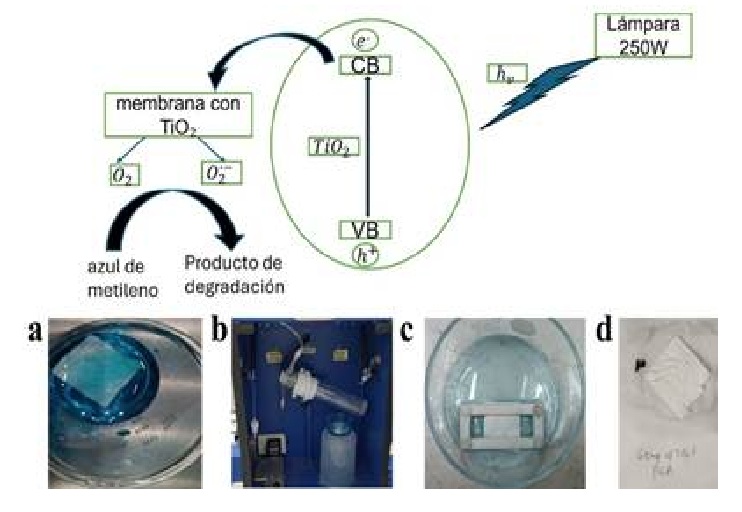
Actualmente la contaminación generada por la industria textil en el área de colorantes es una gran preocupación a nivel nacional e internacional. Una de las propuestas para mitigar esta problemática son la tecnología de membranas. En particular, las basadas en materiales compuestos y polímeros de naturaleza biodegradable han sido sujeto de estudio en las últimas décadas como reemplazo a las membranas a base de polímeros convencionales para tratamiento de aguas, esto debido a la creciente demanda de tecnologías sostenibles para dicha aplicación. Este trabajo aborda la preparación y el uso de nanocompuestos poliméricos empleando el ácido poliláctico y nanopartículas de dióxido de titanio (TiO2) para su aplicación como membranas biodegradables. La adición de estas nanopartículas en la matriz del polímero mejora la estabilidad térmica y dota de propiedades fotocatalíticas, permitiendo la remoción de colorantes con potencial aplicación para el tratamiento de aguas residuales.
Descargas
Citas
Blanchard, R. and Mekonnen, T. H. 2022. Synchronous pyrolysis and activation of poly (ethylene terephthalate) for the generation of activated carbon for dye contaminated wastewater treatment. Journal of Environmental Chemical Engineering. 10(6):108810. https://doi.org/10.1016/j.jece.2022.108810.
Carmona, V. B.; Corrêa, A. C.; Marconcini, J. M. and Mattoso, L. H. C. 2015. Properties of a biodegradable ternary blend of thermoplastic starch (TPS), Poly(ε-Caprolactone) (PCL) and Poly(Lactic Acid) (PLA). Journal of Polymers and the Environment. 23(1):83-89. https://doi.org/10.1007/s10924-014-0666-7.
Deepalekshm, P.; Yara, E.; Sabari, N. and Mohammad, H. 2021. Core-Shell nanofibers of polyvinyl alcohol/polylactic acidcontaining TiO2 nanotubes for natural sunlight drivenphotocatalysis. Macromolecular Materials and Engineering. 307(2):2100482. https://doi.org/10.1002/mame.202100482.
Furukawa, T.; Sato, H.; Murakami, R.; Zhang, J.; Duan, Y. X.; Noda, I.; Ochiai, S. and Ozaki, Y. 2005. Structure, Dispersibility, and crystallinity of poly(hydroxybutyrate)/poly( L -lactic acid) blends studied by ft-ir microspectroscopy and differential scanning calorimetry. Macromolecules. 38(15):6445-6454. https://doi.org/10.1021/ma0504668
George, J.; Jha, S. K.; Chakrabarty, D.; Chakraborty, A. and Vaidyanathan, V. K. 2024. Superior performance of titanium coated magnetic mesoporous silica nanocomposite based poly(lactic acid) membranes for the separation of chlorophenolic organic contaminants. Journal of Polymers and the Environment. 32(5):2325-2335. https://doi.org/10.1007/s10924-023-03098-0.
González, E. A. S.; Olmos, D.; Lorente, M. Á.; Vélaz, I. and González-Benito, J. 2018. Preparation and characterization of polymer composite materials based on pla/tio2 for antibacterial packaging. Polymers. 10(12):1365. https://doi.org/10.3390/polym10121365.
Hickman, R.; Walker, E. and Chowdhury, S. 2018. TiO 2 -PDMS composite sponge for adsorption and solar mediated photodegradation of dye pollutants. Journal of Water Process Engineering. 24:74-82. https://doi.org/10.1016/j.jwpe.2018.05.015.
Hou, X.; Cai, Y.; Mushtaq, M.; Song, X.; Yang, Q.; Huang, F. and Wei, Q. 2018. Deposition of TiO2 nanoparticles on porous polylactic acid fibrous substrates and its photocatalytic capability. Journal of Nanoscience and Nanotechnology. 18(8):5617-5623. https://doi.org/10.1166/jnn.2018.15426.
Inai, R.; Kotaki, M. and Ramakrishna, S. 2005. Structure and properties of electrospun PLLA single nanofibres. Nanotechnology. 16(2):208-213. https://doi.org/10.1088/0957-4484/16/2/005.
Jamee, R. and Siddique, R. 2019. Biodegradation of synthetic dyes of textile effluent by microorganisms: an environmentally and economically sustainable approach. European Journal of Microbiology and Immunology. 9(4):114-118. https://doi.org/10.1556/1886.2019.00018.
Jem, K. J. and Tan, B. 2020. The development and challenges of poly (lactic acid) and poly (glycolic acid). Advanced Industrial and Engineering Polymer Research. 3(2):60-70. https://doi.org/10.1016/j.aiepr.2020.01.002.
Karki, S.; Hazarika, G.; Yadav, D. and Ingole, P. G. 2024. Polymeric membranes for industrial applications: recent progress, challenges and perspectives. Desalination. 573:117200. https://doi.org/10.1016/j.desal.2023.117200.
Kim, A.; Hak-Kim, J. and Patel, R. 2022. Modification strategies of membranes with enhanced anti-biofouling properties for wastewater treatment: a review. Bioresource Technology. 345:126501. https://doi.org/10.1016/j.biortech.2021.126501.
Kumar, V.; Thakur, C. and Chaudhari, P. K. 2022. Anaerobic biological treatment of dye bearing water in anaerobic sequencing batch reactor: performance and kinetics studies. Journal of the Indian Chemical Society. 99(10):100673. https://doi.org/10.1016/j.jics.2022.100673.
Liu, M.; Cheng, Z.; Yan, J.; Qiang, L.; Ru, X.; Liu, F.; Ding, D. and Li, J. 2013. Preparation and characterization of TiO2 nanofibers via using polylactic acid as template. Journal of Applied Polymer Science. 128(2):1095-1100. https://doi.org/10.1002/app.38166.
Luo, T.; Farooq, A.; Weng, W.; Lu, S.; Luo, G.; Zhang, H.; Li, J.; Zhou, X.; Wu, X.; Huang, L.; Chen, L. and Wu, H. 2024. Progress in the preparation and application of breathable membranes. Polymers. 16(12):1686. https://doi.org/10.3390/polym16121686.
Mahmood, K.; Amara, U.; Siddique, S.; Usman, M.; Peng, Q.; Khalid, M.; Hussain, A.; Ajmal, M.; Ahmad, A.; Sumrra, S. H.; Liu, Z.-P.; Khan, W. S.; and Ashiq, M. N. 2022. Green synthesis of Ag@CdO nanocomposite and their application towards brilliant green dye degradation from wastewater. Journal of Nanostructure in Chemistry. 12(3):329-341. https://doi.org/10.1007/s40097-021-00418-5.
Mansoori, S.; Davarnejad, R.; Matsuura, T. and Ismail, A. F. 2020. Membranes based on non-synthetic (natural) polymers for wastewater treatment. Polymer Testing. 84:106381. https://doi.org/10.1016/j.polymertesting.2020.106381.
Mhlanga, N. and Ray, S. S. 2014. Characterisation and thermal properties of titanium dioxide nanoparticles-containing biodegradable polylactide composites synthesized by Sol-Gel Method. Journal of Nanoscience and Nanotechnology. 14(6):4269-4277. https://doi.org/10.1166/jnn.2014.8271.
Mohammad, N. and Atassi, Y. 2021. TiO2/PLLA Electrospun nanofibers membranes for efficient removal of methylene blue using sunlight. Journal of Polymers and the Environment. 29(2):509-519. https://doi.org/10.1007/s10924-020-01895-5.
Mojiri, A.; Zhou, J. L.; Karimi-Dermani, B.; Razmi, E. and Kasmuri, N. 2023. Anaerobic membrane bioreactor (anmbr) for the removal of dyes from water and wastewater: progress, challenges, and future perspectives. Processes. 11(3):855. https://doi.org/10.3390/pr11030855.
Ren, G.; Wan, K.; Kong, H.; Guo, L.; Wang, Y.; Liu, X. and Wei, G. 2023. Recent advance in biomass membranes: fabrication, functional regulation, and antimicrobial applications. Carbohydrate Polymers. 305:120537. https://doi.org/10.1016/j.carbpol.2023.120537.
Romero-Galarza, A.; Dahlberg, K. A.; Chen, X. and Schwank, J. W. 2014. Crystalline structure refinements and properties of Ni/TiO2 and Ni/TiO2-Ce catalysts and application to catalytic reaction of “CO+NO”. Applied catalysis a: general. 478:21-29. https://doi.org/10.1016/j.apcata.2014.03.029.
Salahuddin, N.; Abdelwahab, M.; Gaber, M. and Elneanaey, S. 2020. Synthesis and design of norfloxacin drug delivery system based on PLA/TiO2 nanocomposites: antibacterial and antitumor activities. Materials Science and Engineering. 108:110337. https://doi.org/10.1016/j.msec.2019.110337.
Sarasua, J. R.; Prud’homme, R. E.; Wisniewski, M.; Borgne, A. and Spassky, N. 1998. Crystallization and melting behavior of polylactides. Macromolecules. 31(12):3895-3905. https://doi.org/10.1021/ma971545p.
Taib, N. A. A. B.; Rahman, M. R.; Huda, D.; Kuok, K. K.; Hamdan, S.; Bakri, M. K. B.; Julaihi, M. R. M. B. and Khan, A. 2023. A review on poly lactic acid (pla) as a biodegradable polymer. Polymer Bulletin. 80(2):1179-1213. https://doi.org/10.1007/s00289-022-04160-y.
Teamsinsungvon, A.; Ruksakulpiwat, C. and Ruksakulpiwat, Y. 2022. Effects of titanium-silica oxide on degradation behavior and antimicrobial activity of poly (lactic acid) composites. Polymers. 14(16):3310. https://doi.org/10.3390/polym14163310.
Thiam, B. G.; Magri, A. E.; Vanaei, H. R. and Vaudreuil, S. 2022. 3D printed and conventional membranes a review. Polymers. 14(5):1023. https://doi.org/10.3390/polym14051023.
Thomas, M. S.; Pillai, P. K. S.; Faria, M.; Cordeiro, N.; Kailas, L.; Kalarikkal, N.; Thomas, S. and Pothen, L. A. 2020. Polylactic acid/nano chitosan composite fibers and their morphological, physical characterization for the removal of cadmium(II) from water. Journal of Applied Polymer Science. 137(34):48993. https://doi.org/10.1002/app.48993.
Wang, W. W.; Man, C. Z.; Zhang, C. M.; Jiang, L.; Dan, Y. and Nguyen, T. P. 2013. Stability of poly(l-lactide)/TiO2 nanocomposite thin films under UV irradiation at 254 nm. Polymer Degradation and Stability. 98(4):885-893. https://doi.org/10.1016/j.polymdegradstab.2013.01.003.
Wang, Y. and Wei, G. 2024. Recent trends in polymer membranes: fabrication technique, characterization, functionalization, and applications in environmental science (Part I). Polymers. 16(20):2889-. https://doi.org/10.3390/polym16202889.
Yuanfeng, P.; Farmahini-Farahani M.; O’Hearn, P.; Xiao, H. and Ocampo, H. 2016. An overview of bio based polymers for packaging materials. Journal of Bioresources and Bioproducts. 1(3):106-113. https://doi.org/10.21967/jbb.v1i3.49.
Zhang, H.; Li, H.; Gao, D. and Yu, H. 2022. Source identification of surface water pollution using multivariate statistics combined with physicochemical and socioeconomic parameters. Science of the Total Environment. 806:151274. https://doi.org/10.1016/j.scitotenv.2021.151274.
Zhang, S.; Shen, L.; Deng, H.; Liu, Q.; You, X.; Yuan, J.; Jiang, Z.; and Zhang, S. 2022. Ultrathin membranes for separations: a new era driven by advanced nanotechnology. Advanced Materials. 34(21):2108457. https://doi.org/10.1002/adma.202108457.
Descargas
Publicado
Cómo citar
Número
Sección
Licencia
Derechos de autor 2025 Revista Mexicana de Ciencias Agrícolas

Esta obra está bajo una licencia internacional Creative Commons Atribución-NoComercial 4.0.
Los autores(as) que publiquen en Revista Mexicana de Ciencias Agrícolas aceptan las siguientes condiciones:
De acuerdo con la legislación de derechos de autor, Revista Mexicana de Ciencias Agrícolas reconoce y respeta el derecho moral de los autores(as), así como la titularidad del derecho patrimonial, el cual será cedido a la revista para su difusión en acceso abierto.
Los autores(as) deben de pagar una cuota por recepción de artículos antes de pasar por dictamen editorial. En caso de que la colaboración sea aceptada, el autor debe de parar la traducción de su texto al inglés.
Todos los textos publicados por Revista Mexicana de Ciencias Agrícolas -sin excepción- se distribuyen amparados bajo la licencia Creative Commons 4.0 atribución-no comercial (CC BY-NC 4.0 internacional), que permite a terceros utilizar lo publicado siempre que mencionen la autoría del trabajo y a la primera publicación en esta revista.
Los autores/as pueden realizar otros acuerdos contractuales independientes y adicionales para la distribución no exclusiva de la versión del artículo publicado en Revista Mexicana de Ciencias Agrícolas (por ejemplo incluirlo en un repositorio institucional o darlo a conocer en otros medios en papel o electrónicos) siempre que indique clara y explícitamente que el trabajo se publicó por primera vez en Revista Mexicana de Ciencias Agrícolas.
Para todo lo anterior, los autores(as) deben remitir el formato de carta-cesión de la propiedad de los derechos de la primera publicación debidamente requisitado y firmado por los autores(as). Este formato debe ser remitido en archivo PDF al correo: revista_atm@yahoo.com.mx; revistaagricola@inifap.gob.mx.
Esta obra está bajo una licencia de Creative Commons Reconocimiento-No Comercial 4.0 Internacional.