Effect of weeds on the yield of chiltepín pepper
DOI:
https://doi.org/10.29312/remexca.v17i1.4005Keywords:
Cynodon nlemfuensis, Cyperus rotundus, Medicago sativa, fruits, productionAbstract
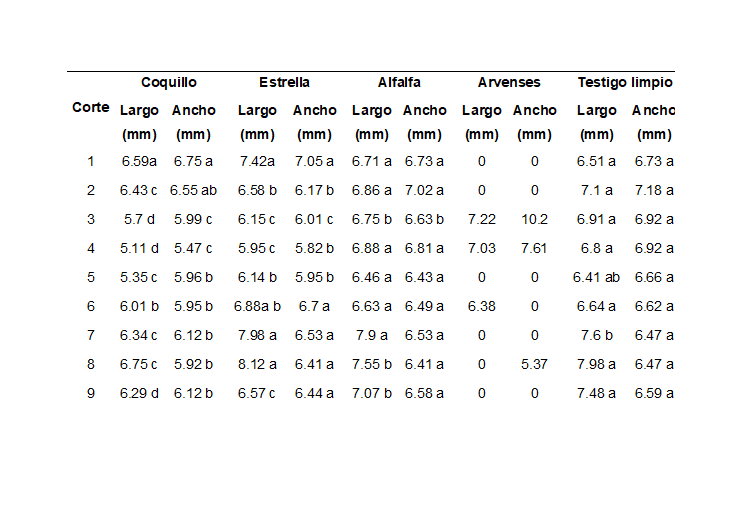
Chiltepín pepper (Capsicum annuum var. glabriusculum) is characterized by being a wild plant appreciated in several regions of Mexico as a condiment and for its intense spiciness. It is a species with small, variable-sized fruits, and as a crop, it can be affected by interference from other undesirable plant species. The research aimed to determine the competitive capacity of weeds on chiltepín fruit yields in terms of weight, number, length, and diameter. A trial was established in 2024 under greenhouse conditions in Tlajomulco de Zúñiga, Jalisco, where the chiltepín pepper crop was maintained with interference from three plant species: Cyperus rotundus (coco-grass), Cynodon nlemfuensis (African bermudagrass), Medicago sativa (cultivated species of alfalfa), emerging weeds and a clean control. The results showed that the treatment with emergent weeds exhibited a total loss of fruit yield (99.97%), followed by C. nlemfuensis, whose greater competitive capacity reduced the yield in weight (88%) and the number of peppers (93%). Treatment with C. rotundus was the one that most affected fruit size, with a 14% reduction in length and a 9.5% reduction in width. Treatment with M. sativa showed interference with fruit weight and number only after the 5th cut, compared with the clean control.
Downloads
References
Abreu, C. E.; Araujo, C. E.; Rodríguez, J. S. L.; Valdivia, A. A. L.; Fuentes, A. L. y Pérez, H. Y. 2018. Efecto de la aplicación combinada de fertilizante químico y humus de lombriz en Capsicum annuum. Centro Agrícola. 45(1):52-61. http://scielo.sld.cu/pdf/cag/v45n1/cag07118.pdf.
Alcalá-Rico, J. S. G. J.; Ramírez-Meraz, M.; Maldonado-Moreno, N.; Borja-Bravo, M.; Camposeco-Montejo, N. y López-Benítez, A. 2023. Variación morfológica en frutos de genotipos de chile piquín (Capsicum annuum var.Glabriusculum) del Noreste y Centro de México. Ecosistemas y Recursos Agropecuarios. 10(2):e3482. Doi:10.19136/era.a10n2.3482.
Araiza-Lizarde, N.; Araiza-Lizarde, E. y Martínez-Martínez, J. G. 2011. Evaluación de la germinación y crecimiento de plántula de chiltepín (Capsicum annuum L. variedad glabriusculum) en invernadero. Revista Colombiana de Biotecnología. 13(2):170-175. http://www.scielo.org.co/scielo.php?script=sci-arttext&pid=S012334752011000200016&lng=en&tlng=es.
Aramendiz-Tatis, H.; Cardona-Ayala, C. y Oro, R. D. 2010. Periodo de interferencia de arvenses en el cultivo de berenjena (Solanum melongena L.). Agronomía Colombiana. 28(1):81-88. http://www.scielo.org.co/scielo.php?script=sci-arttext&pid=S0120-99652010000100010&lng=en&tlng=es.
Ballesta, A. and Lloveras, J. 2010. Nitrogen replacement value of alfalfa to corn and wheat under irrigated mediterranean conditions. Spanish Journal of Agricultural Research. 8(1):159-169. Doi:10.5424/sjar/2010081-1155.
Bañuelos, F. N.; Salido, A. P. L. y Gardea, A. 2008. Etnobotánica del chiltepín: pequeño gran señor en la cultura de los sonorenses. Estudios Sociales (Hermosillo, Sonora). 16(32):177-205. http://www.scielo.org.mx/scielo.php?script=sci-arttext&pid=S0188-45572008000200006&lng=es&tlng=es.
Barboza, G. E.; Carrizo, G. C.; Bem B. L.; Romero, V. M. and Scaldaferro, M. 2022. Monograph of wild and cultivated chili peppers (Capsicum L., Solanaceae). PhytoKeys. 200:1-423. https://doi.org/10.3897/phytokeys.200.71667.
Blanco, V. Y.; Leyva, G. Á. y Castro, L. I. 2014. determinación del período crítico de competencia de arvenses en el cultivo del maíz (Zea mays, L.). Cultivos Tropicales. 35(3):62-69. https://www.redalyc.org/pdf/1932/193232155007.pdf.
Campillo, R. R.; Urquiaga, C. S.; Pino, N. I. y Montenegro, B. A. 2003. Estimación de la fijación biológica de nitrógeno en leguminosas forrajeras mediante la metodología del 15n. Agricultura Técnica. 63(2):169-179. https://dx.doi.org/10.4067/S0365-28072003000200006.
Castellón-Martínez, É.; Chávez-Servia, J. L.; Carrillo-Rodríguez, J. C. y Vera-Guzmán, A. M. 2012. Preferencias de consumo de chiles (Capsicum annuum L.) nativos en los Valles Centrales de Oaxaca, México. Revista Fitotecnia Mexicana. 35(5):27-35. http://www.scielo.org.mx/scielo.php?script=sci-arttext&pid=S018773802012000500007&lng=es&tlng=es.
Esperbent, C. 2015. Malezas: el desafío para el agro que viene. Revista de Investigaciones Agropecuarias. 41(3):235-240. https://www.redalyc.org/articulo.oa?id=86443147004.
Galal, R. M.; Hassanein, A. M. A. and Fedlallah, A. M. 2020. Determination critical periods of weed competition and weed control influence on yield productivity of sweet pepper (Capsicum annuum L.) J. of Plant Production. 11(2):127-137. Doi: 10.21608/jpp.2020.79106.
González-Cortés, N.; Jiménez, V. R.; Guerra, B. E. C.; Silos, E. H. y Payro-Cruz, E. 2015. Germinación del chile Amashito (Capsicum annuum L. Var. Glabriusculum) en el sureste Mexicano. Revista Mexicana de Ciencias Agrícolas. 11(esp):2211-2218. https://doi.org/10.29312/remexca.v0i11.800.
Holm, L. G.; Plucknett, D. L.; Pancho, J. V. and Herberger, J. P. 1977. The world’s worst weeds. John Wiley and Sons, Inc. 609 p.
Latournerie-Moreno, L.; Gutiérrez-Burón, R.; Garruña-Hernández, R.; Ruiz-Sánchez, E.; Lara-Martín, A. R. y Castañón-Nájera, G. 2020. Diversidad fenotípica de chile amashito de Tabasco y Chiapas, México. Revista Mexicana de Ciencias Agrícolas. 11(3):649-62. https://doi.org/10.29312/remexca.v11i3.2087.
López-Muraira, I. G. 2008. Manual de maleza del cultivo del Agave tequilana en Jalisco. Instituto Tecnológico de Tlajomulco y Tequila Sauza, SA de CV. 286 p.
Luna-Ortega, J. G.; Ramos-Hernández, J. A.; Gallegos-Robles, M. A.; Zuñíga-Gracía, D. A.; Márquez-Mendoza, J. I.; García-Carrillo, M. y Gonzalez-Torres, A. 2025. Evaluación del crecimiento y rendimiento de pimiento morrón en dos sitios de producción con fertilizantes orgánicos. Terra Latinoamericana. 43:1-10. https://doi.org/10.28940/terra.v43i.2061.
Márquez-Quiroz, C.; López-Espinosa, S. T.; Cano-Ríos, P. y Moreno-Reséndez, A. 2013. Fertilización orgánica: una alternativa para la producción de chile piquín bajo condiciones protegidas. Revista Chapingo. Serie Horticultura. 19(3):279-286. https://doi.org/10.5154/r.rchsh.2012.12.072.
Martínez Torres, H. L.; Montes Hernández, S.; Corona-Torres, T. y Vibrans, H. L. 2021. Etnobotánica del chile quipín en seis municipios de Querétaro. Chiles en México. In: chiles en México. Historia, culturas y ambientes. Vásquez-Dávila, M. A.; Aguilar-Meléndez, A.; Katz, E. y Manzanero-Medina, G. I. (Coord.) RD Éd. Universidad Veracruzana. 167-181 pp. Doi:10.4000/books.irdeditions.45866.
Megchún-García, J. V.; Rebolledo-Martínez, A.; Angel-Pérez, A. L.; Nataren-Velázquez, J. y Capetillo-Burela, A. 2024. Chile piquín (Capsicum annuum var. Aviculare) establecido en un revestimiento de plástico y arreglos espaciales. Ecosistemas y Recursos Agropecuarios. 11(1):e3984. Doi:10.19136/era.a11n3.3984.
Morales-Payan, J.; Santos, B. M.; Stall, W. M. and Bewick, T. A. 1997. Effects of purple nutsedge (Cyperus rotundus) on tomato (Lycopersicon esculentum) and bell pepper (Capsicum annuum) vegetative growth and fruit yield. Weed Technology. 11(4):672-676. doi:10.1017/S0890037X00043232.
Ramírez, N. U. I.; Cervantes, O. F.; Montes, H. S.; Raya, P. J. C.; Cibrián, J. A. y Andrio, E. E. 2018. Diversidad morfológica del chile piquín (Capsicum annuum L. var. Glabriusculum) de Querétaro y Guanajuato, México. Revista Mexicana de Ciencias Agrícolas. 9(6):1159-72. https://doi.org/10.29312/remexca.v9i6.1581.
Ramírez-Meraz, M.; Villalón-Mendoza, H.; Aguilar-Rincón, V. H.; Corona-Torres, T. y Latournerie-Moreno, L. 2015. Caracterización morfológica de chiles silvestres y semi domesticados de la región huasteca de México. Agroproductividad. 8(1):9-16. https://revista-agroproductividad.org/index.php/agroproductividad/article/view/632.
Rodríguez-Bosque, L. A. 2005. Preferencia del consumidor por el chile piquín en comparación con otros chiles en el noreste de México. Revista Chapingo Serie Horticultura. 11(2):279-281. https://www.redalyc.org/pdf/609/60911214.pdf.
SEMARNAT. 2009. Secretaría de Medio Ambiente y Recursos Naturales. Técnicas para el establecimiento y producción de chiltepín silvestre, bajo un sistema agroforestal en Sonora, México. 41 p. https://www.conafor.gob.mx/biblioteca/tecnicas-chiltepin.pdf.
Silva, A. F.; Ferreira, E. A.; Concenço, G.; Ferreira, F. A.; Aspiazu, I.; Galon, L.; Sediyama, T. and Silva, A. A. 2008. Effect of weed densities and control periods on soybean yield components. Planta Daninha. 26(1):65-71. Doi:10.1590/S0100-83582008000100007.
Silva, D. V.; Freitas, M. A. M.; Silva, G. S.; Souza, M. F.; Silva, A. A.; Ferreira, L. R.; Sediyama, T. and Cecon, P. R. 2015. Growth and yield of maize in purple nutsedge interference. Semina: Ciências Agrárias, Londrina. 36(5):3077-3084. Doi:10.5433/1679-0359.2015v36n5p3077.
Soltani, N.; Dille, J. A.; Burke, I. C.; Everman, W. J.; VanGessel, M. J.; Davis, V. M. and Sikkema, P. H. 2016. Potential corn yield losses from weeds in North America. Weed Technology. 30(4):979-984. Doi:10.1614/WT-D-16-00046.1.
Published
How to Cite
Issue
Section
License
Copyright (c) 2026 Revista Mexicana de Ciencias Agrícolas

This work is licensed under a Creative Commons Attribution-NonCommercial 4.0 International License.
The authors who publish in Revista Mexicana de Ciencias Agrícolas accept the following conditions:
In accordance with copyright laws, Revista Mexicana de Ciencias Agrícolas recognizes and respects the authors’ moral right and ownership of property rights which will be transferred to the journal for dissemination in open access. Invariably, all the authors have to sign a letter of transfer of property rights and of originality of the article to Instituto Nacional de Investigaciones Forestales, Agrícolas y Pecuarias (INIFAP) [National Institute of Forestry, Agricultural and Livestock Research]. The author(s) must pay a fee for the reception of articles before proceeding to editorial review.
All the texts published by Revista Mexicana de Ciencias Agrícolas —with no exception— are distributed under a Creative Commons License Attribution-NonCommercial 4.0 International (CC BY-NC 4.0), which allows third parties to use the publication as long as the work’s authorship and its first publication in this journal are mentioned.
The author(s) can enter into independent and additional contractual agreements for the nonexclusive distribution of the version of the article published in Revista Mexicana de Ciencias Agrícolas (for example include it into an institutional repository or publish it in a book) as long as it is clearly and explicitly indicated that the work was published for the first time in Revista Mexicana de Ciencias Agrícolas.
For all the above, the authors shall send the Letter-transfer of Property Rights for the first publication duly filled in and signed by the author(s). This form must be sent as a PDF file to: revista_atm@yahoo.com.mx; cienciasagricola@inifap.gob.mx; remexca2017@gmail.
This work is licensed under a Creative Commons Attribution-Noncommercial 4.0 International license.