Carbon stored in an agroforestry plot under the Sowing Life Program in Huehuetán
DOI:
https://doi.org/10.29312/remexca.v17i1.3999Keywords:
aboveground biomass, allometric models, climate change, mitigationAbstract
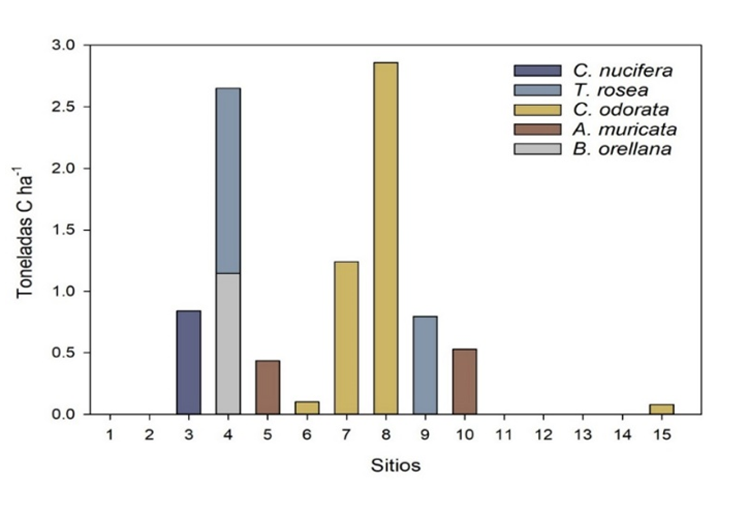
Climate change today constitutes a substantial threat to living beings. Human activities such as the use of fossil fuels, burning, the use of chemicals, and mainly deforestation contribute to the emission of greenhouse gases. In response to this, in Mexico, governmental, national, and environmental programs have been implemented that establish schemes in conjunction with producers in which various social, economic, and environmental benefits are obtained, and whose main objective is to reduce the environmental impact, as is the case with the Sowing Life Program. Agroforestry systems are considered a relevant system to face climate change through the biomass and carbon content of the different plant strata in these agroecosystems. The research estimated the indirect carbon storage in the agroforestry system, with a total of 15 sites measuring 4 x 25 m; the plot is a participant in the Sowing Life Program in the locality of San José El Amate (Huehuetán, Chiapas); once these data have been collected, biomass, carbon, and carbon dioxide were obtained through allometric equations. The agroforestry plot studied has a reserve of 22.6 t ha-1 of aboveground biomass, 8.75 t ha-1 of carbon and 32.14 t ha-1 of carbon dioxide.
Downloads
References
Andrade, H. J.; Figueroa, J. M. y Silva, D. P. 2013. Almacenamiento de carbono en cacaotales (Theobroma cacao) en Armero-Guayabal (Tolima, Colombia). Revista Scientia Agroalimentaria. Ibagué. Universidad del Tolima. http://repository.ut.edu.co/handle/001/1318.
Arias, H. J. J.; Riaño, H. N. M. y Aristizábal, L. M. 2014. Dinámica de la acumulación de materia seca en dos especies de sombrío usadas en cafetales de Colombia. Cenicafé. 65(1):7-17. https://biblioteca.cenicafe.org/bitstream/10778/544/1/arc065%2802%297-17.pdf.
Avellán, A. R.; Barreto, E. D. y Peralta, E. J. 2020. Carbono en biomasa aérea, sistema agroforestal de Theobroma cacao L. laboratorio natural, los laureles 2018. Revista Universitaria del Caribe. 24(01):98-106. Doi:10.5377/ruc.v24i01.9914.
Ávila, G. V.; Jiménez-Otárola, F.; Ibrahim, M. A. y Beer, J. W. 2001. Almacenamiento, fijación de carbono y valoración de servicios ambientales en sistemas agroforestales en Costa Rica. Agroforestería en las Américas (CATIE). 8(30):32-35.
Baca, J. M.; Cuevas-Reyes, V. y Barradas-Miranda, P. 2021. De la dispersión a la centralización de las políticas públicas en el sector rural de México. Nóesis. Revista de Ciencias Sociales. 30(59):4-19. Doi:10.20983/noesis.2021.1.1.
Báez-Bringas, M.; Verdugo-Araujo, L. M. y Tereso-Ramírez, L. 2024. La participación de las mujeres en el programa sembrando vida en la comunidad de Nuevo San Miguel, Ahome, Sinaloa. Comunitaria. Revista internacional de trabajo y ciencias sociales. 28(2):89-109.
Benavides-Solorio, J. D.; Torres-García, O.; Flores-Garnica, J. G.; Acosta-Mireles, M. y Rueda-Sánchez, A. 2021. Ecuaciones alométricas para estimar biomasa y carbono aéreos de Cedrela odorata L. en plantaciones forestales. Revista Mexicana de Ciencias Forestales. 12(65):89-111. Doi:10.29298/rmcf.v12i65.791.
Bermello, Á. D.; Briones-Intriago, L. L. y Vivas, H. T. 2024. Captura de carbono en cacao (Theobroma cacao L.): una estrategia de adaptación al cambio climático. Revista Científica Ciencias Naturales y Ambientales. 18(2):591-598. Doi:10.53591/cna.v18i2.1925.
Casanova-Lugo, F.; Petit-aldama, J. y Soloria-Sánchez, J. 2011. Los sistemas agroforestales como alternativa a la captura de carbono en el trópico mexicano. Revista Chapingo Serie Ciencias Forestales y del Ambiente. 17(1):133-143. Doi:10.5154/r.rchscfa.2010.08.047.
CONAFOR. 2024. Comisión Nacional Forestal. Deforestación bruta a nivel estatal del Sistema Nacional de Monitoreo Forestal. SIAP. Datos Abiertos. https://snmf.cnf.gob.mx/deforestacion/.
Cortez, J. G.; Baca-Moral, J.; Uribe- Gómez, M.; Gómez-Hernández, T. y Valdés-Velarde, E. 2022. La multifuncionalidad de la agricultura como herramienta de análisis de políticas agrarias: el caso del programa sembrando vida en Chahuites, Oaxaca. Acta universitaria. 32:1-18. Doi:10.15174/au.2022.3339.
Danarto, S. A. and Hapsari, L. 2016. Biomass and carbon stock estimation inventory of indonesian bananas (Musa spp.) and its potential role for land rehabilitation. Biotropia The Southeast Asian Journal of Tropical Biology. 22(2):102-108. Doi:10.11598/btb.2015.22.2.376.
Elías, M. y Potvin, C. 2003. Assessing inter-and intra-specific variation in trunk carbon concentration for 32 Neotropical tree species. Canadian Journal of Forest Research. 33(6):1039-1045.
Espinoza-Domínguez, W.; Krishnamurthy, L. R.; Vásquez-Alarcón, A. y Torres-Rivera, A. 2012. Almacén de carbono en sistemas agroforestales con café. Revista Chapingo Serie Ciencias Forestales y del Ambiente. 18(1):57-70. Doi:10.5154/r.rchscfa.2011.04.030.
Fernández, L. J. y Mora, A. X. 2016. Diseño de un modelo de valoración económica para sistemas agroforestales basados en cacao y laurel de la región Caribe de Costa Rica. Universidad Earth, Provincia Limón, Costa Rica. 79 p. Frangí, J. L. and Lugo, A. E. 1985. Ecosystem dynamics of a subtropical floodplain forest. Ecological Monographs. 55(3):351-369. Doi:10.2307/1942582.
Ganeshamurthy, A. N. 2023. Potencial anual de captura de carbono en huertos bananeros de la India. Biotropia. 30(3):374-383. Doi:10.11598/btb.2023.30.3.2005.
González-Abrego, D. O.; Rojo-Gómez, E. G.; Ochoa-Garfias, Á. F. y Trejo-Bautista, R. 2023. Captura, almacenamiento y conversión de CO2: nuevas técnicas de reducción. Pädi boletín científico de ciencias básicas e Ingenierías del ICBI. 11(22):20-27. https://repository.uaeh.edu.mx/revistas/index.php/icbi/article/view/11056.
Hamburg, S. P. 2000. Simple rules for measuring changes in carbon ecosystem in forestry-offset projects. Mitigation and adaptation strategies for global change. 5(1):25-37.
Hernández-Núñez, H. E.; Andrade, H. J.; Suárez, S. J. C.; Gutiérrez, G. G. A.; Trujillo, T. E. y Casanoves, B. F. 2021. Almacenamiento de carbono en sistemas agroforestales en los Llanos Orientales de Colombia. Revista de Biología Tropical. 69(1):352-368.
INECC. 2021. Instituto Nacional de Ecología y Cambio Climático. Potencial de mitigación para el programa sembrando vida: nota técnica. Gobierno de México. https://www.gob.mx/inecc/articulos/potencialdemitigacionparaelprogramasembrandovidanotatecnica.
IPCC. 2003. Intergovernmental Panel on Climate Change. Good practice guidance for Land Use, Special Report: Land-Use Change and Forestry. SNT. 590 p.
Kruskal, W. H. and Wallis, W. A. 1952. Use of ranks in one criterion variance analysis. Journal of the American Statistical Association. 47(260):583-621.
Mendizábal-Hernández, L. C.; Alba-Landa, J.; Márquez-Ramírez, J.; Cruz-Jiménez, H. y Ramírez-García, E. O. 2019. Captura de carbono por Cedrela Odorata L. en una prueba genética. Revista Mexicana de Ciencias Forestales. 2(4):107-114. Doi:10.29298/rmcf.v2i4.612.
Morán-Villa, V. L.; Monterroso, R. A. I.; Mata-González, R.; Marquez, B. S. R.; Abdallah, M.; Valdés, V. E. y Hernández, S. R. 2024. Estimación de la biomasa aérea mediante el desarrollo de ecuaciones alométricas para Theobroma cacao en Tabasco, México. Agroforestry Systems. 98(3):537-549. Doi: 10.1007/s10457-023-00928-x.
Nogueira, E. M.; Fearnside, P. M.; Nelson, B. W.; Barbosa, R. I. and Keizer, E. W. H. 2008. Estimates of forest biomass in the Brazilian Amazon: new allometric equations and adjustments to biomass from wood-volume inventories. Forest Ecology and Management. 256(11):1853-1867. Doi:10.1016/j.foreco.2008.07.022.
Ortiz, Á.; Riascos, L. y Somarriba, E. 2008. Almacenamiento y tasas de fijación de biomasa y carbono en sistemas agroforestales de cacao (Theobroma cacao) y laurel (Cordia alliodora). Agroforestería en las Américas. 46:26-29. https://repositorio.catie.ac.cr/bitstream/handle/11554/5764/Almacenamientoytasasdefijaciondebiomasa.pdf?sequence=1&isAllowed=y.
Pocomucha, V. S.; Alegre, O. J. y Abregú, T. L. 2016. Análisis socio económico y carbono almacenado en sistemas agroforestales de cacao (Theobroma cacao L.) en Huánuco. Ecología Aplicada. 15(2):107-114. Doi:10.21704/rea.v15i2.750.
Podong, C.; Khamfong, K.; Noinamsai, S. and Mhon-ing, S. 2023. Carbon sequestration in agrosilviculture agroforestry systems: preliminary results from three villages in Uttaradit Province, Northern Thailand. The Southeast Asian Journal of Tropical Biology. 31(2):134-145. Doi:10.11598/btb.2024.31.2.1741.
R Core Team. 2023. R: a language and environment for statistical computing. R foundation for statistical computing. Vienna, Austria. https://www.Rproject.org/.
Sáenz-Reyes, J.; Rueda-Sánchez, A.; Benavides-Solorio, J. D. D.; Muñoz-Flores, H. J.; Castillo-Quiroz, D. y Sáenz-Ceja, J. E. 2021. Ecuaciones alométricas, biomasa y carbono en plantaciones forestales tropicales en la costa de Jalisco. Revista Mexicana de Ciencias Forestales. 12(65):26-44. Doi:10.29298/rmcf.v12i65.856.
Shapiro, S. S. and Wilk, M. B. 1965. An analysis of variance test for normality. Biometrika. 52(3-4):591-611.
Tapia-Alba, J. A. y Chiatchoua, C. 2025. Contribución del programa sembrando vida en la reducción de la pobreza en México. Investigación y Ciencia de la Universidad Autónoma de Aguascalientes. 33(94):1-22. Doi:10.33064/iycuaa2025945054.
Zavala, S. J. W.; Zavala, G. S. L. y Mansilla, M. L. G. 2018. Estimación de la biomasa y carbono almacenado en un sistema agroforestal del cafetal de la Universidad Nacional Agraria de la Selva. Revista de Investigación y Amazonia. 8(5):1-8.
Published
How to Cite
Issue
Section
License
Copyright (c) 2026 Revista Mexicana de Ciencias Agrícolas

This work is licensed under a Creative Commons Attribution-NonCommercial 4.0 International License.
The authors who publish in Revista Mexicana de Ciencias Agrícolas accept the following conditions:
In accordance with copyright laws, Revista Mexicana de Ciencias Agrícolas recognizes and respects the authors’ moral right and ownership of property rights which will be transferred to the journal for dissemination in open access. Invariably, all the authors have to sign a letter of transfer of property rights and of originality of the article to Instituto Nacional de Investigaciones Forestales, Agrícolas y Pecuarias (INIFAP) [National Institute of Forestry, Agricultural and Livestock Research]. The author(s) must pay a fee for the reception of articles before proceeding to editorial review.
All the texts published by Revista Mexicana de Ciencias Agrícolas —with no exception— are distributed under a Creative Commons License Attribution-NonCommercial 4.0 International (CC BY-NC 4.0), which allows third parties to use the publication as long as the work’s authorship and its first publication in this journal are mentioned.
The author(s) can enter into independent and additional contractual agreements for the nonexclusive distribution of the version of the article published in Revista Mexicana de Ciencias Agrícolas (for example include it into an institutional repository or publish it in a book) as long as it is clearly and explicitly indicated that the work was published for the first time in Revista Mexicana de Ciencias Agrícolas.
For all the above, the authors shall send the Letter-transfer of Property Rights for the first publication duly filled in and signed by the author(s). This form must be sent as a PDF file to: revista_atm@yahoo.com.mx; cienciasagricola@inifap.gob.mx; remexca2017@gmail.
This work is licensed under a Creative Commons Attribution-Noncommercial 4.0 International license.