Antifungal activity of native isolates of Trichoderma spp. against phytopathogens
DOI:
https://doi.org/10.29312/remexca.v17i1.3987Keywords:
antagonism, growth area, mycoparasitism, inhibition, pathogens, TrichodermaAbstract
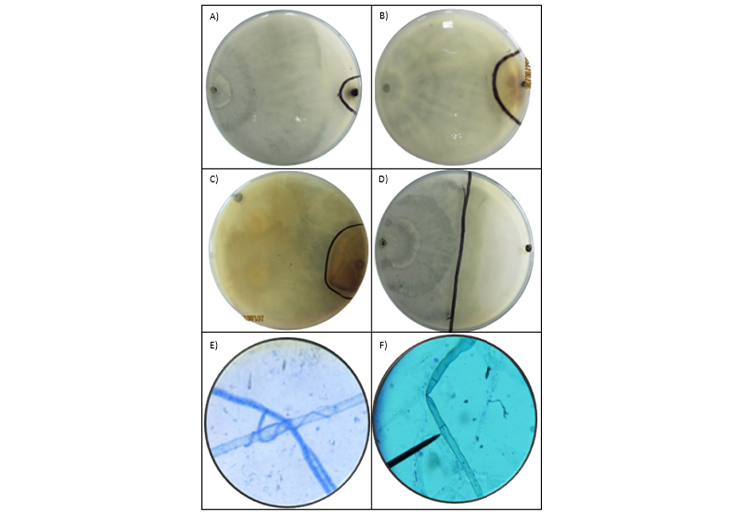
Diseases represent one of the primary causes of loss in agricultural production. Although chemicals are a common alternative for controlling them, they generate adverse effects on human health and the environment. Therefore, sustainable options are required, such as the use of soil microorganisms with biocontrol activity, such as Trichoderma, a fungus that has multiple mechanisms of action against phytopathogens, stimulates the soil microbiota, improves nutrient absorption, and activates plant defense mechanisms. This research aimed to evaluate the antagonism of eleven native Trichoderma species against Botrytis cinerea, Fusarium oxysporum, Rhizoctonia solani and Sclerotinia sclerotiorum using the percentage of radial growth inhibition, the percentage of growth area, the degree of antagonism, and the presence of mycoparasitism. Dual confrontation was performed under in vitro conditions in the phytopathology laboratory of the Faculty of Agricultural Sciences of the Autonomous University of the State of Mexico. The isolates Trichoderma atroviride TH3 and T. asperellum Th11 stood out for their inhibition capacity, reduction of pathogenic growth, high degree of antagonism, and mycoparasitism. The degree of antagonism was assessed with coverage of up to two-thirds of the growth area over the pathogen. Rhizoctonia solani showed the lowest percentage of growth area and was the main target of mycoparasitism. The results suggest that Trichoderma species have potential for use in sustainable agricultural practices.
Downloads
References
Allende-Molar, R.; Báez-Parra, K.; Salazar-Villa, E. and Rojo-Báez, I. 2022. Biodiversity of Trichoderma spp. in Mexico and its potential use in agriculture. Tropical and Subtropical Agroecosystems. 25(3):e4297. https://doi.org/10.56369/tsaes.4297.
Amerio, N. S.; Castrillo, M. L.; Bich, G. A.; Zapata, P. D. y Villalba, L. L. 2020. Trichoderma en la Argentina: estado del arte. Ecología Austral. 30(1):113-124. https://doi.org/10.25260/EA.20.30.1.0.945.
Andrade-Hoyos, P.; Luna-Cruz, A.; Osorio-Hernández, E.; Molina-Gayosso, E.; Landeros-Valenzuela, N. y Barrales-Cureño, H. J. 2019. Antagonismo de Trichoderma spp. vs hongos asociados a la marchitez de chile. Revista Mexicana de Ciencias Agrícolas. 10(6):1259-1272. https://doi.org/10.29312/remexca.v10i6.1326.
Andrade-Hoyos, P.; Rivera-Jiménez, M. N.; Landeros-Valenzuela, N.; Silva-Rojas, H. V.; Martínez-Salgado, S. J. y Romero-Arenas, O. 2023. Beneficios ecológicos y biológicos del hongo cosmopolita Trichoderma spp. en la agricultura: una perspectiva en el campo mexicano. Revista Argentina de Microbiología. 55(4):366-377. https://doi.org/10.1016/j.ram.2023.06.005.
Bell, D. K.; Wells, H. D. and Markham, C. R. 1982. In vitro antagonism of Trichoderma species against six fungal plant pathogens. Phytopathology. 72(4):379-382.
Camacho-Luna, V.; Flores-Moctezuma, H. E.; Rodríguez-Monroy, M.; Montes-Belmont, R. y Sepúlveda-Jiménez, G. 2021. Inducción de la respuesta de defensa de plantas de cebolla en la interacción con Trichoderma asperellum y Alternaria porri. Revista Mexicana de Ciencias Agrícolas. 12(4):685-698.
Companioni, G. B.; Domínguez, A. G. y García, V. R. 2019. Trichoderma: su potencial en el desarrollo sostenible de la agricultura. Biotecnología Vegetal. 19(4):237-248.
Corrales, R. L. C. y Caycedo, L. L. 2020. Principios fisicoquímicos de los colorantes en microbiología. Nova. 18(33):73-100. https://doi.org/10.22490/24629448.3701.
Cortés-Hernández, F. C.; Alvarado-Castillo, G. y Sánchez-Viveros, G. 2023. Trichoderma spp., una alternativa para la agricultura sostenible: una revisión. Revista Colombiana de Biotecnología. 25(2):73-87. https://doi.org/10.15446/rev.colomb.biote.v25n2.111384.
Dennis, C. and Webster, J. 1971. Antagonistic properties of species-groups of Trichoderma. I. Production of non-volatile antibiotics. Transactions of the British Mycological Society. 57(1):25-39. https://doi.org/10.1016/s00071536(71)80077-3.
Di Rienzo, J. A.; Casanoves, F.; Balzarini, M. G.; González, L.; Tablada, M. y Robledo, C. W. 2020. InfoStat versión 2020. Universidad Nacional de Córdoba. (Software). http://www.infostat.com.ar.
Ezziyyani, M.; Pérez-Sánchez, C.; Requena, M. E.; Rubio, L. y Candela, M. E. 2004. Biocontrol por Streptomyces rochei-ziyani, de la podredumbre del pimiento (Capsicum annuum L.) causada por Phytophthora capsici. Anales de Biología. 26:69-78. https://revistas.um.es/analesbio/article/view/30471.
Fernández, M. B.; Almenares, C. M.; Aguado, M. E.; Díaz, O. A. y Hernández-Rodríguez, A. 2022. Actividad micoparasítica en la interacción Trichoderma spp. -Fusarium oxysporum f. sp. ciceris. Revista Cubana de Ciencia Biológicas. 10(2):1-7.
Geng, L.; Fu, Y.; Peng, X.; Yang, Z.; Zhang, M.; Song, Z.; Guo, N.; Chen, S.; Chen, J.; Bai, B.; Liu, A. and Ahammed, G. J. 2022. Biocontrol potential of Trichoderma harzianum against Botrytis cinerea in tomato plants. Biological Control. 174:105019. https://doi.org/10.1016/j.biocontrol.2022.105019.
Gutiérrez-Ramírez, A.; Robles-Bermúdez, A.; Santillán-Ortega, C.; Ortiz-Catón, M. y Cambero-Campos, O. J. 2013. Control biológico como herramienta sustentable en el manejo de plagas y su uso en el estado de Nayarit, México. Revista Bio Ciencias. 2(3):102-112.
Hernández-Melchor, D. J.; Ferrera-Cerrato, R. y Alarcón, A. 2019. Trichoderma: Importancia agrícola, biotecnología y sistemas de fermentación para producir biomasa y enzimas de interés industrial. Chilean Journal of Agricultural & Animal Sciences. 35(1):98-112. https://doi.org/10.4067/S0719-38902019005000205.
Khroshko, A. 2020. The research of possibilities and application of the AutoCAD software package for creating electronic versions of textbooks for ‘engineering and computer graphics’ course. TEM Journal. 9(3):1141-1149. https://doi.org/10.18421/TEM93-40.
Martínez-Canto, O. J.; Cristóbal-Alejo, J.; Tun-Suárez, J. M. y Reyes-Ramírez, A. 2021. Detección de genes Epl1 y Sm1 en Trichoderma spp. antagonistas contra hongos fitopatógenos. Ecosistemas y Recursos Agropecuarios. 8(2):e2791.
Martínez-Martínez, T. O.; Guerrero-Aguilar, B. Z.; Pecina-Quintero, V.; Rivas-Valencia, P.; González-Pérez, E. y Ángeles-Núñez, J. G. 2020. Antagonismo de Trichoderma harzianum contra la fusariosis del garbanzo y su efecto biofertilizante. Revista Mexicana de Ciencias Agrícolas. 11(5):1135-1147.
Matas-Baca, M. A.; Flores-Córdova, M. A.; Pérez-Álvarez, S.; Rodríguez-Roque, M. J.; Salas-Salazar, N. A.; Soto-Caballero, M. C. and Sánchez-Chávez, E. 2023. Trichoderma fungi as an agricultural biological control in México. Revista Chapingo. Serie Horticultura. 29(3):79-114. https://doi.org/10.5154/r.rchsh.2022.11.015.
Montes-Vergara, D.; Barboza-García, A. and Pérez-Cordero, A. 2022. Antifungal and growth activity of strains of Trichoderma spp. against the avocado tristeza disease, Phytophthora cinnamomi. Egyptian Journal of Biological Pest Control. 32:115. https://doi.org/10.1186/s41938-022-00613-8.
Pérez, A. A.; Pérez, M. A.; Martínez-Coca, B.; Rollhaiser, I. N. and Blengini, M. C. 2020. Selection of Trichoderma spp. isolates in vitro as potential biofungicides for the control of Rhizoctonia solani Kühn on potato. Agroscientia. 37(2):21-33.
Rodríguez, I. C. and Flores, J. 2018. Capacidad antagónica in vitro de Trichoderma spp. frente a Rhizoctonia solani Kuhn y Fusarium verticillioides Neirenberg. Bioagro, 30(1):49-58.
Sallam, N. M. A.; Eraky, A. M. I. and Sallam, A. 2019. Effect of Trichoderma spp. on Fusarium wilt disease of tomato. Molecular Biology Reports. 46(4):4463-4470. https://doi.org/10.1007/s11033-019-04901-9.
Savary, S.; Willocquet, L.; Pethybridge, S. J.; Esker, P.; McRoberts, N. and Nelson, A. 2019. The global burden of pathogens and pests on major food crops. Nature Ecology & Evolution. 3(3):430-439. https://doi.org/10.1038/s41559-018-0793-y.
Silva, L. G.; Camargo, R. C.; Mascarin, G. M.; Oliveira-Nunes, P. S. O.; Dunlap, C. and Bettiol, W. 2022. Dual functionality of Trichoderma: biocontrol of Sclerotinia sclerotiorum and biostimulant of cotton plants. Frontiers in Plant Science. 13:983127. https://doi.org/10.3389/fpls.2022.983127.
Skendžić, S.; Zovko, M.; Živković, I. P.; Lešić, V. and Lemić, D. 2021. The impact of climate change on agricultural insect pests. Insects. 12(5):440. https://doi.org/10.3390/insects12050440.
Sood, M.; Kapoor, D.; Kumar, V.; Sheteiwy, M. S.; Ramakrishnan, M.; Landi, M.; Araniti, F. and Sharma, A. 2020. Trichoderma: the ‘secrets’ of a multitalented biocontrol agent. Plants. 9(6):762. https://doi.org/10.3390/plants9060762.
Tyśkiewicz, R.; Nowak, A.; Ozimek, E. and Jaroszuk-Ściseł, J. 2022. Trichoderma: the current status of its application in agriculture for the biocontrol of fungal phytopathogens and stimulation of plant growth. International Journal of Molecular Sciences. 23(4):2329. https://doi.org/10.3390/ijms23042329.
Viera-Arroyo, W. F.; Tello-Torres, C. M.; Martínez-Salinas, A. A.; Navia-Santillán, D. F.; Medina-Rivera, L. A.; Delgado-Párraga, A. G.; Perdomo-Quispe, C. E.; Pincay-Verdezoto, A. K.; Báez-Cevallos, F. J.; Vásquez-Castillo, W. A. y Jackson, T. 2020. Control biológico: una herramienta para una agricultura sustentable, un punto de vista de sus beneficios en Ecuador. Journal of the Selva Andina Biosphere. 8(2):128-149. https://doi.org/10.36610/j.jsab.2020.080200128.
Vinchira-Villarraga, D. M. y Moreno-Sarmiento, N. 2019. Control biológico: camino a la agricultura moderna. Revista Colombiana de Biotecnología. 21(1):2-5. https://doi.org/10.15446/rev.colomb.biote.v21n1.80860.
Published
How to Cite
Issue
Section
License
Copyright (c) 2026 Revista Mexicana de Ciencias Agrícolas

This work is licensed under a Creative Commons Attribution-NonCommercial 4.0 International License.
The authors who publish in Revista Mexicana de Ciencias Agrícolas accept the following conditions:
In accordance with copyright laws, Revista Mexicana de Ciencias Agrícolas recognizes and respects the authors’ moral right and ownership of property rights which will be transferred to the journal for dissemination in open access. Invariably, all the authors have to sign a letter of transfer of property rights and of originality of the article to Instituto Nacional de Investigaciones Forestales, Agrícolas y Pecuarias (INIFAP) [National Institute of Forestry, Agricultural and Livestock Research]. The author(s) must pay a fee for the reception of articles before proceeding to editorial review.
All the texts published by Revista Mexicana de Ciencias Agrícolas —with no exception— are distributed under a Creative Commons License Attribution-NonCommercial 4.0 International (CC BY-NC 4.0), which allows third parties to use the publication as long as the work’s authorship and its first publication in this journal are mentioned.
The author(s) can enter into independent and additional contractual agreements for the nonexclusive distribution of the version of the article published in Revista Mexicana de Ciencias Agrícolas (for example include it into an institutional repository or publish it in a book) as long as it is clearly and explicitly indicated that the work was published for the first time in Revista Mexicana de Ciencias Agrícolas.
For all the above, the authors shall send the Letter-transfer of Property Rights for the first publication duly filled in and signed by the author(s). This form must be sent as a PDF file to: revista_atm@yahoo.com.mx; cienciasagricola@inifap.gob.mx; remexca2017@gmail.
This work is licensed under a Creative Commons Attribution-Noncommercial 4.0 International license.