Evaluation of water stress in strawberry crops under a humid climate
DOI:
https://doi.org/10.29312/remexca.v17i1.3971Keywords:
efficient irrigation, evapotranspiration, soluble solids, water efficiencyAbstract
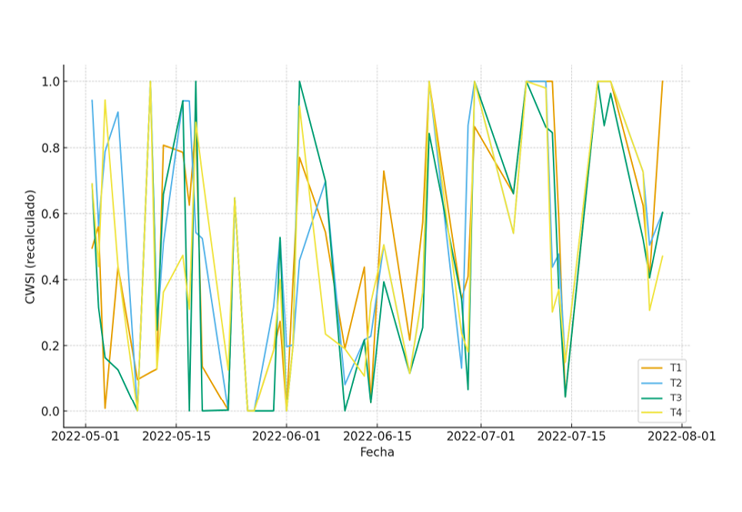
Strawberries (Fragaria x ananassa Duch.) are a crop of high commercial value whose productivity depends on efficient irrigation management, given their sensitivity to water deficits. In humid regions, high relative humidity reduces evaporative demand and limits the effectiveness of indicators based on leaf temperature, such as the crop water stress index (CWSI). This research aimed to evaluate the usefulness of the crop water stress index as a criterion for managing strawberry irrigation under humid climate conditions. The study was conducted in 2022 in a greenhouse of the Faculty of Agricultural and Livestock Sciences of the Meritorious Autonomous University of Puebla, Teziutlán, Puebla. Four irrigation treatments (100, 90, 80 and 70% of reference evapotranspiration, ETc) were established in a completely randomized design with four replications. Morphological and quality variables (number of flowers, number of fruits, polar and equatorial diameters, and total soluble solids) were recorded, and the crop water stress index was monitored throughout the cycle. The results showed that 80% ETc treatment maintained a yield similar to that of the 100% treatment, indicating potential water savings without affecting production. However, fruits with full irrigation reached a higher content of total soluble solids, whereas deficit treatments generated larger fruits but with lower sweetness, reflecting a trade-off between yield and quality. The crop water stress index registered low (0.3-0.55) and homogeneous values across treatments, confirming that, in humid climates, it is not a single reliable indicator and must be complemented with other physiological and productive variables.
Downloads
References
Baronti, S.; Orlandini, S.; Caruso, G. and Fontana, G. 2019. Water saving in strawberry cultivation through rational irrigation scheduling. Agricultural Water Management. 183(31):194-201. https://doi.org/10.1016/j.agwat.2018.10.016.
FAO. 2021. Food and Agriculture Organization of the United Nations. The state of the world’s land and water resources for food and agriculture. Systems at breaking point.
Ferreyra, E. R.; Sellés, V. G.; Peralta, A. J.; Burgos, R. L. y Valenzuela, B. J. 2002. Efectos de la restricción del riego en distintos períodos de desarrollo de la vid cv. Cabernet Sauvignon sobre producción y calidad del vino. Agricultura Técnica. 62(3):406-417.
García, A. E. 2004. Modificaciones al sistema de clasificación climática de Köppen. 5ta. edición. Instituto de Geografía-Universidad Nacional Autónoma de México (UNAM). 47-74 pp.
Giuliani, R.; Magnanini E. and Flore, J. A. 2001. Potential use of infrared thermometry for the detection of water deficit in apple and peach orchards. Acta Horticulturae. 557:38-43.
González-Dugo, V.; Moran, M. S.; Mateos, L. A. and Bryant, R. E. 2006. Canopy temperature variability is an indicator of crop water stress severity. Irrigation Science. 24(4):233-240. https://doi.org/10.1007/s00271-005-0022-8.
Gutiérrez-Colín, M.; Rodríguez, J. A.; Moreno-Pérez, M. y Peña-Sánchez, M. 2017. Respuesta de plantas de fresa a diferentes tensiones hídricas. Revista Chapingo Serie Horticultura. 23(2):93-103. https://doi.org/10.5154/r.rchsh.2016.10.030.
Idso, S. B.; Jackson, R. D.; Pinter, P. J.; Reginato, R. J. and Hatfield, J. L. 1982. Normalizing the stress-degree-day parameter for environmental variability. Agricultural Meteorology. 27:81-89. https://doi.org/10.1016/0002-1571(81)90032-7.
Jackson, R. D.; Idso, S. B.; Reginato, R. J. and Pinter, P. J. 1981. Canopy temperature as a crop water stress indicator. Water Resources Research. 17(4):1133-1138.
Jones, H. G. 2004. Irrigation scheduling: advantages and pitfalls of plant-based methods. Journal of Experimental Botany. 55(407):2427-2436.
Katimbo, X. A.; Rudnick, D. R.; DeJonge, K. C.; Lo, T. H.; Qiao, X.; Franz, T. E.; Nakabuye, H. N. y Duan, J. 2022. Crop water stress index computation approaches and their sensitivity under different water stress conditions. Agricultural Water Management. 267:1-16. https://doi.org/10.1016/j.agwat.2022.107676.
Kruskal, W. H. and Wallis, W. A. 1952. Use of ranks in one criterion variance analysis. Journal of the American Statistical Association. 47(260):583-621. https://doi.org/10.1080/01621459.1952.10483441.
Liotta, M. A.; Carrión, R. A.; Ciancaglini, N. y Olguín-Pringles, A. 2015. Riego por goteo. PROSAP-INTA. 1ra edición. Buenos Aires, Argentina. 150 p.
Liu, L.; Gao, W.; Ren, C.; Cheng, G.; Zhou, Y.; Huang, H. y Zhang, J. 2022. Applicability of the crop water stress index based on different computation approaches. Agricultural and Forest Meteorology, 327(1):1-12. https://doi.org/10.1016/j.agrformet.2022.109046.
López, R. L.; Ramírez, R. A.; Peña, M. A. V.; Cruz, I. L. y Cohen, I. S. 2009. Índice de estrés hídrico como un indicador del momento de riego en cultivos agrícolas. Agricultura Técnica en México. 35(1):92-106.
Mertens, S.; Verbraeken, L.; Sprenger, H.; De Meyer, S.; Demuynck, K.; Cannoot, B.; Merchie, J.; De Block, J.; Vogel, J. T.; Bruce, W.; Nelissen, H.; Maere, S.; Inzé, D. and Wuyts, N. 2023. Monitoring drought stress and transpiration rate using proximal thermal and hyperspectral imaging in an indoor automated plant phenotyping platform. Plant Methods. 19(1):1-25. https://doi.org/10.3390/plants12203536.
Monteith, J. L. and Unsworth, M. H. 2013. Principles of environmental physics 4th ed. Academic Press. 217-247 pp.
Parkash, V. and Singh, S. S. 2020. A review on potential plant-based water stress indicators for vegetable crops. Sustainability. 12(10):1-28.
Pires, M. R.; Folegatti, M. V.; Passos, F. A.; Arruda, F. B. and Sakai, E. 2006. Vegetative growth and yield of strawberry under irrigation and soil mulches for different cultivation environments. Scientia Agricola. 63(5):417-425.
Rousseeuw, P. J. and Hubert, M. 2011. Robust statistics for outlier detection. Wiley interdisciplinary reviews: data mining and knowledge discovery. 1(1):73-79. https://doi.org/10.1002/widm.2.
Wilcox, R. R. 2012. Introduction to robust estimation and hypothesis testing 3rd Edition. Academic Press. 29-38 pp.
Published
How to Cite
Issue
Section
License
Copyright (c) 2026 Revista Mexicana de Ciencias Agrícolas

This work is licensed under a Creative Commons Attribution-NonCommercial 4.0 International License.
The authors who publish in Revista Mexicana de Ciencias Agrícolas accept the following conditions:
In accordance with copyright laws, Revista Mexicana de Ciencias Agrícolas recognizes and respects the authors’ moral right and ownership of property rights which will be transferred to the journal for dissemination in open access. Invariably, all the authors have to sign a letter of transfer of property rights and of originality of the article to Instituto Nacional de Investigaciones Forestales, Agrícolas y Pecuarias (INIFAP) [National Institute of Forestry, Agricultural and Livestock Research]. The author(s) must pay a fee for the reception of articles before proceeding to editorial review.
All the texts published by Revista Mexicana de Ciencias Agrícolas —with no exception— are distributed under a Creative Commons License Attribution-NonCommercial 4.0 International (CC BY-NC 4.0), which allows third parties to use the publication as long as the work’s authorship and its first publication in this journal are mentioned.
The author(s) can enter into independent and additional contractual agreements for the nonexclusive distribution of the version of the article published in Revista Mexicana de Ciencias Agrícolas (for example include it into an institutional repository or publish it in a book) as long as it is clearly and explicitly indicated that the work was published for the first time in Revista Mexicana de Ciencias Agrícolas.
For all the above, the authors shall send the Letter-transfer of Property Rights for the first publication duly filled in and signed by the author(s). This form must be sent as a PDF file to: revista_atm@yahoo.com.mx; cienciasagricola@inifap.gob.mx; remexca2017@gmail.
This work is licensed under a Creative Commons Attribution-Noncommercial 4.0 International license.