Population structure of Agave gentryi B. Ullrich in southern Nuevo León
DOI:
https://doi.org/10.29312/remexca.v17i1.3950Keywords:
Agave, sustainable, use, mezcal, non-timberAbstract
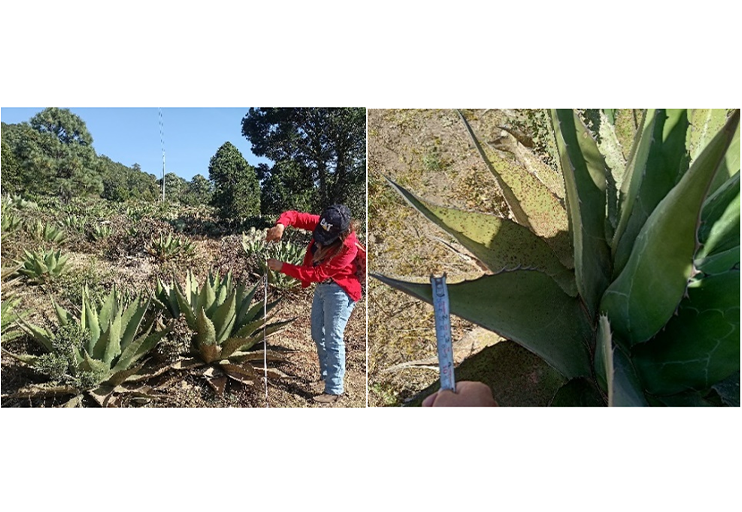
Agave has great economic demand in Nuevo León; of the 14 species reported, Agave gentryi B. Ulrich has the highest rate of utilization for distillation of individuals in juvenile stages and in harvesting, so based on the hypothesis that the population of these stages has decreased, the objective of the research was to evaluate the population structure of the phenological stages of this species. The study area was located in the Ejido La Canoa, municipality of Aramberri. Sampling was carried out twice a year at two sampling sites: the first in a harvesting area and the second in an area excluded from harvesting. A total of 10 quadrats 64 m2 were established, from which the individuals were counted, classified into phenological stages, and morphometrically evaluated. The data follow a normal distribution, so a factor analysis and a Tukey test were performed. The results indicate a total of 3 687 and 6 156 individuals per ha for the sites under harvesting and without harvesting, respectively; there is a highly significant difference in quadrat coverage (F= 4.3, p≤ 0.01). In the non-harvested sites, the phenological stage corresponding to juvenile stage one registered the highest relative abundance with 36%, the adult stage presents relative dominance of 33.42%, and the juvenile stage two exhibits an importance value index of 50.48%; in contrast, in the harvested sites, the highest values correspond to the adult stage, relative abundance of 31.82%, relative dominance of 51.4%, and importance value index of 54.41%; a high demand was found in juvenile phenological stages one and three.
Downloads
References
Aguirre-Dugua, X. and Eguiarte, L. E. 2013. Genetic diversity, conservation and sustainable use of wild Agave cupreata and Agave potatorum extracted for mezcal production in Mexico. Journal of Arid Environments. 90(1):36-44.
Alfaro, R. G.; Legaría, J. P. S. and Rodríguez, J. E. P. 2007. Genetic diversity in populations of pulquero Agaves (Agave spp.) in Northeastern México State. Revista Fitotecnia Mexicana. 30(1):1-12. https://doi.org/10.35196/rfm.2007.1.1.
Álvarez-Ríos, G. D.; Figueredo-Urbina, C. J. and Casas, A. 2020. Sistemas de manejo de maguey pulquero en México. Etnobiología. 18(2):3-23. ISSNe 2448-8151; ISSN 1665-2703 https://www.researchgate.net/.
APG. 2009. The Angiosperm Phylogeny Group. An update of the angiosperm phylogeny group classification for the orders and families of flowering plants: APG. Botanical Journal of the Linnean Society. 161(1):122-127.
APG. 2016. The Angiosperm Phylogeny Group. An update of the angiosperm phylogeny group classification for the orders and families of flowering plants: APG. Botanical Journal of the Linnean Society. 181(1):1-20. http://doi.org/10.11/boj.12385.
Castillo-Hernández, H. and Treviño-Carreón, J. 2009. Biología floral de Agave gentryi Ullrich (Agavaceae) en la localidad de la Marcela, Miquihuana, Tamaulipas. CienciaUAT. 4(2):62-66.
Cervera, H. J.; Leirana, J. C. A. and Navarro, J. A. A. 2018. Environmental Factors Associated wWith The Cover of Agave angustifolia (Asparagaceae) In the coastal scrubland of Yucatan, Mexico. Acta Botánica Mexicana. 124(1):1-20. Doi: https://doi. org/10.21829/abm124. 2018.1252.
García-Mendoza, A. J.; Franco-Martínez, I. S. and Sandoval-Gutiérrez, D. 2019. Cuatro especies nuevas de Agave (Asparagaceae, Agavoideae) del sur de México. Acta botánica mexicana. 1(126):10-15. https://doi.org/10.21829/abm126.2019.1461.
Gentry, H. S. 2004. Agaves of Continental North America. University of Arizona Press. Tucson, Arizona. USA. 670-840.
Hernández-Castro, E.; López-Sandoval, Y. Y.; Escobar-Álvarez, J. L.; Ramírez-Reynoso, O.; Maldonado-Peralta, M. D. L. A y Valenzuela-Lagarda, J. L. 2021. Análisis morfométrico de semilla y desarrollo de plántulas de maguey sacatoro (Agave angustifolia Haw.). Ecosistemas y recursos agropecuarios. 8(3):1-20. https://doi.org/10.19136/era.a8n3.2964.
Huerta-Zavala, J. 2018. Variación morfológica y áreas potenciales de poblaciones del complejo Agave angustifolia en el Estado de Guerrero. Tesis de Maestría. Universidad Autónoma de Guerrero. Iguala, Guerrero, México. 20-54 pp.
INEGI. 2019. Instituto Nacional de Estadística y Geografía. Anuario estadístico y geográfico. México.
Lara-Ávila, J. P. y Alpuche-Solís, Á. G. 2016. Análisis de la diversidad genética de agaves mezcaleros del centro de México. Revista Fitotecnia Mexicana. 39(3):323-330. https://doi.org/10.35196/rfm.2016.3.323-330.
Loera-Gallegos, H. M.; Corral-Rivas, J. J.; Montiel-Antuna, E.; Solis-Moreno, R.; Chávez-Simental, J. A. y González-Cervantes, G. 2018. Calidad de sitio para Agave durangensis Gentry en la Sierra de Registrillo, Durango. Revista Mexicana de Ciencias Agrícolas. 9(6):1171-1180. https://doi.org/10.29312/remexca.v9i6.1582
Magurran, A. E. 2004. Measuring biological diversity. Oxford, Blackwell publishing company. 21-70 pp. http://books.google.es/books?id=iHoOAAAAQAAJ&hl=es&source=gbs-similarbooks.
Manzanilla-Quijada, G. E. 2021. Diversidad, estructura y distribución potencial de áreas productivas en bosques templados de Nuevo León, México. Tesis de Docto-rado. Universidad Autónoma de Nuevo León Linares, N. L., México. 13-24 pp.
Mata, B. M.; Treviño, G. E.; Valdecantos, C. A.; Jiménez, P. J.; Aguirre, C. O.; Alanís, R. A. y Foroughbackhch, P. R. 2014. Diversidad y composición vegetal de matorrales en el Valle de Santa Catarina, en el noreste de México. Revista Iberoamericana de Ciencias. 1(3):1-15.
Msahli, S. M.; Jaouadi, F.; Sakli, F. and Drean, J. Y. 2015. Study of the mechanical properties of fibers extracted from tunisian Agave americana L. Journal of natural fibers. 12(6):552-560. https://doi.org/10.1080/15440478.2014.984046.
Nuñez, G. G.; Hernández, J. P.; Rocha, A. E.; Foroughbakhch, R. P. y Moreno, S. L. 2021. Agave espadín (Agave striata Zucc.) un posible recurso para las comunidades ixtleras de Nuevo León. Ciencia-UANL. 24(105):3-13. Doi: https://doi.org/10.29105/cienciauanl24.105-1.
Red Temática Mexicana Aprovechamiento Integral Sustentable y Biotecnología de los Agaves. 2017. Panorama del aprovechamiento de los agaves en México. CIATEJ. 1 Ed. ISBN: 978-607-97548-5-3. 19-49 pp. https://www.cyted.org/sites/default/files/libro-rebibirt-2021.pdf#page=17.
Reyes, A. J. A.; Aguirre, J. R. R. y Peña, C. B. V. 2017. Biología y Aprovechamiento de Agave lechuguilla Torrey. Botanical Sciences. 088(67):75-88. Doi: https://doi.org/10.17129/botsci.1626.
Roldán-Cruz, I. E.; Medina-Mendoza, C. y Mendoza-Tolentino, Y. 2023. Políticas públicas para el aprovechamiento sustentable del maguey pulquero (Agave salmiana) en Hidalgo, México. Investigium IRE: Ciencias Sociales y Humanas. 14(1):137-247.
Salvador, M. M. 2005. Indicadores e índice de sustentabilidad para especies sujetas a aprovechamiento comercial: el caso de ecosistemas forestales. Doctoral dissertation. Centro de Investigaciones Biológicas del Noroeste (CIBNOR-IPN). 18-64 pp.
Secretaría del Medio Ambiente. 2017. Sistema Integral de Información Ambiental del Estado de Coahuila: sectores primarios. Secretaría de Medio Ambiente del Estado de Coahuila (Sema). Coahuila, México. https://sma.gob.mx/.
SEMARNAT. 2024. Secretaría del Medio Ambiente y Recursos Naturales. https://www.gob.mx/semarnat
SPSS Inc. 2011. IBM SPSS Statistics 20 Core System. User’s guide, Chicago, Illinois, USA.
Torres, I.; Casas, A.; Delgado, L. A y Rangel, S. L. 2013. Aprovechamiento, demografía y establecimiento de Agave potatorum en el Valle de Tehuacán, México: Aportes ecológicos y etnobiológicos para su manejo sustentable. Zonas Áridas. 15(1):92-109. http://www.lamolina.edu.pe/zonasaridas/za15/RZA15completo.pdf#page=92.
Valdivieso-Solís, D. G.; Vargas-Escamilla, C. A.; Mondragón-Contreras, N.; Galván-Valle, G. A.; Gilés-Gómez, M.; Bolívar, F. and Escalante, A. 2021. Sustainable production of pulque and maguey in Mexico: Current situation and perspectives. Frontiers in Sustainable Food Systems. 5(1):678168.
Published
How to Cite
Issue
Section
License
Copyright (c) 2026 Revista Mexicana de Ciencias Agrícolas

This work is licensed under a Creative Commons Attribution-NonCommercial 4.0 International License.
The authors who publish in Revista Mexicana de Ciencias Agrícolas accept the following conditions:
In accordance with copyright laws, Revista Mexicana de Ciencias Agrícolas recognizes and respects the authors’ moral right and ownership of property rights which will be transferred to the journal for dissemination in open access. Invariably, all the authors have to sign a letter of transfer of property rights and of originality of the article to Instituto Nacional de Investigaciones Forestales, Agrícolas y Pecuarias (INIFAP) [National Institute of Forestry, Agricultural and Livestock Research]. The author(s) must pay a fee for the reception of articles before proceeding to editorial review.
All the texts published by Revista Mexicana de Ciencias Agrícolas —with no exception— are distributed under a Creative Commons License Attribution-NonCommercial 4.0 International (CC BY-NC 4.0), which allows third parties to use the publication as long as the work’s authorship and its first publication in this journal are mentioned.
The author(s) can enter into independent and additional contractual agreements for the nonexclusive distribution of the version of the article published in Revista Mexicana de Ciencias Agrícolas (for example include it into an institutional repository or publish it in a book) as long as it is clearly and explicitly indicated that the work was published for the first time in Revista Mexicana de Ciencias Agrícolas.
For all the above, the authors shall send the Letter-transfer of Property Rights for the first publication duly filled in and signed by the author(s). This form must be sent as a PDF file to: revista_atm@yahoo.com.mx; cienciasagricola@inifap.gob.mx; remexca2017@gmail.
This work is licensed under a Creative Commons Attribution-Noncommercial 4.0 International license.