Grain yield stability of rainfed oat varieties in the High Valleys of Mexico
DOI:
https://doi.org/10.29312/remexca.v16i8.3940Keywords:
Avena sativa L., genotype × environment interaction, rainfed environments, yield stabilityAbstract
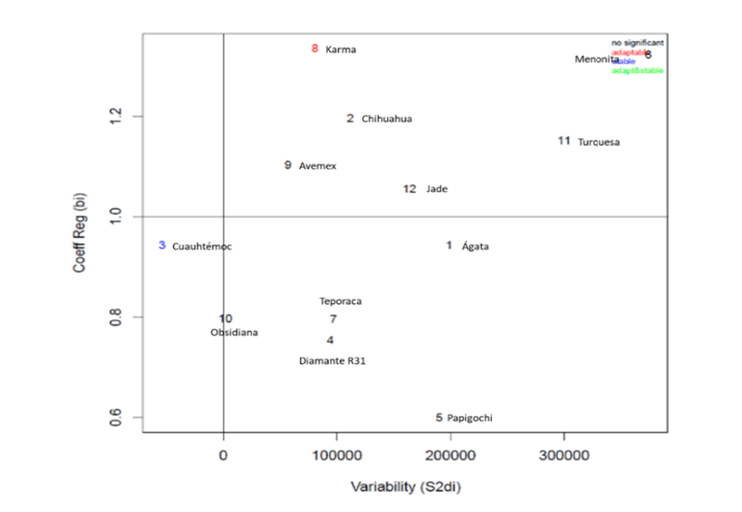
The grain yield stability of 12 oat varieties was evaluated in 23 localities situated in rainfed environments of the High Valleys of Mexico. Two methodologies were used to assess grain yield stability: Eberhart and Russell parameters and AMMI analysis. The stability parameters allowed us to better discriminate the varieties through the interaction they had in the environments; these parameters showed similar results to each other, in which the Ágata variety stood out for its high yield, stability, and consistency; in second place were Turquesa and Menonita, while the Cuauhtémoc, Papigochi, and Avemex varieties were the least suitable genotypes. The results showed classifying the varieties with the highest qualities for recommendation and those that no longer have potential for commercial use.
Downloads
References
Adnan, A. A.; Diels, J.; Jibrin, J. M.; Kamara, A. Y.; Shaibu, A. S.; Craufurd, P. and Menkir, A. 2020. CERES-maize model simulating genotype-by-environment interaction of maize and its stability in the dry and wet savannas of Nigeria. Field Crops Research. 253:107826. https://doi.org/10.1016/j.fcr.2020.107826.
Akcura, M.; Ceri, S.; Taner, S.; Kaya, Y. Ozer, E. and Ayranci, R. 2005. Grain yield stability of winter oat (Avena sativa L.) cultivars in the central Anatolian region of Turkey. Journal of Central European Agriculture. 6(3):203-210.
Buerstmayr, H.; Krenn, N.; Stephan, U. Grausgruber, H. and Zechner, E. 2007. Agronomic performance and quality of oat (Avena sativa L.) genotypes of worldwide origin produced under Central European growing conditions. Field Crops Research. 101(3):343-351. https://doi.org/10.1016/j.fcr.2006.12.011.
Carballo, C. A.; Márquez, S. F. y Molina, G. J. 1970. Comparación de variedades de maíz del Bajío y de la Mesa Central por su rendimiento y estabilidad. Agrociencia. 5(1):129-146.
Dyulgerova, B. and Savova, T. 2020. Genotype by environment interaction for grain yield in winter oat. Bulgarian Journal of Agricultural Science. 26(5):992-997.
Ebdon, J. S. and Gauch, H. G. 2002. Additive mean effect and multiplicative interaction analysis of national turfgrass performance trials: 1. Interpretation of genotype x environmental interaction. Crop Science. 42(2):489-496.
Eberhart, S. T. and Russell, W. A. 1966. Stability parameters for comparing varieties 1. Crop Science. 6(1):36-40.
FAO. 2024. Food and Agriculture Organization of the United Nations. FAO Statistics. Rome, Italy. www.fao.org/statistics/es/.
García, M. P. J.; Pérez, A. I. B.; Prieto, R. G. P.; Medina, C. D. E.; Sánchez, D. M.; Marín, R. C. A. y Medina, H. A. E. 2021. Interacción genotipo ambiente y potencial productivo de 25 variedades de maíz amarillo en la provincial de Tayacaja, Perú. Bioagro. 33(2):67-69.
Gauch, H. G. and Zobel, R. W. 1988. Predictive and postdictive success of statistical analysis of yield trials. Theroretical and Applied Genetics. 76(1):1-10. https://doi.org/10.1007/BF00288824.
Kahn, M. M. H.; Rafii, M. Y.; Ramlee, S. I.; Jusoh, M. and Al Mamun, M. 2021. AMMI and GGE biplot analysis for yield performance and stability assessment of selected Bambara groundnut (Vigna subterranean L. Verdc) genotypes under the multi-environmental trails (METs). Scientific reports. 11(1):1-17. https://doi.org/10.1038/s41598-021-01411-2.
Liu, H.; Gan, W.; Rengel, Z. and Zhao, P. 2016. Effects of zinc fertilizer rate and application method on photosynthetic characteristics and grain yield of summer maize. Journal of Soil Science and Plant Nutrition. 16(2):550-562. http://dx.doi.org/10.4067/S0718-95162016005000045.
Luo, J.; Pan, Y. B.; Que, Y.; Zhang, H.; Grisham, M. P. and Xu, L. 2015. Biplot evaluation of test environments and identification of mega-environment for sugarcane cultivars in China. Sci Rep. 5(15505):1-11. https://doi.org/10.1038/srep15505.
Mehraj, U.; Abidi, I. and Ahmad, M. 2017. Stability analysis for physiological traits, grain yield and its attributing parameters in oats (Avena sativa L.) in the Kashmir Valley. Electronic Journal of Plant Breeding. 8(1):59-62.
Mühleisen, J.; Piepho, H. P.; Maurer, H. P.; Longin, C. F. H. and Reif, J. C. 2014. Yield stability of hybrids versus lines in wheat, barley and triticale. Theor Appl Genet. 127(2):309-316. https://doi.org/10.1007/s00122-013-2219-1.
Müller, C.; Elliott, J.; Pugh, T. A. M.; Ruane, A. C.; Ciais, P.; Balkovic, J.; Deryng, D.; Folberth, C.; Izauralde, R. C.; Jones, C. D.; Khabarov, N.; Lawrence, P.; Liu, W.; Reddy, A. D.; Schmid, E. and Wang, X. 2018. Global patterns of crop yield stability under additional nutrient and water inputs. PLos One. 13(6):1-14. https://doi.org/10.1371/journal.pone.0198748.
Mut, Z.; Akay, H. and Erbas Köse, Ö. D. 2018. Grain yield, quality traits and grain yield stability of local oat cultivars. Journal of soil science and plant nutrition. 18(1):269-281. http://dx.doi.org/10.4067/S0718-95162018005001001.
Reckling, M.; Ahrends, H.; Chen, T. W.; Eugster, W.; Hadasch, S.; Knapp, S.; Laidig, F.; Linstädter, A.; Macholdt, J.; Piepho, H. P.; Schiffers, K. and Döring, T. 2021. Methods of yield stability analysis in long-term field experiments. A review. Agron. Sustain. Dev. 41(27):1-28. https://doi.org/10.1007/s13593-021-00681-4.
Rodríguez, P. J. E.; Sahagún, C. J.; Villaseñor, M. H. E.; Molina, G. J. D. and Martínez, G. A. 2002. Estabilidad de siete variedades comerciales de trigo (Triticum aestivum L.) de temporal. Revista Fitotecnia Mexicana. 25(2):143-151.
SIAP. 2024. Sistema de Información Agroalimentaria y Pesquera. Panorama Agroalimentario 2024. http://www.siap.gob.mx.
Tigchelaar, M.; Battisti, D. S.; Naylor, R. L. and Ray, D. K. 2018. Future warming increases probability of globally synchronized maize production shocks. Proc Natl Acad Sci USA. 115(26):6644-6649. https://doi.org/10.1073/pnas.1718031115.
Vargas. H. M. y Crossa, J. F. 2000. El análisis AMMI y la gráfica del Biplot en SAS. Unidad de biometría. CIMMYT. México. 46 p. www.cimmyt.cgiar.org/biometrics.
Villaseñor, M. H. E. y Espitia, R. E. 2000. Características de las áreas productivas de trigo de temporal: problemática y condiciones de producción. In: el trigo de temporal en México. Secretaría de Agricultura, Ganadería, Pesca y Alimentación, Instituto, Nacional de Investigaciones, Forestales (INIFAP), Agrícolas y Pecuarias (SAGARPA), Centro de Investigación del Centro, Campo Experimental Valle de México. Chapingo, Estado de México. 85-98 p.
Villaseñor, M. H. E.; Espitia, R. E.; Huerta, E. J.; Osorio, A. L.; Hortelano, S. R.; Martínez, C. E. and Rodríguez, G. M. F. 2018. Ágata: nueva variedad de avena (Avena sativa L.) para la producción de grano en México. Revista Mexicana de Ciencias Agrícolas. 9(5):1083-1088. https://doi.org/10.29312/remexca.v9i5.1512.
Villaseñor, M. H. E.; Huerta, E. J.; Rodríguez, G. M. F.; Hortelano, S. R. R.; Espitia, R. E. y Martínez, C. E. 2021. Mejoramiento genético de avena en México. Revista Mexicana de Ciencias Agrícolas. 12(25):21-25. https://doi.org/10.29312/remexca.v12i25.2808.
Published
How to Cite
Issue
Section
License
Copyright (c) 2025 Revista Mexicana de Ciencias Agrícolas

This work is licensed under a Creative Commons Attribution-NonCommercial 4.0 International License.
The authors who publish in Revista Mexicana de Ciencias Agrícolas accept the following conditions:
In accordance with copyright laws, Revista Mexicana de Ciencias Agrícolas recognizes and respects the authors’ moral right and ownership of property rights which will be transferred to the journal for dissemination in open access. Invariably, all the authors have to sign a letter of transfer of property rights and of originality of the article to Instituto Nacional de Investigaciones Forestales, Agrícolas y Pecuarias (INIFAP) [National Institute of Forestry, Agricultural and Livestock Research]. The author(s) must pay a fee for the reception of articles before proceeding to editorial review.
All the texts published by Revista Mexicana de Ciencias Agrícolas —with no exception— are distributed under a Creative Commons License Attribution-NonCommercial 4.0 International (CC BY-NC 4.0), which allows third parties to use the publication as long as the work’s authorship and its first publication in this journal are mentioned.
The author(s) can enter into independent and additional contractual agreements for the nonexclusive distribution of the version of the article published in Revista Mexicana de Ciencias Agrícolas (for example include it into an institutional repository or publish it in a book) as long as it is clearly and explicitly indicated that the work was published for the first time in Revista Mexicana de Ciencias Agrícolas.
For all the above, the authors shall send the Letter-transfer of Property Rights for the first publication duly filled in and signed by the author(s). This form must be sent as a PDF file to: revista_atm@yahoo.com.mx; cienciasagricola@inifap.gob.mx; remexca2017@gmail.
This work is licensed under a Creative Commons Attribution-Noncommercial 4.0 International license.