Native corn in Sinaloa: agroclimatic and sociocultural factors that limit its productivity
DOI:
https://doi.org/10.29312/remexca.v16i8.3912Keywords:
corn yield, milpa, precipitationAbstract
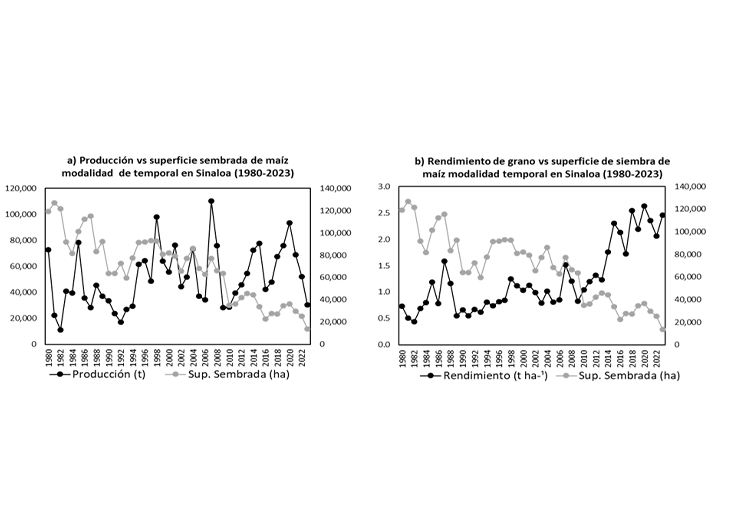
The state of Sinaloa is internationally recognized for its high production of corn from commercial hybrids and technified systems. Nevertheless, native corn is also grown by small producers, mainly in the mountain region. This practice has experienced a sharp reduction in its sowing area as well as variability in its production. The objective was i) to identify the main agroclimatic and sociocultural factors that have influenced the reduction of the area allocated to the cultivation of native corn varieties; and ii) to analyze the variability in the production volumes of these types of corn in the northern regions of the state of Sinaloa. The data were categorized into quantitative and qualitative; the former were analyzed using one-way Anova and Pearson’s correlation, while the qualitative data were analyzed by content analysis. Analysis of historical data from 1980 to 2023 indicates a substantial 88.6% reduction in the planting area allocated to native corn cultivation, whereas production is highly variable between harvests. This is a result of the decrease in rainfall and the increase in temperatures. Likewise, the lack of public policies, insecurity, and the migration of young people to urban areas have led small producers to consider abandoning traditional corn practices, reducing the production of rainfed native corn, and putting at risk the genetic diversity of corn, compromising the food security of communities.
Downloads
References
Cano-González, A. y Cadena-Iñiguez, P. 2021. Strategy to strengthen the traditional milpa family production systems. Agroproductividad. 14(4):119-125. Doi.org/10.32854/agrop.v14i4.1840.
CONAGUA- SEMARNAT. 2024. Comisión Nacional del Agua, Estadísticas del Agua en México- Secretaría de Medio Ambiente y Recursos Naturales. Ciudad de México, México. www.gob.mx/conagua/acciones-y-programas/publicaciones-estadisticas-y-geograficas-60692.
Cruz, D. D. y Leos, R. J. A. 2019. La producción de maíz en Sinaloa, México, y sus implicaciones para el medio ambiente. Letras verdes. Revista Latinoamericana de Estudios Socioambientales. 25(1):100-118. Doi.org/10.17141/letrasverdes.25.2019.3705.
Cruz-González, A.; Arteaga-Ramírez, R.; Sánchez-Cohen, I.; Soria-Ruiz, J. y Monterroso-Rivas, A. 2024. Impactos del cambio climático en la producción de maíz en México. Revista Mexicana de Ciencias Agrícolas. 15(1):e3327. Doi.org/10.29312/remexca.v15i1.3327.
Fonteyne, S.; Castillo-Caamal, J. B.; Lopez-Ridaura, S.; Van-Loon, J.; Espidio-Balbuena, J.; Osorio-Alcalá, L. and Verhulst, N. 2023. Review of agronomic research on the milpa, the traditional polyculture system of Mesoamerica. Frontiers in Agronomy. 5(1115490) 1-16. Doi.org/10.3389/fagro.2023.1115490.
Gerardo-Montoya, L. y Armenta-Bojórquez, A. D. 2010. Reflexiones sobre el impacto socioeconómico del cultivo de maíz en Sinaloa. Ra Ximhai. 6(1):69-72. Doi.org/10.35197/rx.06.01.2010.10.lg.
González-Cruz, J. L. and Torres-Rojo, J. M. 2024. Regional differences in rainfed white corn production in Mexico. Revista Mexicana de Ciencias Agrícolas. 15(1):e3170. Doi.org/10.29312/remexca.v15i1.3170.
Ibarrola-Rivas, M. J.; Castillo, G. and González, J. 2020. Social, economic and production aspects of maize systems in Mexico. Investigaciones geográficas. 102:e60009. Doi.org/10.14350/rig.60009.
INEGI. 2019. La Encuesta Nacional Agropecuaria. www.inegi.org.mx/programas/ena/2019/.
Lara-Ponce, E.; Valdés-Vega, J. L.; Medina-Torres, S. M. y Martínez-Ruíz, R. 2017. Situación de la agricultura de mayos y mestizos del Norte de Sinaloa, México. Agricultura, Sociedad y Desarrollo. 14(4):577-597. https://www.scielo.org.mx/scielo.php?pid=S1870-54722017000400577&script=sci-arttext.
Linares-Holguín, O.; Rocandio-Rodríguez, M.; Santacruz-Varela, A.; López-Valenzuela, J. A.; Córdova-Téllez, L.; Parra-Terraza, S.; Leal-Sandoval, A.; Maldonado-Mendoza, I. y Sánchez-Peña, P. 2019. Caracterización fenotípica y agronómica de maíces (Zea mays ssp. mays L.) nativos de Sinaloa, México. Interciencia. 44(7):421-428. https://www.redalyc.org/journal/339/33960285008/html/.
Mancera-Gonzáles, O. 2022. Las presas en Sinaloa, México: asimetrías regionales e inexperiencias necesarias. O Público e o Privado. 20(42):61-95. uece.br/index.php/opublicoeoprivado/article/view/8175.
Pineda-Hidalgo, K.; Méndez-Marroquín, K. P.; Vega-Álvarez, E.; Chávez-Ontiveros, J.; Sánchez-Peña, P.; Garzón-Tiznado, J. A.; Vega-García, M. O. and López-Valenzuela, J. A. 2013. Microsatellite-based genetic diversity among accessions of maize landraces from Sinaloa in Mexico. Hereditas. 150(4):53-59. 10.1111/j.1601-5223.2013.00019.x.
R Core Team. 2021. R: a language and environment for statistical computing. R Foundation for Statistical Computing, Vienna, Austria. www.R-project.org/.
SIACON. 2023. Servicio de Información Agroalimentaria de Consulta. www.gob.mx/siap/documentos/siacon-ng-161430.
SIAP. 2023. Servicio de Información Agroalimentaria y Pesquera. www.gob.mx/siap.
Simanjuntak, C.; Gaiser, T.; Ahrends, H. E.; Ceglar, A.; Singh, M.; Ewert, F. and Srivastava, A. K. 2023. Impact of climate extreme events and their causality on maize yield in South Africa. Sci. Rep. 13(12462):1-16. Doi.org/10.1038/s41598-023-38921-0.
Sosa-Cabrera, E. and González-Amaro, R. M. 2022. Profitability of corn (Zea mays L.) grown in milpa production systems in Oaxaca, Puebla, and Veracruz, México. Agro Productividad. 15(10):51-59. Doi.org/10.32854/agrop.v15i10.2212.
Ureta, C.; González, E. J.; Espinosa, A.; Trueba, A.; Piñeyro-Nelson A. and Álvarez-Buylla, A. 2020. Maize yield in Mexico under climate change. Agricultural Systems. 177(102697):1-11. Doi.org/1 0.1016/j.agsy.2019.102697.
Uzcanga, P. N. G.; Larqué, S. B.; Del Ángel, P. A. L.; Rangel, F. M. A. y Cano, G. A. J. 2017. Preferencias de los agricultores por semillas mejoradas y nativas de maíz en la Península de Yucatán, México. Revista Mexicana de Ciencias Agrícolas. 8(5):1021-1033. Doi.org/10.29312/remexca.v8i5.105.
Uzcanga-Pérez, N; Cano-González, A. y Cadena-Iñiguez, P. 2021. Strategy to strengthen the traditional milpa family production systems. Agroproductividad. 14(4):119-125. Doi.org/10.32854/agrop.v14i4.1840.
Vizcarra, B. I.; Thomé-Ortíz, H. y Hernández, L. C. D. 2015. Miradas al futuro: el relevo generacional en el desarrollo de la conciencia social como estrategia de conservación de los maíces nativos. Carta Económica Regional. 1(115):55-73. n2t.net/ark:/13683/ptuO/hSz.
Zhang, Z.; Wei, J.; Li, J.; Jia, Y.; Wang, W.; Li, J.; Lei, Z. and Gao, M 2022. The impact of climate change on maize production: empirical findings and implications for sustainable agricultural development. Front. Environ. Sci. 10(954940):1-10. Doi.org/10.3389/fenvs.2022.954940.
Zhao, Z. W.; Leng, P.; Han, X. J. and Shang, G. F. 2025. Global maize yield responses to essential climate variables: assessment using atmospheric reanalysis and future climate scenarios. Computers and Electronics in Agriculture. 232(110140):1-12. Doi.org/10.1016/j.compag.2025.110140.
Zúñiga-Espinoza, N. G. 2023. Producción de maíz: evidencia de Sinaloa, México. International Journal of Professional Business Review. 8(9):e03558. Doi.org/10.26668/businessreview/2023.v8i9.3558.
Published
How to Cite
Issue
Section
License
Copyright (c) 2025 Revista Mexicana de Ciencias Agrícolas

This work is licensed under a Creative Commons Attribution-NonCommercial 4.0 International License.
The authors who publish in Revista Mexicana de Ciencias Agrícolas accept the following conditions:
In accordance with copyright laws, Revista Mexicana de Ciencias Agrícolas recognizes and respects the authors’ moral right and ownership of property rights which will be transferred to the journal for dissemination in open access. Invariably, all the authors have to sign a letter of transfer of property rights and of originality of the article to Instituto Nacional de Investigaciones Forestales, Agrícolas y Pecuarias (INIFAP) [National Institute of Forestry, Agricultural and Livestock Research]. The author(s) must pay a fee for the reception of articles before proceeding to editorial review.
All the texts published by Revista Mexicana de Ciencias Agrícolas —with no exception— are distributed under a Creative Commons License Attribution-NonCommercial 4.0 International (CC BY-NC 4.0), which allows third parties to use the publication as long as the work’s authorship and its first publication in this journal are mentioned.
The author(s) can enter into independent and additional contractual agreements for the nonexclusive distribution of the version of the article published in Revista Mexicana de Ciencias Agrícolas (for example include it into an institutional repository or publish it in a book) as long as it is clearly and explicitly indicated that the work was published for the first time in Revista Mexicana de Ciencias Agrícolas.
For all the above, the authors shall send the Letter-transfer of Property Rights for the first publication duly filled in and signed by the author(s). This form must be sent as a PDF file to: revista_atm@yahoo.com.mx; cienciasagricola@inifap.gob.mx; remexca2017@gmail.
This work is licensed under a Creative Commons Attribution-Noncommercial 4.0 International license.