Eficiencia de la fumigación con bromuro de metilo al 100% en toronja infestada por Anastrepha spp
DOI:
https://doi.org/10.29312/remexca.v16i8.3911Palabras clave:
Anastrepha spp., bromuro de metilo, fumigación, toronjaResumen
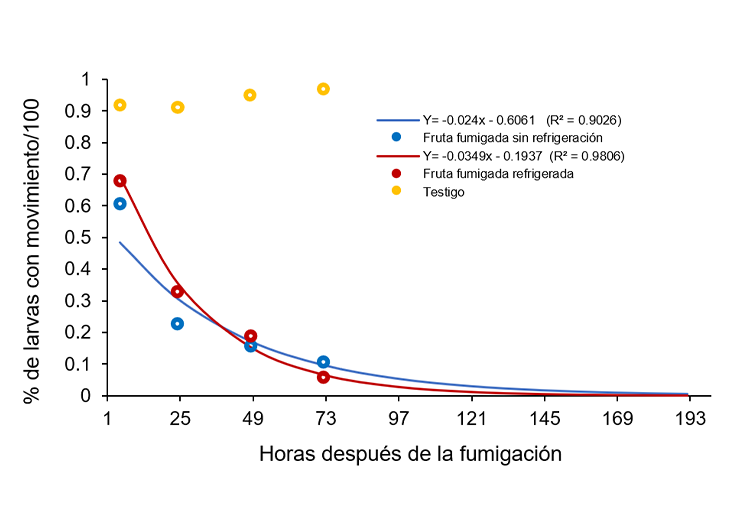
Se evaluó la respuesta de larvas de mosca de la fruta (Anastrepha spp.) a la fumigación con bromuro de metilo al 100% en toronjas infestadas naturalmente. Al finalizar el ciclo de producción 2021 en la región citrícola de Nuevo León, México, para ello se recolectaron toronjas (Citrus paradisi) infestadas por mosca de la fruta. Los frutos recolectados se dividieron en tres lotes, dos se trataron en una cámara de fumigación con bromuro de metilo a 24 g m-3 y dos h de exposición y el otro sirvió como control. Después de la fumigación uno de los lotes fumigados se refrigeró a 5 °C y el otro se mantuvo a temperatura ambiente entre 19 y 24 °C. El porcentaje de larvas vivas se evaluó 5, 24, 48 y 72 h después de la fumigación en 30 frutos de cada lote. El 89 a 94% de las larvas dejaron de moverse 72 h después de la fumigación. Utilizando el modelo Exponencial ajustado a los datos se estimó que todas las larvas pierden su capacidad de movimiento 120-144 h después de la fumigación (5-6 días). La refrigeración aumentó el porcentaje de larvas con movimiento, pero este efecto se perdió 48 h después de la fumigación. Estos resultados indicaron que la efectividad de la fumigación en la fruta hospedera de Anastrepha spp., con bromuro de metilo, puede evaluarse con certeza a los 5-6 días después del tratamiento.
Descargas
Citas
APHIS. 2010. Animal and Plant Health Inspection Service. Treatment manual. 920 p. https://aphis.stg.platform.usda.gov/sites/default/files/treatment.pdf.
Campbell, C. L. and Madden, L. V. 1990. Introduction to plant disease epidemiology. Jonh Wiley & Sons, Nueva York. 532 p.
CESAVE. 2015. Comité Estatal de Sanidad Vegetal de Veracruz. Moscas de la fruta (Anastrepha spp.). https://cesave.org.mx/moscas-de-la-fruta-anastrepha/.
Hallman, G. J. and Thomas, D. B. 2011. Evaluation of the efficacy of the methyl bromide fumigation schedule against Mexican fruit fly (Diptera: tephritidae) in citrus fruit. United State of América. Journal of Economic Entomology. 104(1):63-68. https://doi.org/10.1603/EC10199.
Heather, N. W. and Hallman, G. J. 2008. Pest management and phytosanitary trade barriers. CABI, Wallingford, United Kingdom. 251 p.
NOM 075 FITO. 1997. Por la que se establecen los requisitos y especificaciones para la movilización de frutos hospederos de moscas de la fruta. Diario Oficial de la federación. https://www.gob.mx/senasica/documentos/normasoficialesmexicanasenmateriadesanidadvegetal.
SENASICA. 2016. Servicio Nacional de Sanidad, Inocuidad y Calidad Agroalimentaria. Manual de tratamientos fitosanitarios. 215 p. https://www.gob.mx/senasica/documentos/manual-de-tratamientos-fitosanitarios-83952.
SENASICA. 2016. Servicio Nacional de Sanidad, Inocuidad y Calidad Agroalimentaria. Fichas técnicas de moscas nativas de la fruta. https://www.gob.mx/senasica/documentos/fichas-tecnicas-moscas-nativas-de-la-fruta.
SENASICA. 2020. Servicio Nacional de Sanidad, Inocuidad y Calidad Agroalimentaria. Cítricos libres de moscas de la fruta para Estados Unidos de América. https://www.gob.mx/senasica/documentos/citricoslibresdemoscasdelafrutaparaestadosunidosdeamerica.
UNEP. 2010. United Nations Environment Programme. Report of the methyl bromide technical options committee. 397 p. https://acd-ext.gsfc.nasa.gov/Documents/O3-Assessments/Docs/WMO-2010/2010assessment/MBTOC-2010-Assessment-Report.pdf.
Descargas
Publicado
Cómo citar
Número
Sección
Licencia
Derechos de autor 2025 Revista Mexicana de Ciencias Agrícolas

Esta obra está bajo una licencia internacional Creative Commons Atribución-NoComercial 4.0.
Los autores(as) que publiquen en Revista Mexicana de Ciencias Agrícolas aceptan las siguientes condiciones:
De acuerdo con la legislación de derechos de autor, Revista Mexicana de Ciencias Agrícolas reconoce y respeta el derecho moral de los autores(as), así como la titularidad del derecho patrimonial, el cual será cedido a la revista para su difusión en acceso abierto.
Los autores(as) deben de pagar una cuota por recepción de artículos antes de pasar por dictamen editorial. En caso de que la colaboración sea aceptada, el autor debe de parar la traducción de su texto al inglés.
Todos los textos publicados por Revista Mexicana de Ciencias Agrícolas -sin excepción- se distribuyen amparados bajo la licencia Creative Commons 4.0 atribución-no comercial (CC BY-NC 4.0 internacional), que permite a terceros utilizar lo publicado siempre que mencionen la autoría del trabajo y a la primera publicación en esta revista.
Los autores/as pueden realizar otros acuerdos contractuales independientes y adicionales para la distribución no exclusiva de la versión del artículo publicado en Revista Mexicana de Ciencias Agrícolas (por ejemplo incluirlo en un repositorio institucional o darlo a conocer en otros medios en papel o electrónicos) siempre que indique clara y explícitamente que el trabajo se publicó por primera vez en Revista Mexicana de Ciencias Agrícolas.
Para todo lo anterior, los autores(as) deben remitir el formato de carta-cesión de la propiedad de los derechos de la primera publicación debidamente requisitado y firmado por los autores(as). Este formato debe ser remitido en archivo PDF al correo: revista_atm@yahoo.com.mx; revistaagricola@inifap.gob.mx.
Esta obra está bajo una licencia de Creative Commons Reconocimiento-No Comercial 4.0 Internacional.