Effects of agricultural gypsum with micronutrients on the yield and quality of bread wheat
DOI:
https://doi.org/10.29312/remexca.v16i8.3910Keywords:
fulvic acids, humic acids, micronutrientsAbstract
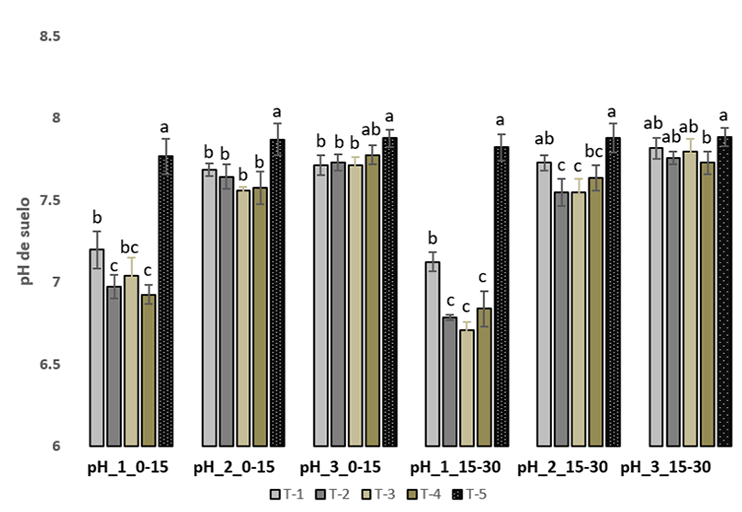
Wheat is a crop that requires large amounts of fertilizer; nevertheless, its availability limits productivity. In alkaline soils, nutrients such as iron (Fe), copper (Cu), zinc (Zn) and manganese (Mn) are less available, which causes deficiencies that are reflected in the yield and quality of the grain. Faced with this problem, a study was conducted during the 2023-2024 autumn-winter agricultural cycle at the Norman E. Borlaug Experimental Field, located in the Yaqui Valley. Five treatments with different doses of agricultural gypsum (25 and 50 kg ha-1) enriched with micronutrients (Fe, Cu, Zn, and Mn), with and without humic and fulvic acids, were evaluated to determine the effect of the optimal dose that contributes to improving the yield and quality of Borlaug 100 bread wheat. The experimental design consisted of randomized complete blocks with four replications. The variables evaluated included: soil pH at different depths, nutrient analysis of the flag leaf, yield components, and quality parameters (protein, sedimentation index, incidence of white belly, and partial bunt). The results showed that the treatments with the high dose of agricultural gypsum and micronutrients led to a temporary acidification of the soil until the stem elongation stage, no longer than 30 days, due to a cation exchange, generating an acid hydrolysis that releases hydrogen ions, which indirectly contributed to acidification, which suggests a greater availability of nutrients for the development of the crop. This resulted in a 17% increase in yield in treatments 1 and 3 compared to the control, with a 14% increase in the number of grains per spike. In addition, values of 11.6% of protein were obtained, with less than 0.5% incidence of white belly.
Downloads
References
Abbas, F.; Siddique, T.; Fan, R. and Azeem, M. 2023. Role of gypsum in conserving soil moisture macronutrients uptake and improving wheat yield in the rainfed area. Water. 15(6):1-13. https://doi.org/10.3390/w15061011.
Alcantar, G. G. y Sandoval, V. M. 1999. Manual de análisis químico de tejido vegetal. Sociedad Mexicana de la ciencia del suelo, A.C. Publicación especial núm. 10. 156 p.
Arroyo, E. A.; Sanzano, A.; Rojas-Quinteros, H. C. y Navarro-Marco, J. P. 2022. Estado de fertilidad de los suelos cañeros de Tucumán, Argentina: materia orgánica, nitrógeno y pH del suelo. Revista industrial y agrícola de Tucumán. 99(1):37-42. https://www.scielo.org.ar/scielo.php?script=sci-arttext&pid=S185130182022000100005&lng=es&tlng=es.
Bartzen, B. T.; Oliveira, P. S. R.; Seidel, G. O.; Hoelscher, G. L. y Piano, J. T. 2020. Resposta do trigo e soja após a aplicação de doses de gesso agrícola. Acta Iguazu. 9(3):113-123. https://doi.org/10.48075/actaiguaz.v9i3.24834.
Bryson, G. M. and Mills, H. A. 2014. Plant analysis handbook IV. 4ta. Ed. United States: MicroMacro Publishing. 305 p. ISBN: 978-1-878148-03-2.
Buenrostro-Rodríguez, J. F.; Gámez-Vázquez, A. J.; Solís-Moya, E.; Covarrubias-Prieto, J.; Ledesma-Ramírez, L.; Mandujano-Bueno, A. y Cisneros-López, H. C. 2024. Efecto del nitrógeno sobre rendimiento y calidad de semilla de trigo en el Bajío, México. Revista Fitotecnia Mexicana. 47(2):109-114. https://doi.org/10.35196/rfm.2024.2.109.
De Cori, C. E. C.; Ruiz, M.; Aular, L. M.; Mora, R.; Castillo, L.; Arrieche, I. E.; Diaz, T.; Fernández, S.; Noguera, R.; Martinez, A. y Tovar, M. R. 2010. Un método turbidimétrico para determinar azufre en fertilizantes inorgánicos. Venesuelos, 18(1):6-15.
De Oliveira S. A.; Ciampitti, I. A.; Slafer, G. A. and Lollato, R. P. 2020. Nitrogen utilization efficiency in wheat: a global perspective. European Journal of Agronomy. 114(20):1-14. https://doi.org/10.1016/j.eja.2020.126008.
Días dos Santos, F.; Aparecida-Fantinel, R.; Broetto-Weiler, E. y Cabral-Cruz, J. 2021. Fatores que afetam a disponibilidade de micronutrientes no solo. Tecnológica. 25(2):272-278. https://doi.org/10.17058/tecnolog.v25i2.15552.
Espitia-Rangel, E.; Martínez-Cruz, E.; Villaseñor-Mir, H. E.; Hortelano-Santa, R.; Limón-Ortega, A. y Lozano-Grande, A. 2021. Variabilidad genética y criterios de selección del rendimiento y los componentes en trigos harineros de temporal. Revista Mexicana de Ciencias Agrícolas. 12(2):305-315. https://doi.org/10.29312/remexca.v12i2.2787.
Feng, F.; Han, Y.; Wang, S.; Yin, S.; Peng, Z.; Zhou, M. and Siddique, K. H. 2018. The effect of grain position on genetic improvement of grain number and thousand grain weight in winter wheat in North China. Frontiers in Plant Science. 9(129):1-9. https://doi.org/10.3389/fpls.2018.00129.
Giancaspro, A.; Giove, S. L.; Zacheo, S. A.; Blanco, A. and Gadaleta, A. 2019. Genetic variation for protein content and yield-related traits in a durum population derived from an inter-specific cross between hexaploid and tetraploid wheat cultivars. Frontiers in Plant Science. 10(1509):1-13. https://doi.org/10.3389/fpls.2019.01509.
Liu, L.; Ji, H.; An, J.; Shi, K.; Ma, J. y Liu, B. 2019. Respuesta de la acumulación de biomasa en trigo al estrés por bajas temperaturas en las etapas de unión y arranque. Medio Ambiente. Exp. Bot. 157(19):46-57. https://doi.org/10.1016/j.envexpbot.2018.09.026.
Marschner, P. 2012. Marschner’s Mineral Nutrition of Higher Plants. 3rd Ed. Academic Press. 191-248 pp.
Martínez-Cruz, E.; Espitia-Rangel, E.; Villaseñor-Mir, H. E. y Hortelano-Santa, R. 2020. La productividad del trigo harinero bajo diferentes condiciones de riego. Revista Mexicana de Ciencias Agrícolas. 11(6):1349-1360. https://doi.org/10.29312/remexca.v11i6.2050.
Mazur, P.; Gozdowski, D. and Wnuk, A. 2022. Relationships between soil electrical conductivity and sentinel 2 derived NDVI with pH and content of selected nutrients. Agronomy. 12(2):1-17. https://doi.org/10.3390/agronomy12020354.
Moreno-Araiza, O.; Torres-Chávez, P. I.; Ramírez-Wong, B.; Magaña-Barajas, E.; Montaño-Leyva, B.; Medina-Rodríguez, C. L. y Delgado-Rodríguez, J. 2020. Calidad proteica en las fracciones de molienda de rodillos de trigo (T. aestivum) a nivel comercial. Biotecnia. 22(3):53-60. https://doi.org/10.18633/biotecnia.v22i3.1201.
Nardi, S.; Schiavon, M. and Francioso, O. 2021. Chemical structure and biological activity of humic substances define their role as plant growth promoters. Molecules. 26(8):1-20. https://doi.org/10.3390/molecules26082256.
Nigro, D.; Gadaleta, A.; Mangini, G.; Colasuonno, P.; Marcotuli, I.; Giancaspro, A. and Blanco, A. 2019. Candidate genes and genome-wide association study of grain protein content and protein deviation in durum wheat. Planta. 249(19):1157-1175. https://doi.org/10.1007/s00425-018-03075-1.
Osorio-Vera, L. R.; Rasche-Álvarez, J. W.; González-Blanco, A. N.; Leguizamón-Rojas, C. A. y Fatecha-Fois, D. A. 2021. Fertilización con zinc en trigo, maíz y sésamo en suelos de diferentes texturas. Investigación Agraria. 23(2):53-62. https://doi.org/10.18004/investig.agrar.2021.diciembre.2302691.
Peña, R. J. 1990. Variation in quality characteristics associated with some spring 1B/1R translocation wheats. J. Cereal Sci. 12(2):105-112.
Philipp, N.; Weichert, H.; Bohra, U.; Weschke, W.; Schulthess, A. W. and Weber, H. 2018. Grain number and grain yield distribution along the spike remain stable despite breeding for high yield in winter wheat. PloS one. 13(10):1-17. https://doi.org/10.1371/journal.pone.0205452.
Ramírez, A. F. V.; Ramírez, I. M. y Arroyave, A. F. 2022. Relación entre el pH y las mediciones de conductividad eléctrica en un suelo cultivable ubicado en Medellín, Colombia. Ingenierías USBMed. 13(2):56-62. http://doi10.21500/20275846.4706.
Riaz, M. W.; Yang, L.; Yousaf, M. I.; Sami, A.; Mei, X. D.; Shah, L.; Rehman, S.; Xue, L.; Si, H. and Ma, C. 2021. Efectos del estrés térmico en el crecimiento, la fisiología de las plantas, el rendimiento y la calidad del grano de diferentes trigos de primavera (Triticum aestivum L.) Genotipos. Sostenibilidad. 13(5):1-18. https://doi.org/10.3390/su13052972.
Riesen, O. and Feller, U. 2005. Redistribution of nickel, cobalt, manganese, zinc, and cadmium via the phloem in young and maturing wheat. Journal of Plant Nutrition. 28(3):421-430. https://doi.org/10.1081/PLN-200049153.
Rojas-Padilla, J.; De-Bashan, L. E.; Parra-Cota, F. I.; Rocha-Estrada, J. and de los Santos-Villalobos, S. 2022. Microencapsulation of bacillus strains for improving wheat (Triticum turgidum subsp. durum) growth and development. Plants. 11(21):1-15. https://doi.org/10.3390/plants11212920.
Shah, A.; Nazari, M.; Antar, M.; Msimbira, L. A.; Naamala, J.; Lyu, D.; Rabileh, M.; Zajonc, J. and Smith, D. L. 2021. PGPR in agriculture: a sustainable approach to. 12(23):1-22. https://doi.org/10.3389/fsufs.2021.667546.
SIAP. 2024. Servicio de Información Agroalimentaria y Pesquera. Producción anual agrícola. https://www.gob.mx/siap/acciones-y-programas/produccion-agricola-33119.
Singh, P.; Benbi, D. K. and Verma, G. 2021. Nutrient management impacts on nutrient use efficiency and energy, carbon, and net ecosystem economic budget of a rice-wheat cropping system in Northwestern India. Journal of Soil Science and Plant Nutrition. 21(1):559-577. Doi: 10.1007/s42729-020-00383-y.
Team, R. 2023. RStudio: integrated development environment for R. Boston, MA. RStudio, PBC. 2020.
Tóth, B.; Juhász, C.; Labuschagne, M. and Moloi, M. J. 2020. The influence of soil acidity on the physiological responses of two bread wheat cultivars. Plants. 9(11):1-13. https://doi.org/10.3390/plants9111472.
Trivisiol, V. S.; Cargnelutti-Filho, A.; Facco, G. and Loro, M. V. 2024. Partial correlations between production traits and grain protein in wheat. Revista Caatinga. 37(24):1-7. https://doi.org/10.1590/1983-21252024v3712312rc.
Tsvey, Y.; Ivanina, R.; Ivanina, V. y Senchuk, S. 2021. Rendimiento y calidad del grano de trigo de invierno (Triticum aestivum L.) en relación con la fertilización nitrogenada. Revista Facultad Nacional de Agronomía Medellín. 74(1):9413-9422. https://doi.org/10.15446/rfnam.v74n1.88835.
Villaseñor-Mir, H. E.; Huerta-Espino, J.; Hortelano-Santa, R.; Martínez-Cruz, E.; Rodríguez-García, M. F.; Solís-Moya, E. and Martínez-Medina, J. 2021. Bacorehuis F2015, nueva variedad de trigo harinero para áreas de riego en México. Revista Fitotecnia Mexicana. 44(4):693-695. https://doi.org/10.35196/rfm.2021.4.693.
Xiao, L.; Asseng, S.; Wang, X.; Xia, J. Zhang, P. y Liu, L. 2022. Simulación de los efectos del estrés por bajas temperaturas en el crecimiento y rendimiento de la biomasa de trigo. Agric. For. Meteorol. 326(22)109191. https://doi.org/10.1016/j.agrformet.2022.109191.
Yuan, G.; Huan, W.; Song, H.; Lu, D.; Chen, X.; Wang, H. and Zhou, J. 2021. Effects of straw incorporation and potassium fertilizer on crop yields, soil organic carbon, and active carbon in the rice wheat system. Soil and Tillage Research. 209:1-8. https://doi.org/10.1016/j.still.2021.104958.
Zadoks, J. C.; Chang, T. T. and Konzak, C. F. 1974. A decimal code for the growth stages of cereals. Weed research. 14(6):415-421.
Published
How to Cite
Issue
Section
License
Copyright (c) 2025 Revista Mexicana de Ciencias Agrícolas

This work is licensed under a Creative Commons Attribution-NonCommercial 4.0 International License.
The authors who publish in Revista Mexicana de Ciencias Agrícolas accept the following conditions:
In accordance with copyright laws, Revista Mexicana de Ciencias Agrícolas recognizes and respects the authors’ moral right and ownership of property rights which will be transferred to the journal for dissemination in open access. Invariably, all the authors have to sign a letter of transfer of property rights and of originality of the article to Instituto Nacional de Investigaciones Forestales, Agrícolas y Pecuarias (INIFAP) [National Institute of Forestry, Agricultural and Livestock Research]. The author(s) must pay a fee for the reception of articles before proceeding to editorial review.
All the texts published by Revista Mexicana de Ciencias Agrícolas —with no exception— are distributed under a Creative Commons License Attribution-NonCommercial 4.0 International (CC BY-NC 4.0), which allows third parties to use the publication as long as the work’s authorship and its first publication in this journal are mentioned.
The author(s) can enter into independent and additional contractual agreements for the nonexclusive distribution of the version of the article published in Revista Mexicana de Ciencias Agrícolas (for example include it into an institutional repository or publish it in a book) as long as it is clearly and explicitly indicated that the work was published for the first time in Revista Mexicana de Ciencias Agrícolas.
For all the above, the authors shall send the Letter-transfer of Property Rights for the first publication duly filled in and signed by the author(s). This form must be sent as a PDF file to: revista_atm@yahoo.com.mx; cienciasagricola@inifap.gob.mx; remexca2017@gmail.
This work is licensed under a Creative Commons Attribution-Noncommercial 4.0 International license.