Modelado predictivo del rendimiento de trigo bajo estrés por inundación: enfoque basado en el algoritmo Chaid
DOI:
https://doi.org/10.29312/remexca.v17i2.3895Keywords:
Triticum durum L., precision agriculture, risk management, water stressAbstract
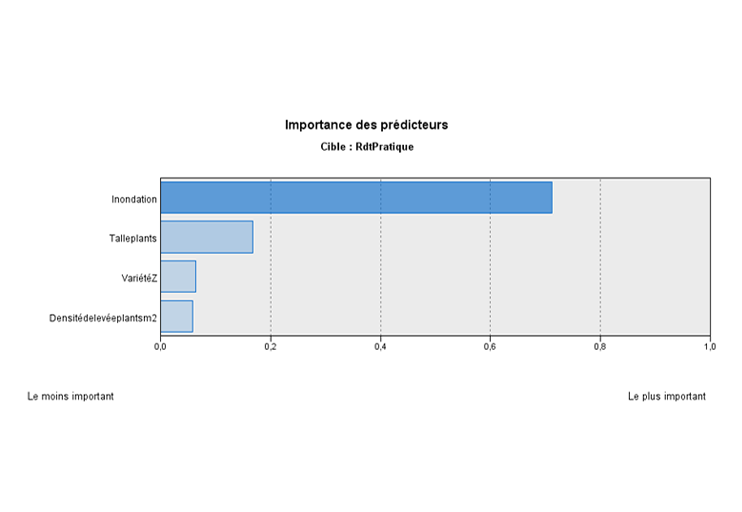
Our research aims to examine the impact of waterflooding on durum wheat yield using a predictive modelling approach based on CHAID analysis. Randomized complete block trials were conducted in two locations, with and without waterflooding, using four durum wheat cultivars (GTA dur, Citra, Simeto, and Boussalem). The assessment of yield loss highlighted significant sensitivity of cultivars to waterflooding, with Simeto showing the highest yield loss (64.33%). The CHAID analysis enabled the identification and prioritization of factors influencing yield, revealing that waterflooding is the most important predictor (71.14%), followed by the average number of tillers per plant (16.74%), cultivar (6.32%), and plant emergence density (5.8%). Beyond merely observing the negative impact, our model allows for predicting yield losses based on various agronomic parameters. The results showed that waterflooding significantly reduces yield (16.89 q ha-1) but tillering and cultivar also play an important role in wheat response to waterflooding. The study highlights the importance of predictive modelling to anticipate yield losses and guide crop management decisions in flood-prone areas.
Downloads
References
Aslam, A.; Mahmood, A.; Ur-Rehman, H.; Li, C.; Liang, X.; Shao, J. Negm, S.; Moustafa, M.; Aamer, M. and Hassan, M. U. 2023. Plant adaptation to flooding stress under changing climate conditions: ongoing breakthroughs and future challenges. Plants. 12(22):1-23. https://doi.org/10.3390/plants12223824.
Bailey-Serres, J. and Voesenek, L. A. C. J. 2008. Flooding stress: acclimations and genetic responses. Annual Review of Plant Biology. 59(1):313-339. https://doi.org/10.1146/annurev.arplant.59.032607.092752.
Basso, B. and Liu, L. 2019. Seasonal crop yield forecast: methods, applications, and accuracies. Advances in agronomy. 154(1):201-255.
Bassu, S.; Asseng, S.; Motzo, R. and Giunta, F. 2009. Optimising sowing date of durum wheat in a variable Mediterranean environment. Field Crops Research. 111(1-2):109-118. https://doi.org/10.1016/j.fcr.2008.11.002.
Berry, P. M. and Spink, J. 2012. Predicting yield losses caused by lodging in wheat. Field Crops Research. 137(1):19-26. https://doi.org/10.1016/j.fcr.2012.07.019.
Collaku, A. and Harrison, S. A. 2002. Losses in wheat due to waterlogging. Crop Science. 42(2):444-450. https://doi.org/10.2135/cropsci2002.4440.
Dadrasi, A.; Chaichi, M.; Nehbandani, A.; Sheikhi, A.; Salmani, F. and Nemati, A. 2023. Addressing food insecurity: an exploration of wheat production expansion. Plos One. 18(12):e0290684. https://doi.org/10.1371/journal.pone.0290684.
Degaïchia, H.; Bouchenak, F.; Benrima, A. and Forti, J. A. 2019. Modeling of the linear extension of Verticillium dahliae Kleb. (Moniliaceae) in soil based on eggplant root exudates, Agrobiologia. 9(1):1284-1291.
Elbasi, E.; Zaki, C.; Topcu, A. E.; Abdelbaki, W.; Zreikat, A. I.; Cina, E.; Shdefat, A. and Saker, L. 2023. Crop prediction model using machine learning algorithms. Applied Sciences. 13(16):1-20. https://doi.org/10.3390/app13169288.
Gebbers, R. and Adamchuk, V. I. 2010. Precision agriculture and food security. Science. 327(5967):828-831. https://doi.org/10.1126/science.1183899.
Githui, F.; Beverly, C.; Aiad, M.; McCaskill, M.; Liu, K. and Harrison, M. T. 2022. Modelling waterlogging impacts on crop growth: a review of aeration stress definition in crop models and sensitivity analysis of APSIM. International Journal of Plant Biology. 13(3):180-200.
Herzog, M.; Striker, G. G.; Colmer, T. D. and Pedersen, O. 2016. Mechanisms of waterlogging tolerance in wheat a review of root and shoot physiology. Plant, Cell & Environment. 39(5):1068-1086. https://doi.org/10.1111/pce.12676.
Kass, G. V. 1980. An exploratory technique for investigating large quantities of categorical data. Journal of the Royal Statistical Society: series C. Applied Statistics. 29(2):119-127. https://doi.org/10.2307/2986296.
Kaur, G.; Singh, G.; Motavalli, P. P.; Nelson, K. A.; Orlowski, J. M. and Golden, B. R. 2020. Impacts and management strategies for crop production in waterlogged or flooded soils: a review. Agronomy Journal. 112(3):1475-1501. https://doi.org/10.1002/agj2.20093.
Lesk, C.; Rowhani, P. and Ramankutty, N. 2016. Influence of extreme weather disasters on global crop production. Nature. 529(7584):84-87. https://doi.org/10.1038/nature16467.
Li, J.; Xie, T.; Chen, Y.; Zhang, Y.; Wang, C.; Jiang, Z. and Zhang, J. 2022. High-throughput UAV-based phenotyping provides insights into the dynamic process and genetic basis of rapeseed waterlogging response in the field. Journal of Experimental Botany. 73(15):5264-5278.
Liakos, K. G.; Busato, P.; Moshou, D.; Pearson, S. and Bochtis, D. 2018. Machine learning in agriculture: a review. Sensors. 18(8):1-29. https://doi.org/10.3390/s18082674.
Liliane, T. N. and Charles, M. S. 2020. Factors affecting yield of crops. In: agronomy, climate change & food security. Johnson, R. P. and Wang, L. Ed. 2nd. Springer. New York, NY, USA. 9-24 pp.
Miralles, D. J.; Richards, R. A. and Slafer, G. A. 2000. Duration of the stem elongation period influences the number of fertile florets in wheat and barley. Functional Plant Biology. 27(10):931-940. https://doi.org/10.1071/PP00021.
Mustroph, A. 2018. Improving flooding tolerance of crop plants. Agronomy. 8(9):1-25. https://doi.org/10.3390/agronomy8090160.
Setter, T. L. and Waters, I. 2003. Review of prospects for germplasm improvement for waterlogging tolerance in wheat, barley and oats. Plant and soil. 253(1):1-34.
Shao, G. C.; Lan, J. J.; Yu, S. E.; Liu, N.; Guo, R. Q. and She, D. L. 2013. Photosynthesis and growth of winter wheat in response to waterlogging at different growth stages. Photosynthetica. 51(3):429-437.
Shen, C.; Yuan, J.; Ou, X.; Ren, X. and Li, X. 2021. Genome-wide identification of alcohol dehydrogenase (ADH) gene family under waterlogging stress in wheat (Triticum aestivum). PeerJ. 9(1):1-26. https://doi.org/10.7717/peerj.11861.
Slafer, G. A. and Araus, J. L. 2007. Physiological traits for improving wheat yield under a wide range of conditions. In: scale and complexity in plant systems research. Spiertz, J. H. J.; Struik, P. C. and Laar van, H. H. Ed. Springer. Dordrecht, Netherlands. 147-156 pp.
Steel, R. G. D.; Torrie, J. H. and Dickey, D. A. 1997. Principles and procedures of statistics: a biometrical approach. 3rd Ed. McGraw-Hill. New York, NY, USA. 666 p.
Trought, M. and Drew, M. C. 1980. The development of waterlogging damage in wheat seedlings (Triticum aestivum L.) II. Accumulation and redistribution of nutrients by the shoot. Plant and Soil. 56(2):187-199.
Zhang, J.; Pan, B.; Shi, W. and Zhang, Y. 2023. Monitoring waterlogging damage of winter wheat based on Hydrus-1D and Wofost coupled model and assimilated soil moisture data of remote sensing. Remote Sensing. 15(17):1-21.
Published
How to Cite
Issue
Section
License
Copyright (c) 2026 Revista Mexicana de Ciencias Agrícolas

This work is licensed under a Creative Commons Attribution-NonCommercial 4.0 International License.
The authors who publish in Revista Mexicana de Ciencias Agrícolas accept the following conditions:
In accordance with copyright laws, Revista Mexicana de Ciencias Agrícolas recognizes and respects the authors’ moral right and ownership of property rights which will be transferred to the journal for dissemination in open access. Invariably, all the authors have to sign a letter of transfer of property rights and of originality of the article to Instituto Nacional de Investigaciones Forestales, Agrícolas y Pecuarias (INIFAP) [National Institute of Forestry, Agricultural and Livestock Research]. The author(s) must pay a fee for the reception of articles before proceeding to editorial review.
All the texts published by Revista Mexicana de Ciencias Agrícolas —with no exception— are distributed under a Creative Commons License Attribution-NonCommercial 4.0 International (CC BY-NC 4.0), which allows third parties to use the publication as long as the work’s authorship and its first publication in this journal are mentioned.
The author(s) can enter into independent and additional contractual agreements for the nonexclusive distribution of the version of the article published in Revista Mexicana de Ciencias Agrícolas (for example include it into an institutional repository or publish it in a book) as long as it is clearly and explicitly indicated that the work was published for the first time in Revista Mexicana de Ciencias Agrícolas.
For all the above, the authors shall send the Letter-transfer of Property Rights for the first publication duly filled in and signed by the author(s). This form must be sent as a PDF file to: revista_atm@yahoo.com.mx; cienciasagricola@inifap.gob.mx; remexca2017@gmail.
This work is licensed under a Creative Commons Attribution-Noncommercial 4.0 International license.