Wheat yield prediction for multiple cultivars based on agroclimatic factors
DOI:
https://doi.org/10.29312/remexca.v17i1.3892Keywords:
Triticum durum, decision tree analysis, machine learning, precision agricultureAbstract
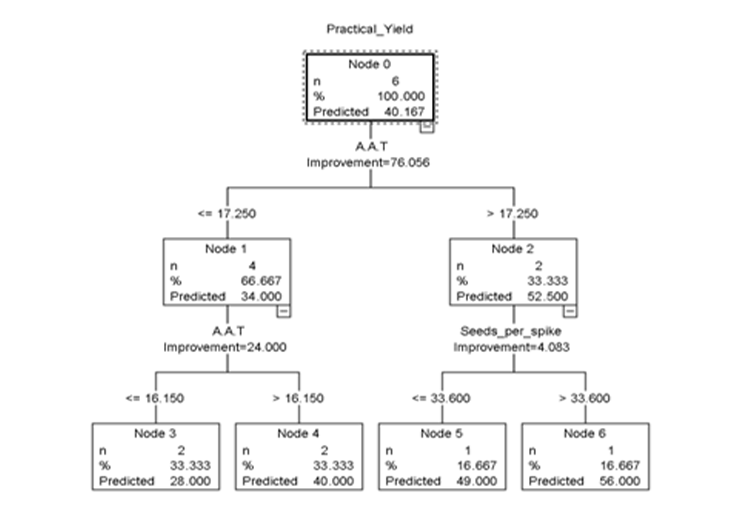
This study aimed to evaluate the performance of four durum wheat cultivars Odysseo, Saragola, Irid and Maestrale using two machine learning techniques: classification and regression trees and random trees. Classification tree and regression analysis showed that mean annual temperature is the dominant factor influencing yield in all cultivars. For the Saragola, Irid and Maestrale cultivars, yield increased significantly when the mean annual temperature exceeded 17.25 °C, particularly when emergence density was optimal. In contrast, the Odysseo cultivar showed sensitivity to both average annual temperature and seeds per spike, with higher yields associated with an average annual temperature above 17.25 °C and seeds per spike above 33.6. The random tree analysis confirmed the importance of average annual temperature and emergence density, highlighting their strong predictive power. The models provided greater robustness and generalizability by reducing prediction variance, making them reliable tools for yield prediction. These findings highlight cultivar-specific responses to agroclimatic conditions, with Odysseo influenced by both mean annual temperature and seeds per ear, while Saragola, Irid and Maestrale demonstrate a critical interaction between mean annual temperature and emergence density. Integrating random tree models improves prediction accuracy and provides valuable information for developing precision agriculture strategies tailored to environmental conditions.
Downloads
References
Blum, A. 2011. Plant breeding for water-limited environments. Springer Science Business Media. ISBN: 978-1-4419-7490-7. 68-69 pp.
Breiman, L. 2001. Random Forests. Machine Learning. 45(1):5-32.
Chlingaryan, A.; Sukkarieh, S. and Whelan, B. 2018. Machine learning approaches for crop yield prediction and nitrogen status estimation in precision agriculture: a review. Computers and Electronics in Agriculture. 151(1):61-69.
Cséplő, M.; Puskás, K.; Vida, G.; Mészáros, K.; Uhrin, A.; Tóth, V.; Ambrózy, Z.; Grausgruber, H.; Bonfiglioli, L.; Pagnotta, M. A.; Urbanavičiūtė, I.; Mikó, P. and Bányai, J. 2024. Performance of a durum wheat diversity panel under different management systems. Cereal Research Communications. 52(1):489-502.
De Vita, P.; Mastrangelo, A. M.; Matteu, L.; Mazzucotelli, E. and Cattivelli, L. 2007. Genetic improvement effects on yield stability in durum wheat genotypes grown in Italy. Field Crops Research. 100(1):133-141.
Ferrise, R.; Moriondo, M. and Bindi, M. 2019. Climate change impacts on wheat and maize production in Europe and adaptation options. Agricultural Systems. 175(1):112-124.
Hastie, T.; Tibshirani, R. and Friedman, J. 2009. The elements of statistical learning: data mining, ınference, and prediction 2nd Ed. Springer Science Business Media. 745-763 pp.
Joia, S.; Siddiqi, R. A. and Singh, T. P. 2025. Study of physicochemical properties, amino acid composition and fatty acid profile of bitter himalayan wild apricot kernel: a step towards its valorization. Waste Biomass Valor. 16(1):1-12
Kabbaj, H.; Sall, A. T.; Al-Abdallat, A.; Geleta, M.; Amri, A.; Filali-Maltouf, A.; Belkadi, B.; Ortiz, R. and Bassi, F. M. 2017. Genetic diversity within a global panel of durum wheat (Triticum durum) landraces and modern germplasm reveals the history of alleles exchange. Frontiers in Plant Science. 8(1):1-13.
Kang, Y.; Khan, S. and Ma, X. 2020. Climate change impacts on crop yield, crop water productivity and food security. A review. Progress in Natural Science: Materials International. 19(2):166-173.
Liaw, A. and Wiener, M. 2002. Classification and regression by random Forest. R News. 2(3):18-22.
Lobell, D. B. and Asseng, S. 2017. Comparing estimates of climate change impacts from process-based and statistical crop models. Environmental Research Letters. 12(1):1-12.
López-Granados, F.; Jurado-Expósito, M.; Peña, J. M. and Serrano, N. 2020. Precision agriculture for weed management. Weed Science. 68(3):171-190.
Maccaferri, M.; Sanguineti, M. C.; Demontis, A.; El-Ahmed, A.; Garcia-Moral, L.; Maalouf, F.; Nachit, M.; Nserallah, N.; Ouabbou, H.; Rhouma, S.; Royo, C.; Villegas, D. and Tuberosa, R. 2011. Association mapping in durum wheat grown across a broad range of water regimes. Journal of Experimental Botany. 62(2):409-438.
Martínez-Moreno, F.; Ammar, K. and Solís, I. 2022. Global changes in cultivated area and breeding activities of durum wheat from 1800 to date: a historical review. Agronomy. 12(5):1-17.
Royo, C.; Soriano, J. M. and Villegas, D. 2020. Assessing the adaptation of durum wheat genotypes to Mediterranean environments. Euphytica. 216(5):1-14.
Sarker, I. H.; El-Gayar, O. and Badar, M. A. 2020. Machine Learning: a review of applications in agriculture. Agronomy. 10(4), 563-582.
Sharma, R.; Shukla, S. and Shukla, A. K. 2021. Machine learning in agriculture: A review. Journal of Applied and Natural Science. 13(1):64-71.
Shewry, P. R. and Hey, S. J. 2015. The contribution of wheat to human diet and health. Food and Energy Security. 4(3):178-202.
Trnka, M.; Rötter, R. P.; Ruiz-Ramos, M.; Kersebaum, K. C.; Olesen, J. E.; Žalud, Z. and Semenov, M. A. 2021. Adverse weather conditions for European wheat production will become more frequent with climate change. Nature Climate Change. 11(7):675-680.
Published
How to Cite
Issue
Section
License
Copyright (c) 2026 Revista Mexicana de Ciencias Agrícolas

This work is licensed under a Creative Commons Attribution-NonCommercial 4.0 International License.
The authors who publish in Revista Mexicana de Ciencias Agrícolas accept the following conditions:
In accordance with copyright laws, Revista Mexicana de Ciencias Agrícolas recognizes and respects the authors’ moral right and ownership of property rights which will be transferred to the journal for dissemination in open access. Invariably, all the authors have to sign a letter of transfer of property rights and of originality of the article to Instituto Nacional de Investigaciones Forestales, Agrícolas y Pecuarias (INIFAP) [National Institute of Forestry, Agricultural and Livestock Research]. The author(s) must pay a fee for the reception of articles before proceeding to editorial review.
All the texts published by Revista Mexicana de Ciencias Agrícolas —with no exception— are distributed under a Creative Commons License Attribution-NonCommercial 4.0 International (CC BY-NC 4.0), which allows third parties to use the publication as long as the work’s authorship and its first publication in this journal are mentioned.
The author(s) can enter into independent and additional contractual agreements for the nonexclusive distribution of the version of the article published in Revista Mexicana de Ciencias Agrícolas (for example include it into an institutional repository or publish it in a book) as long as it is clearly and explicitly indicated that the work was published for the first time in Revista Mexicana de Ciencias Agrícolas.
For all the above, the authors shall send the Letter-transfer of Property Rights for the first publication duly filled in and signed by the author(s). This form must be sent as a PDF file to: revista_atm@yahoo.com.mx; cienciasagricola@inifap.gob.mx; remexca2017@gmail.
This work is licensed under a Creative Commons Attribution-Noncommercial 4.0 International license.