Synthetic fertilizer application strategies for environmentally responsible food production
DOI:
https://doi.org/10.29312/remexca.v17i1.3871Keywords:
climate change, fertilizers, nitrous oxideAbstract
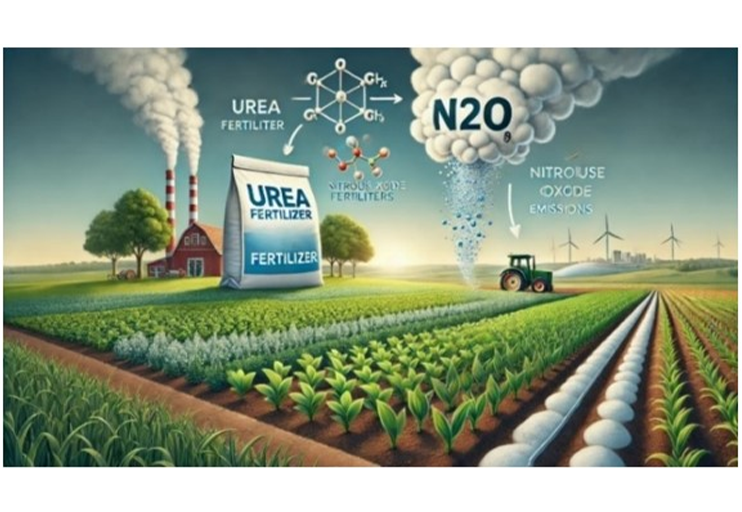
Guaranteeing global food security and mitigating global warming requires optimizing agrifood productivity and reducing emissions of greenhouse gases, such as nitrous oxide (N2O), which has a global warming potential 300 times greater than that of carbon dioxide (CO2). In this context, it was proposed to demonstrate that the appropriate application of synthetic fertilizers enables environmentally responsible food production and to identify the impact of reducing nitrous oxide through strategies for the efficient use of synthetic fertilizers. The ex post facto design was applied along with a review of the literature in journals indexed in Scopus in 2023 and 2024; various strategies for applying synthetic fertilizers were identified, and the results show that it is necessary to reduce synthetic fertilizers and add biochar or other minerals that maximize the use of nitrogen by plants and minimize environmental emissions; the application of Student’s t for 15 studies on wheat, rice, and maize crops revealed with a significance of 1% (p= 0) that the strategies shown on the use of nitrogen fertilizers in crops reduce N₂O emissions. It is concluded that the appropriate application of synthetic fertilizers significantly enables environmentally responsible food production.
Downloads
References
Aguilera, E.; Piñero, P.; Infante, J.; González-Molina, M.; Lassaletta, L. y Sanz, A. 2020. Emisiones de gases de efecto invernadero en el sistema agroalimentario y huella de carbono de la alimentación en España. Real Academia de Ingeniería. Madrid, España. 110 p. ISBN: 978-84-95662-77-4.2.
Bi, R.; Xu, X.; Zhan, L.; Chen, A.; Zhang, Q. and Xiong, Z. 2023. Proper organic substitution attenuated both N2O and NO emissions derived from AOB in vegetable soils by enhancing the proportion of Nitrosomonas. Science of the Total Environment. 866:1-12. https://doi.org/10.1016/j.scitotenv.2022.161231.
Castro-Arce, K. and Vanclay, F. M. 2020. Transformative social innovation for sustainable rural development: an analytical framework to assist community-based initiatives. Journal of Rural Studies. 74:45-54. https://doi.org/10.1016/j.jrurstud.2019.11.010.
Chen, H.; Liu, C.; Sun, Q.; Li, B.; Jiang, Q. and Wang, Z. 2024. Wollastonite addition can significantly inhibit greenhouse gas emissions of freeze-thaw farmland soil. Environmental Technology & Innovation. 34:1-12. https://doi.org/10.1016/j.eti.2024.103547.
Chiaravalloti, I.; Theunissen, N.; Shuang, Z.; Wang, J.; Fengchao, S.; Ahmed, A.; Pihlap, E.; Reinhard, C. and Planavsky J. 2023. Mitigation of soil nitrous oxide emissions during maize production with basalt amendments. Frontiers in Climate. 5:4-6. 10.3389/fclim.2023.1203043.
Coello, F.; Decorte, T.; Janssens, I.; Mortier, S.; Sardans, J.; Peñuelas, J. and Verdonck, T. 2025. Conjunto de datos globales de fertilización específica de cultivos. Sci Data. 12(40):1961-2019. https://doi.org/10.1038/s41597-024-04215-x.
Crippa, M.; Solazzo, E.; Guizzardi, D.; Monforti-Ferrario, F.; Tubiello, F. and Leip, A. 2021. Los sistemas alimentarios son responsables de un tercio de las emisiones antropogénicas globales de GEI. Nature Foo. 2(3):198-209. https://doi.org/10.1038/s43016-021-00225-9.
Dos Reis, M.; Ammann, C.; Boos, C.; Calanca, P.; Kiese, R.; Wolf, B. and Keel, S. 2024. Reducing N fertilization in the framework of the European farm to fork strategy under global change: impacts on yields, N2O emissions and N leaching of temperate grasslands in the alpine region. Agricultural Systems. 219:1-9. https://doi.org/10.1016/j.agsy.2024.104036.
EPA. 2025. Agencia de protección ambiental de Estados Unidos. Emisiones de óxido nitroso. https://espanol.epa.gov/la-energia-y-el-medioambiente/emisiones-de-oxido-nitroso.
FAO. 2017. Organización de las Naciones Unidas para la Alimentación y la Agricultura. Apreciar el suelo sobre el que caminamos. https://www.fao.org/newsroom/story/Cherishing-the-ground-we-walk-on/es.
Galgo, J. C.; Canatoy, R. C.; Lim, J. Y.; Park, H. C. and Kim, P. J. 2024. A potential of iron slag-based soil amendment as a suppressor of greenhouse gas (CH4 and N2O) emissions in rice paddy. Frontiers in Environmental Science. 12:1-12. 10.3389/fenvs.2024.1290969.
Griffis, T. J.; Chen, Z.; Baker, J. M.; Wood, J. D.; Millet, D. B.; Lee, X.; Venterea, R. T. and Turner, P. A. 2017. Nitrous oxide emissions are enhanced in a warmer and wetter world. Proceedings of the National Academy of Sciences. 114(45)12081-12085. https://doi.org/10.1073/pnas.1704552114.
Heffer, P. and Prud’homme, M. 2017. Fertilizer outlook 2017-2021. International Fertilizer Association (IFA). 2-7 pp. https://www.fertilizer.org/wp-content/uploads/2023/01/2017-IFA-Annual-Conference-Marrakech-PIT-AG-Fertilizer-Outlook.pdf.
Hu, Y.; Su, M. and Jiao, L. 2023. Peak and fall of China's agricultural GHG emissions, Journal of Cleaner Production. 389:1-10. https://doi.org/10.1016/j.jclepro.2023.136035.
IFA. 2024. International Fertilizer Association. ¿Qué son los fertilizantes? https://www.fertilizer.org/about-fertilizers/what-are-fertilizers/.
Ishfaq, M.; Wang, Y.; Xu, J.; Ul, M.; Yuan, H.; Liu, L. y He, B. 2023. Mejora de la calidad nutricional de los cultivos alimentarios con fertilizantes: un metaanálisis. Agronom. 43(74):1-35. https://doi.org/10.1007/s13593-023-00923-7.
Lagos, A. 2025. Weya Academy. ¿Qué es el potencial de calentamiento global? https://weya.academy/co2-equivalente/#elementor-toc-heading-anchor-7.
Lam, S. K.; Suter, H.; Mosier, A. R. y Chen, D. 2017. Uso de inhibidores de la nitrificación para mitigar las emisiones agrícolas de N2O ¿un arma de doble filo? Global Change Biology. 23:485-489. https://doi.org/10.1111/gcb.13338.
Li, H.; Lin, L.; Peng, Y.; Hao,Y.; Li, Z.; Li, J.; Yu, M.; Li, X.; Lu, Y.; Gu, W. and Zhang, B. 2024. Biochar's dual role in greenhouse gas emissions: nitrogen fertilization dependency and mitigation potential. Science of The Total Environment. 917:1-12. https://doi.org/10.1016/j.scitotenv.2024.170293.
Liu, D.; Dong, H.; Ma, C.; Mo, Q.; Liu, B.; Irshad, A.; Li, H.; Yang, B.; Ding, R.; Shayakhmetoya, A.; Zhang, X. and Han, Q. 2023. Inhibiting N2O emissions and improving environmental benefits by integrating garlic growing in grain production systems. Agriculture, Ecosystems & Environment. 347:1-10. https://doi.org/10.1016/j.agee.2023.108371.
Lu, C. y Tian, H. 2017. Uso global de fertilizantes de nitrógeno y fósforo para la producción agrícola. Earth Syst. Sci. Data. 9(1):181-192. https://doi.org/10.5194/essd-9-181-2017.
Lu, J.; Zhang, W.; Liu, X.; Khan, A.; Wang, W.; Ge, J.; Yan, S. and Xiong, Y. 2024. Can converting raw straw into biochar incorporation achieve both higher maize yield and lower greenhouse gas emissions intensity in drought-prone environment? Environmental Technology & Innovation. 35:1-15. https://doi.org/10.1016/j.eti.2024.103683.
NOAA Research. 2025. Emisión de óxido nitroso. NOAA https://research.noaa.gov/nitrous-oxide-emissions-grew-40-percent-from1980to2020-accelerating-climate-change/.
Pérez-Peralta, P.; Ferrera-Cerrato, R.; Alarcón, A.; Trejo-Téllez, L.; Cruz-Ortega, R. y Silva-Rojas, H. 2019. Respuesta del simbiosistema frijol (Phaseolus vulgaris L.) y Rhizobium tropici CIAT899 ante el efecto alelopático de Ipomoea purpurea L. Roth. Revista Argentina de Microbiología. 51(1):47-55. https://doi.org/10.1016/j.ram.2018.01.006.
Shrestha, R. K.; Jacinthe, P. A.; Lal, R.; Lorenz, K.; Singh, M. P.; Demyan, S. M.; Ren, W. and Lindsey, L. E. 2023. Biochar as a negative emission technology: a synthesis of field research on greenhouse gas emissions. Journal of Environmental Quality. 52(4):769-798. https://doi.org/10.1002/jeq2.20475.
Sun, H.; Zhang, X.; Zhang, J.; Wang, C. and Zhou, S. 2024. Long term comparison of GHG emissions and crop yields in response to direct straw or biochar incorporation in rice-wheat rotation systems: a 10-year field observation. Agriculture, Ecosystems & Environment. 374:1-11. https://doi.org/10.1016/j.agee.2024.109188.
Valkama, E.; Tzemi, D.; Esparza-Robles, U. R.; Syp, A.; O’Toole, A. and Maenhout, P. 2024. Effectiveness of soil management strategies for mitigation of N2O emissions in European arable land: a meta-analysis. European Journal of Soil Science. 75(3):e13488. https://doi.org/10.1111/ejss.13488.
Wang, C.; Wang, Z.; Liu, M.; Batool, M.; El-Badri, A.; Wang, X.; Lou, H.; Shao, D.; Tan, X.; Li, Z.; Kuai, J.; Wang, B.; Wang, J.; Xu, Z.; Zhou, G.; Jiang, D. and Zhao, J. (2024). Optimizing tillage regimes in rice-rapeseed rotation system to enhance crop yield and environmental sustainability. Field Crops Research. 318:1-12. https://doi.org/10.1016/j.fcr.2024.109614.
Wu, Q.; Wang, J.; He, J.; Liu, Y. y Jiang, Q. 2023. Evaluación cuantitativa y estrategias de mitigación de las emisiones de GEI de los arrozales en China: basado en datos y modelado estadístico. Computers and Electronics in Agriculture. 210:1-12. https://doi.org/10.1016/j.compag.2023.107929.
Wypych, A. 2023. Information on data fields. Editorial ChemTec Publishing. 2da. Edición. Ontario, Canada. 3-16 pp. https://doi.org/10.1016/B978-1-77467-012-5.50005-6.
Yang, X.; Xiong, J.; Du, T.; Ju, X.; Gan, Y.; Li, S.; Xia, L.; Shen, Y.; Pacenka, S.; Siddique, K.; Kang, S. y Butterbach-Bahl, K. 2024. La diversificación de la rotación de cultivos aumenta la producción de alimentos, reduce las emisiones netas de gases de efecto invernadero y mejora la salud del suelo. Nature Communications. 15(198):1-14. https://doi.org/10.1038/s41467-023-44464-9.
Zabaloy, M. 2021. Una sola salud: la salud del suelo y su vínculo con la salud humana. Revista Argentina de Microbiología. 53(4):275-276. https://doi.org/10.1016/j.ram.2021.11.001.
Zhang, L.; Zhang, F.; Zhang, K.; Liao, P. and Xu, Q. 2024. Effect of agricultural management practices on rice yield and greenhouse gas emissions in the rice wheat rotation system in China. Science of The Total Environment. 196:1-12. https://doi.org/10.1016/j.scitotenv.2024.170307.
Zhao, J. 2024. Optimizing tillage regimes in rice-rapeseed rotation system to enhance crop yield and environmental sustainability. Field Crops Research. 318:1-12. https://doi.org/10.1016/j.fcr.2024.109614.
Zhou, Y.; Li, D.; Li, Z.; Guo, S.; Chen, Z.; Wu, L. and Zhao, Y. 2023. Greenhouse gas emissions from soils amended with cornstalk biochar at different addition ratios. International Journal of Environmental Research and Public Health. 20(927):1-13. https://doi.org/10.3390/ijerph20020927.
Zhu, Y.; Qu, Z.; Zhao, J.; Wang, J.; Wei, D. and Meng, Q. 2024. Can high-yielding maize system decrease greenhouse gas emissions largely while simultaneously enhancing economic and ecosystem benefits through the ‘Rhizobiont’ concept? evidence from field. Science of the Total Environment. 914:1-12. https://doi.org/10.1016/j.scitotenv.2024.169889.
Published
How to Cite
Issue
Section
License
Copyright (c) 2026 Revista Mexicana de Ciencias Agrícolas

This work is licensed under a Creative Commons Attribution-NonCommercial 4.0 International License.
The authors who publish in Revista Mexicana de Ciencias Agrícolas accept the following conditions:
In accordance with copyright laws, Revista Mexicana de Ciencias Agrícolas recognizes and respects the authors’ moral right and ownership of property rights which will be transferred to the journal for dissemination in open access. Invariably, all the authors have to sign a letter of transfer of property rights and of originality of the article to Instituto Nacional de Investigaciones Forestales, Agrícolas y Pecuarias (INIFAP) [National Institute of Forestry, Agricultural and Livestock Research]. The author(s) must pay a fee for the reception of articles before proceeding to editorial review.
All the texts published by Revista Mexicana de Ciencias Agrícolas —with no exception— are distributed under a Creative Commons License Attribution-NonCommercial 4.0 International (CC BY-NC 4.0), which allows third parties to use the publication as long as the work’s authorship and its first publication in this journal are mentioned.
The author(s) can enter into independent and additional contractual agreements for the nonexclusive distribution of the version of the article published in Revista Mexicana de Ciencias Agrícolas (for example include it into an institutional repository or publish it in a book) as long as it is clearly and explicitly indicated that the work was published for the first time in Revista Mexicana de Ciencias Agrícolas.
For all the above, the authors shall send the Letter-transfer of Property Rights for the first publication duly filled in and signed by the author(s). This form must be sent as a PDF file to: revista_atm@yahoo.com.mx; cienciasagricola@inifap.gob.mx; remexca2017@gmail.
This work is licensed under a Creative Commons Attribution-Noncommercial 4.0 International license.