Caracterización y predicción fenológica de genotipos de frijol negro tropical
DOI:
https://doi.org/10.29312/remexca.v17i2.4244Palabras clave:
Phaseolus vulgaris L., etapas de desarrollo de cultivos, temperatura del dosel, unidades calorResumen
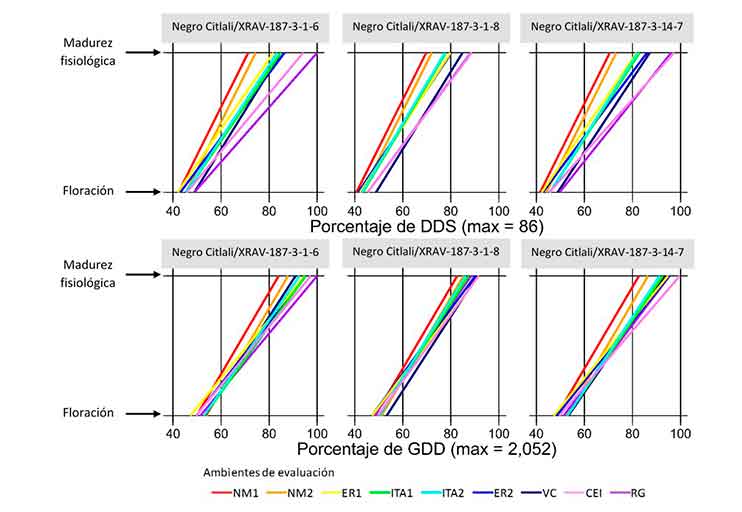
La caracterización fenológica de las variedades de frijol negro generadas por el Programa de Frijol del Instituto Nacional de Investigaciones Forestales, Agrícolas y Pecuarias para el sureste de México se realiza cuantificando el número de días después de siembra requerido para alcanzar las distintas etapas de desarrollo. Esta caracterización es imprecisa en ambientes contrastantes. El objetivo de este estudio fue caracterizar nueve líneas avanzadas y dos variedades de frijol negro opaco, utilizando el número de días después de siembra y el índice grados-días-de-desarrollo necesarios para alcanzar las etapas de floración y madurez fisiológica, además de comparar la precisión del número de días después de siembra y grados-días-de-desarrollo para predecir la fenología. Se cuantificaron el número de días después de siembra y grados-días-de-desarrollo requeridos por los genotipos para alcanzar las etapas de floración y madurez fisiológica en nueve ambientes del sureste de México. Se evaluó la capacidad de cinco modelos mixtos, considerando del número de días después de siembra, grados-días-de-desarrollo y el ambiente como efectos fijos y el genotipo como efecto aleatorio, para predecir las etapas fenológicas de las líneas y variedades. Cuatro líneas fueron más precoces que Negro Grijalva (1 892 grados-días-de-desarrollo), con un promedio de 1 859 grados-días-de-desarrollo, mientras que otras cuatro obtuvieron un promedio de 1 902 grados-días-de-desarrollo, valor superior a Negro Grijalva pero inferior a Negro Comapa (1 920 grados-días-de-desarrollo) y sólo una línea fue más tardía que ambas variedades (1 976 grados-días-de-desarrollo). El mejor modelo para predecir la fenología fue el que consideró únicamente los grados-días-de-desarrollo, sin importar el ambiente. Se concluyó que los grados-días-de-desarrollo son más precisos que el número de días después de siembra para predecir la floración y madurez fisiológica de los genotipos en los distintos ambientes de evaluación.
Descargas
Referencias
Ahmad, L.; Habib-Kanth, R.; Parvaze, S. and Sheraz-Mahdi, S. 2017. Growing degree days to forecast crop stages. In: Ahmad, L.; Habib Kanth, R.; Parvaze, S. and Sheraz Mahdi, S. Ed. Experimental agrometeorology: a practical manual. Springer, Cham. Cham, Switzerland. 95-98 pp.
Akaike, H. 1998. A Bayesian analysis of the minimum AIC procedure. In: Parzen, E.; Tanabe, K. and Kitagawa, G. Ed. Selected papers of hirotugu akaike. Springer, New York, NY. 275-280 pp.
Bonhomme, R. 2000. Bases and limits to using ‘degree day’ units. Eur. J. Agron. 13(1):1-10. https://doi.org/10.1016/S1161-0301(00)00058-7.
Fernández, F.; Gepts, P. y López, M. 1986. Etapas de desarrollo de la planta de frijol común (Phaseolus vulgaris L.). Centro Internacional de Agricultura Tropical (CIAT). Cali, Colombia. 7-33 pp.
FIRA. 2016. Fideicomiso Instituido en Relación a la Agricultura. Panorama agroalimentario. Dirección de Investigación y Evaluación Económica y Sectorial. Frijol. FIRA. México. 11-13 pp.
López, S. E.; Tosquy, V. O. H.; Acosta, G. J. A.; Villar, S. B. and Ugalde, A. F. J. 2011b. Drought resistance of tropical dry black bean lines and cultivars. Trop. Subtrop. Agroecosyst. 14(2):749-755.
López, S. E.; Tosquy, V. O. H.; Jiménez, H. Y.; Salinas, P. R. A.; Villar, S. B. y Acosta, G. J. A. 2012. Rendimiento y adaptación de la variedad de frijol Negro Comapa en dos regiones de México. Revista Fitotecnia Mexicana. 35(4):309-315. https://doi.org/10.35196/rfm.2012.4.309.
Neukam, D.; Ahrends, H.; Luig, A.; Manderscheid, R. and Kage, H. 2016. Integrating wheat canopy temperatures in crop system models. Agronomy 6(1):7-19. https://doi.org/10.3390/agronomy6010007.
Paleari, L.; Vesely, F. M.; Ravasi, R. A.; Movedi, E.; Tartarini, S.; Invernizzi, M. and Confalonieri, R. 2020. Analysis of the similarity between in silico ideotypes and phenotypic profiles to support cultivar recommendation-a case study on Phaseolus vulgaris. L. Agronomy 10(11):1733-20. https://doi.org/10.3390/agronomy10111733.
Rai, A.; Sharma, V. and Heitholt, J. 2020. Dry bean [Phaseolus vulgaris L.] growth and yield response to variable irrigation in the arid to semi-arid climate. Sustainability 12(9):3851-25. https://doi.org/10.3390/su12093851.
Salazar-Gutierrez, M. R.; Johnson, J.; Chaves-Cordoba, B. and Hoogenboom, G. 2013. Relationship of base temperature to development of winter wheat. International Journal of Plant Production. 7(4):741-762. https://dx.doi.org/10.22069/ijpp.2013.1267.
Seguin, B. and Itier, B. 1983. Using midday surface temperature to estimate daily evaporation from satellite thermal IR data. Int. J. Remote Sens. 4(2):371-383. https://doi.org/10.1080/01431168308948554.
Tosquy, V. O. H.; López, S. E.; Francisco, N. N.; Acosta, G. J. A. y Villar, S. B. 2014. Genotipos de frijol negro opaco resistentes a sequía terminal. Revista Mexicana de Ciencias Agrícolas. 5(7):1205-1217. https://doi.org/10.29312/remexca.v5i7.866.
Tosquy, V. O. H.; Villar, S. B.; Rodríguez, R. J. R.; Ibarra, P. F. J.; Zetina, L. R.; Meza, P. A. y Anaya-López, J. L. 2019. Adaptación de genotipos de frijol negro a diferentes ambientes de Veracruz y Chiapas. Revista Mexicana de Ciencias. Agrícolas. 10(6):1301-1312. https://doi.org/10.29312/remexca.v10i6.1658.
Villar, S. B.; López, S. E. y Tosquy, V. O. H. 2009. Negro Grijalva, nuevo cultivar de frijol para el trópico húmedo de México. Agricultura Técnica en México. 35(3):349-352.
Weijers, S.; Pape, R.; Löffler, J. and Myers-Smith, I. H. 2018. Contrasting shrub species respond to early summer temperatures leading to correspondence of shrub growth patterns. Environmental Research Letters. 13(3):1-11. http://dx.doi.org/10.1088/1748-9326/aaa5b8.
Willmott, C. J. and Matsuura, K. 2005. Advantages of the mean absolute error (MAE) over the root mean square error (RMSE) in assessing average model performance. Clim. Res. 30(1):79-82. http://dx.doi.org/10.3354/cr030079.
Willmott, C. J.; Matsuura, K. and Robeson, S. M. 2009. Ambiguities inherent in sums-of-squares-based error statistics. Atmos. Environ. 43(3):749-752. https://doi.org/10.1016/j.atmosenv.2008.10.005.
Descargas
Publicado
Número
Sección
Licencia
Derechos de autor 2026 Revista Mexicana de Ciencias Agrícolas

Esta obra está bajo una licencia internacional Creative Commons Atribución-NoComercial 4.0.
Los autores(as) que publiquen en Revista Mexicana de Ciencias Agrícolas aceptan las siguientes condiciones:
De acuerdo con la legislación de derechos de autor, Revista Mexicana de Ciencias Agrícolas reconoce y respeta el derecho moral de los autores(as), así como la titularidad del derecho patrimonial, el cual será cedido a la revista para su difusión en acceso abierto.
Los autores(as) deben de pagar una cuota por recepción de artículos antes de pasar por dictamen editorial. En caso de que la colaboración sea aceptada, el autor debe de parar la traducción de su texto al inglés.
Todos los textos publicados por Revista Mexicana de Ciencias Agrícolas -sin excepción- se distribuyen amparados bajo la licencia Creative Commons 4.0 atribución-no comercial (CC BY-NC 4.0 internacional), que permite a terceros utilizar lo publicado siempre que mencionen la autoría del trabajo y a la primera publicación en esta revista.
Los autores/as pueden realizar otros acuerdos contractuales independientes y adicionales para la distribución no exclusiva de la versión del artículo publicado en Revista Mexicana de Ciencias Agrícolas (por ejemplo incluirlo en un repositorio institucional o darlo a conocer en otros medios en papel o electrónicos) siempre que indique clara y explícitamente que el trabajo se publicó por primera vez en Revista Mexicana de Ciencias Agrícolas.
Para todo lo anterior, los autores(as) deben remitir el formato de carta-cesión de la propiedad de los derechos de la primera publicación debidamente requisitado y firmado por los autores(as). Este formato debe ser remitido en archivo PDF al correo: revista_atm@yahoo.com.mx; revistaagricola@inifap.gob.mx.
Esta obra está bajo una licencia de Creative Commons Reconocimiento-No Comercial 4.0 Internacional.