Atributos de calidad física, química, sensorial y estabilidad microbiológica de muffins con harina de Jatropha curcas L. comestible no tóxico
DOI:
https://doi.org/10.29312/remexca.v17i7.4224Palabras clave:
genotipo no tóxico, panificación, proteína, recursos subutilizadosResumen
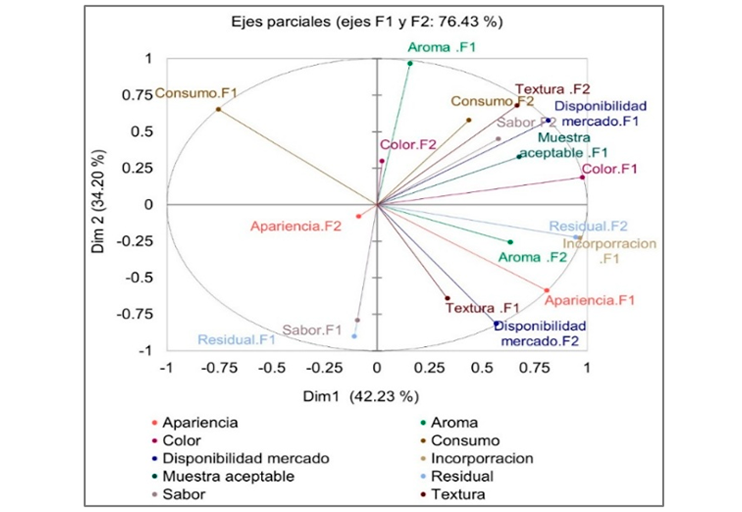
El genotipo comestible no tóxico de Jatropha curcas L. es un recurso subutilizado con potencial para diversificar los sistemas agroalimentarios tropicales. Se evaluó la sustitución parcial de harina de trigo por harina desgrasada de J. curcas sobre la calidad fisicoquímica, sensorial y estabilidad microbiológica de muffins almacenados a 4 °C. En 2024 se colectó material en Pueblillo, Papantla, Veracruz. La harina se obtuvo por extracción Soxhlet con hexano y se formularon muffins con 0, 5, 10 y 15% de sustitución. Se evaluaron la composición proximal, actividad de agua, color, estabilidad microbiológica y aceptación sensorial de muffien 150 consumidores. Las determinaciones se realizaron por triplicado; los datos se analizaron mediante Anova y prueba deTukey (α= 0.05) y los sensoriales; además, mediante análisis factorial múltiple. La proteína aumentó de 9.57 a 12.06% y las cenizas de 1.59 a 2.66%, los lípidos variaron de 21.64 a 24.91%, con respuesta no lineal. La humedad y la actividad de agua no variaron significativamente. M-5 y M-10 presentaron tonos rojizos y amarillos más intensos, M-15 conservó un color amarillo claro similar al testigo. Los recuentos microbianos fueron <1 log UFC g-1 durante seis días a 4 °C, los muffins mostraron aceptación sensorial favorable en todos los tratamientos. En las condiciones evaluadas, sustituir hasta 15% de harina de trigo por harina desgrasada de J. curcas aumentó el contenido proteico sin comprometer la aceptación sensorial ni la estabilidad microbiológica.
Descargas
Referencias
Alemán-Huerta, M. E.; Castillo-Cázares, B. A.; Márquez-Reyes, J. M.; Báez-González, J. G.; Quintero-Zapata, I.; Gandarilla-Pacheco, F. L.; de Luna-Santillana, E. J. and Treviño-Garza, M. Z. 2023. Muffin-type bakery product based on Mexican mesquite (Prosopis spp.) flour: texture profile, acceptability and physicochemical properties. Suiza. Foods. 12(19):3587. https://doi.org/10.3390/foods12193587.
Alpers, T.; Kerpes, R.; Frioli, M.; Nobis, A.; Hoi, K. I.; Bach, A.; Jekle, M. and Becker, T. 2021. Impact of storing condition on staling and microbial spoilage behavior of bread and their contribution to prevent food waste. Suiza. Foods. 10(1):76. https://doi.org/10.3390/foods10010076.
AOAC. 2000. Association of official analytical chemists. Official methods of analysis of AOAC International. AOAC International. 17th. Edition. Gaithersburg, Maryland, EE. UU. 1-30 pp. https://www.aoac.org/official-methods-of-analysis/.
Argüello-García, E.; Córdova-Téllez, L.; Martínez-Herrera, J.; Sánchez-Sánchez, O.; Pérez-Herrera, P. and Zaldívar-Cruz, J. M. 2020. Rheological, chemical and sensory characterization of fortified cookies with edible flour of Xuta (Jatropha curcas L.). Alemania. Journal of Food Science and Technology. 57(9):3502-3508. https://doi.org/10.1007/s13197-020-04385-7.
Argüello-García, E.; Martínez-Herrera, J.; Córdova-Téllez, L.; Sánchez-Sánchez, O. and Corona-Torres, T. 2017. Textural, chemical and sensorial properties of maize tortillas fortified with nontoxic Jatropha curcas L. flour. Reino Unido. CyTA-Journal of Food. 15(2):301-306. https://doi.org/10.1080/19476337.2016.1255915.
CIOMS. 2016. Council for international organizations of medical sciences. International ethical guidelines for health-related research involving humans. 4th. Edition. Geneva, Switzerland. Council for International Organizations of Medical Sciences. 34-38 pp. https://doi.org/10.56759/rgxl7405.
Figueroa-Saavedra, M.; Montero, L. and Sánchez-Sánchez, O. 2020. Aproximación etnohistórica sobre el uso y semidomesticación de la Xuta (Jatropha curcas L.) en la Nueva España. Relaciones. Estudios de Historia y Sociedad. 41(162):62-85. https://doi.org/10.24901/rehs.v41i162.790.
Grasso, S.; Liu, S. and Methven, L. 2020. Quality of muffins enriched with upcycled defatted sunflower seed flour. Reino Unido. LWT-Food Science and Technology. 119:108893. https://doi.org/10.1016/j.lwt.2019.108893.
Grünwald, M.; Adrar, N.; Francis, G.; Rugen, N.; Döring, M.; Braun, H. P. and Esatbeyoglu, T. 2026. A comparative study of the nutritional and physiological potential of Xuta (edible Jatropha curcas L.) protein: insights into its digestibility and effects on the intestinal barrier. Paises Bajos. Current Research in Food Science. 12:101257. https://doi.org/10.1016/j.crfs.2025.101257.
Heo, Y.; Kim, M. J.; Lee, J. W. and Moon, B. K. 2019. Muffins enriched with dietary fiber from kimchi byproduct: baking properties, physical-chemical properties and consumer acceptance. Estados Unidos. Food Science and Nutrition. 7(5):1778-1785. https://doi.org/10.1002/fsn3.1020.
INEGI. 2025. Instituto Nacional de Estadística y Geografía. Climatología. México. Instituto Nacional de Estadística y Geografía. https://www.inegi.org.mx/temas/climatologia/.
Martínez-Herrera, J.; Argüello-García, E.; Sánchez-Sánchez, O. and Valdés-Rodríguez, O. A. 2017. Fortification of hotcakes from edible flour of non-toxic Mexican Jatropha curcas L. African Journal of Food Science. 11(4):106-111. https://doi.org/10.5897/AJFS2016.1551.
Martínez-Herrera, J.; Siddhuraju, P.; Francis, G.; Dávila-Ortiz, G. and Becker, K. 2006. Chemical composition, toxic/antimetabolic constituents and effects of different treatments on their levels, in four provenances of Jatropha curcas L. from Mexico. Países Bajos. Food Chemistry. 96(1):80-89. https://doi.org/10.1016/j.foodchem.2005.01.059.
NOM-092-SSA1-1994. 1994. Bienes y servicios. Método para la cuenta de bacterias aerobias en placa. México. Diario Oficial de la Federación. https://dof.gob.mx/nota-detalle.php?codigo=4886029.
NOM-110-SSA1-1994. 1994. Bienes y servicios. Preparación y dilución de muestras de alimentos para su análisis microbiológico. México. Diario Oficial de la Federación. http://www.ordenjuridico.gob.mx/Documentos/Federal/wo69533.pdf.
NOM-111-SSA1-1994. 1994. Bienes y servicios. Método para la cuenta de mohos y levaduras en alimentos. México. Diario Oficial de la Federación. https://dof.gob.mx/nota-detalle.php?codigo=4881226.
NOM-113-SSA1-1994. 1994. Bienes y servicios. Método para la cuenta de microorganismos coliformes totales en placa. México. Diario Oficial de la Federación. http://www.ordenjuridico.gob.mx/Documentos/Federal/wo69536.pdf.
Ozuna, C.; Trueba-Vázquez, E.; Moraga, G.; Llorca, E. and Hernando, I. 2020. Agave syrup as an alternative to sucrose in muffins: impacts on rheological, microstructural, physical and sensorial properties. Suiza. Foods. 9(7):895. https://doi.org/10.3390/foods9070895.
Pareyt, B.; Finnie, S. M.; Putseys, J. A. and Delcour, J. A. 2011. Lipids in bread making: sources, interactions and impact on bread quality. Journal of Cereal Science. 54(3):266-279. https://doi.org/10.1016/j.jcs.2011.08.011.
Paulos, M. 2024. Morphological characterization of pigeon pea [Cajanus cajan (L.) Millspaugh] accessions for agronomic traits in Assosa district, northwestern Ethiopia. México. Tropical and Subtropical Agroecosystems. 27(1):1-12. http://doi.org/10.56369/tsaes.5681.
Peryam, D. R. and Pilgrim, F. J. 1957. Hedonic scale method of measuring food preferences. Food Technology. 11(9):9-14.
Salazar, D; Arancibia, M.; Silva, D. R.; López-Caballero, M. E. and Montero, M. P. 2021. Exploring the potential of Andean crops to produce gluten-free muffins. Suiza. Agronomy. 11(8):1642. https://doi.org/10.3390/agronomy11081642.
Sánchez-Chino, X. M.; Corzo-Ríos, L. J.; Martínez-Herrera, J.; Cardador-Martínez, A. and Jiménez-Martínez, C. 2019. Effect of thermal treatment on the extraction efficiency, physicochemical quality of Jatropha curcas oil and biological quality of its proteins. India. Journal of Food Science and Technology. 56(3):1567-1574. https://doi.org/10.1007/s13197-019-03666-0.
Senger, E.; Bohlinger, B.; Esgaib, S.; Hernández-Cubero, L. C.; Montes, J. M. and Becker, K. 2017. Chuta (edible Jatropha curcas L.), the newcomer among underutilized crops: a rich source of vegetable oil and protein for human consumption. Alemania. European Food Research and Technology. 243(6):987-997. https://doi.org/10.1007/s00217-016-2814-x.
Talucder, M. S. A.; Ruba, U. B. and Robi, M. A. S. 2024. Potentiality of neglected and underutilized species (NUS) as a future resilient food: a systematic review. Países Bajos. Journal of Agriculture and Food Research. 16:101116. https://doi.org/10.1016/j.jafr.2024.101116.
Tsykhanovska, I.; Stabnikova, O.; Riabchykov, M.; Lazarieva, T. and Korolyova, N. 2024. Effect of partial replacement of wheat flour with extruded sunflower seed flour on muffin quality. Plant Foods for Human Nutrition. 79(4):769-778. https://doi.org/10.1007/s11130-024-01232-4.
Zielińska, E.; Pankiewicz, U. and Sujka, M. 2021. Nutritional, physiochemical, and biological value of muffins enriched with edible insect’s flour. Antioxidants. 10(7):1122. https://doi.org/10.3390/antiox10071122.
Descargas
Publicado
Número
Sección
Licencia
Derechos de autor 2026 Revista Mexicana de Ciencias Agrícolas

Esta obra está bajo una licencia internacional Creative Commons Atribución-NoComercial 4.0.
Los autores(as) que publiquen en Revista Mexicana de Ciencias Agrícolas aceptan las siguientes condiciones:
De acuerdo con la legislación de derechos de autor, Revista Mexicana de Ciencias Agrícolas reconoce y respeta el derecho moral de los autores(as), así como la titularidad del derecho patrimonial, el cual será cedido a la revista para su difusión en acceso abierto.
Los autores(as) deben de pagar una cuota por recepción de artículos antes de pasar por dictamen editorial. En caso de que la colaboración sea aceptada, el autor debe de parar la traducción de su texto al inglés.
Todos los textos publicados por Revista Mexicana de Ciencias Agrícolas -sin excepción- se distribuyen amparados bajo la licencia Creative Commons 4.0 atribución-no comercial (CC BY-NC 4.0 internacional), que permite a terceros utilizar lo publicado siempre que mencionen la autoría del trabajo y a la primera publicación en esta revista.
Los autores/as pueden realizar otros acuerdos contractuales independientes y adicionales para la distribución no exclusiva de la versión del artículo publicado en Revista Mexicana de Ciencias Agrícolas (por ejemplo incluirlo en un repositorio institucional o darlo a conocer en otros medios en papel o electrónicos) siempre que indique clara y explícitamente que el trabajo se publicó por primera vez en Revista Mexicana de Ciencias Agrícolas.
Para todo lo anterior, los autores(as) deben remitir el formato de carta-cesión de la propiedad de los derechos de la primera publicación debidamente requisitado y firmado por los autores(as). Este formato debe ser remitido en archivo PDF al correo: revista_atm@yahoo.com.mx; revistaagricola@inifap.gob.mx.
Esta obra está bajo una licencia de Creative Commons Reconocimiento-No Comercial 4.0 Internacional.