Efecto de paclobutrazol en la densidad estomática y altura de Chenopodium quinoa
DOI:
https://doi.org/10.29312/remexca.v17i6.4150Palabras clave:
área del poro estomático, células epidérmicas, número de estomas, Suyana, TunkahuanResumen
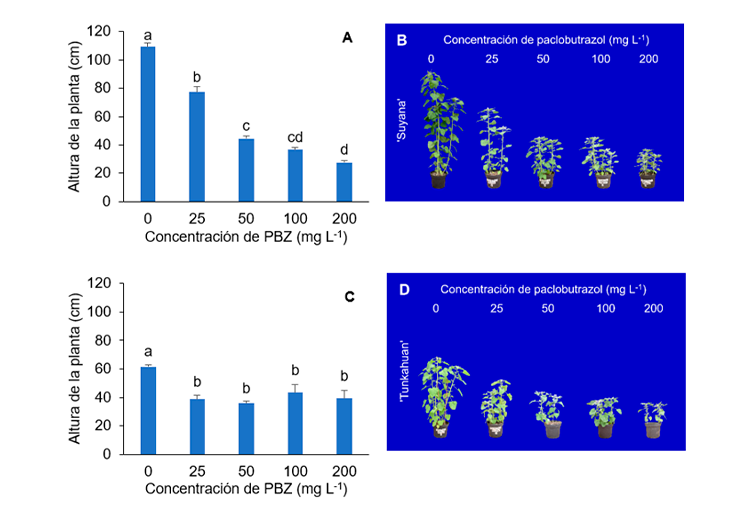
Paclobutrazol (PBZ) es un retardante del crecimiento que, además de reducir la altura de las plantas, podría incrementar la densidad estomática y el área del poro. En esta investigación se evaluó el efecto de cinco concentraciones de PBZ en el número de estomas, área del poro estomático, altura de las plantas y apariencia visual de Chenopodium quinoa cv. Suyana y Tunkahuan. El experimento se realizó de julio a diciembre de 2024 en la Facultad de Estudios Superiores Iztacala, UNAM. La siembra se realizó en 50 macetas con 2.5 L de peat moss:agrolita (1:1). A los 25 días se realizó el aclareo y se aplicaron de manera foliar los tratamientos siguientes: 0, 25, 50, 100 y 200 mg L-1 de PBZ. Al número de estomas y área del poro se les aplicó análisis de varianza de un factor y pruebas de comparación de medias (Tukey, p≤ 0.05). Los resultados mostraron que las células epidérmicas de ambas superficies foliares tuvieron paredes anticlinales con contornos sinuosos y estomas de tipo anomocítico. ‘Suyana’ tuvo mayor altura (109.25 cm), más estomas mm-2 (98.4) y poros más grandes (21.28 µm2) que ‘Tunkahuan’. La aplicación de PBZ incrementó el número de estomas y la apertura del poro estomático a partir de 25 mg L-1 y fue más acentuado con 100 o 200 mg L-1. PBZ también redujo la altura de las plantas y las tornó más coloridas para un posible uso ornamental.
Descargas
Referencias
Aguilar-Rodríguez, S. 1998. Apéndice I. Técnicas de laboratorio para el estudio de las embriofitas. Plantae. Introducción al estudio de las plantas con embrión. Tejero, J. D.; Granillo, M. P. y Ávila, J. J. (Eds.). 2da. Ed. Universidad Nacional Autónoma de México (UNAM). México, DF. 247-272 pp.
Buedo, S. E.; Mercado, M. I. y González, J. A. 2024. Caracterización fotosintética y anatomía foliar de Chenopodium album y Ch. hircinum (Chenopodiaceae) en un valle de altura del noroeste Argentino. Boletín de la Sociedad Argentina de Botánica. 59(1):13-25. https://doi.org/10.31055/1851.2372.v59.n1.42881.
Espitia, R. E.; Rivas, V. P.; Valverde, R. M. G. y Sesma, H. F. 2023. Suyana, variedad de quinua para los valles altos de México. Reporte anual 2022 ciencia y tecnología para el campo mexicano. https://www.gob.mx/cms/uploads/attachment/file/836561/formato-reporte-anual-2022-edomex.pdf.
Gaafar, A. 2019. Morphology and stem anatomy of Chenopodium species from Egyptian Flora. Egyptian Journal of Botany. 59(1):53-58. https://doi.org/10.21608/ejbo.2018.4699.1193.
García-Parra, M. A.; Amado-Rodríguez J. L. and Hernández-Criado, J. C. 2024. Photosynthetic capacity, phenology, yield and chemical composition of seeds of three cultivars of quinoa (Chenopodium quinoa Willd.). Revista Colombiana de Ciencias Hortícolas. 18(2):e17524. https://doi.org/10.17584/rcch.2024v18i2.17524.
González, J. A.; Mercado, M. I.; Martínez-Calsina, L.; Erazzú, L. E.; Buedo, S. E.; González, D. A. and Ponessa, G. I. 2022. Plant density effects on quinoa yield, leaf anatomy, ultrastructure and gas exchange. The Journal of Agricultural Science. 160(5):349-359. https://doi.org/10.1017/S0021859622000533.
González, J. A.; Ponessa, G. I.; Buedo, S.; Mercado, M. I. and Prado, F. E. 2014. Asimilación fotosintética máxima en variedades de quinoa (Chenopodium quinoa) de diferentes orígenes geográficos y su relación con la morfología foliar. Lilloa. 51(2):177-193. https://ri.conicet.gov.ar/handle/11336/12428.
Hussain, M. I.; Farooq, M.; Syed, Q. A.; Ishaq, A.; Al-Ghamdi, A. A. and Hatamleh, A. A. 2021. Botany, nutritional value, phytochemical composition and biological activities of quinoa. Plants. 10(11):2258. https://doi.org/10.3390/plants10112258.
Martinez, R. M.; Melo, C. P.; Pinto, I. C.; Mendes-Pierotti, S.; Vignoli, J. A.; Verri, W. A. and Casagrande, R. 2024. Betalains: a narrative review on pharmacological mechanisms supporting the nutraceutical potential towards health benefits. Foods. 13(23):3909. https://doi.org/10.3390/foods13233909.
Martínez-Villaluenga, C.; Peñas, E. and Hernández-Ledesma, B. 2020. Pseudocereal grains: nutritional value, health benefits and current applications for the development of gluten-free foods. Food and Chemical Toxicology. 137:111178. https://doi.org/10.1016/j.fct.2020.111178.
Nowak, V.; Du, J. and Charrondière, R. 2016. Assessment of the nutritional composition of quinoa (Chenopodium quinoa Willd.). Food Chemistry. 193:47-54. https://doi.org/10.1016/j.foodchem.2015.02.111.
Panteris, E. and Adamakis, I. D. S. 2022. Double puzzle: morphogenesis of the bi-layered leaf adaxial epidermis of magnolia grandiflora. Plants. 11:3437. https://doi.org/10.3390/plants11243437.
Rademacher, W. 2000. Growth retardants: effects on gibberellin biosynthesis and other metabolic pathways. Annual review of plant biology. 51(1):501-531. https://doi.org/10.1146/annurev.arplant.51.1.501.
Rasouli, F.; Kiani-Pouya, A.; Movahedi, A.; Wang, Y.; Li, L.; Yu, M.; Pourkheirandish, M.; Zhou, M.; Chen, Z.; Zhang, H. and Shabala, S. 2023. Guard cell transcriptome reveals membrane transport, stomatal development and cell wall modifications as key traits involved in salinity tolerance in halophytic Chenopodium quinoa. Plant and Cell Physiology. 64(2):204-220. https://doi.org/10.1093/pcp/pcac158.
Rios-Florida, L. G.; De La Cruz-Guzmán, G. H.; Arriaga-Frías, A. and Mandujano-Piña, M. 2022. Efecto de Paclobutrazol y Glomus intraradices en el cultivo de Lilium cv. Armandale y Tresor. Siembra. 9(2):e3978. https://doi.org/10.29166/siembra.v9i2.3978.
Romero-Benavides, J. C.; Guaraca-Pino, E.; Duarte-Casar, R.; Rojas-Le-Fort, M. and Bailon-Moscoso, N. 2023. Chenopodium quinoa Willd. and Amaranthus hybridus L.: ancestral Andean food security and modern anticancer and antimicrobial activity. Pharmaceuticals. 16(12):1728. https://doi.org/10.3390/ph16121728.
Sapala, A.; Runions, A.; Routier-Kierzkowska, A. L.; Gupta, M. D.; Hong, L.; Hofhuis, H.; Verger, S.; Mosca, G.; Li, C. B.; Hay, A.; Hamant, O.; Roeder, A. H.; Tsiantis, M.; Prusinkiewicz, P. and Smith, R. S. 2018. Why plants make puzzle cells, and how their shape emerges. Elife. 27(7):e32794. https://doi.org/10.7554/eLife.32794.
SAS Institute Inc. 2013. Statistical Analysis Software. Versión 9.0 Cary, NC., USA. http://www.sas.com/en us/software/analytics/stat.html.
Shevchuk, O. A.; Tkachuk, O. O.; Kuryata, V. G.; Khodanitska, O. O. and Polyvanyi, S. V. 2019. Features of leaf photosynthetic apparatus of sugar beet under retardants treatment. Ukrainian Journal of Ecology. 9(1):115-120. https://vsau.vin.ua/repository/getfile.php/20152.pdf.
Srinivasan, A. 2017. Effect of pigments, phenol content and postharvest life on application of plant growth retardants in Celosia Spp. Chem. Sci. Rev. Lett. 6(23):1769-1772.
Steiner, A. A. 1961. A universal method for preparing nutrient solutions of a certain desired composition. Plant Soil. 15(2):134-154. https://doi.org/10.1007/BF01347224.
Taiz, L. and Zeiger, E. 2010. Plant physiology. 5th. Ed. Sinauer Associates Inc. Sunderland, UK. 782 p.
Tantawy, M. E.; Salim, M. A.; Bayoumy, A. and Mohamed, A. H. 2023. Taxonomic significance of stem, lamina and epidermal micro-characters in understanding Chenopodiaceae and Amaranthaceae alliance. Pakistan Journal of Botany. 55(1):277-289. https://doi.org/10.1007/BF01347224.
Torres-Pio, K.; De la Cruz-Guzmán, G. H.; Arévalo-Galarza, M. D. L.; Aguilar-Rodríguez, S.; Grego-Valencia, D.; Arriaga-Frías, A. and Mandujano-Piña, M. 2021. Morphological and anatomical changes in Lilium cv. Arcachon in response to plant growth regulators. Horticulture, Environment, and Biotechnology. 62(3):325-335. https://doi.org/10.1007/s13580-020-00319-6.
Velasco-Lara, D.; Cruz-Guzmán, G. H. D. L.; Mandujano-Piña, M.; Arriaga-Frías, A. y Ramírez-Santiago, D. 2024. Dosis de paclobutrazol para modificar el aspecto visual de Lilium cv. Litouwen. Revista Mexicana de Ciencias Agrícolas. 15(3): e3662. https://doi.org/10.29312/remexca.v15i3.3662.
Vőfély, R. V.; Gallagher, J.; Pisano, G. D.; Bartlett, M. and Braybrook, S. A. 2019. Of puzzles and pavements: a quantitative exploration of leaf epidermal cell shape. New Phytologist. 221(1):540-552. https://doi.org/10.1111/nph.15461.
Waqas, M.; Yaning, C.; Iqbal, H.; Shareef, M.; Rehman, H. and Bilal, H. M. 2021. Synergistic consequences of salinity and potassium deficiency in quinoa: Linking with stomatal patterning, ionic relations and oxidative metabolism. Plant Physiology and Biochemistry. 159:17-27. https://doi.org/10.1016/j.plaphy.2020.11.043.
Waqas, M.; Yaning, C.; Iqbal, H.; Shareef, M.; Rehman, H. and Yang, Y. 2017. Paclobutrazol improves salt tolerance in quinoa: beyond the stomatal and biochemical interventions. Journal of Agronomy and Crop Science. 203(4):315-322. https://doi.org/10.1111/jac.12217.
Xia, X.; Tang, Y.; Wei, M. and Zhao, D. 2018. Effect of paclobutrazol application on plant photosynthetic performance and leaf greenness of herbaceous peony. Horticulturae. 4(1):5. https://doi.org/10.3390/horticulturae4010005.
Xie, H.; Zeng, J.; Feng, W.; Gao, W.; Lai, Z. and Liu, S. 2025. Differential expression of amaranth AtrDODA gene family members in betalain synthesis and functional analysis of AtrDODA1-1 promoter. Plants. 14:454. https://doi.org/10.3390/plants14030454.
Xiong, D. and Flexas, J. 2020. From one side to two sides: the effects of stomatal distribution on photosynthesis. New Phytologist. 228(6):1754-1766. https://doi.org/10.1111/nph.16801.
Descargas
Publicado
Número
Sección
Licencia
Derechos de autor 2026 Revista Mexicana de Ciencias Agrícolas

Esta obra está bajo una licencia internacional Creative Commons Atribución-NoComercial 4.0.
Los autores(as) que publiquen en Revista Mexicana de Ciencias Agrícolas aceptan las siguientes condiciones:
De acuerdo con la legislación de derechos de autor, Revista Mexicana de Ciencias Agrícolas reconoce y respeta el derecho moral de los autores(as), así como la titularidad del derecho patrimonial, el cual será cedido a la revista para su difusión en acceso abierto.
Los autores(as) deben de pagar una cuota por recepción de artículos antes de pasar por dictamen editorial. En caso de que la colaboración sea aceptada, el autor debe de parar la traducción de su texto al inglés.
Todos los textos publicados por Revista Mexicana de Ciencias Agrícolas -sin excepción- se distribuyen amparados bajo la licencia Creative Commons 4.0 atribución-no comercial (CC BY-NC 4.0 internacional), que permite a terceros utilizar lo publicado siempre que mencionen la autoría del trabajo y a la primera publicación en esta revista.
Los autores/as pueden realizar otros acuerdos contractuales independientes y adicionales para la distribución no exclusiva de la versión del artículo publicado en Revista Mexicana de Ciencias Agrícolas (por ejemplo incluirlo en un repositorio institucional o darlo a conocer en otros medios en papel o electrónicos) siempre que indique clara y explícitamente que el trabajo se publicó por primera vez en Revista Mexicana de Ciencias Agrícolas.
Para todo lo anterior, los autores(as) deben remitir el formato de carta-cesión de la propiedad de los derechos de la primera publicación debidamente requisitado y firmado por los autores(as). Este formato debe ser remitido en archivo PDF al correo: revista_atm@yahoo.com.mx; revistaagricola@inifap.gob.mx.
Esta obra está bajo una licencia de Creative Commons Reconocimiento-No Comercial 4.0 Internacional.