Crecimiento y asimilación de CO2 de Agave potatorum Zucc. abastecidas a diferentes niveles nutrimentales
DOI:
https://doi.org/10.29312/remexca.v17i4.4358Palabras clave:
área foliar, fotosíntesis, plantas micropropagadas, solución nutritivaResumen
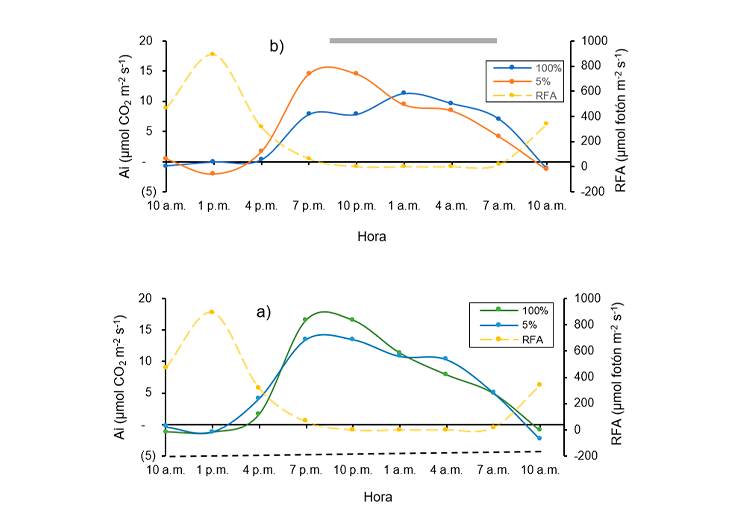
In the state of Oaxaca, Mexico, Agave potatorum is collected from wild populations or propagated by seeds in small areas and used to make the distilled beverage mezcal. The species has been propagated in vitro, and the resulting plants are transplanted into a substrate for 90 days of acclimatization, then established in a greenhouse for 12 months to reach a larger size; likewise, fertilizing the plants has improved their growth. The objective was to evaluate the leaf area and CO2 assimilation rate of micropropagated-acclimatized plants fertigated with California (Cal) or Steiner (St) nutrient solutions. Plants fertigated with Cal-5% and Cal-100% had 20.8 and 27.7 leaves, leaf areas of 1 031.5 cm2 and 1 867.4 cm2, rosette diameters of 37 and 52.3 cm, and heights of 19.5 and 29.5 cm, respectively. Stomatal opening and CO2 assimilation began at 16:00 h as photosynthetically active radiation decreased, reaching maximum assimilation values between 19:00 and 22:00 h. Plants fertigated with Cal-100% and St-100% showed CO2 assimilation values of 17 and 11 μmol CO2 m-2 s-1, respectively.
Descargas
Referencias
Badr, A. and Brüggemann, W. 2020. Comparative analysis of drought stress response of maize genotypes using chlorophyll fluorescence measurements and leaf relative water content. Photosynthetica. 58(SI):638-645. https://doi.org/10.32615/ps.2020.014.
Bautista-Castellanos, A. I.; Enríquez-del Valle, J. R.; Velasco-Velasco, V. A. y Rodríguez-Ortiz, G. 2020. Enraizado y aclimatación de Agave potatorum. Ecosistemas y Recursos Agropecuarios. 7(3):e2618. https://doi.org/10.19136/era.a7n3.2618.
Carrillo-Hernández, M. A.; Viguera, A. L. y Portillo, L. 2014. Observaciones sobre el comportamiento de estomas en plantas suculentas. Boletín Nakari. 25(2):27-30.
Cen-Cen, E.; Gómez-Merino, F. y Martínez- Hernández, A. 2015. Tolerancia de Agave tequilana a altas concentraciones de cationes metálicos divalentes. Polibotánica. 40(20):163-182.
Correa-Hernández, L.; Baltazar-Bernal, O.; Sánchez-Páez, R. and Bello-Bello, J. J. 2022. In vitro multiplication of agave tobala (Agave potatorum Zucc.) using ebb-and-flow bioreactor. South African Journal of Botany. 147:670-677. https://doi.org/10.1016/j.sajb.2022.03.009.
Cruz-García, H.; Campos-Ángeles, G. V.; Enríquez-del Valle, J. R.; Velasco-Velasco, V. A. y Rodríguez-Ortiz, G. 2017. Senescencia foliar en plantas micropropagadas de Agave americana durante su aclimatización. Revista Mexicana de Ciencias Agrícolas. 8(2):381-391.
Efthimiadou, A.; Bilalis, D.; Karkanis, A. and Froud-Williams, B. 2010. Combined organic/inorganic fertilization enhances soil quality and increased yield, photosynthesis and sustainability of sweet maize crops. Australian Journal of Crop Science. 4(9):722-729.
Enríquez-del Valle, J. R. 2008. La propagación y crecimiento de agaves. Fundación Produce Oaxaca AC. e Instituto Tecnológico del Valle de Oaxaca. México. 46 p.
Enríquez-del Valle, J. R.; Alcara-Vázquez, S. E.; Rodríguez-Ortiz, G.; Miguel-Luna, M. E. y Manuel-Vázquez, C. 2016. Fertirriego en vivero a plantas de Agave potatorum Zucc. micropropagadas-aclimatizadas. Revista Mexicana de Ciencias Agrícolas. 7(5):1167-1177.
Jarquín-Rosales, D.; Enríquez-del Valle, J. R.; Alpuche-Osorno, J. J.; Rodríguez-Ortiz, G.; Martin, M. P. and Campos-Ángeles, G. V. 2022. The effects of fertirrigation and Azospirillum brasilense inoculation on photosynthetic compounds of Agave angustifolia. Australian Journal of Crop Science. 16(01):162-168. https://doi.org/10.21475/ajcs.22.16.01.p3280.
Luna-Luna, S.; Enríquez-del Valle, J. R.; Rodríguez-Ortiz, G.; Carrillo-Rodríguez, J. C. y Velasco-Velasco, V. A. 2017. Anatomía y morfología de plantas micropropagadas-aclimatadas de Agave potatorum Zucc. fertirrigadas en vivero. Revista Fitotecnia Mexicana. 40(4):491-494.
Makino, A. 2011. Photosynthesis, grain yield, and nitrogen utilization in rice and wheat. Plant Physiology. 155(1):125-129.
Morales, I.; Martínez-Gutiérrez, G. A.; Cortés-Martínez, C. I.; Aquino-Bolaños, T.; Escamirosa-Tinoco, C. y Hernández-Tolentino, M. 2017. Crecimiento de Agave potatorum cultivado en ambientes contrastantes y fertirrigación. Revista Mexicana de Agroecosistemas. 4(2):18-27.
Nobel, P. S. 1976. Water relations and photosynthesis of a desert CAM plant, Agave deserti. Plant Physiol. 58(4):576-582.
Osipova, S. V.; Permyakov, A. V.; Permyakova, M. D.; Rudikovskaya, E. G.; Verchoturov, V. V. and Rudikovsky, A. V. 2019. Tolerance of the photosynthetic apparatus in recombinant lines of wheat adapting to water stress of varying intensity. Photosynthetica. 57(1):160-169. https://doi.org/10.32615/ps.2019.007.
Patishtán, P. J.; Rodríguez, G. R.; Zavala, G. F. y Jasso, C. D. 2010. Conductancia estomática y asimilación neta de CO2 en Sábila (Aloe vera Tourn.) bajo sequía. Revista Fitotecnia Mexicana. 33(4):305-314.
Pimienta-Barrios, E.; Zañudo-Hernández, J.; Nobel, P. y García-Galindo, J. 2005. Respuesta fisiológica a factores ambientales del agave azul (Agave tequilana Weber). Scientia-CUCBA. 7(2):85-97.
Pimienta-Barrios, E.; Zañudo-Hernández, J. y García-Galindo, J. 2006. Fotosíntesis estacional en plantas jóvenes de Agave tequilana. Agrociencia. 40(6):699-709.
Ramírez-Mosqueda, M. A.; Cárcamo-Corona, R. G.; Aguilar-Jiménez, D. and Bello-Bello J. J. 2022. Micropropagation of agave (Agave potatorum Zucc.) through direct organogénesis. Agrociencia. 56(6):1-11. https://doi.org/10.47163/agrociencia.v56i6.2823.
Sánchez-del Castillo, F. 1989. Hidroponia. Universidad Autónoma Chapingo. México. 194 p.
SAS Institute. 2022. The SAS system for Windows user´s guide. Release 9.4 SAS Institute. Cary, NC. USA. https://support.sas.com/en/documentation/install-center/94/installation-guide-forwindows.html.
Steiner, A. A. 1984. The universal nutrient solution. International society for soilless culture (ISOSC). In: Sixth International Congress on Soilless Culture Lunteren. 633-650 pp.
Descargas
Publicado
Número
Sección
Licencia
Derechos de autor 2026 Revista Mexicana de Ciencias Agrícolas

Esta obra está bajo una licencia internacional Creative Commons Atribución-NoComercial 4.0.
Los autores(as) que publiquen en Revista Mexicana de Ciencias Agrícolas aceptan las siguientes condiciones:
De acuerdo con la legislación de derechos de autor, Revista Mexicana de Ciencias Agrícolas reconoce y respeta el derecho moral de los autores(as), así como la titularidad del derecho patrimonial, el cual será cedido a la revista para su difusión en acceso abierto.
Los autores(as) deben de pagar una cuota por recepción de artículos antes de pasar por dictamen editorial. En caso de que la colaboración sea aceptada, el autor debe de parar la traducción de su texto al inglés.
Todos los textos publicados por Revista Mexicana de Ciencias Agrícolas -sin excepción- se distribuyen amparados bajo la licencia Creative Commons 4.0 atribución-no comercial (CC BY-NC 4.0 internacional), que permite a terceros utilizar lo publicado siempre que mencionen la autoría del trabajo y a la primera publicación en esta revista.
Los autores/as pueden realizar otros acuerdos contractuales independientes y adicionales para la distribución no exclusiva de la versión del artículo publicado en Revista Mexicana de Ciencias Agrícolas (por ejemplo incluirlo en un repositorio institucional o darlo a conocer en otros medios en papel o electrónicos) siempre que indique clara y explícitamente que el trabajo se publicó por primera vez en Revista Mexicana de Ciencias Agrícolas.
Para todo lo anterior, los autores(as) deben remitir el formato de carta-cesión de la propiedad de los derechos de la primera publicación debidamente requisitado y firmado por los autores(as). Este formato debe ser remitido en archivo PDF al correo: revista_atm@yahoo.com.mx; revistaagricola@inifap.gob.mx.
Esta obra está bajo una licencia de Creative Commons Reconocimiento-No Comercial 4.0 Internacional.