Materia seca e índice de cosecha como indicadores de producción en accesiones de yuca
DOI:
https://doi.org/10.29312/remexca.v17i6.4207Palabras clave:
adaptabilidad, almidón, gravedad específica, hongos micorrícicos, producción de biomasaResumen
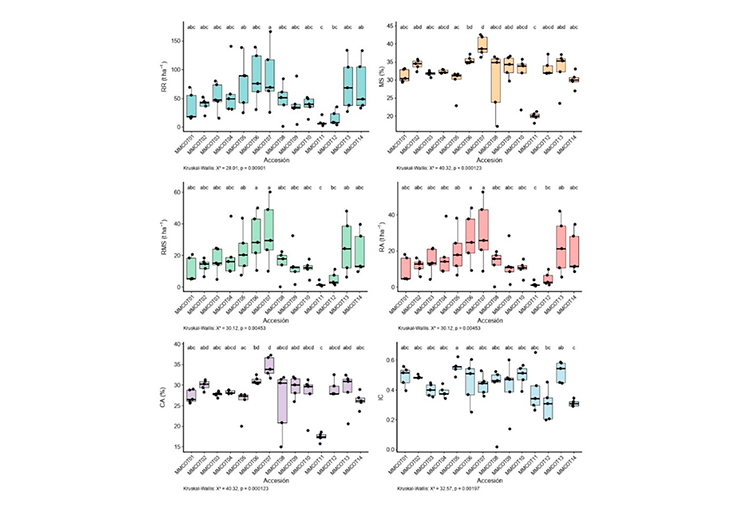
La yuca (Manihot esculenta Crantz) es un cultivo de importancia estratégica en México; sin embargo, la caracterización del germoplasma se ha basado principalmente en el rendimiento de raíces frescas, lo que limita la interpretación fisiológica de su producción. El objetivo de este estudio fue analizar el rendimiento de materia seca y el índice de cosecha como indicadores de la variabilidad productiva entre accesiones mexicanas de yuca. Se evaluaron 14 accesiones bajo condiciones de campo mediante un diseño completamente al azar, determinándose el rendimiento de raíces (RR), el contenido y rendimiento de materia seca de raíces (MS, RMS), el contenido y rendimiento de almidón (CA, RA) y el índice de cosecha (IC). El análisis no paramétrico evidenció diferencias altamente significativas entre accesiones para todas las variables evaluadas (p< 0.01). La accesión MMCOT07 presentó el desempeño más sobresaliente, con los valores más altos de RR (88.01 t ha-1), RMS (34.37 t ha-1) y RA (30.08 t ha-1), asociados a elevados contenidos de MS (39.39%) y CA (34.46%). Otras accesiones mostraron combinaciones contrastantes de rendimiento y calidad, reflejando estrategias diferenciales de partición de biomasa. El análisis de correlación confirmó asociaciones fuertes entre RR, RMS y RA (p≥ 0.98), mientras que el IC aportó información complementaria sobre la eficiencia fisiológica. Estos resultados demuestran que el RMS y el IC son variables clave para una caracterización funcional más precisa del germoplasma mexicano de yuca.
Descargas
Referencias
Adiele, J. G.; Schut, A. G. T.; Van Den Beuken, R. P. M.; Ezui, K. S.; Pypers, P.; Ano, A. O. and Giller, K. E. 2020. Towards closing cassava yield gap in West Africa: agronomic efficiency and storage root yield responses to NPK fertilizers. Field Crops Research. 253:107820. https://doi.org/10.1016/j.fcr.2020.107820.
Adjebeng-Danquah, J.; Asante, I. K.; Manu-Aduening, J.; Agyare, R. Y.; Gracen, V. E. and Offei, S. K. 2020. Genotypic variability in some morpho‐physiological traits in different environments and their relationship with cassava (Manihot esculenta Crantz) root yield. International Journal of Agronomy. 2020:5871351. https://doi.org/10.1155/2020/5871351.
Burbano-Figueroa, O.; Pérez-Pazos, J. V. and Moreno-Moran, M. 2022. Assessing NPK use efficiency of commercial inoculants in cassava (Manihot esculenta Crantz): an application of data envelopment analysis. Journal of Crop Science and Biotechnology. 25(3):253-267. https://doi.org/10.1007/s12892-021-00128-y.
Chaiprasert, P.; Sdoodee, S.; Kaveeta, L.; Kulrut, N.; Sansayawichai, T.; Sanitchon, J. and Whankaew, S. 2022. Effective metabolic carbon utilization and shoot-to-root partitioning modulate distinctive yield in high yielding cassava variety. Frontiers in Plant Science. 13:832304. https://doi.org/10.3389/fpls.2022.832304.
Codjia, E. D.; Olasanmi, B.; Udemba, I. O. and Rabbi, I. Y. 2025. Variability for cassava root yield and yield components among half-sib cassava progenies. Journal of Crop Improvement. 39(3):192-207. https://doi.org/10.1080/15427528.2025.2470444.
De Souza, A. P.; Massenburg, L. N.; Jaiswal, D.; Cheng, S.; Shekar, R. and Long, S. P. 2017. Rooting for cassava: insights into photosynthesis and associated physiology as a route to improve yield potential. New Phytologist. 213(1):50-65. https://doi.org/10.1111/nph.14250.
Del Rosario-Arellano, J. L.; Meneses-Márquez, I.; Cruz-Moreno, F. Z.; Serna-Lagunes, R.; Leyva-Ovalle, O. R.; Andrés-Meza, P.; Verdejo-Lara, R. A.; Llarena-Hernández, C. R. and Diaz-José, J. 2025. Morpho-agronomic diversity of Manihot esculenta Crantz accessions: implications for conservation and genetic management. Revista Bio Ciencias. 12:e1719. https://doi.org/10.15741/revbio.12.e1719.
Durán-Prado, A.; Vásquez-Hernández, A.; Meneses-Márquez, I.; Rodríguez-Cuevas, M.; Ramírez-Guillermo, M. Á. y Martínez-Herrera, J. 2023. Impacto económico del biofertilizante micorrízico INIFAPMR en el cultivo de yuca (Manihot esculenta Crantz) en Veracruz. In: López-Vázquez, M. E.; Tosquy-Valle, O. H.; Peralta-Antonio, N.; Rebolledo-García, R. L.; Capetillo-Burela, Á. y Perdomo-Montes, C. (Comps.). XXXV Reunión Científica-Tecnológica, Forestal y Agropecuaria Veracruz. Año 5, Núm. 1. INIFAP. Ciudad de México, México. 23 p. https://rctveracruz.org/assets/img/publicaciones/publicacion_2023/publicacion/publicacion-2023.pdf.
Enesi, R. O.; Hauser, S.; Pypers, P.; Kreye, C.; Tariku, M. and Six, J. 2022. Understanding changes in cassava root dry matter yield by different planting dates, crop ages at harvest, fertilizer application and varieties. European Journal of Agronomy. 133:126448. https://doi.org/10.1016/j.eja.2021.126448.
Gili, O. R. S.; Suwarto, B.; Hartono, A. and Herdiyeni, Y. 2025. Biomass partitioning of cassava (Manihot esculenta Crantz) at various doses of nitrogen fertilization. Journal of Tropical Crop Science. 12(01):10-17. https://doi.org/10.29244/jtcs.12.01.10-17.
González-Valdivia, N. A.; Matos-Pech, G.; García-Acedo, C.; Arcocha-Gómez, E.; López-Hernández, M. y Puertovannetti-Arroyo, A. 2023. Estimación del rendimiento de harina seca de yuca (Manihot esculenta Crantz) en un luvisol férrico de Campeche, México. Journal of the Selva Andina Biosphere. 11(1):3-19. https://doi.org/10.36610/j.jsab.2023.110100073.
Menegucci, N. C.; Leonel, M.; Fernandes, A. M.; Nunes, J. G. da S. and Nunes, J. G. da S. 2023. Biomass yield and chemical composition of the cassava plant over two vegetative growth cycles. Acta Scientiarum. Agronomy. 46(1):e63719. https://doi.org/10.4025/actasciagron.v46i1.63719.
Meneses-Márquez, I.; Vásquez-Hernández, A.; Rosas-González, X. and Becerra-Leor, E. N. 2014. Contenido de materia seca y almidón en clones de yuca (Manihot esculenta Crantz). Revista Biológico Agropecuaria Tuxpan. 2(1):107-110. https://doi.org/10.47808/revistabioagro.v2i1.268.
Muktar, H.; Beshir, H. M.; Tadesse, T. and Haile, A. 2024. Rooting performance of cassava cuttings due to the number of nodes and rooting media. Food and Energy Security. 13(1):e512. https://doi.org/10.1002/fes3.512.
NOM-021-SEMARNAT-2000. 2002. Norma oficial mexicana. Antes NOM-021-RECNAT-2000, que establece las especificaciones de fertilidad, salinidad y clasificación de suelos. Estudio, muestreo y análisis. Diario oficial de la federación. México, D. F.: SEGOB. https://n9.cl/a85no.
Okoma, P. M.; Kayondo, S. I.; Rabbi, I. Y.; Moreno-Cadena, P. L.; Hoogenboom, G. and Jannink, J. L. 2025. Evaluating a cassava crop growth model by optimizing genotype-specific parameters using multienvironment trial breeding data. Frontiers in Plant Science. 16:1535058. https://doi.org/10.3389/fpls.2025.1535058.
Olayinka, A. F.; Dzidzienyo, D. K.; Mbanjo, E. G. N.; Offei, S. K.; Tongoona, P. B.; Danquah, E. Y. and Rabbi, I. Y. 2025. Genome-wide association study identifies novel genes for plant architecture and yield traits in cassava (Manihot esculenta Crantz). Frontiers in Plant Science. 16:1660789. https://doi.org/10.3389/fpls.2025.1660789.
Onyenali, T. C.; Ogwuche, T. O.; Onyeka, J.; Diebiru-Ojo, E. M.; Ikechukwu, I.; Abah, S. P.; Okwuonu, I.; Ameh, E. A.; Sanni, L.; Kulakow, A. P. and Egesi, C. N. 2025. Evaluation of improved cassava genotypes for fresh root yield and yield components in demand creation trial. Frontiers in Plant Science. 16:1564393. https://doi.org/10.3389/fpls.2025.1564393.
Pérez-Fons, L.; Ovalle, T. M.; Drapal, M.; Ospina, M. A.; Gkanogiannis, A.; Bohorquez-Chaux, López-Lavalle, L. A. B. and Fraser, P. D. 2023. Integrated genetic and metabolic characterization of Latin American cassava (Manihot esculenta) germplasm. Plant Physiology. 192(4):2672-2686. https://doi.org/10.1093/plphys/kiad269.
Phanthanong, P.; Promnikorn, K.; Kongsil, P.; Kraichak, E.; Jenweerawat, S.; Vuttipongchaikij, S. and Kittipadakul, P. 2025. Variety-specific responses to climatic and edaphic factors in cassava productivity. Frontiers in Agronomy. 7:1476033. https://doi.org/10.3389/fagro.2025.1476033.
Phun-iam, M.; Anusontpornperm, S.; Thanachit, S. and Kheoruenromne, I. 2018. Yield response of cassava Huay Bong 80 variety grown in an Oxyaquic paleustult to cassava starch waste and nitrogen fertilizer. Agriculture and Natural Resources. 52(6):573-580. https://doi.org/10.1016/j.anres.2018.11.026.
R Core Team. 2020. R: a language and environment for statistical computing (version 4.4.3). R Foundation for Statistical Computing, Vienna, Austria. https://www.R-project.org/.
Rebolledo-García, R. L.; Rebolledo-Martínez, A.; López-Vázquez, M. E.; Peralta-Antonio, N. and Ramírez-García, R. 2025. Production and quality of cassava (Manihot esculenta Crantz) organically and chemically fertilized and intercropped with sapodilla. Agroproductividad. 18(2):233-240. https://doi.org/10.32854/agrop.v18i2.3259.
Rosas-González, X.; Meneses-Márquez, I.; Becerra-Leor, E. N. y Vásquez Hernández, A. 2014. Efecto de la posición de estacas sobre el rendimiento de raíz de yuca (Manihot esculenta Crantz.) en Veracruz. Revista Biológico Agropecuaria Tuxpan. 2(1):172-177. https://doi.org/10.47808/revistabioagro.v2i1.283.
Sampaio Filho, J. S.; De Souza Campos, M. and De Oliveira, E. J. 2024. Stability and genetic parameters for cassava yield attributes in the tropical humid region of Brazil. Euphytica. 220(8):127. https://doi.org/10.1007/s10681-024-03384-5.
Silva, R. M. D.; Fernandes, A. M.; Leonel, M.; Pelvine, R. A.; Figueiredo, R. T. D.; Rangel, M. A. S.; Ringenberg, R.; Oliveira, L. A. D.; Santos, V. D. S. and Vieira, E. A. 2023. Measurement of dry matter and starch in modern cassava genotypes during long harvest cycles. Horticulturae. 9(7):733. https://doi.org/10.3390/horticulturae9070733.
Descargas
Publicado
Número
Sección
Licencia
Derechos de autor 2026 Revista Mexicana de Ciencias Agrícolas

Esta obra está bajo una licencia internacional Creative Commons Atribución-NoComercial 4.0.
Los autores(as) que publiquen en Revista Mexicana de Ciencias Agrícolas aceptan las siguientes condiciones:
De acuerdo con la legislación de derechos de autor, Revista Mexicana de Ciencias Agrícolas reconoce y respeta el derecho moral de los autores(as), así como la titularidad del derecho patrimonial, el cual será cedido a la revista para su difusión en acceso abierto.
Los autores(as) deben de pagar una cuota por recepción de artículos antes de pasar por dictamen editorial. En caso de que la colaboración sea aceptada, el autor debe de parar la traducción de su texto al inglés.
Todos los textos publicados por Revista Mexicana de Ciencias Agrícolas -sin excepción- se distribuyen amparados bajo la licencia Creative Commons 4.0 atribución-no comercial (CC BY-NC 4.0 internacional), que permite a terceros utilizar lo publicado siempre que mencionen la autoría del trabajo y a la primera publicación en esta revista.
Los autores/as pueden realizar otros acuerdos contractuales independientes y adicionales para la distribución no exclusiva de la versión del artículo publicado en Revista Mexicana de Ciencias Agrícolas (por ejemplo incluirlo en un repositorio institucional o darlo a conocer en otros medios en papel o electrónicos) siempre que indique clara y explícitamente que el trabajo se publicó por primera vez en Revista Mexicana de Ciencias Agrícolas.
Para todo lo anterior, los autores(as) deben remitir el formato de carta-cesión de la propiedad de los derechos de la primera publicación debidamente requisitado y firmado por los autores(as). Este formato debe ser remitido en archivo PDF al correo: revista_atm@yahoo.com.mx; revistaagricola@inifap.gob.mx.
Esta obra está bajo una licencia de Creative Commons Reconocimiento-No Comercial 4.0 Internacional.