Eficacia de insecticidas botánicos y biológicos contra Spodoptera frugiperda en maíz
DOI:
https://doi.org/10.29312/remexca.v17i5.4175Palabras clave:
bioinsecticidas, dosificación, entomopatógenos, mortalidad, sustituciónResumen
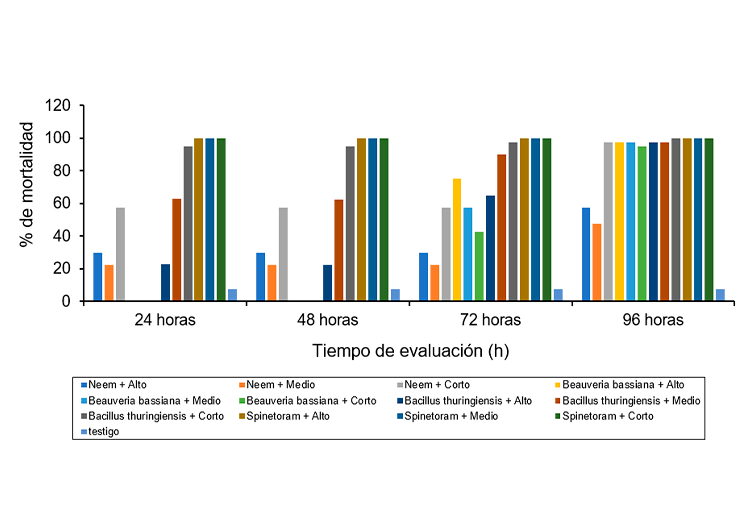
El gusano cogollero Spodoptera frugiperda, es una de las principales plagas del maíz en Ecuador, generando pérdidas significativas en el rendimiento. El uso intensivo de insecticidas químicos para su control plantea riesgos ambientales y para la salud humana. El gusano cogollero Spodoptera frugiperda es una de las principales plagas del maíz en Ecuador, generando pérdidas significativas en el rendimiento. Como alternativa sostenible, este estudio evaluó la eficiencia de insecticidas biológicos y botánicos bajo condiciones de laboratorio. La investigación se realizó entre mayo y julio de 2025 mediante un diseño completamente al azar con cuatro tratamientos: BotaniGard® ES (Beauveria bassiana), Dipel® WG (Bacillus thuringiensis), NeemAzal® T/S (aceite de neem) y Delegate® 250 WG (spinetoram) como control químico, aplicados a larvas de tercer estadio mediante la técnica de inmersión foliar, con evaluaciones a las 24, 48, 72 y 96 h. Los resultados mostraron que B. thuringiensis alcanzó una mortalidad del 100% a las 96 h, seguido del aceite de neem y B. bassiana, ambos con 97.5%. El spinetoram presentó una mortalidad inmediata y sostenida del 100% desde las 24 h. En contraste, el neem mostró una mortalidad inicial baja (17.5%) que aumentó progresivamente con el tiempo. En conjunto, los insecticidas biológicos y botánicos evaluados constituyen alternativas eficaces para el manejo de S. frugiperda bajo condiciones de laboratorio, contribuyendo a la reducción de la dependencia de insecticidas químicos convencionales.
Descargas
Referencias
Akeme, C.; Ngosong, C.; Sumbele, S.; Aslan, A.; Tening, A.; Krah, C.; Kamanga, B.; Denih, A. and Nambangia, O. 2021. Different controlling methods of fall armyworm (Spodoptera frugiperda) in maize farms of small- scale producers in Cameroon. IOP Conference Series: Earth and Environmental Science. 911(1):1-21. https://doi.org/10.1088/1755-1315/911/1/012053. DOI: https://doi.org/10.1088/1755-1315/911/1/012053
Amezcua, L. G.; Fuentes, L. T.; Gutiérrez, J. M.; Sánchez, J. C.; Hernández, H. A. and Castrejón, J. E. 2023. Eficacia insecticida de spinetoram, Bacillus thuringiensis Berliner y clorpirifos contra Spodoptera frugiperda (J.E. Smith, 1797) en maíz. Avances en Investigación Agropecuaria. 27(1):208-2018. https://doi.org/10.53897/RevAIA.23.27.71. DOI: https://doi.org/10.53897/RevAIA.23.27.71
Analuisa, I. A.; Jimber, J. A.; Fernández, J. A. and Vergara, A. 2023. The value chain of Ecuadorian hard yellow corn. Challenges and opportunities. Lecturas de Economía. 1(98):231-262. https://doi.org/10.17533/udea.le.n98a347315. DOI: https://doi.org/10.17533/udea.le.n98a347315
Berube, B.; Ernst, E.; Cahn, J.; Roche, B.; de Santis Alves, C.; Lynn, J.; Scheben, A.; Grimanelli, D.; Siepel, A.; Ross-Ibarra, J.; Kermicle, J. and Martienssen, R. A. 2024. Teosinte pollen drives maize diversification and domestication by RNAi. Nature. 633(1):380-388. https://doi.org/10.1038/s41586-024-07788-0. DOI: https://doi.org/10.1038/s41586-024-07788-0
Bravo, A.; Likitvivatanavong, S.; Gill, S. S. and Soberón, M. 2011. Bacillus thuringiensis: A story of a successful bioinsecticide. Insect Biochemistry and Molecular Biology. 41(7):423-431. https://doi.org/10.1016/j.ibmb.2011.02.006. DOI: https://doi.org/10.1016/j.ibmb.2011.02.006
Butt, T. M.; Coates, C. J.; Dubovskiy, I. M. and Ratcliffe, N. A. 2016. Entomopathogenic Fungi. In: Advances in Genetics. 94(1):307-364. Elsevier. https://doi.org/10.1016/bs.adgen.2016.01.006. DOI: https://doi.org/10.1016/bs.adgen.2016.01.006
González, M. B.; Gurrola, N. J. and Chaírez, I. 2015. Biological products for the control of Spodoptera frugiperda (Lepidoptera: Noctuidae). Revista Colombiana de Entomología. 41(2):200-204. http://www.scielo.org.co/scielo.php?script=sci-arttext&pid=S0120-04882015000200009. DOI: https://doi.org/10.1177/012004881504100209
Idrees, A.; Afzal, A.; Qadir, Z. A. and Li, J. 2022. Bioassays of Beauveria bassiana Isolates against the Fall Armyworm, Spodoptera frugiperda. Journal of Fungi. 8(7):1-16. https://doi.org/10.3390/jof8070717. DOI: https://doi.org/10.3390/jof8070717
Isman, M. B. 2020. Botanical insecticides in the twenty-first century-fulfilling their promise? Annual Review of Entomology. 65(1):233-249. https://doi.org/10.1146/annurev-ento-011019-025010. DOI: https://doi.org/10.1146/annurev-ento-011019-025010
Iwanicki, N. S.; Lopes, E. C.; De Lira, A. C.; Poletto, T. B.; Fonseca, L. Z. and Delalibera, J, I. 2023. Comparative analysis of Beauveria bassiana submerged conidia with blastospores: yield, growth kinetics and virulence. Biological Control. 185(1):1-16. https://doi.org/10.1016/j.biocontrol.2023.105314. DOI: https://doi.org/10.1016/j.biocontrol.2023.105314
Kinyanjui, G.; Tadesse Mawcha, K. and Ndolo, D. 2025. Advancing entomopathogenic fungi for improved management of Phthorimaea (Tuta) absoluta (Lepidoptera: Gelechiidae). Journal of Integrated Pest Management. 16(1):1-19. https://doi.org/10.1093/jipm/pmaf034. DOI: https://doi.org/10.1093/jipm/pmaf034
Kulye, M.; Mehlhorn, S.; Boaventura, D.; Godley, N.; Venkatesh, S.; Rudrappa, T., Charan, T.; Rathi, D. and Nauen, R. 2021. Baseline susceptibility of Spodoptera frugiperda populations collected in India towards different chemical classes of insecticides. Insects. 12(8):1-11. https://doi.org/10.3390/insects12080758. DOI: https://doi.org/10.3390/insects12080758
Lin, S.; Li, S.; Liu, Z.; Zhang, L.; Wu, H.; Cheng, D. and Zhang, Z. 2021. Using azadirachtin to transform Spodoptera frugiperda from pest to natural enemy. Toxins. 13(8):1-12. https://doi.org/10.3390/toxins13080541. DOI: https://doi.org/10.3390/toxins13080541
Martínez, A.; Ortega, J. S.; Hernández, S. I.; Olivas, E. H. and Alba, J. J. 2016. Applications of neem (Azadirachta indica) in agriculture: a review. Journal of Plant Growth Regulation. 13(2):191-198. https://doi.org/10.4314/ajtcam.v13i2.23. DOI: https://doi.org/10.4314/ajtcam.v13i2.23
Martinez, S. S. and Emden, H. F. 2001. Growth disruption, abnormalities and mortality of Spodoptera littoralis (Boisduval) (Lepidoptera: Noctuidae) caused by Azadirachtin. Neotropical Entomology. 30(1):113-125. https://doi.org/10.1590/S1519-566X2001000100017. DOI: https://doi.org/10.1590/S1519-566X2001000100017
Mascarin, G. M. and Jaronski, S. T. 2016. The production and uses of Beauveria bassiana as a microbial insecticide. World Journal of Microbiology and Biotechnology. 32(177):1-26. https://doi.org/10.1007/s11274-016-2131-3. DOI: https://doi.org/10.1007/s11274-016-2131-3
Mordue, A. J. and Nisbet, A. J. 2000. Azadirachtin from the neem tree Azadirachta indica: Its action against insects. Anais da Sociedade Entomológica do Brasil. 29(4):615-632. https://doi.org/10.1590/S0301-80592000000400001. DOI: https://doi.org/10.1590/S0301-80592000000400001
Palma, L.; Sauka, D. H. and Ibarra, J. E. 2024. Bacillus thuringiensis: a broader view of its biocidal activity. Toxins. 16(3):1-3. https://doi.org/10.3390/toxins16030162. DOI: https://doi.org/10.3390/toxins16030162
Real, C. I. and Paiba, K. O. 2023. Reactivation of the nuclear polyhedrosis virus strain VPNHz1991 for the management of the corn earworm (Helicoverpa zea). Revista Iberoamericana de Bioeconomia y Cambio Climático. 9(18):2193-2201. https://doi.org/10.5377/ribcc.v9i18.17547. DOI: https://doi.org/10.5377/ribcc.v9i18.17547
Rodríguez, J. C.; Salazar, M. L. and Contreras, M. 2018. Effect of different surfactants on larvae III of Spodoptera frugiperda Smith under laboratory and field conditions. Arnaldoa. 25 (3):1041-1052. http://dx.doi.org/10.22497/arnaldoa.253.25315. DOI: https://doi.org/10.22497/arnaldoa.253.25315
Sala, A.; Barrena, R.; Meyling, N. V. and Artola, A. 2023. Conidia production of the entomopathogenic fungus Beauveria bassiana using packed-bed bioreactor: Effect of substrate biodegradability on conidia virulence. Journal of Environmental Management. 341(1):1-10. https://doi.org/10.1016/j.jenvman.2023.118059. DOI: https://doi.org/10.1016/j.jenvman.2023.118059
Saleem, U.; Asrar, M.; Jabeen, F.; Makhdoom Hussain, S. and Hussain, D. 2024. Determination of insecticidal potential of selected plant extracts against fall armyworm (Spodoptera frugiperda) larvae. Heliyon. 10(20):1-13. https://doi.org/10.1016/j.heliyon.2024.e39593. DOI: https://doi.org/10.1016/j.heliyon.2024.e39593
Saquee, F. S.; Norman, P. E.; Saffa, M. D.; Kavhiza, N. J.; Pakina, E.; Zargar, M.; Diakite, S.; Stybayev, G.; Baitelenova, A. and Kipshakbayeva, G. 2023. Impact of diffent types of green manure on pest and disease incidence and severity as well as growth and yield parameters of maize. Heliyon. 9(6):1-10. https://doi.org/10.1016/j.heliyon.2023.e17294. DOI: https://doi.org/10.1016/j.heliyon.2023.e17294
Vásquez, L. H.; Alvarado, K. A.; Intriago, F. G.; Raju, N. M. and Prasad, R. 2024. Banana and apple extracts with efficient microorganisms and their effect on cadmium reduction in cocoa beans (Theobroma cacao L.). Discover Food. 4(163):1-13. https://doi.org/10.1007/s44187-024-00205-5. DOI: https://doi.org/10.1007/s44187-024-00205-5
Wan, J.; Huang, C.; Li, C.; Zhou, H.; Li, Z.; Xing, L.; Zhang, B.; Qiao, X.; Liu, B.; Liu, C.; Liu, W.; Wang, W.; Qian, W.; Makrdy, S. and Wan, F. 2021. Biology, invasion and management of the agricultural invader: Fall armyworm, Spodoptera frugiperda (Lepidoptera:Noctuidae). Journal of Integrative Agriculture. 20(3):646-663. https://doi.org/10.1016/S2095-3119(20)63367-6. DOI: https://doi.org/10.1016/S2095-3119(20)63367-6
Wen, H.; Zhang, Q.; Cheng, D.; Zhang, Z.; Xu, H. and Xiangning, C. 2013. Cassia oil as a substitute solvent for xylene for rotenone EC and its synergistic activities. Pesticide Biochemistry and Physiology. 105(3):189-196. https://doi.org/10.1016/j.pestbp.2013.02.002. DOI: https://doi.org/10.1016/j.pestbp.2013.02.002
Yang, N.; Wang, Y.; Liu, X.; Jin, M.; Vallebueno-Estrada, M.; Calfee, E.; Chen, L.; Dilkes, B. P.; Gui, S.; Fan, X.; Harper, T. K.; Kennett, D. J.; Li, W.; Lu, Y.; Ding, J.; Chen, Z.; Luo, J.; Mambakkam, S.; Menon, M. and Ross-Ibarra, J. 2023. Two teosintes made modern maize. Science. 382(6674):1-40. https://doi.org/10.1126/science.adg8940. DOI: https://doi.org/10.1126/science.adg8940
Yasin, S.; Zavala, F.; Niño, G.; Rodríguez, P.; Gutiérrez, A.; Sinagawa, S. and Lugo, E. 2024. Morphological and physiological response of maize (Zea mays L.) to drought stress during reproductive stage. Agronomy. 14(8):1-16. https://doi.org/10.3390/agronomy14081718. DOI: https://doi.org/10.3390/agronomy14081718
Zhou, W.; Li, M. and Achal, V. 2025. A comprehensive review on environmental and human health impacts of chemical pesticide usage. Emerging Contaminants; 11(1):1-13. https://doi.org/10.1016/j.emcon.2024.100410. DOI: https://doi.org/10.1016/j.emcon.2024.100410
Zimmermann, G. 2007. Review on safety of the entomopathogenic fungi Beauveria bassiana and Beauveria brongniartii. Biocontrol Science and Technology. 17(6):553-596. https://doi.org/10.1080/09583150701309006. DOI: https://doi.org/10.1080/09583150701309006
Descargas
Publicado
Número
Sección
Licencia
Derechos de autor 2026 Revista Mexicana de Ciencias Agrícolas

Esta obra está bajo una licencia internacional Creative Commons Atribución-NoComercial 4.0.
Los autores(as) que publiquen en Revista Mexicana de Ciencias Agrícolas aceptan las siguientes condiciones:
De acuerdo con la legislación de derechos de autor, Revista Mexicana de Ciencias Agrícolas reconoce y respeta el derecho moral de los autores(as), así como la titularidad del derecho patrimonial, el cual será cedido a la revista para su difusión en acceso abierto.
Los autores(as) deben de pagar una cuota por recepción de artículos antes de pasar por dictamen editorial. En caso de que la colaboración sea aceptada, el autor debe de parar la traducción de su texto al inglés.
Todos los textos publicados por Revista Mexicana de Ciencias Agrícolas -sin excepción- se distribuyen amparados bajo la licencia Creative Commons 4.0 atribución-no comercial (CC BY-NC 4.0 internacional), que permite a terceros utilizar lo publicado siempre que mencionen la autoría del trabajo y a la primera publicación en esta revista.
Los autores/as pueden realizar otros acuerdos contractuales independientes y adicionales para la distribución no exclusiva de la versión del artículo publicado en Revista Mexicana de Ciencias Agrícolas (por ejemplo incluirlo en un repositorio institucional o darlo a conocer en otros medios en papel o electrónicos) siempre que indique clara y explícitamente que el trabajo se publicó por primera vez en Revista Mexicana de Ciencias Agrícolas.
Para todo lo anterior, los autores(as) deben remitir el formato de carta-cesión de la propiedad de los derechos de la primera publicación debidamente requisitado y firmado por los autores(as). Este formato debe ser remitido en archivo PDF al correo: revista_atm@yahoo.com.mx; revistaagricola@inifap.gob.mx.
Esta obra está bajo una licencia de Creative Commons Reconocimiento-No Comercial 4.0 Internacional.