elocation-id: e4224
The non-toxic edible genotype of Jatropha curcas L. is an underutilized resource with potential to diversify tropical agrifood systems. This study evaluated the partial substitution of wheat flour with defatted J. curcas flour on the physicochemical and sensory quality and microbiological stability of muffins stored at 4 °C. In 2024, the material was collected in Pueblillo, Papantla, Veracruz. The flour was obtained by Soxhlet extraction with hexane, and muffins were prepared with 0, 5, 10 and 15% substitution. The proximate composition, water activity, color, microbiological stability and sensory acceptance of muffins were evaluated among 150 consumers. Determinations were made in triplicate; the data were analyzed by Anova and Tukey’s test (α= 0.05), and the sensory data were also analyzed using multiple factor analysis. Protein increased from 9.57 to 12.06%; ash increased from 1.59 to 2.66% and lipids varied from 21.64 to 24.91%, with a nonlinear response. Moisture and water activity did not vary significantly. M-5 and M-10 presented more intense reddish and yellow tones; M-15 retained a light-yellow color similar to the control. Microbial counts were <1 log CFU g-1 for six days at 4 °C; muffins showed favorable sensory acceptance in all treatments. Under the conditions evaluated, substituting up to 15% wheat flour with defatted J. curcas flour increased protein content without compromising sensory acceptance or microbiological stability.
baking, non-toxic genotype, protein, underutilized resources
Mexican tropical agrifood systems face the challenge of diversifying their crops through underutilized species with food value (Paulos, 2024; Talucder et al., 2024). The use of these species can be promoted through their incorporation into culturally accepted food products. Among these species, edible Jatropha curcas L. is a local resource with food potential due to its protein content and its possible use as defatted flour (Argüello-García et al., 2020). In Papantla, Veracruz, a non-toxic genotype has been documented, which is characterized by the absence of phorbol esters, compounds associated with the species’ toxicity (Martínez-Herrera et al., 2006; Figueroa et al., 2020; Grünwald et al., 2026).
Partially substituting wheat flour with alternative vegetable flours is an innovative strategy in baking; however, their physicochemical and sensory effects depend on the ingredient, substitution level, and food matrix (Salazar et al., 2021). Therefore, muffins are a suitable matrix for evaluating unconventional ingredients such as J. curcas (Heo et al., 2019; Grasso et al., 2020).
The proposed hypothesis was that partially substituting wheat flour with defatted edible J. curcas flour would improve the muffins’ nutritional quality without compromising their physicochemical quality, sensory acceptance or microbiological stability. Therefore, this study evaluated the effect of this substitution on the proximate composition, water activity, color, sensory acceptance and microbiological stability of muffins stored at 4 °C.
Seeds were collected from plants of the non-toxic edible genotype of J. curcas established in Pueblillo, Papantla, Veracruz, Mexico (20° 09’ 06.48” north latitude and 97° 31’ 09.12” west longitude; 80 masl) (INEGI, 2025). Ripe fruits were collected manually in 2024. Seeds were extracted, cleaned and dried at room temperature for 48 h; subsequently, they were stored in sealed containers at 4 °C until processing (Argüello-García et al., 2017).
The seeds were hulled manually and the resulting almonds were ground in an electric mill (Novaka, 150 W). The flour obtained was defatted by Soxhlet extraction with hexane for 16 h at 65 °C (Argüello-García et al., 2020). The residual hexane was removed by aeration in an extraction hood at room temperature for 12 h. The defatted flour was then sieved through an 80-mesh sieve to standardize particle size (Martínez-Herrera et al., 2017).
The presence of residual hexane was verified by gas chromatography-mass spectrometry (GC-MS; Agilent 6890N Network GC System, coupled to Agilent 5975 Inert XL); the chromatographic peak corresponding to this solvent was not detected under the analytical conditions used (data not shown).
The muffins were made with modifications to the method by Ozuna et al. (2020), substituting commercial wheat flour (Tres Estrellas®) with defatted J. curcas flour in 0, 5, 10 and 15% per 100 g of farinaceous mixture; the treatments were identified as T-T, M-5, M-10 and M-15, respectively. In all treatments, the other ingredients remained constant: 74.5 g agave syrup, 32 g oil, 95 g milk, 55 g egg, 5 ml vanilla, 0.75 g salt and 2 g baking powder. The mixture was homogenized, distributed in molds and baked at 180 °C for 20 min in an Oster® oven; it was then cooled to 25 °C for 30 min.
Moisture (AOAC 934.01), protein (AOAC 979.09; N factor × 6.25), lipids (AOAC 991.36), and ash (AOAC 930.05) were determined by AOAC (2000). Carbohydrate content was calculated by difference. aw was measured at 25 ±0.5 °C using a portable meter (VTSYIQI VTS-160A, Hefei, Anhui, China) and the reading was recorded once hygroscopic equilibrium was reached (Alemán-Huerta et al., 2023).
The color of the crumb was determined using a portable colorimeter (FRU WR-18, Shenzhen, Guangdong, China), with the CIELAB system (L*, a* and b*). These values were used to calculate C*, h° and ΔE (Alemán-Huerta et al., 2023).
Microbiological stability was evaluated during six days of storage at 4 °C (days 0, 3 and 6). Sample preparation and dilutions were performed according to NOM-110-SSA1-1994, and aerobic mesophiles, total coliforms and molds and yeasts were counted according to NOM-092-SSA1-1994, NOM-113-SSA1-1994 and NOM-111-SSA1-1994, respectively. The results were expressed as CFU g-1.
The sensory evaluation of the muffins was carried out with 150 untrained consumers aged 19- 50 years; the panel comprised 52% women and 48% men. All participants were given an informed consent form in accordance with the guidelines of the Council of International Organizations of Medical Sciences (CIOMS, 2016), which they signed, indicating their agreement to participate in the study, the type of sample and their right to withdraw at any time.
Four formulations of muffins (0, 5, 10 and 15% substitution with defatted J. curcas flour) were included in the sensory evaluation, coded with random numbers according to a balanced incomplete block design (t= 4, k= 2, r= 3, b= 6, λ= 1 and E= 0.67), whose base scheme was repeated 25 times.
Each consumer received two 24 g samples. The attributes were rated using a seven-point hedonic scale adapted from Peryam and Pilgrim (1957); in addition, acceptability, intention to incorporate the product into their diet, and purchase intention were recorded.
The determinations of proximate composition, water activity, color and sensory attributes were performed in triplicate and were analyzed using Anova and Tukey’s test (α= 0.05) in RStudio® version 4.3. Physicochemical results were expressed as mean ± standard deviation and the sensory results as mean ± standard error.
The relationships between sensory attributes and consumer acceptance indicators were analyzed using multiple factor analysis with XLSTAT version 2023.3.0.1415.
Table 1 presents the proximate chemical composition of the fortified muffins. Moisture ranged from 31.74 to 33.47%, with no significant differences among treatments (p> 0.05). Grasso et al. (2020) reported that substituting 15% wheat flour with defatted sunflower seed flour did not alter muffin moisture.
Water activity remained at 0.80 in all treatments, a value above 0.60, which can favor the development of molds and yeasts at room temperature; therefore, using natural preservatives or storing below 10 °C is recommended.
Protein content was lower in T-T and higher in M-15, with significant differences between treatments. This result was related to the high protein content of defatted J. curcas flour, which is higher than 55% on a dry basis (Sánchez-Chino et al., 2019; Argüello-García et al., 2020).
Likewise, Senger et al. (2017) reported that the edible almond of J. curcas has an adequate amino acid profile, which reinforces its potential as a protein ingredient in baked goods.
Lipids showed a nonlinear behavior among treatments, with M-10 having the lowest content and M-15 presenting the highest. Grasso et al. (2020) reported a similar behavior in muffins with defatted sunflower seed flour. This variation may relate to changes in the baked matrix, where interactions among proteins, starches and lipid phases influence the distribution and retention of the ethereal extract (Pareyt et al., 2011).
Ash increased from 1.59% in T-T to 2.66% in M-15, which was linked to the mineral contribution of J. curcas; iron, calcium, zinc and magnesium have been reported in its edible almonds (Senger et al., 2017).
Carbohydrates decreased only in M-15 because of the proportional increase in protein, lipids, and ash in the difference calculation.
Partial substitution with defatted J. curcas flour modified the color of the muffin crumbs, mainly in M-5 and M-10, which showed a greater tendency toward reddish and yellow tones and an increase in color intensity. In contrast, M-15 showed a coloration close to that of the control muffin, with less reddish tendency and color intensity (Table 2).
In contrast, lightness (L*) did not differ significantly among treatments, showing values between 55.5 and 60. This behavior indicates a nonlinear color response to substitution level, suggesting that color changes depended not only on the amount of defatted flour incorporated but also on its interaction with the ingredients in the muffin matrix during baking (Alemán-Huerta et al., 2023).
During six days of storage at 4 °C, the counts of aerobic mesophiles, total coliforms, molds, and yeasts remained below the detection limit (<1 log CFU g-1). Although water activity remained at 0.8, an intermediate level that does not exclude mold development under favorable conditions, the observed stability may be associated with the combined effect of the baked matrix and refrigerated storage, factors that influence microbial spoilage in bakery products (Alpers et al., 2021).
The sensory attributes evaluated did not differ significantly among treatments (Tukey, α= 0.05; Figure 1). Color scores exceeded 5.5 in all formulations, indicating positive visual acceptance.
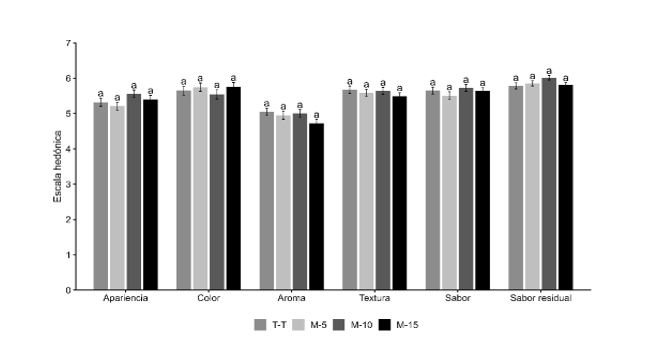
In aroma, scores ranged from 4.72 to 5.05, while texture, taste and residual taste values were above 5.5, indicating positive acceptance and the absence of unpleasant sensations after swallowing.
This behavior is consistent with Grasso et al. (2020), who observed that muffins with 15% defatted sunflower seed flour presented a sensory profile closer to the control. Likewise, incorporating unconventional ingredients into muffins can maintain consumer acceptance; however, it can modify sensory attributes depending on the type and level of substitution (Zielińska et al., 2021).
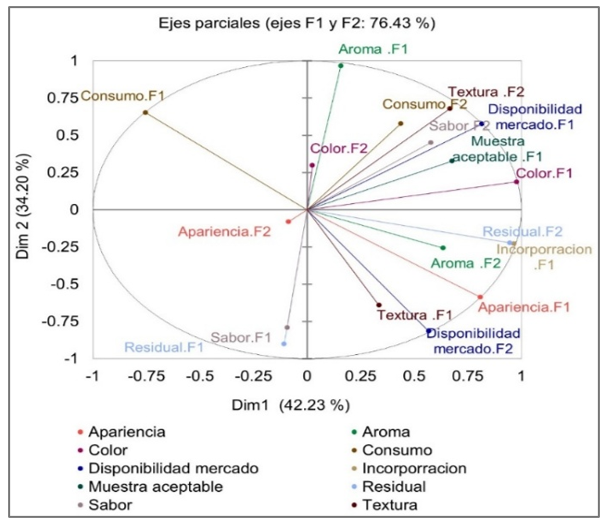
The multiple factor analysis showed the relationship between sensory attributes and consumer acceptance indicators (Figure 2). F1 was mainly associated with color, acceptable sample, market availability, incorporation and texture, while F2 was related to aroma and consumption.
Substituting up to 15% of wheat flour with defatted edible J. curcas flour increased protein and ash contents in muffins without altering moisture or water activity, showing good stability in refrigerated storage. Muffins substituted with 15% J. curcas flour showed a coloration close to the control. In addition, they presented favorable sensory acceptance.
Defatted flour of edible J. curcas, grown in localized agrifood agroecosystems, can be incorporated into the formulation of baked goods, such as muffins, to improve their nutritional value and complement dietary protein deficiencies.
We are grateful to the Secretariat of Science, Humanities, Technology and Innovation (SECIHTI, by its Spanish acronym) for the doctoral scholarship awarded to the main author; to the College of Postgraduates and to the TECNM-Higher Technological Institute of Huatusco for the support provided for the conduct of the research and to the producers of J. curcas in Pueblillo, Veracruz, Mexico.
Alemán-Huerta, M. E.; Castillo-Cázares, B. A.; Márquez-Reyes, J. M.; Báez-González, J. G.; Quintero-Zapata, I.; Gandarilla-Pacheco, F. L.; de Luna-Santillana, E. J. and Treviño-Garza, M. Z. 2023. Muffin-type bakery product based on Mexican mesquite (Prosopis spp.) flour: texture profile, acceptability and physicochemical properties. Suiza. Foods. 12(19):3587. https://doi.org/10.3390/foods12193587.
Argüello-García, E.; Córdova-Téllez, L.; Martínez-Herrera, J.; Sánchez-Sánchez, O.; Pérez-Herrera, P. and Zaldívar-Cruz, J. M. 2020. Rheological, chemical and sensory characterization of fortified cookies with edible flour of Xuta (Jatropha curcas L.). Alemania. Journal of Food Science and Technology. 57(9):3502-3508. https://doi.org/10.1007/s13197-020-04385-7.
Argüello-García, E.; Martínez-Herrera, J.; Córdova-Téllez, L.; Sánchez-Sánchez, O. and Corona-Torres, T. 2017. Textural, chemical and sensorial properties of maize tortillas fortified with nontoxic Jatropha curcas L. flour. Reino Unido. CyTA-Journal of Food. 15(2):301-306. https://doi.org/10.1080/19476337.2016.1255915.
Grünwald, M.; Adrar, N.; Francis, G.; Rugen, N.; Döring, M.; Braun, H. P. and Esatbeyoglu, T. 2026. A comparative study of the nutritional and physiological potential of Xuta (edible Jatropha curcas L.) protein: insights into its digestibility and effects on the intestinal barrier. Paises Bajos. Current Research in Food Science. 12:101257. https://doi.org/10.1016/j.crfs.2025.101257.
Martínez-Herrera, J.; Siddhuraju, P.; Francis, G.; Dávila-Ortiz, G. and Becker, K. 2006. Chemical composition, toxic/antimetabolic constituents and effects of different treatments on their levels, in four provenances of Jatropha curcas L. from Mexico. Países Bajos. Food Chemistry. 96(1):80-89. https://doi.org/10.1016/j.foodchem.2005.01.059.
Sánchez-Chino, X. M.; Corzo-Ríos, L. J.; Martínez-Herrera, J.; Cardador-Martínez, A. and Jiménez-Martínez, C. 2019. Effect of thermal treatment on the extraction efficiency, physicochemical quality of Jatropha curcas oil and biological quality of its proteins. India. Journal of Food Science and Technology. 56(3):1567-1574. https://doi.org/10.1007/s13197-019-03666-0.
Senger, E.; Bohlinger, B.; Esgaib, S.; Hernández-Cubero, L. C.; Montes, J. M. and Becker, K. 2017. Chuta (edible Jatropha curcas L.), the newcomer among underutilized crops: a rich source of vegetable oil and protein for human consumption. Alemania. European Food Research and Technology. 243(6):987-997. https://doi.org/10.1007/s00217-016-2814-x.