elocation-id: elocation-id: e4159
This study explored combining compost from the organic fraction of municipal solid waste with a consortium of arbuscular mycorrhizal fungi to improve phosphorus nutrition in corn (Zea mays L.) plants and consequently, their growth. The objectives were: to assess the abundance and composition of spores of a consortium of arbuscular mycorrhizal fungi in this type of compost, to determine the colonization capacity of these spores and to evaluate the joint application of compost and an inoculant composed of 12 species of a consortium of arbuscular mycorrhizal fungi on the phosphorus content and growth of corn plants. The experiment was conducted in Mexico City in 2024 under greenhouse conditions for 53 days, with plant growth in unsterilized and sterilized soil, with and without compost, and with and without inoculant from a consortium of arbuscular mycorrhizal fungi. The compost contained an average of 5 090 spores kg-1 and three taxa from a consortium of arbuscular mycorrhizal fungi; however, these did not colonize the plants’ roots. Colonization by a consortium of arbuscular mycorrhizal fungi decreased due to the compost. The joint application of compost and inoculant with a consortium of arbuscular mycorrhizal fungi increased the cumulative phosphorus of the plants grown in sterilized soil, but not that of the plants in unsterilized soil. The joint application had a neutral effect on plant growth. In conclusion, the compost from the organic fraction of municipal solid waste, enriched with a consortium of arbuscular mycorrhizal fungi, did not improve phosphorus content or plant growth in the presence of a consortium of native arbuscular mycorrhizal fungi.
Zea mays, competition, native, phosphorus.
Phosphorus (P) is nutrient plants require for cell division, root development and photosynthesis, as it is a component of fundamental molecules such as phospholipids, nucleic acids and ATP (Bohórquez et al., 2024). The demand for phosphate fertilizers for agricultural production has increased worldwide over time (Zou et al., 2022).
In Mexico, the annual rate has increased eight-fold, from 45 000 to 372 652 t between 1961 and 2022 (FAOSTAT, 2024). Purchase costs are rising because phosphate rock is mined in a few countries; for example, Morocco, China, the United States of America and Russia (de Boer et al., 2019).
Organic fertilization is an alternative to reduce dependence on this input and harness underutilized renewable sources, such as the organic fraction of municipal solid waste (OFMSW), which represents 46.4% of MSW (SEMARNAT, 2020). In Mexico, approximately 55 763 t of OFMSW are generated per day (SEMARNAT, 2020); according to Zou et al. (2022), the country needs to redouble its efforts to increase P recycling from waste, given the scarcity of phosphate rock.
On the other hand, there are numerous studies that have tested the beneficial effects of arbuscular mycorrhizal fungi (AMF) on P uptake and crop growth in P-deficient soil (Mohammadi et al., 2011). These fungi colonize plant roots to exchange nutrients, particularly P, for hexoses and fatty acids (Roth and Paszkowski, 2017). Both AMF inoculation and compost application in the soil are agricultural diversification practices that could sustain crop yields over time (Tamburini et al., 2020).
The presence of AMF propagules has been recognized in compost applied to soil (Cavagnaro, 2015); nevertheless, little attention has been paid to studying AMF spores from compost. Although these fungi are obligate plant symbionts and require an active root system to grow and sporulate, it is crucial to determine whether their resistance structures survive during community aerated static pile composting, which reduces the thermophilic phase compared with turned windrow composting (Villar et al., 2016).
The combination of compost application and an AMF consortium is novel because different AMF species vary in their ability to supply P to the plant (Sangabriel-Conde et al., 2014), and it is advisable to use inoculants composed of several AMF species to increase the likelihood of effective associations (Gou et al., 2024).
Therefore, studying the abundance and composition of AMF spores from OFMSW compost produced via aerated static piles is relevant to understanding plant nutrition regulated by these fungi, especially when compost and AMF inoculant are simultaneously applied to the soil, since the effectiveness of inoculated AMF depends on competition with the native AMF community (Xiao et al., 2020; Pulleman et al., 2022).
Therefore, the research aimed: 1) to assess the abundance and composition of AMF spores contained in the compost of Huerto Roma Verde; 2) to explore the colonization capacity of these spores by growing corn plants in sterilized soil; and 3) to evaluate the cumulative P and growth of the plants following the joint application of compost and an inoculant composed of 12 AMF species in sterilized and unsterilized soil. The hypothesis was that the joint application of both inputs improves plant growth and P content in plant biomass.
The soil and compost were collected from Huerto Roma Verde in Mexico City. The compost was produced at the same site based on the following combination of organic waste (percentage by volume): food waste (62%), straw (20%), poultry manure (9%), leaf litter (5%) and dried flowers (4%). The waste was composted using aerated static piles.
On the second day after composting began, the pile was in the thermophilic phase at 61° C. By day 5, it was in the mesophilic phase at 42° C, and until day 26, it was in the cooling phase at 30° C. Table 1 shows the physicochemical properties of the soil and compost.
[i] EC= electrical conductivity; GI= germination index; na= not applicable; *= based on the stability and maturity of compost; 1= NADF-020-AMB-2011.
The germination index (GI) determines compost maturity based on phytotoxicity. When its value exceeds 100%, the compost is considered a phytostimulant (Boruah et al., 2023). This index was calculated using lettuce seeds (Lactuca sativa L.) and a 1:5 suspension with the compost (NADF-020-AMB-2011). Half of the soil was sterilized three times at 120 °C and 15 PSI for 50 min to remove native AMF populations from the soil and determine the mycorrhizal colonization capacity of AMF spores from the compost.
The soil contained four AMF species (Septoglomus constrictum, Funneliformis mosseae, Acaulospora scrobiculata and Diversispora sp.), with an average concentration of 69 AMF spores per 50 g of soil.
The inoculant used was Rizofermic® (Rz), which contains 12 AMF species (Funneliformis mosseae, Funneliformis geosporus, Glomus macrocarpum, Glomus aggregatum, Rhizophagus intraradices, Acaulospora morrowiae, Acaulospora spinosa, Acaulospora scrobiculata, Gigaspora rosea, Gigaspora decipiens, Scutellospora pellucida and Claroideoglomus etunicatum). Rz contained an average of 40 spores per gram, equivalent to 2 000 spores in 50 g.
A total of 15 subsamples were collected from different depths and at equidistant points along the pile to form a representative sample, which was then divided into nine parts. Each 50 g fraction (dry weight) was used for spore extraction, following the method described by Acoltzi-Conde et al. (2024).
Taxonomic identification was based on INVAM’s descriptions (https://invam.ku.edu/species-descriptions), considering morphological traits of the spores, such as size, color, type of germination hyphae, wall layers, wall ornamentation and Melzer coloration.
The experiment was conducted in pots under greenhouse conditions for 53 days after plant germination. A completely balanced factorial design was used, based on two soil conditions (unsterilized, sterilized), two fertilization conditions (without compost, with compost), and two inoculation conditions (with Rz, without Rz), resulting in eight treatments (Table 2). Replications were considered for each treatment.
The compost was added at a concentration of 2.5% to simulate an application of 10 t ha-1 (Cavagnaro, 2014), recommended to sustain soil organic matter for agricultural purposes (Sayara et al., 2024).
Three seeds of white corn (Hippopotamus hybrid from Asgrow®) were sown in each pot; however, five days after germination, one plant was left per pot. The pots were watered by hand to maintain a 60% field capacity and randomly rearranged weekly (Cavagnaro, 2014).
In the second and fourth weeks of growth, 10 ml of 5% NH4NO3 was added to all pots. The greenhouse conditions were natural light with an average temperature of 21 °C and relative humidity of 66%.
At the end of the experiment, 4 g of roots (fresh weight) were separated to measure mycorrhizal colonization (MC). The roots were cut into 1 cm fragments and washed with distilled water. They were then exposed to 10% KOH for 24 h, followed by washing, exposure to 1% HCl for one minute, and exposure to 0.05% trypan blue for 4 h.
The fragments were observed under a stereo microscope (Nikon SMZ745T Model C-LEDS) to detect AMF hyphae, vesicles, arbuscules or spores and to determine the percentage of MC through the gridline intersect method of Giovannetti and Mose, using 120 fragments per treatment. The plant material, roots, and aerial part were dried at 70 °C for 72 h for biomass measurement.
Total plant biomass was pulverized to quantify P concentration. From each pot, 150 g of previously homogenized soil was collected. Soil and plant P concentrations were determined in 1 g of each sample (dry weight) using the colorimetric method of Olsen and Sommers (1982), with a digesting solution of nitric and perchloric acids, the molybdovanadate reagent and the absorbance value at 470 nm. Cumulative plant P was determined by multiplying the concentration of P by the dry biomass of the plant.
Generalized linear models were used to assess the effects of soil type (S), fertilization (F), and inoculation (I). In each model, second-order (S×F, S×I, F×I) and third-order (S×F×I) interactions were analyzed. When interactions were not explanatory, the model was simplified backward. MC data equal to zero were excluded from the analysis to avoid bias. Analyses were performed in R software (R Core Team, 2024).
An average (with standard error) of 254.5(16.7) spores was found in 50 g of compost. The taxa identified were as follows: Glomus sp., Diversispora sp. and Tricispora nevadensis. The spores may have entered the compost through composted roots, poultry manure and leaf litter.
After evaluation, a representative sample of poultry manure from the garden was analyzed, and 68 spores were found in 50 g of poultry manure. The sample was taken from the soil, where AMF spores can naturally occur. Spores can also be produced within the roots (Mohammadi et al., 2011), and spores of the genera Diversispora and Glomus have been isolated from leaf litter (Rocha de Lima et al., 2024).
Compared with the spore size of Gigaspora spp., the group of AMF that produces giant spores; for example, 500 μm (Chaudary et al., 2020), the spores found were small: 110, 85 and 65 μm for Diversispora sp., Glomus sp. and T. nevadensis, respectively.
Figure 1a shows corn roots colonized by AMF and Figure 1b shows the condition of the plants at the end of the experiment. In this study, AMF spores from compost did not colonize corn roots, as no fungal structures were detected in the compost-Rz treatment in sterilized soil (Figure 1a).
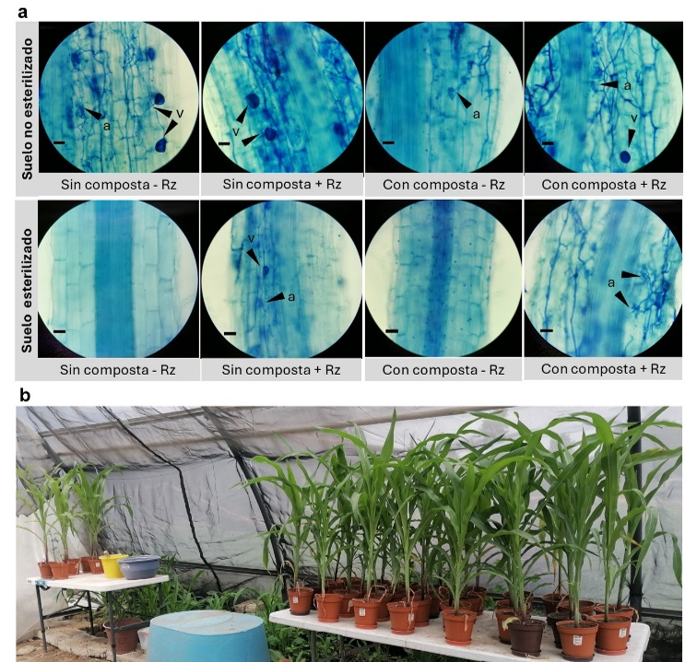
Temperature fluctuations during composting may have affected their colonization capacity but not their structure, as the identified spores had walls with at least two layers.
The colonization response may depend on fungal species tolerance and the experimental period. Hu et al. (2020) found that, after exposure to 180 °C for 30 min, Rhizophagus irregularis spores achieved an MC of 16% in three-month-old corn plants.
Soil sterilization (p< 0.01) and fertilization (p< 0.01) affected MC. MC was 22.9% lower in sterilized soil than in unsterilized soil. This may be due to the large difference in spore abundance between sterilized soil (0 to 320 per pot) and unsterilized soil (1 380 to 1 700 per pot) (Table 3).
In contrast, Zhang et al. (2011) found that MC was higher in sterilized than in unsterilized soil because inoculated AMF competed with soil-native microorganisms. This response appears to occur when the inoculant contains a single AMF species (Gou et al., 2024).
The compost decreased MC by 21% compared to the control. In other studies, the reduction in MC due to the effect of the compost is attributed to a collateral increase in available P (Pi) in the soil (Xiao et al., 2020). Possibly, the compost increased the Pi of the soil since the concentration of total P was 6.5% higher in the soil with compost than without compost (Table 3).
The S×F interaction (p< 0.01) showed that the compost reduced MC in sterilized soil but not in unsterilized soil (Figure 2a). This result reflects that the presence of native AMF may mask the compost effect on MC.
Cumulative P in plants responded to fertilization (p< 0.001) and inoculation (p< 0.001), as P content was 28.8% and 18.4% higher in plants grown with compost and Rz compared to their counterparts (Table 3). The increase in P in plants grown with compost may be related to the increase in total P in the soil with compost. In contrast, the S×I interaction (p< 0.001) showed that Rz increased plant P content only in sterilized soil (Figure 2b).
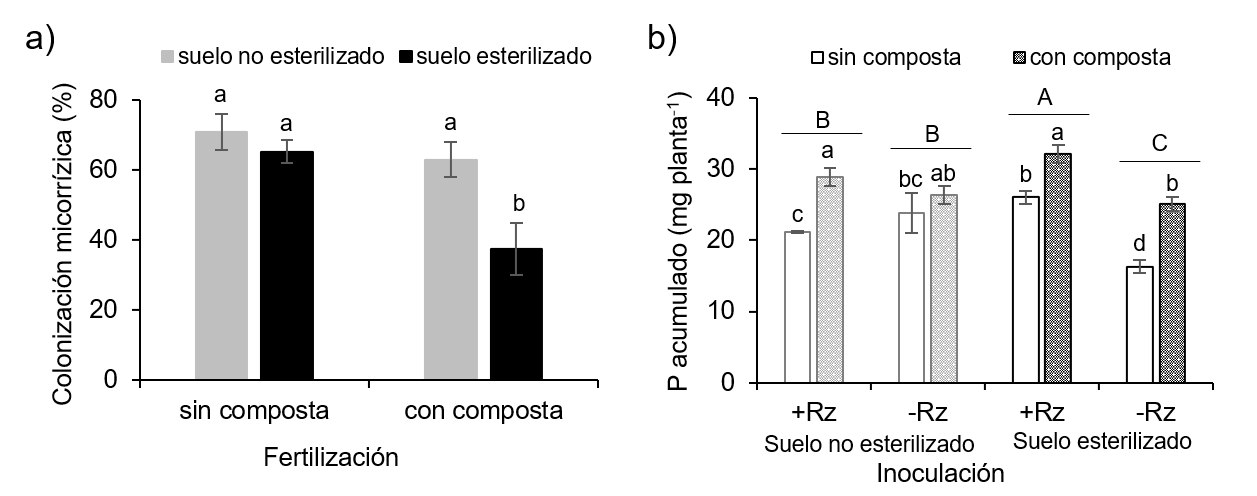
For the S×F×I interaction (p< 0.01), it was found that the joint application of compost and Rz increased plant P content only in sterilized soil (Figure 2b). It has been reported that AMF inoculants may not be effective in soils with a well-established native AMF community (Pulleman et al., 2022).
On the other hand, the function of inoculated AMF may be overestimated in sterilized soils where P levels are modified (Hu et al., 2020). In this case, the increase in P in sterilized soil likely promoted greater P uptake via the direct route rather than the mycorrhizal route (Qin et al., 2022), making it difficult to evaluate the inoculant’s effectiveness.
In unsterilized soil, cumulative P tends to increase with compost-Rz and decrease without compost+Rz (Figure 2b), suggesting that the inoculant does not replace the benefit of the compost for the phosphorus nutrition of plants grown in soil not altered by heat. Notably, cumulative P was 31.9% lower in the treatment without compost-Rz in sterile soil than in the same treatment in unsterilized soil (Figure 2b), indicating that native AMF improved corn P uptake.
The joint application of compost and Rz did not affect plant growth, as the F×I interaction did not explain variability in plant biomass (p= 0.4145). Basal nitrogen fertilization may have masked the effect of applying both inputs on plant growth. In plant biomass, inoculation had a negative effect (p< 0.01), with biomass 11.2% lower than in plants without Rz (Table 3).
The cumulative P was not positively related to plant biomass, possibly because inoculated AMF suppressed plant growth, as plants allocate 4 to 23% of their photosynthates to associated AMF (Salmeron-Santiago et al., 2021).
Total soil P was affected by soil sterilization (p< 0.001) and fertilization (p< 0.01). The increase in total P in sterilized soil can be attributed to reduced Pi-absorbing microorganisms (Doydora et al., 2020). Although Pi is a component of total P, it is plausible to assume that inoculated AMF increased competition for Pi, as the concentration of total P was almost significantly lower in soil with Rz than without Rz (p= 0.054).
The S×I interaction (p< 0.001) showed that the inoculant decreased total P in sterilized soil but not in unsterilized soil (Figure 3a).
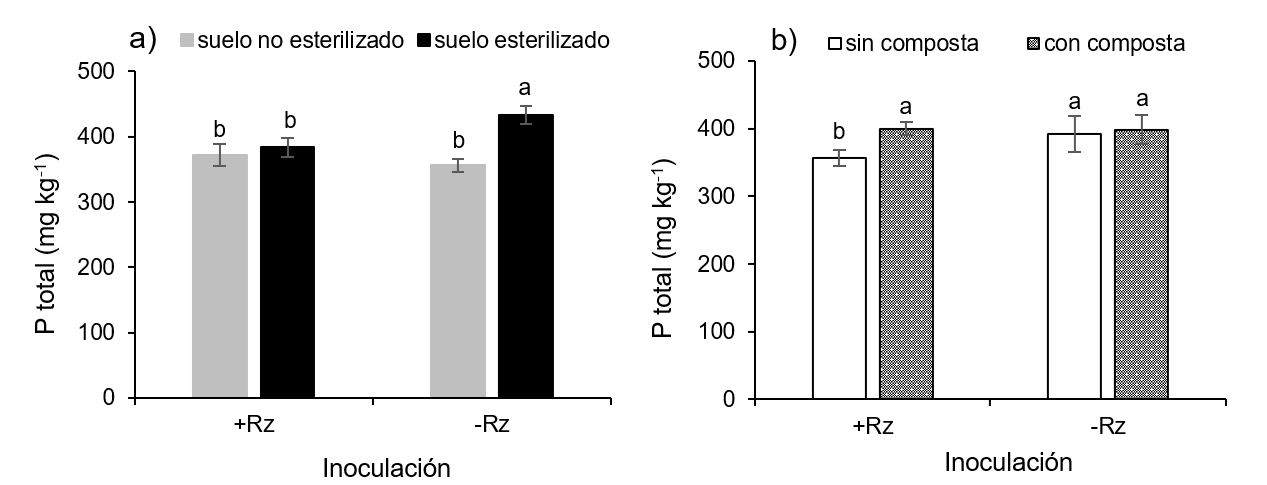
This suggests a mechanism by which soil microbiota regulates P in response to introducing several AMF species. Inoculation with several AMF species may increase the abundance of native bacteria compared with inoculating with a single AMF species (Gou et al., 2024). Finally, the S×F interaction (p< 0.05) revealed that the inoculant reduced the concentration of total P in soil without compost (Figure 3b), suggesting that compost could buffer competition for P when AMF are inoculated.
In the compost of OFMSW from Huerto Roma Verde, three AMF species were identified through the morphological characterization of the spores and a high content of spores per kilogram (>5 000) was found.
Nonetheless, these spores were not viable, as no colonization was observed in the roots of plants grown in sterilized soil throughout the experimental period.
The hypothesis that the joint application of both inputs improves plant growth and P content in plant biomass was not fully rejected, because their joint application improved P content in plants in sterilized soil but not in unsterilized soil.
Additionally, plant biomass did not improve with the application of both inputs under any soil condition. Therefore, the joint application of bioinputs does not improve P content or biomass in corn when a native AMF community is present in the soil.
We are grateful to Dr. Yasmín Vazquéz-Santos and MC. Eduardo Chimal-Sánchez for training in spore isolation and taxonomic identification. We also thank Dr. Dora Trejo-Aguilar for providing us with the inoculant Rizofermic®. This work was funded by the National Polytechnic Institute through the Secretariat of Research and Graduate Studies (SIP, by its Spanish acronym) within the framework of the project: use of municipal compost and phosphorus-supplying fungi to optimize corn growth.
Bohórquez-Sandoval, L. J.; García-Molano, J. F.; Pascual-Valero, J. A. and Ros-Muñoz, M. 2024. A comprehensive review on organic waste compost as an effective phosphorus source for sustainable agriculture. International Journal of Recycling of Organic Waste in Agriculture. 13(4):1-16. https://doi.org/10.57647/ijrowa-ybbx-kp03.
Mohammadi, K.; Khalesro, S.; Sohrabi, Y. and Heidari, G. 2011. A review: beneficial effects of the mycorrhizal fungi for plant growth. Journal of Applied Environmental and Biological Sciences. 1(9):310-319. https://www.researchgate.net/publication/235617686-A-Review-Beneficial-Effects-of-the-Mycorrhizal-Fungi-for-Plant-Growth.
Sedema. 2012. Norma ambiental para el Distrito Federal NADF-020-AMB-2011 que establece los requerimientos mínimos para la producción de composta a partir de la fracción orgánica de los residuos sólidos urbanos, agrícolas, pecuarios y forestales, así como las especificaciones mínimas de calidad de la composta producida o distribuida en el Distrito Federal. http://data.sedema.cdmx.gob.mx/padla/images/stories/normatividaddf/nadf-020-ambt-2011.pdf.
Qin, Z.; Peng, Y.; Yang, G.; Feng, G.; Christie, P.; Zhou, J.; Zhang, J.; Li, X. and Gai, J. 2022. Relationship between phosphorus uptake via indigenous arbuscular mycorrhizal fungi and crop response: A 32P-labeling study. Applied Soil Ecology. 180:104624. https://doi.org/10.1016/j.apsoil.2022.104624.
Salmeron-Santiago, I. A.; Martínez-Trujillo, M.; Valdez-Alarcón, J. J.; Pedraza-Santos, M. E.; Santoyo, G.; Pozo, M. J. and Chávez-Bárcenas, A. T. 2021. An updated review on the modulation of carbon partitioning and allocation in arbuscular mycorrhizal plants. Microorganisms. 10(1):1-20. https://doi.org/10.3390/microorganisms10010075.