elocation-id: e4459
The growing demand for mezcal has generated increased pressure on agave resources, making it essential to implement traceability systems that ensure product authenticity, regulatory compliance and the sustainability of the production chain. In the municipality of Nombre de Dios, Durango, mezcal production represents an activity of great economic, social and cultural importance; however, it still faces challenges related to process standardization, certification and sustainable agave management in 2024. In this context, the research aimed to determine the traceability system of the Tradiciones Mezcaleras Rural Production Society to strengthen mezcal authenticity, identify critical points of the production process and establish the bases for future organic certification. The research used a qualitative-descriptive approach with an applied scope, employing a case study and participatory research strategy. Information collectors were based on field visits, direct observation of all stages of the production process, semi-structured interviews and directed questionnaires for the actors involved. The results enabled comprehensive documentation of the mezcal production chain and identification of areas for improvement in agave management, process control, and information recording. It is concluded that implementing a traceability system strengthens transparency, facilitates compliance with certification requirements, optimizes production process management, and contributes to the environmental, economic and social sustainability of mezcal production in the region.
Agave durangensis, certification, harvesting
Maguey, as the plants of the genus Agave are known in Mexico, is a species that, together with nopal and corn, has had immense historical significance for the development and evolution of the ancestral cultures that inhabited our country’s territory and for our current society. The genus Agave is endemic to the Americas and its natural distribution extends from the southern United States of America, throughout the country, Central America, to the north of Venezuela and Colombia, as well as the Caribbean islands (Gentry, 1982).
The mezcal designation of origin (MDO) is a distinctive used in Mexico to recognize a product originating from a specific region, whose quality and characteristics are due solely to the environment in which it is produced. As a type of geographical indication closely linked to place of origin, designations of origin (DO) have generated growing interest because they promote development and economic growth, especially in marginalized localities that carry out a specific activity.
According to this declaration, only certain states in the country can produce this beverage; to date, eleven states of the Mexican Republic have territories protected under this DO: Oaxaca, Guerrero, Michoacán, San Luis Potosí, Durango, Puebla, Tamaulipas, Zacatecas, Aguascalientes, State of Mexico, and Morelos; the latter three states were recently included in August 2018 (DOF, 2018a, 2018b, 2018c).
Mezcal production in Mexico has experienced an important boom; according to the Mexican Regulatory Council for Mezcal Quality (Comercam, 2026), at the national level from 2011 to 2025, production rose from 980 000 L to 6 912 000 L. The state of Oaxaca concentrates approximately 90.7% of national mezcal production, exceeding the 77.4% reported in 2011, showing the state’s growth and consolidation as a leader in mezcal production in Mexico. By 2025, Durango ranked third in mezcal production with 2.12%.
In Ejido Nicolás Romero and Nombre de Dios, Durango, the use of Agave durangensis dates back to the 1970 land endowment, initially for domestic use until the end of the seventies, when the first commercial distillation plants or vinatas, were established (García, 1998; García and Franco, 2018; Loera et al., 2018). Since 1970, mezcal activity in the region has shifted toward an intensive use scheme (Casas et al., 2014).
The growth and positioning of mezcal nationally and internationally led to the creation in 1997 of the Mexican Regulatory Council for Mezcal Quality, AC (Comercam, by its Spanish acronym), whose primary function is to verify compliance with the Official Mexican Standard Nom-070-SCFI-2016, which sets the specifications for its production, certification and marketing.
Traceability is a key element of sustainability because it strengthens supply-chain transparency, enables identification of environmental risks, optimizes resource use and improves production efficiency. It also helps detect unsustainable practices and implement corrective measures that ensure product quality and safety (Mishra et al., 2018; Rodríguez and Quevedo, 2024).
Although the MDO aims to standardize production and ensure these attributes, in practice it imposes high costs on producers, which represents a significant barrier, especially for those with limited economic resources and technical knowledge. This problem is accentuated in states such as Durango, where structural conditions make it difficult for small producers to integrate into formal certification and marketing schemes.
Conducting a mezcal traceability study is essential, as it helps identify critical points that may affect compliance with the requirements established in Nom-070-SCFI-2016 for certifying the production process. Likewise, it contributes to formulating technical recommendations that promote more sustainable practices in mezcal production, in accordance with the environmental guidelines established in Nom-152 (SEMARNAT 2006).
The general objective of the study was to determine the traceability system of Tradiciones Mezcaleras, a Limited Liability Rural Production Society (SPRL de RL, by its Spanish abbreviation), in the municipality of Nombre de Dios, Durango, in order to strengthen the product’s authenticity and promote the sustainability of its production process; for its part, the specific objective was to establish the basis for future organic certification of mezcal in accordance with Nom-070-SCFI-2016. The proposed hypothesis posits that traceability will enable the identification of the critical points that threaten the sustainability of mezcal production.
The study was conducted in the municipality of Nombre de Dios, Durango, considered the oldest settlement in the state, originally established in 1562 as ‘Villa de los Cuatro Templos’ on an old Franciscan mission. Its historical monuments are part of the cultural itinerary of Camino Real de Tierra Adentro protected by INAH (INAH, 2010; Gobierno del estado de Durango, 2020).
The municipality has approximately 36 mezcal distillation plants, of which only six are formally certified by Comercam. The research was carried out specifically in the certified plant owned by the Tradiciones Mezcaleras Limited Liability Rural Production Society (SPRL de RL, by its Spanish abbreviation). This selection was based on its operational status, which has the ‘green seal’ of certification, offering an ideal scenario to analyze the factors necessary to retain that certification and identify areas of opportunity to move toward certified organic production.
The study used a mixed qualitative-descriptive methodological approach with an applied scope, employing a case study strategy (Yin, 2018). It also integrated a participatory research approach (Kindon et al., 2007; FAO, 2017), in which the researcher was directly involved in all stages of the mezcal production and transformation processes.
To collect field information, the researcher designed and administered a structured questionnaire and conducted in-depth interviews with key operational actors (mezcal masters, harvesters and administrators). The gaps and areas of opportunity were determined by comparing actual field practices with the explicit criteria of Nom-070-SCFI-2016 and the Comercam regulations.
During the field visits, the presence of two usable species was confirmed: Agave salmiana ‘green maguey’ and Agave durangensis ‘ashy maguey.’ The inflorescence of A. salmiana produces about 12 panicles in the upper part of the flower stalk or quiote. By contrast, A. durangensis is distinguished by having 25 to 30 panicles densely distributed from the base to the apex of the flower stalk, housing the seed-containing umbels.
The traceability process formally begins with visually identifying phenotypically outstanding ‘mother plants’ (healthy, vigorous and pest-free) in July and August, after flowering. Collecting mature capsules and handling seeds under controlled conditions enable accurate documentation of the plant material’s botanical and geographical origin.
Selecting mother plants with outstanding phenotypic characteristics aligns with García and Franco (2018), who establish that conserving individuals with high genetic quality is one of the pillars for maintaining the biological diversity of natural agave populations. Likewise, Casas et al. (2016) note that conserving genetic variability is essential to ensure the permanence of the species used in the mezcal industry.
The collection of ashy agave (Agave durangensis) seeds is carried out once the plant reaches physiological maturity and completes its reproductive cycle, as evidenced by the emergence of the flower stalk and the subsequent practical flowering that coincides with the provisions established in Nom-005-SEMARNAT-1997 and Nom-152-SEMARNAT-2006, which promote the sustainable use of non-timber forest resources by conserving reproductive individuals and establishing management programs.
From a traceability perspective, this practice allows documentation of the origin of the plant material, an aspect considered by Olsen and Borit (2013) as one of the essential components of any modern traceability system. It is carried out manually, taking advantage of the site’s climatic and ecological conditions from December to February. The geographical location of agaves from which the seed was collected was 15 km from the town of Nombre de Dios, at a latitude of 23° 82’ 09”, longitude of -104° 30’ 83”, and an altitude of 1 899 m.
Plant production begins with seed germination in outdoor seedbeds in soil previously prepared for this purpose. Seed germination reaches 95%, but only 80% manage to survive. When plants reach a height of 5 cm, they are transferred to nursery beds; finally, after reaching 10-24 cm in height (a period of 12 months), they are transplanted to the final site.
The high germination and survival percentages obtained during nursery production reflect adequate technical management of the propagation process. These results align with reports by Loera et al. (2018), who highlight that the controlled reproduction of Agave durangensis represents an alternative to reduce pressure on wild populations. Similarly, Toledo (2013) argues that the sustainability of biocultural resources depends on the ability to replace direct extraction with planned production systems progressively.
Agave plants in the nursery beds are irrigated with water from an artisanal, open-air well that works with electricity from a solar panel. Soil preparation for the establishment and development of agave plants includes bovine manure at a rate of 0.5 kg m-2; while the plants remain in the nursery beds, weeding is done manually, and weeds are controlled by placing mezcal bagasse between the aisles of the nursery beds, which inhibits weed emergence and facilitates the passage of people who control weeds in dry and rainy times.
Once plants reach maturity and the necessary height (approximately two years), they are manually extracted from the nursery beds and arranged in piles, where they remain for two to three weeks in the shade to heal and then they are transferred to the field. Replanting is carried out systematically from July to September, coinciding with the rainy season, a practice that producers have followed consistently over the years.
One of the study’s most relevant findings corresponds to the system for controlling and monitoring plantations through official registrations with Comercam. Documenting each batch, from establishment to final use, maintains information continuity throughout the production process, an essential condition for complying with the traceability principles established by FAO (2025). In this sense, the information obtained showed that traceability fulfills not only an administrative function but also serves as a tool to ensure the transparency of the product’s origin.
It was observed that the process of selecting the maguey to be ‘castrated’ was carried out in 2024. This process forces the agave to concentrate its sugars and nutrients in the heart, optimizing yield and improving the mezcal’s taste and aroma.
Four to six months after castration, harvest begins, which consists of separating the roots, severely cutting the fibrous stalks with a steel coa, and isolating the heart or ‘piña,’ of the agave. To ensure optimal alcohol yield and strict regulatory compliance with using only mature plants, a crew evaluator takes preliminary readings of soluble solids (°Brix) at the base of the inner leaves with a portable refractometer.
Field observations confirmed that harvest is authorized only for individuals that register readings between 15 and 20° Brix, ensuring an adequate concentration of fermentable fructans, a range that, from the harvester’s empirical knowledge, indicates an adequate level of physiological maturity and sufficient accumulation of fermentable sugars to favor the yield and quality of mezcal, in accordance with what has been indicated by the literature on the harvest of agaves at their maximum carbohydrate content (Ávila et al., 2025).
This procedure aligns with Nom-070-SCFI-2016, which establishes that only mature agaves should be used for mezcal production. In addition, various studies indicate that sugar concentration is one of the main factors determining yield during fermentation and the final quality of the distillate (Pérez et al., 2016). Consequently, objective measurements strengthen process standardization and reduce variability between batches.
The harvested hearts, whose individual weights range from 150 to 300 kg, are sectioned into pieces of approximately 70 kg to facilitate their manual handling. For the experimental phase of the traceability study, a homogeneous batch of 10 t of raw hearts, consisting of 75 agave hearts (average weight of 133 kg per unit), was documented and monitored.
The material was transported to the plant using two cargo vehicles with a combined capacity of 10 t. The legal origin and mobilization of the raw material were formally validated through the non-timber forest remittance forms and transport guides authorized and issued by SEMARNAT. The time elapsed from harvest to loading into the oven remained within the critical range of 12 to 24 h.
The cooking oven consists of a conical pit covered with volcanic stone, and its shape helps redirect heat toward its center. It has a capacity that ranges from 10 to 14 t of raw hearts. To heat it and have it ready for ‘a run’ of hearts, between 1.5 and 2 t of firewood are used. The time it takes to be very hot was 7 h, enough to reach a temperature of 500 to 600 °C. After cooking, the hearts register about 35° Brix and a temperature of 60°. After 72 h of cooking, they undergo milling and juice extraction. During this stage, the hearts release sugars.
From the 10 t of raw hearts, 6 t of cooked hearts were obtained, representing 60% of the raw weight. Nonetheless, upon entering fermentation, this value decreases to between 10 and 14° due to the addition of water needed to initiate fermentation. Once cooked, and with the help of the workers, the hearts are immediately transferred to the crushing area, then to the milling area, and then through roller mills to extract the juice. The processes described were carried out industrially in a plant with the necessary equipment for it, manufactured from food-grade stainless steel.
The extracted juice is mechanically pumped into a fermentation tank with a capacity of 14 000 L, where it takes 5 to 7 days to finish fermenting. To speed up the fermentation process, they use Nevada yeast at a rate of 900 g per 10 000 L of must; however, when ferment is left over from a previous fermentation, fermentation is carried out without yeast.
The sign that the ferment is ready is when it stops bubbling (CO2 emissions decrease), and the aroma is bittersweet; that is, the yeasts have stopped working and the measurement is 5 °Brix (the ideal time is when 0 oBrix are recorded, which is when the sugars have been transformed into alcohol). The measurement is made with an instrument called a refractometer. At this point, the 10 t of raw mezcal hearts reach a volume of 8 000 L of must, depending on the concentration of degrees Brix.
Mezcal fermentation is followed by the distillation process; to this end, the ferment is transferred to a stainless-steel still with a capacity of 250 L, where it is gently heated. The mezcal distillery or mill that heats the still uses poplar, mesquite or sabino wood; the first of two distillations begin here; this phase is called saque.
The distillate that comes out first, called despunte, has an alcohol content of 40°. The process of the first distillation stops when the portable density meter reads an alcohol content of 10° because below ten degrees of alcohol, the distillate contains residues that reduce the quality of the mezcal.
Once the distillation of the 250 L of ferment is complete (lasting about 3 h), the residues that remain in the still, called vinazas (brown-colored waste), are led to a waste treatment tank built especially for this purpose. The first distillate, called aguavino, is collected in plastic buckets that are taken and emptied into another copper still with a capacity of 350 L. In this new still, the second distillate occurs, also called resaque.
The first mezcal obtained from the second distillation or resaque, comes off the still at 75-80° alcohol. To measure this data, the distilled mezcal is monitored with an alcohol density meter. Once the mezcal being distilled decreases to a value of 35° alcohol, the process of the second distillation is stopped. The resaque lasts about three more hours.
After the second distillation, the mezcal is poured into a stainless-steel still. The alcohol content of the mezcal poured into the still ranges from 55 to 60°. This mezcal is called mezcal de corazón. After this process, the mezcal is sent for standardization. The total volume of young mezcal obtained from the batch under study (10 t of raw mezcal) amounted to 676 L, meaning that obtaining one liter of mezcal requires 15 kg of raw mezcal hearts.
The cooking, milling, fermentation and distillation stages showed a clearly documented operational sequence, allowing identification of each critical point of the process. From a quality management perspective, this documentation helps detect deviations, improves process repeatability and strengthens the capacity to respond to possible safety problems.
The findings of Anastasiadis et al. (2022) indicate that continuous documentation of each stage is one of the essential elements for achieving transparent and reliable agrifood systems. Regarding quality control, the results indicate that the company complies with the procedures established by COMERCAM to keep the product certification valid.
Nonetheless, it was also found that a significant portion of the information is still recorded manually. This situation aligns with Rossi et al. (2025), who state that traditional recording systems limit consultation speed and reduce the efficiency of audit processes.
The results also showed that the traceability currently implemented adequately complies with regulatory requirements for mezcal certification; however, there are still opportunities for improvement to move toward organic certification schemes. These include comprehensive digitization of records, automated batch tracking, georeferencing of plantations and integrating environmental indicators that allow documenting compliance with sustainability criteria at all stages of the production process.
From an international perspective, several authors have noted that modern traceability systems are rapidly evolving toward digital platforms based on blockchain and Internet of Things (IoT) technologies, capable of recording information in real time from the origin of the raw material to the final consumer (Saberi et al., 2019).
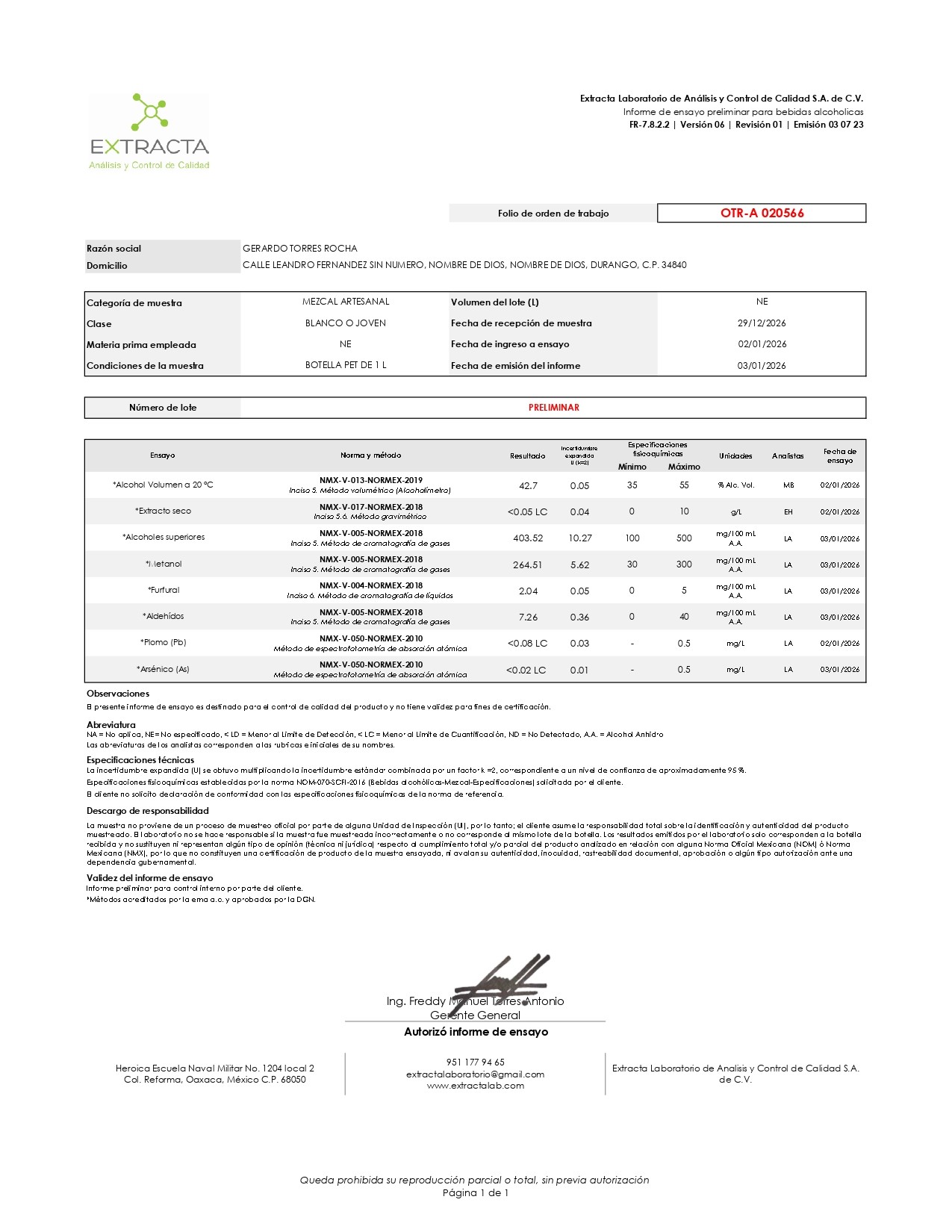
The distillery under study standardizes to 48, 45, 43, 40 and 38° of alcohol. From the processed mezcal batch, a sample was sent to the city of Oaxaca for certification to Extracta Laboratorio de Análisis y Control de Calidad, SA de CV, certified by Nom-070-SCFI-2016 (alcoholic beverages, mezcal specifications).
The results of the mezcal laboratory analysis are shown in Figure 1; it can be observed that the quality of the product was approved by the methods accredited by the Mexican accreditation entity (EMA, AC) and approved by the General Directorate of Standards (DGN, by its Spanish initialism) of the Secretariat of Economy (SE). These studies analyze whether certain components fall within the margins allowed by the methanol-ethanol standard.
Once the distillery receives the approved product certification results, it carries out the packaging process manually. In this case, the distillery has two brands granted by the Mexican Regulatory Council for Mezcal Quality, namely: mezcal raíz de mi tierra and madre tierra. Because of the management and quality with which the tradiciones mezcaleras distillery produces mezcal, it has the Nom certificate for bulk mezcal and the Nom certificate for mezcal bottling.
The three types of mezcal that SPR tradiciones mezcaleras packages manually in 750 ml glass bottles are the following: young mezcal (containing 38° alcohol) and rested and aged mezcal with 40° alcohol. The labels they carry are mezcal raíz de mi tierra and madre tierra, and the level of alcohol it contains amounts to 38°.
The aging period of rested mezcal ranges from two to twelve months, and that of aged mezcal is three years in american white oak barrels. In addition to these types of mezcal, they prepare two types of mezcal liqueur: one with pomegranate, and the other with quince. These two liqueurs have an alcohol level of 14°.
The tradiciones mezcaleras distillery, in addition to carrying out the stages of production and packaging of mezcal, provides packaging services for various brands registered with the Mexican Regulatory Council for Mezcal Quality (Comercam, by its Spanish acronym). The diversity of brands served shows the company’s operational capacity to comply with the regulatory and quality requirements demanded by the mezcal sector, as well as its participation in the value chain of this beverage with designation of origin.
Regarding quality control, the results indicate that the company complies with the procedures established by Comercam to keep the product’s certification valid. Nevertheless, it was also identified that a significant part of the information is still recorded manually.
In this context, Rossi et al. (2025) state that traditional recording systems limit consultation speed and reduce the efficiency of audit processes. In this sense, incorporating digital platforms would increase the accuracy, availability and reliability of the information generated. Finally, the hypothesis raised in this research is confirmed, as applying traceability analysis enabled the identification of the main critical points of the production process related to sustainability, regulatory compliance, and the conservation of the agave resource.
Likewise, the study showed that traceability transcends its documentary function and becomes a strategic tool that simultaneously contributes to mezcal authenticity, natural resource conservation and the strengthening of certified companies’ competitiveness.
It was verified that traceability is a strategic tool to strengthen mezcal authenticity, since it allows recording the origin of the raw material, documenting the operations carried out during the production process and demonstrating compliance with the requirements established by Nom-070-SCFI-2016 and Comercam’s certification procedures.
The study enabled the identification of various critical points in the production process, primarily related to record management and conservation, documentation of each batch, control of raw materials, plantation monitoring, monitoring of degrees Brix during harvest, and systematization of the information generated at each stage. These elements represent opportunities for improvement to strengthen traceability and facilitate future certification audits.
Establishing own nurseries and permanent planting programs ensures a future supply of raw material, reducing dependence on natural populations and supporting a more sustainable management of the resource. Measuring °Brix before harvest is a decisive control point in the traceability system, as it allows selection of physiologically mature plants and improves the yield of fermentable sugars during mezcal production.
Integrating the information obtained throughout the research enabled us to design a continuous traceability scheme that can be incorporated into digital tools, such as QR codes, through which consumers, certifying bodies and marketers can consult the product’s history from seed collection to bottling.
The research showed that traceability was not only a certification requirement but also a management strategy that strengthens environmental sustainability, process transparency, consumer confidence and the competitiveness of mezcal produced in Nombre de Dios, Durango.
Loera-Gallegos, H. M.; Corral-Rivas, J. J.; Montiel-Antuna, E.; Solís-Moreno, R.; Chávez-Simental, J. A. y González-Cervantes, G. 2018. Calidad de sitio para Agave durangensis Gentry en la Sierra de Registrillo, Durango. Revista Mexicana de Ciencias Agrícolas. 9(6):1171-1180. https://doi.org/10.29312/remexca.v9i6.1582.
SEMARNAT. 1997. Secretaría de Medio Ambiente y Recursos Naturales. Norma oficial mexicana Nom-005-SEMARNAT-1997, que establece los procedimientos, criterios y especificaciones para realizar el aprovechamiento, transporte y almacenamiento de corteza, tallos y plantas completas de vegetación forestal. Diario Oficial de la Federación. https://www.dof.gob.mx/nota-detalle.php?codigo=4880026&fecha=20/05/1997.
SEMARNAT. 2006. Secretaría de medio ambiente y recursos naturales. Norma oficial mexicana Nom-152-SEMARNAT-2006, que establece los lineamientos, criterios y especificaciones de los contenidos de los programas de manejo forestal. Diario Oficial de la Federación. https://www.dof.gob.mx/nota-detalle.php?codigo=4934816&fecha=17/10/2006.