elocation-id: elocation-id: e4449
Sorghum (Sorghum bicolor L. Moench) is a cereal with the potential to diversify its use in food for human consumption; however, Mexico lacks specific commercial varieties for popping. This study aimed to evaluate the technological, sensory and microbiological potential of seven Mexican sorghum varieties for popcorn production. The RB-Gaviota, Fortuna, Costeño-201, Gavatero-203, Matinal, M-16 and RB-Paloma varieties, grown in the spring-summer cycle of 2024, were analyzed. Initial moisture content, pericarp thickness, starch granule size, expansion volume and popping percentage were determined; in addition, sensory acceptability was evaluated using a five-point hedonic scale, and microbiological quality was quantified. Grain moisture ranged from 11.85 to 13.01%. Gavatero-203 presented the highest expansion volume (8.9 ml g-1) and popping percentage (59.9%), followed by RB-Paloma and Matinal. RB-Paloma recorded the highest pericarp thickness (23.99 μm), whereas Fortuna and Costeño-201 showed the largest starch granules. In the sensory test, RB-Paloma stood out for its general acceptance and Gavatero-203 for color and appearance. The loads of aerobic mesophiles, total coliforms, fungi, and yeasts remained below the limits established by NOM-247-SSA1-2008. The results indicate that RB-Paloma, Gavatero-203 and Matinal are promising materials for making sorghum popcorn and for diversifying the food use of national varieties.
acceptability, expansion volume, microbiological quality, popping percentage.
Sorghum (Sorghum bicolor L. Moench) is a strategic cereal because of its adaptation to drought conditions, efficient water use and contributions of carbohydrates, protein, fiber and phenolic compounds, attributes that have increased interest in incorporating it into functional foods and low-cost snacks (Kent and Rooney, 2021; Hossain et al., 2022; Vázquez-Sosa et al., 2023; Zhang et al., 2025).
Although in Mexico its main destination continues to be associated with livestock use, diversification toward products for human consumption represents an opportunity to add value to the crop and expand the food options available to the population (Medina-Álvarez et al., 2025).
Among these alternatives, popping the grain makes it possible to obtain sorghum popcorn, a ready-to-eat product that can be prepared using hot air, microwaves, or a frying pan, with a direct effect on the microstructure, texture, expansion volume and yield (Castro-Campos et al., 2021; Swarnakar et al., 2022; Vázquez-Sosa et al., 2023).
During popping, internal water turns into steam, increasing pressure inside the grain and promoting starch gelatinization; subsequently, pericarp rupture allows expansion and popcorn formation. Therefore, grain integrity, moisture content, pericarp thickness, endosperm structure, and starch properties are determinant variables of popcorn quality (Kent and Rooney, 2021; Zhang et al., 2025).
Recent studies have shown that threshing methods and post-harvest management can modify popping efficiency by causing physical damage to the grain, and that processing methods affect the volume, texture and acceptance of the final product (Kent and Rooney, 2021; Vázquez-Sosa et al., 2023). In Mexico, information on sorghum varieties suitable for popcorn remains limited and no commercial materials have been developed for this purpose.
Therefore, assessing national varieties based on their technological performance, sensory acceptance, and microbiological quality is relevant for guiding breeding programs, selecting promising materials and promoting the development of sorghum-based snacks. This study aimed to evaluate the technological, sensory and microbiological potential of seven Mexican sorghum varieties for popcorn production.
The materials consisted of grains from seven sorghum varieties developed by the National Institute of Forestry, Agricultural and Forestry Research (INIFAP, by its Spanish acronym), grown under irrigation conditions at the Bajío Experimental Field during the spring-summer cycle of 2024. Six varieties with white or white-cream pericarp (RB-Gaviota, Fortuna, Costeño-201, M-16, Matinal and RB-Paloma) and one variety with dark pericarp (Gavatero-203) were evaluated.
Before analysis, samples were manually cleaned to remove broken or damaged grains and those with visible impurities. Subsequently, the initial moisture content of the grain was determined using method 931.04 (AOAC, 2019).
Pericarp thickness and starch granule size were determined by scanning electron microscopy (SEM; EVO-50, Carl Zeiss, with 20 kV acceleration voltage, 20 μm resolution, and 430X magnification). Longitudinal cuts were made in the grains of each variety, and the grains were placed directly in the sample holder without prior treatment or coating.
Measurements were taken using ImageJ software version 1.53. For each variety, 30 starch granules from the mealy endosperm were measured in the region near the embryo, and five replications were made at different points to determine pericarp thickness.
To determine expansion volume, samples of 15 g of grain per variety were used. Each sample was popped in a Turmix® hot-air popcorn maker for 90 s. The popcorn obtained was placed in a 250 ml graduated cylinder, and the expansion volume was recorded. Expansion volume was calculated by dividing the popcorn volume by the initial weight; for its part, the percentage of popping was calculated by obtaining the percentage of popped grains relative to the grains contained in 15 g of sample (Dofing et al., 1990). The measurements were made in triplicate.
Popcorn was prepared with all seven varieties after 20 min soak. Acceptability was assessed using a five-point hedonic scale: 1) I dislike it very much; 2) I dislike it moderately; 3) I neither like it nor dislike it; 4) I like it moderately; and 5) I like it very much (Head et al., 1977).
The test was administered to 50 randomly selected, untrained judges aged 20-50 years (Lawless and Heymann, 2010), who evaluated the following attributes: color, aroma, taste, texture and overall appearance. Samples were presented individually to avoid comparison biases across treatments.
The microbiological quality of the popcorn was evaluated by quantifying aerobic mesophiles, total coliforms, fungi and yeasts. The analyses followed the methodologies established in the official Mexican standards NOM-092-SSA1-1994, NOM-113-SSA1-1994, and NOM-111-SSA1-1994.
Determinations were made in triplicate over three weeks of storage. The results were expressed as colony-forming units per gram (CFU g-1) and compared with the limits established in NOM-247-SSA1-2008.
For the variables initial moisture content (MC), pericarp thickness (PT), starch granule size (SGS), expansion volume (EV), and popping percentage (PP), a completely randomized design was used. The data were subjected to analysis of variance, and when significant differences were detected, means were compared using Tukey’s test (p <0.05).
Data expressed as percentages were previously transformed using the arcsine function. The hedonic test results were analyzed using an X2 test with contingency tables prepared in Excel. All analyses were performed in RStudio version 1.4.1106 (Lawless and Heymann, 2010).
The initial moisture content (MC) differed significantly among varieties and ranged from 11.85 to 13.01% (Table 1).
Fortuna had the highest MC, followed by Matinal, Costeño-201 and RB-Gaviota; in contrast, Gavatero-203 and RB-Paloma showed the lowest values. Despite this, these two varieties exhibited the best popcorn yield, indicating that initial MC was not the only factor determining popping.
Gavatero-203 reached the highest expansion volume (EV; 8.9 ml g-1) and popping percentage (PP; 59.9%), followed by RB-Paloma (6.7 ml g-1 and 57.4%) and Matinal (6.7 ml g-1 and 52.3%). In contrast, RB-Gaviota and Fortuna showed the lowest EV and PP values.
These results show a differentiated varietal response and suggest that PP depends on interactions among moisture, grain physical integrity, endosperm structure, pericarp thickness and conditioning parameters prior to heating.
The superiority of Gavatero-203, RB-Paloma and Matinal confirms that sorghum popping is a multifactorial process in which harvest moisture and threshing methods modify popping efficiency, expansion ratio, and popcorn size through physical damage to the grain (Kent and Rooney, 2021). In addition, popping produces structural and thermal changes associated with rapid starch gelatinization and endosperm expansion (Castro-Campos et al., 2021).
Therefore, the higher values observed in Gavatero-203 and RB-Paloma may be related to a favorable combination of moisture (CODEXSTAN 1989 and NMX-FF-037-1994), pericarp resistance and internal grain structure. Nonetheless, processing methods affect the microstructure, volume, texture and yield of sorghum popcorn. Consequently, varietal selection must be accompanied by the optimization of soaking time, temperature and the heating system (Vázquez-Sosa et al., 2023).
The behavior of Gavatero-203 is particularly relevant because it is a pigmented pericarp material that has not been identified as a specific popcorn variety. Its high PP and EV suggest it may be a useful snack source. RB-Paloma confirmed its technological suitability, previously associated with good popping quality in national sorghum (Cabrera-Ramírez et al., 2020; Vázquez-Sosa et al., 2023). Matinal’s response was also favorable, although its lower PT indicates that other internal grain attributes could compensate for this characteristic.
Pericarp thickness (PT) and starch granule size (SGS) differed significantly among varieties (p <0.001). RB-Paloma had the thickest pericarp (23.99 μm), whereas Matinal had the lowest thickness (Table 2). In SGS, Fortuna and Costeño-201 showed the highest values, whereas RB-Paloma and M-16 showed the lowest.
The comparison between the two variables indicates that a higher SGS is not directly related to better popping, because Fortuna and Costeño-201 did not stand out in EV or PP. In contrast, RB-Paloma combined thick pericarp, small granules and high popcorn yield, suggesting a favorable structure for retaining steam and promoting endosperm expansion during heating.
The pericarp’s importance in popping relates to its role as a physical barrier that retains steam until internal pressure exceeds the grain’s resistance. In this study, RB-Paloma had the highest thickness and one of the best popping percentages, which aligns with the idea that pericarp integrity favors expansion (O-Olán et al., 2018).
Nevertheless, Matinal, with a thinner pericarp, showed good performance, so the popping quality must also be explained by the endosperm structure and the thermal properties of the starch (Castro-Campos et al., 2021), whereas the composition of amylose and amylopectin, the distribution of chains, and viscosity influence the processing quality of sorghum (Zhang et al., 2025). This supports the idea that the average granule size alone does not predict the popcorn yield.
The results also show that the pigmented pericarp of Gavatero-203 did not limit the popping process; instead, this variety showed the highest expansion volume and popping percentage. This finding broadens selection prospects, as many previous studies have focused on white sorghum for its color and neutral taste.
Recent evidence indicates that using technologies such as hot air, microwaves (Mishra et al., 2015), frying pans or hot salt can modify the texture, volume and appearance of the final product (Vázquez-Sosa et al., 2023). Therefore, pigmented varieties such as Gavatero-203 could be leveraged in differentiated products, provided that processing is adjusted to maintain acceptable sensory attributes and microbiological stability.
Sensory evaluation enabled the integration of technological performance with consumer acceptance. RB-Paloma received the best overall ratings and was among the preferred varieties in taste, aroma, color, texture and general appearance. M-16 and Matinal stood out in taste and texture, whereas Gavatero-203 stood out for color and appearance (Figure 1).
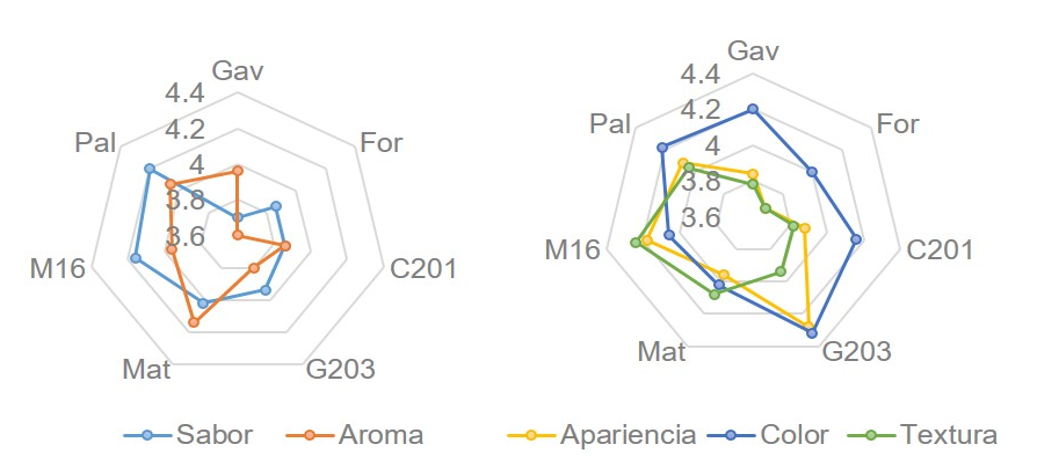
These results indicate that selecting materials for sorghum popcorn should be based not only on EV or PP but also on sensory attributes that influence product acceptance. The processing method for popped sorghum alters the microstructure and texture, variables closely related to sensory perception (Vázquez-Sosa et al., 2023). In cereals, popping quality depends on interactions among raw material, moisture, heat treatment and final texture (Swarnakar et al., 2022).
From an application perspective, RB-Paloma represents the most balanced alternative for direct consumption because of its technological performance and sensory acceptance (Vázquez-Sosa et al., 2023). Although Gavatero-203 showed the greatest expansion, it could be directed toward products with a differentiated visual identity, such as mixed snacks, bars or brittle, where the grain’s color provides commercial value (Gaul and Rayas-Duarte, 2008).
Matinal and M-16 are also materials of interest due to their sensory acceptance, especially when seeking to improve taste and texture. These results are relevant to developing sorghum-based foods in Mexico, where the availability of national varieties would reduce dependence on imported raw materials and promote value-added products.
The microbiological quality was adequate during the three weeks of storage (Table 3). The loads of aerobic mesophiles, total coliforms, fungi and yeasts remained below the limits established in NOM-247-SSA1-2008. In the third week, Costeño-201 and RB-Gaviota had the highest loads of aerobic mesophiles, with 87 and 60 CFU g-1, respectively; however, these values were low compared with the normative limit.
In fungi and yeasts, Costeño-201 showed the highest load (60 CFU g-1) without compromising product safety under the evaluated conditions. The reduced microbial load is associated with the heat treatment applied during popping, the low moisture level of the final product, and storage at room temperature (Swarnakar et al., 2022).
These results support a preliminary shelf life of three weeks; nevertheless, it is recommended to evaluate water activity, packaging, oxidative rancidity, and the presence of mycotoxins in subsequent studies, given the sanitary importance of stored cereals (Adetunji et al., 2018).
The results show that sorghum popcorn yield should not be interpreted based on a single variable but rather on the integration of moisture, pericarp morphology, starch properties, grain integrity and sensory acceptance.
The results indicate that the varieties developed by INIFAP have the potential to diversify the food uses of sorghum and generate value-added snacks. In particular, RB-Paloma, Gavatero-203 and Matinal are identified as promising materials for scale-up, process optimization and genetic improvement studies aimed at popcorn quality, as they exhibit technological, structural, sensory and microbiological differences relevant to popcorn production.
Castro-Campos, F. G.; Cabrera-Ramírez, A. H.; Morales-Sánchez, E.; Rodríguez-García, M. E.; Villamiel, M.; Ramos-López, M. A. and Gaytán-Martínez, M. 2021. Impact of the popping process on the structural and thermal properties of sorghum grains (Sorghum bicolor L. Moench). Food Chemistry. 348:129092. https://doi.org/10.1016/j.foodchem.2021.129092.
DOF. 2008. Norma Oficial Mexicana NOM-247-SSA1-2008, Productos y servicios. Cereales y sus productos. Cereales, harinas de cereales, sémolas o semolinas. Alimentos a base de: cereales, semillas comestibles, de harinas, sémolas o semolinas o sus mezclas. Productos de panificación. Disposiciones y especificaciones sanitarias y nutrimentales. Métodos de prueba. https://dof.gob.mx/nota-detalle-popup.php?codigo=5100356.
O-Olán, M.; Santacruz-Varela, A.; Sangerman-Jarquín, D. M.; Gámez-Vázquez, A. J.; Arellano-Vázquez, J. L.; Valadez-Bustos, M. G. and Avila-Perches, M. A. 2018. Estandarización del método de reventado para la evaluación experimental del maíz palomero. Revista Mexicana de Ciencias Agrícolas. 9(7):1471-1482. https://doi.org/10.29312/remexca.v9i7.1675.
Vázquez-Sosa, G. G.; Cabrera-Ramírez, A. H.; Reyes-Vega, M. L.; Morales-Sánchez, E.; Gaytán-Martínez, M. and Vega-Vázquez, L. B. 2023. Alternative technologies for the production of popped sorghum: A comparative study. Journal of Food Science and Technology. 60(1):103-113. https://doi.org/10.1007/s13197-022-05592-0.
Zhang, K.; Ke, F.; Zhou, H.; Wang, J.; Ma, Z.; Zhang, F.; Wang, Y.; Zhang, Z.; Lu, F.; Duan, Y.; Wu, H.; Yang, L.; Yang, Z.; Zhu, K. and Zou, J. 2025. The correlation of starch composition, physicochemical and structural properties of different sorghum grains. Frontiers in Plant Science. 16:1515022. https://doi.org/10.3389/fpls.2025.1515022.