elocation-id: e4268
In 2016, Mexico imported almost 13 million tons of yellow corn, valued at more than 2.3 billion dollars. However, imports could be reduced or eliminated if the yellow-grained varieties and hybrids generated by the National Institute of Forestry, Agricultural and Livestock Research were grown. The study aimed to identify the best hybrid and the best variety of yellow corn that the National Institute of Forestry, Agricultural and Livestock Research has released for the Mexican tropics, where more than 420 000 ha are planted, and 2.1 million tons of yellow corn are produced. During the spring-summer agricultural cycle of 2018, 21 genotypes were evaluated in three localities in Chiapas; the hybrids H-443A, REMACO15A and H-386A stood out statistically with grain yields of 5.748, 5.608, and 5.514 t ha-1 and equaled two of the control commercial hybrids; of the improved varieties, Población Amarilla C1 stood out with 4.9 t ha-1 and of the native varieties, the Olotillo Amarillo-1 variety, from Ocozocoautla, stood out with 3.1 t ha-1.
elite trials, genetic improvement.
In 2022, 26.5 million tons of corn grain were produced in Mexico on 6.9 million hectares, where 92% of production was white grain and 8% yellow grain (SIAP, 2023). Mexico has always had a deficit in yellow corn, and its imports have been increasing, making it one of the largest importers worldwide: 12.7 million tons in 2016 (SAGARPA, 2017); purchases from US producers, mainly from Iowa, North Dakota, Kansas, Missouri and Nebraska, totaled 2.32 billion dollars, 10.36% more than in 2015; imports from Argentina totaled only 17.7 million dollars and those from Brazil totaled 10 million dollars in the same period.
This grain is mainly used in the livestock sector (76%) for feed production; between 18 and 24% is used in the starch sector; approximately 2% is used for self-consumption; and the cereals and snacks sectors account for approximately 4% (SAGARPA, 2017). One of the causes of the low production of yellow corn at the national level is that barely five percent of the national territory is planted using improved seed and seed of native varieties (García and Ramírez, 2014); there are not enough improved seeds that are competitive in production in comparison to white-grained corn for the main corn-producing regions of Mexico.
In the spring-summer (SS) cycle of 2022, the area planted with yellow corn in Mexico was 472 462 ha (SIAP, 2023). The leading states in yellow corn production, which contribute 88.5% of national production, are Chihuahua with 39.5%, Jalisco with 16.5%, Tamaulipas with 18%, and Chiapas with 14.5% (García et al., 2016). The production of this grain in Chiapas is not encouraging when compared with the production of the rest of the country, since of the 1.2 million tons of corn produced in the 704 thousand ha that are destined for this crop, 85.5% corresponds to white grain, and the remaining 14.5% corresponds to yellow grain (García et al., 2016).
Eighty-seven point six percent of the planted area is covered with seed from white genotypes and 9.1% with yellow seed, of which 74.4% is sown with seeds of native varieties and 25.5% with improved seed. Flores and García (2016) reported that the rate of adoption of improved seeds depends on economic, social and geographic factors. To increase yellow grain production, it is necessary to have improved seeds that are competitive in grain yield and stability, with registration in the National Catalog of Plant Varieties (CNVV, by its Spanish acronym), production technology and agronomic management recommendations; likewise, it is required that registered seeds be available.
In recent years, the National Institute of Forestry, Agriculture and Livestock Research (INIFAP, by its Spanish acronym) has developed hybrids and improved yellow-grained varieties for different regions of the country (Gámez et al., 1996), namely: H-378A, H-380A, H-381A, H-382A, H-384A, H-385A, H-386A, H-443A, HV-59A, HV-60A, as well as the following open-pollinated varieties: V-54A, V-55A, V-556AC, V-31A, V238AC and V56AC (Ramírez et al., 2017; Espinosa et al., 2010; Coutiño y Vázquez, 2018; Coutiño et al., 2022).
These varieties and hybrids already released have not been tested across all tropical regions; nevertheless, some sporadic evaluations have been conducted, along with exchanges of yellow germplasm among the different experimental fields of the country’s tropics. In the state of Chiapas, native yellow-grained varieties are also grown (Coutiño et al., 2021) and INIFAP has formed improved varieties from this native germplasm; a yellow population is currently being improved, which is a genetic compound with germplasm from hybrids and native varieties, to form a variety with local adaptation genes and high yield, suitable for cultivation in the tropical region of the center of the state (Coutiño et al., 2019).
The objective of the present research was to evaluate different hybrids and improved varieties formed in the INIFAP Experimental Fields of the states of Tamaulipas, Jalisco, Mexico, Veracruz, and Chiapas, as well as some native local corn varieties to detect at least one hybrid, one improved variety, and one native variety with good plant and ear characteristics and good yields of yellow grain.
Twenty-one genotypes were evaluated: 12 hybrids, five improved open-pollinated varieties and four native varieties. The hybrids: H-386A and REMACO-15A from the Centro-Altos de Jalisco Experimental Field, H-443A from the Río Bravo Experimental Field, and H-UNAM, HV-60A2, HV-60A1, and HV-59A from the Valle de México-UNAM Experimental Field; five improved varieties and in the process of improvement: V-556AC from the Cotaxtla Experimental Field and V238AC, Población AC0, Población AC1 and Población AC2 from the Centro de Chiapas Experimental Field; four native varieties grown in Chiapas: Olotillo A1, Olotillo A2, Olotillo A3 and Thaiska and commercial hybrids from seed companies as controls: NA35 from Semillas Novasem, Castaño and Sur-42 from Semillas Surmex and SP-528A and 24 Kilates from Semillas Proseso.
The 21 genotypes were randomized in a triple alpha lattice experimental design (3 x 7) (three replications); the size of the plot was two rows, each 5 m long, spaced 75 cm apart, with one plant every 20 cm, to have an approximate population density of 66 000 plants ha-1 and a useful plot of 7.5 m2.
The genotypes were evaluated during the 2018 spring-summer agricultural cycle under rainfed conditions, in three localities in the tropical region of Central Chiapas: 1) Jiquipilas High School; 2) Centro de Chiapas Experimental Field and 3) Rancho San Ramón of the Autonomous University of Chiapas; all of which have a warm subhumid climate Aw0 (w) (i)g, with rainfall in summer, average annual temperature of 23 °C and annual precipitation of 800 to 1 200 mm.
The land was prepared mechanically by plowing, double harrowing and very shallow furrowing, just to facilitate manual sowing, which was done by depositing two seeds every 20 cm; two weeks later, the plants were thinned to one plant per clump, eliminating the smallest and weakest seedlings. The sowing was carried out on July 5 in Jiquipilas, on July 6 in Villaflores and on July 26 in Ocozocoautla. In each locality, the application of fertilizers, herbicides and insecticides and the measurement of variables were performed uniformly for all genotypes.
During sowing, the granulated insecticide Permethrin was applied next to the seed in doses of 8 kg ha-1 to prevent and control root insects; likewise, pre-emergent herbicide was also applied, which was a mixture of Glyphosate plus 2-4 D Amine in doses of 2 L ha-1; 21 days after sowing, the insecticide Cypermethrin was applied in doses of 150 ml ha-1 to control foliage larvae. The first fertilization was at 15 days after emergence, at a dose of 70-60-00, using urea and diammonium phosphate, and the second at 40 days, at a dose of 70-00-00, using urea. Two other applications of Cypermethrin against fall armyworm were made at 25 and 34 days after sowing. The harvest was carried out 140, 141 and 148 days after planting, in Villaflores, Ocozocoautla and Jiquipilas, respectively.
The variables measured in five plants were: female and male flowering (days), plant and ear heights (cm), ear length and diameter (cm), cob diameter (cm), number of rows and grains per row, grain moisture using a Dickey-John portable determinator (%), dry matter ((100-grain moisture)/100) and shelling (grain weight/ear weight); the ear weight of the useful plot was obtained using a Tor-Rey EQB-50/100 electronic scale (kg) and grain yield (t ha-1) was obtained at 14% grain moisture by the formula:
The data of the measured variables were subjected to an analysis of variance by locality and a combined analysis, considering a mixed model (the environmental effect as random and the genotype effect as fixed), to estimate variability between genotypes, between localities and between genotype x locality interactions; likewise, the multiple comparison of means test called least significant difference (LSD at 0.05%) was also conducted.
Additionally, an orthogonal contrast test (Littell et al., 1966) was performed to compare the average behavior of the best three hybrids of INIFAP vs. the best three control commercial hybrids and the best three improved varieties vs. the best three native varieties; to this end, the GLM procedure of the Statistical Analysis System (version 9.3) was used to determine the best locality, the best genotypes as hybrids and as varieties, and the best genotype x locality interaction.
During the 2018 rainy season, there was an intra-summer drought throughout the state, and the rainfall was lower than in previous years, which is why grain yields were lower than in previous years. The development of the plants and their yields in the three localities were contrasting mainly due to the differences in soil texture, the amount and distribution of rainfall and the duration of the intra-summer drought.
In 2018, a total rainfall of 694.8 mm was recorded in Ocozocoautla, while in 2017, precipitation was 1 240 mm, which is equivalent to a reduction of 545.2 mm (44%); in Jiquipilas, it rained 821.4 mm, and in Villaflores, 992.5 mm were recorded, which were better distributed. Climate change in the distribution and amount of rainfall, high temperatures and the presence and duration of the intra-summer drought period affect plant development and therefore, grain production, so the planting date and genotype are important to obtain good yields, hence the importance of evaluating different genetic materials in environments contrasting in rainfall, temperatures and soils in order to identify the best ones (Velázquez et al., 2018).
Combined analysis. The combined analysis of variance (Table 1) showed significant differences between localities and between hybrids for all variables; in contrast, for the genotype x locality interaction, there were significant differences only for days to female and male flowering and grain yield.
Among localities, the highest flowering levels were in Villaflores; the plant and ear heights were higher and the same in Ocozocoautla and Villaflores (284 and 279 cm), whereas in Jiquipilas, due to the more severe intra-summer drought, the plants grew less (234 cm); grain moisture and grain rot were higher in Villaflores, perhaps influenced by the higher rainfall in this environment; the ear phenotype was statistically the same in Ocozocoautla and Villaflores, whereas grain yield was statistically higher in Villaflores.
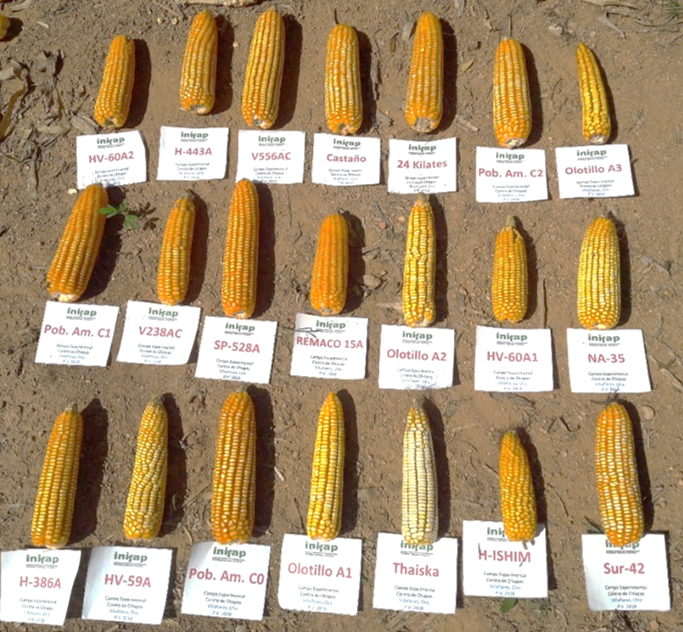
Among genotypes, the latest with tallest plants were the native varieties (349 to 323 cm), whereas the improved ones grew less (228 to 220 cm); the longest ears were obtained in Villaflores and Ocozocoautla, indicative of the better rainfall conditions than in Jiquipilas; the genotypes of longer ears, with a smaller diameter, with fewer rows and with thinner cobs were the Olotillo native varieties, which differed from the hybrids, which had shorter ears, but with a greater number of rows and greater grain weight.
In grain yield, five of the 21 genotypes stood out statistically, which were the hybrids Castaño, 24 Kilates, H-443A, REMACO 15A and H-386A, with yields of 5.9 to 5.5 t ha-1; immediately below this group was Población AC1, which is an improved variety with a combined selection cycle of half-sibling families, applied to a population formed by a select group of local native varieties and hybrids, which competes favorably with the INIFAP hybrids REMACO15A and H-386A and outperformed the commercial controls Sur-42 and NA-35 (Table 2).
The V238AC variety had the lowest yield because its environment is the Comitán Plateau, which had a subtropical climate; likewise, the varietal hybrids HV-59A, HV-60A1, HV-60A2 and H-UNAM had low yields because they were outside their production environment, since in the High Valleys, they produce yields above 7 t ha-1 (García et al., 2018); however, Gómez et al. (2017) state that intervarietal hybrids are a good alternative to increase corn yield in areas of medium productive potential and are easy to reproduce compared to traditional hybrids.
The yields of hybrid corn depend a lot on the evaluation environments; Tadeo-Robledo et al. (2012) reported that two experimental yellow corn hybrids, evaluated in the High Valleys of Mexico, had 36% and 12% higher yield than the white-grained control hybrid, one of them standing out with 8.7 t ha-1; these results are different from those of this work because they correspond to different years, hybrids and environments than those of Chiapas, but they coincide in demonstrating that some yellow-grained hybrids from INIFAP compete favorably with the commercial controls of transnational companies, both yellow- and white-grained materials.
When comparing the grain yield of the three best INIFAP hybrids (H386A, REMACO15A, and H443A) with the best control commercial hybrids (Castaño, 24 Kilates and SP528A) by means of orthogonal contrasts, no significant difference was found between them; significance was found between both groups (p < 0.01) only when comparing the four improved varieties of INIFAP: V556AC, Población AC0, Población AC1 and Población AC2, with the four local native varieties: Olotillo A1, Olotillo A2, Olotillo A3 and Thaiska, where the improved varieties surpassed the yield of the native varieties, with yields of 3.1 to 1.8 t ha-1.
Nonetheless, there are yellow-grained Olotillo varieties that have shown high yields, of 5.5 t ha-1 in Ocozocoautla and Villaflores, Chiapas (Coutiño et al., 2019); in Campeche, Medina et al. (2014) tested yellow commercial hybrids from different companies and local native varieties and found that the hybrids had grain yields of 6.8 to 4.1 t ha-1; in contrast, the local native varieties produced 3.3 to 1.5 t ha-1 in the test environments, results similar to those found in this work.
Although the open-pollinated varieties had longer ears, smaller ear and corn diameters, and fewer rows of grains, they were inferior to hybrids in grain yield, which had more rows and more grains per ear (Figure 1), resulting in higher grain yields.
The analysis of variance showed significant differences among the genotypes evaluated for the traits of days to female and male flowering, plant and ear heights and grain yield; the average grain yield obtained in this locality was 5.511 t ha-1. The hybrids REMACO15A, H-443A and H-386A and the improved varieties Población AC0 and Población AC1 statistically produced the highest grain yields, ranging from 6.6 to 3.9 t ha-1, matching commercial hybrids (controls) and other improved varieties.
On the other hand, hybrids from the State of Mexico showed maladaptation to tropical conditions and produced the lowest grain yields; nevertheless, in the Valley of Mexico, Tadeo-Robledo et al. (2012) reported that two experimental yellow corn hybrids had 36% and 12% higher yields than the white-grained control hybrid, one of them standing out with 8.7 t ha-1; in Jiquipilas, the highest yielding hybrids also stood out for their better plant and ear phenotypes (uniformity, low plant and ear heights, vigor and health), with ear ratings of 1.7.
The analysis of variance detected significant differences among hybrids in the variables of days to male flowering, plant and ear heights, percentage of grain moisture, dry matter, shelling and grain yield. Thirteen genotypes were statistically superior in grain yield, with the hybrids H-386A, REMACO15A, H-443A and Población AC2 standing out, producing 6.1 to 5 t ha-1, which statistically equaled one of the control commercial hybrids.
Findings such as those of Ramírez et al. (2017) reported that H-386A was evaluated in 13 localities in the tropics and subtropics of the country, with altitudes of 14 to 1 949 m, obtaining an average yield of 8.241 t ha-1; likewise, they mentioned that, in the locality of Ocozocoautla, it produced 9.205 t ha-1. Reyes et al. (2009) evaluated H-443A under irrigated conditions in localities located at less than 1 000 m altitude, in Tamaulipas and Coahuila, and found that the average grain yield was 7.1 t ha-1, similar to that of the control commercial hybrids.
The analysis of variance detected significant differences among genotypes for the traits of days to female flowering, plant and ear heights, phenotypic ear qualification and grain yield. Statistically, 10 genotypes with the highest grain yields (6.6 to 5.3 t ha-1) stood out, including Población AC1, REMACO15A, H386A, H-443A, Población AC2 and V-556A, which equaled the yield of the control commercial hybrids; however, these were not as expected, mainly due to the negative effect of climatological conditions (heat wave) on the sandy texture of the soil used, not suitable for these hybrids, which did not allow them to express their good yield potential. The best plant and ear phenotypes were found in Olotillo A2, Población AC1, REMACO15A, Población AC2 and H-386A, values that coincide with the highest grain yields.
The Villaflores environment showed the statistically highest grain yields, with an average of 4.285 t ha-1 and 10 genotypes stood out statistically, with grain yields of 6.6 to 5.3 t ha-1, including Población AC1, REMACO15A, H-386A, H-443A, Población AC2 and V-556AC, which equaled the yield of the commercial hybrids. In Jiquipilas, the hybrids REMACO15A, H-443A and H-386A, and the improved varieties Población AC0 and Población AC1 also stood out statistically, with yields of 6.6 to 3.9 t ha-1 and statistically equaled the yield of four commercial hybrids.
In Ocozocoautla, 13 genotypes were statistically more yielding than the others; the same hybrids stood out as in Jiquipilas, along with the improved variety Población AC2, with yields of 6.1 to 5.3 t ha-1, which statistically equaled one of the commercial hybrids. On average of the three localities, the hybrids H-443A, REMACO15A and H-386A stood out statistically, with grain yields of 5.748, 5.608 and 5.514 t ha-1 and equaled two of the control commercial hybrids; in a second group, the improved variety Población AC1 stood out and statistically equaled two other control commercial hybrids, whereas the Olotillo Amarillo-1 variety stood out from the other native varieties with a grain yield of 3.1 t ha-1.
Coutiño, E. B.; Cruz, V. C.; Hernández, C. J. M.; Gómez, M. O.; Cruz, C. F. J.; Vidal, M. V. y Aguilar, J. C. E. 2021. Diversidad de razas de maíz cultivadas en Chiapas, México. Libro técnico núm. 14. Instituto Nacional de Investigaciones Forestales, Agrícolas y Pecuarias. Ocozocoautla, Chiapas, Méx. 303 p.
Medina, M. J.; Soto, R. J. M. y Villalobos, G. A. 2015. Rendimientos de materiales genéticos de maíz de grano amarillo bajo temporal en el estado de Campeche, México. En: memorias de resúmenes de la LX reunión de la sociedad del programa cooperativo centroamericano para el mejoramiento de cultivos y animales. Guatemala, Centroamérica. 116 p.
Ramírez, D. J. L.; Alemán, T. I.; Chuela, B. M.; Vidal, M. V. A.; Ledesma, M. A.; Vallejo, D. H. L.; Ramírez, Z. R.; Gómez, M. N. O.; Ruiz, R. S.; Peña, R. A.; Reyes, M. C. A., Salinas, M. Y.; Vázquez, C. M. G.; Ruiz, C. J. A.; Trujillo, C. A. y Preciado, O. R. E. 2017. H-386A. Híbrido trilineal de maíz de grano amarillo para la zona subtropical de México. Folleto técnico núm. 5. CIRPAC-INIFAP. Campo Experimental Centro-Altos de Jalisco. 48 p.