elocation-id: e4258
In Mexico, the problems faced by rural communities lie in their high institutional economic dependence. The integration and participation of producers and society represent an opportunity to use natural resources sustainably. The objective was to describe proposals for sustainable production practices as possibilities for producers in the rural communities of Chalcatongo de Hidalgo to apply in the management of productive projects and in the improvement of the local economy. Forests have the capacity to capture carbon dioxide (CO2), which is traded in exchange for economic resources. Nevertheless, it is required to have a solid organization, strong commitment, constant effort and effective collaboration of social capital. After a review of relevant documents, database analysis, and participant observation, it was determined that it is feasible to apply sustainable productive practices to the management of sustainable projects and local economies; however, commitment, awareness, responsibility and the implementation and strengthening of social capital are essential.
carbon capture, natural resources, rural communities, sustainable
In Mexico, particularly in the rural areas of the state of Oaxaca, collectivity is practiced; generally, these social groups belong to specific ethnic groups, which preserve their traditions and customs. The state of Oaxaca has 31.1% of its population speaking an indigenous language, which represents 16.3% of the national total (DIGEPO, 2023). The situation of poverty in rural communities is critical, since deficiencies persist in some characteristics of food, capacities, and heritage; in general, the indigenous population in poverty was 69.5% (CONEVAL, 2020), and it is engaged in primary-sector activities.
In rural communities, the state has promoted anti-poverty programs to ensure families’ standard of living, and the conservation of natural resources has also been encouraged. Nonetheless, these strategies have had little impact due to the lack of follow-up. At present, productive activities are unfavorable, and the natural potential is not used to improve families’ standard of living. There are natural resources, such as forests and water, that are not efficiently managed. Hillside land is considered of little productive value and does not regenerate. In addition, soil erosion has expanded, and technologies are not being applied to recover it through efficient, sustainable agricultural methods and practices; fertilizers and agrochemicals are used intensively. On the other hand, the interrelations between producers regarding production systems are scarce, and most depend on the actions promoted by their representatives.
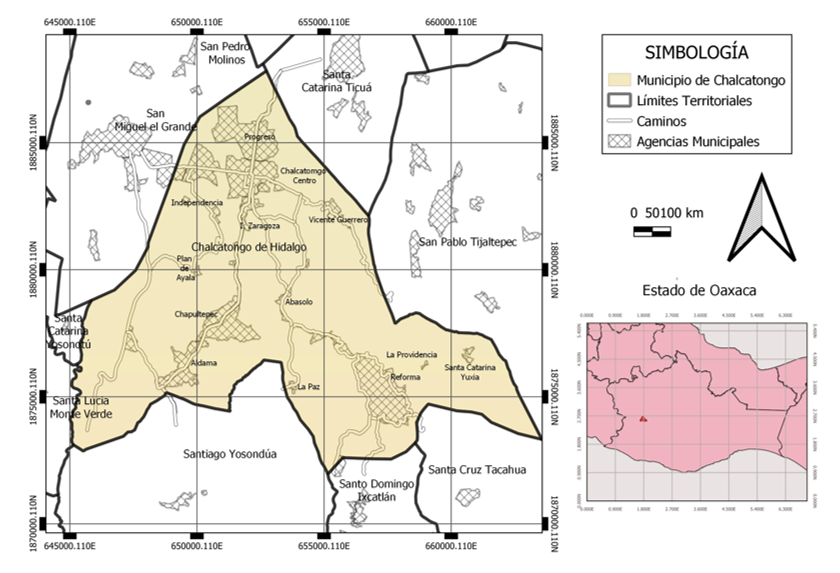
In the essay, the research question was: what could be the sustainable production practice (SPP) strategies for producers to apply in sustainable project management (SPM) and improve the local economy (LE)? The study question led to the objective of describing proposals for sustainable productive practices (SPP), as possibilities for producers in the rural communities of Chalcatongo de Hidalgo to apply in the management of productive projects (SPM) and in the improvement of the local economy (LE). The study population was the ethnic group of the Mixteca Alta region; the study area was the municipality of Chalcatongo de Hidalgo, Oaxaca (Figure 1).
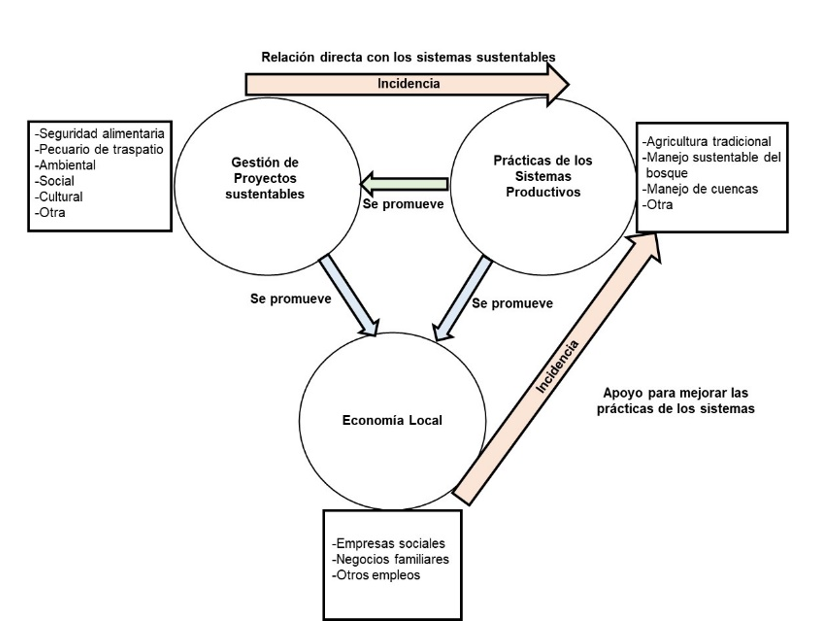
Description of the diagram in Figure 2: control of sustainable production practices (SPP): it refers to the management and use of the milpa system, forests, and other subsystems. Sustainable project management (SPM) has two functions: the first is to provide economic resources to the practice of these systems, and the second is to support the local economy. The local economy (LE) refers to rural family businesses born from local enterprises, engaged in economic, social, and environmental issues.
The concept of strategy is conceived as the activities to design, operate, and allocate actions and resources in order to achieve the proposed objectives successfully. In the environmental field, it is a proactive commitment (Martín et al., 2022); they are planned actions that support environmental, social, and economic values (Luederitz et al., 2020). Its application has become widespread in different areas of organizations. Economic resources for rural communities arise from current environmental problems.
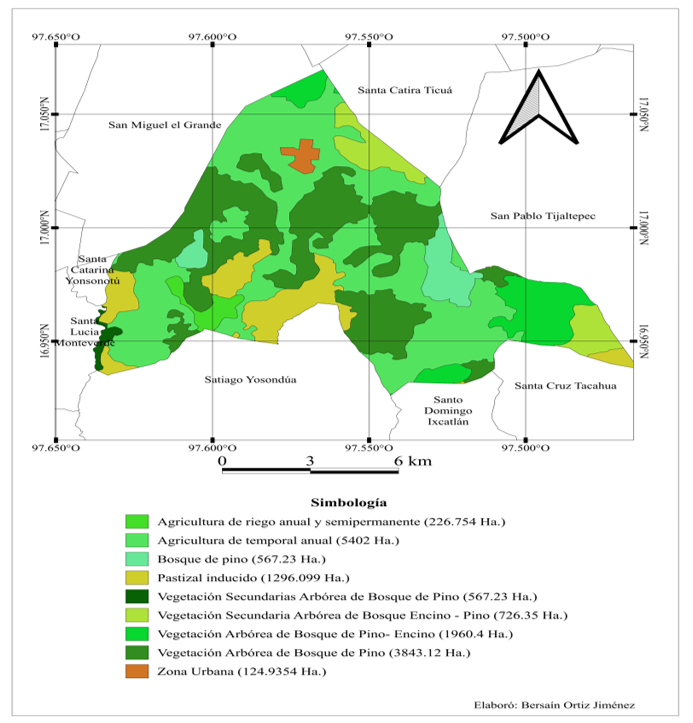
One of the primary natural resources of the municipality of Chalcatongo de Hidalgo is its forests, which regenerate on their own over the years. These natural resources can be exchanged for economic resources without compromising the territory at the local level. The natural resources of forests in Mexico are approximately 3.5 million hectares; however, this number has decreased in recent years. In the state of Oaxaca, 67% of the territory is covered by forest area (COESFO, 2024). The municipality of Chalcatongo de Hidalgo (Figure 3) has an area of 11 100 ha, of which 6 542.29 ha are forest: 5 370.93 ha are coniferous forest and 1 171.36 ha are coniferous and broadleaved forest (Martínez et al., 2009). These have a large capacity to store CO2 (WMO, 2024).
On the other hand, it is estimated that Mexico’s forests capture around 48 028 840 m3 of water per year and absorb between 35 and 54 million tons of CO2 (Rojo and Guevara, 2002). Therefore, carbon capture and markets are some of the possibilities for obtaining economic benefits for communities. Tradable emission quotas allow polluters with low pollution levels to sell their permitted or used emissions to polluters with high pollution levels (Rontard et al., 2020). Thus, CO2 sellers must fulfill certain responsibilities, such as the sustainable and efficient management of forests (Lamb et al., 2024).
In Mexico, the National Forestry Commission (CONAFOR, by its Spanish acronym) is the government body responsible for supervising and implementing projects that involve the purchase and sale of CO2. For their part, in the study area, potential and sustainable production systems are subsystems related to productive activities in the agricultural and livestock sectors. In rural communities, there is also basic backyard rural production that includes: silvicultural production, agricultural production, fruit trees, medicinal herbs, aromatic plants, backyard animals, etc. (SISPLADE-Oaxaca, 2022). These are some of the reasons why the agricultural and fruit sectors have the potential to cover certain food and commercial needs.
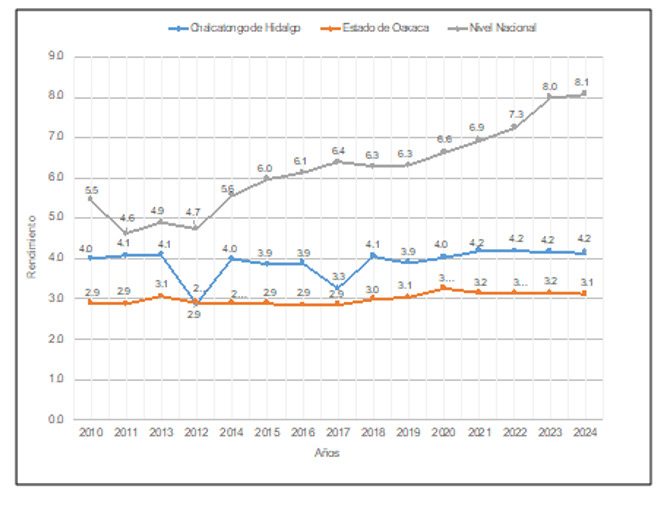
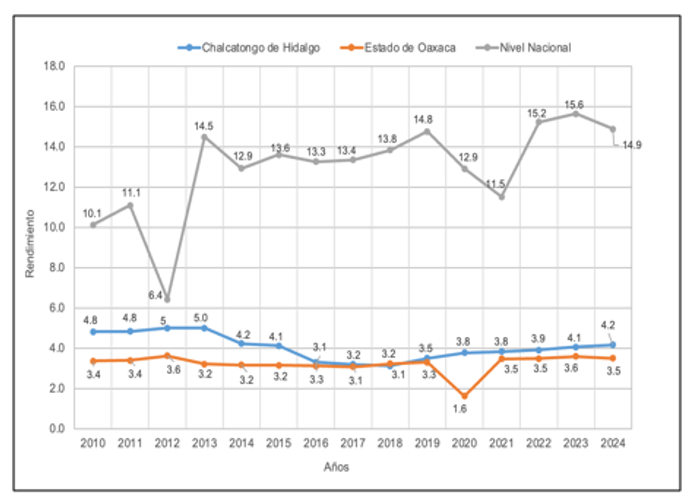
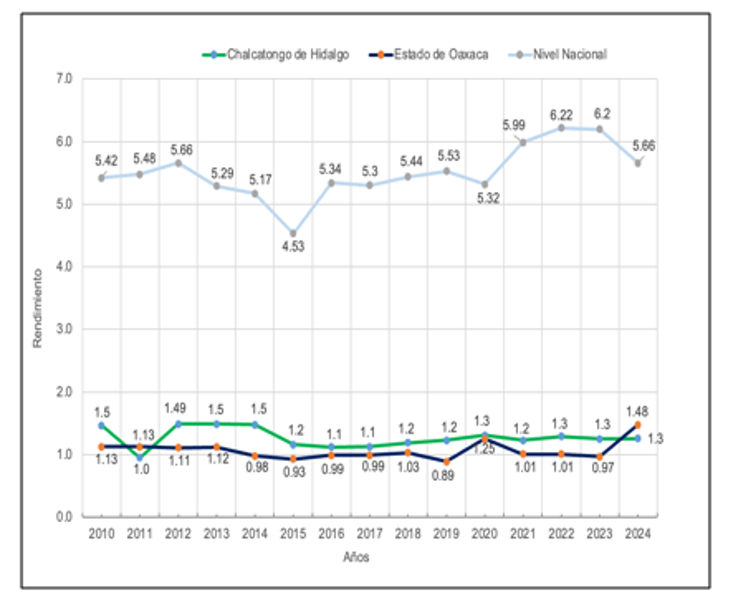
Nevertheless, from 2010 to 2024, the most common fruit trees, which are peaches and apples, showed an unbeatable yield trend at the local and state levels; only at the national level are slight increases observed in these crops (Figures 4 and 5). Thus, the average peach production at the national level was 204 304 998 t; the state of Oaxaca obtained an average of 3 388.61 t, and in the municipality of Chalcatongo de Hidalgo, the average was 22.44 t; this obtained amount represented 0.66% of the state’s average production.
On the other hand, apple production averaged 723 480.06 tons at the national level; in the state of Oaxaca, the average production was 2 431.29 t, and in the municipality of Chalcatongo de Hidalgo, the average was 34.39 t. The latter figure represented 1.41% of the state’s average production (SAGARPA-SIAP, 2024).
For corn and wheat, used for self-consumption and commercial activities, yields at the local and state levels were low and showed no increase; only at the national level were yields high (Figures 6 and 7). Thus, corn production averaged 41 930 220.28 t at the national level; in the state of Oaxaca, the average was 669 871.33 t and in the municipality of Chalcatongo de Hidalgo, the average was 2 513.42 t; the latter represented 0.37% of the state’s average production.
Regarding wheat production, the national average was 3 602 332.11 t; in the state of Oaxaca, the average was 13 375.67 t and in the municipality of Chalcatongo de Hidalgo, the average was 310.05 t, representing 2.3% of the state’s average production (SAGARPA-SIAP, 2024). The low production led to reflection on the existence of comprehensive knowledge and methodologies to ensure the food and yields of small-scale producers.
A proposal to increase family income and increase corn and fruit production is the milpa interspersed with fruit trees (MIFT), which diversifies crops. Producers who cultivate in hillside areas adopted this proposal, achieving high yields and restoring eroded soils (Martínez et al., 2021; Hernández et al., 2021).
Another proposal to improve family income is local economies, which consist of processes and strategies aimed at promoting and supporting social enterprises that include culture and care for the environment. In their study, Sanchis et al. (2021) address cooperatives that offer job security, and producers participate in decision-making about surpluses; it is a model based on reflection, participation in values and the common good (Rincón and López, 2021; Sanchis et al., 2021). In the economy for the common good or social economy, the value of perceived support, respect, and responsibility stand out (Rincón and López, 2021).
The municipality of Chalcatongo de Hidalgo was chosen for the essay based on the following characteristics: a community engaged in primary-sector activities, significant forest extensions and a population of the Mixtec ethnic group with high and very high levels of marginalization. Secondary information, such as documents and electronic files, was reviewed to detect concepts, address and analyze the problem and propose the strategies. An immersion was also carried out in the context of the study to obtain primary information through the technique of participant observation, with members of the communal property authorities and authorities of the communities that make up the municipality of Chalcatongo de Hidalgo, to strengthen the arguments raised in the essay.
Currently, the concept of sustainability has been studied and analyzed in literature from various perspectives. In the Mixteca region, there are microclimates that can be used sustainably. The forest is essential to manage and administer the economy efficiently; it is a fundamental element analyzed in the proposal to reactivate the local economy (LE).
First, a strategy for the management of sustainable resources (SPM) that is carried out by the municipality of Chalcatongo de Hidalgo, with revenues that do not come from the federal or state government. Environmental services are closely related to agroforestry, silvicultural, and agropastoral ecosystems (Torres, 2023); the concept of carbon (CO2) sequestration in the case of forests and plants in general consists of a complex process that depends on several enzymatic or physical factors, through which vegetation exchanges gases, captures carbon dioxide (CO2) from the atmosphere and releases oxygen (O2), as well as on other water and nutritional factors (Gómez et al., 2021). Conservation, restoration, and management measures have a variable capacity to remove carbon dioxide (CO2) from the atmosphere, restore land, and ensure the sustainable management of terrestrial ecosystems (Niu et al., 2024).
National and international companies that emit carbon dioxide (CO2) should not skimp on the exchange of economic resources, and should also be transparent and regulated (CONAFOR, 2024). Therefore, the transfer or exchange of economic resources does not exempt them from responsibility for the increase in atmospheric carbon dioxide (CO2) and global warming. For this reason, innovative strategies must be sought to improve production processes for the benefit of the environment and society. On the other hand, rural communities need to improve forestry and agricultural systems and the capacities of producers (Ahmed et al., 2023).
To know the economic benefits obtained from forests, the following comparison was made: in 2009, the communal localities of Oaxaca, specifically those of the Sierra Juárez region, received from the voluntary carbon market (VCM) an amount of $1 283 884.00 for the provision of services for payment of carbon capture (CO2). A total of 8 627 t of carbon dioxide (CO2) was managed, at a price of 10 dollars per tonne (Banco Mundial, 2017). Table 1 shows the historical price of a tonne of carbon dioxide (CO2) in dollars and in national currency; it was observed that the price has not been constant over the years but has experienced significant variations.
[i] *= Banco Mundial (2017); **= calculations according to the peso-dollar exchange rate history (Banco de México, 2025).
Calculations were made to exemplify the profits from environmental services and carbon capture in the municipality of Chalcatongo de Hidalgo (Table 2). Subsequently, another strategy refers to the allocation of economic resources to the management of social projects (SPM) that contribute to improving the living standards of the population.
Especially, emphasis should be placed on strengthening the participation of society, attention to the needs of the elderly, the rescue and dissemination of regional music, painting, the mother tongue, culinary art, and clothing, the field of plants (herbal medicine, vegetables, and other local crops), as well as on the use and management of water and soil.
It is confirmed that productive practices and sustainable project management are strategies producers must apply to strengthen the local economy. Forests, through environmental services activities, generated economic resources to invest in economies for the common good, but these depend a lot on the situation of the (status quo) that prevails in the society of rural communities; for this reason, it is necessary to move towards strengthening social capital.
This begins with knowledge, recognition, collaboration, and reciprocity and depends to a large extent on the management and collaborative practices of community members in the forestry sector. In addition, the authorities and the society of rural communities must be responsible for the forest’s natural resources; that is, the work carried out in the forest must become a habit, as it brings economic and social benefits to rural communities.
We are grateful to the National Council of Science and Technology (CONACYT, by its Spanish acronym) for its valuable support in carrying out this work of knowledge dissemination, and to the LLMI Noami García Orguña, for her unconditional support in the review and contributions to the abstract.
Ahmed, S.; Lutz, D.; Rapp, J.; Huish, R.; Dufour, B.; Brunelle, A.; Lyn, M. T.; Stinson, K. and Warne, T. 2023. Climate change and maple syrup: producer observations, perceptions, knowledge and adaptation strategies. Frontiers in Forests and Global Change. 6:1-21. https://doi.org/10.3389/ffgc.2023.1092218.
Gobierno de México. 2024. Sistema de Información Agroalimentaria de Consulta (SIACON). Herramienta electrónica accesible de instalación local y fácil manejo; para la generación de reportes dinámicos de la estadística anual de los subsectores agrícola, pecuario y pesquero. https://www.gob.mx/siap/prensa/sistema-de-informacion-agroalimentaria-de-consulta-siacon.
Lamb, W. F.; Pathak, N.; Crippa, M.; Guizzardi, D.; Grassi, G.; Glen, P. P. and Pongratz, J. 2024. Global emissions trends, 3-12. In no, more hot air please! With a massive gap between rhetoric and reality, countries draft new climate commitments. Emissions Gap Report. United Nations Environment Programme. 75 p. https://doi.org/10.59117/20.500.11822/46404.
Luederitz, C.; Caniglia, G.; Colbert, B. and Burch, S. 2020. How do small businesses pursue sustainability? The role of collective agency for integrating planned and emergent strategy making. Journal Business Strategy and The Environment published by ERP Environment and John Wiley & Sons. 30(7):3376-3393. https://doi.org/10.1002/bse.2808.
Martín-Castro, G.; Amores-Salvador, J. and Díez-Vial, I. 2022. Framing the evolution of the environmental strategy concept: exploring a key construction for the environmental policy agenda. Journal Business Strategy and The Environment published by ERP Environment and John Wiley & Sons. 32(4):1308-1333. https://doi.org/10.1002/bse.3190.
SISPLADE-Oaxaca. 2022. Sistema de información para la planeación del desarrollo de Oaxaca. Plan municipal de desarrollo sustentable de chalca tongo de Hidalgo 2022-2024. Instituto de Planeación para la Planeación. 242 p. http://sisplade.oaxaca.gob.mx/bm-sim-services/planesmunicipales/2022-2024-/026.pdf.
Torres, M. J. 2023. Importancia de las cuencas Cachi Mayu y Cajamarca en Sucre: una revisión basada en ecorregiones, política y servicios ambientales. Revista de Investigación e Innovación Agropecuaria y de Recursos Naturales. Bolivia. 10(3):106-125. https://www.scielo.org.bo/pdf/riiam/v10n3/2409-1618-riiarn-10-03-106.pdf.