elocation-id: elocation-id: e4241
This article presents the results derived from a bibliometric review of scientific production on the tourism-education binomial. The research aimed to analyze the perspectives from which this relationship is approached, based on the literature published between 2014 and 2024, in order to identify the predominant approaches, quantify scientific production, recognize who publishes, determine which journals disseminate the knowledge, and identify which countries conduct the research. Likewise, the conceptual, intellectual and social structure that characterizes this field of study is examined. Methodologically, the research adopts a quantitative approach with a longitudinal design. The literature retrieval was carried out in the Web of Science database, using the search term ‘tourism education’, which allowed us to identify 490 documents. The information was analyzed using R software and the Bibliometrix package. Among the main findings, it is identified that the countries with the highest scientific production are China, the United States of America and Australia; contributions are concentrated mainly on motor themes such as performance, results-oriented models and competencies, with particular emphasis on educating students in tourism. In contrast, less attention was observed toward basic issues such as identity, sustainability, leisure, ethics and heritage, which opens the possibility for the tourism-education binomial to position itself as a new line of research focused on communities and their population.
literature review, local development, research, scientific production.
Scientific research on tourism as an object of study allows us to know the advances related to the construction of knowledge in the field and thus recognize the needs and opportunities for research. A relevant binomial that is taken up in tourism studies is the relationship between tourism and education.
This relationship has been approached from pedagogical perspectives (Cañellas and González, 1993; De Lima et al., 2020; Santa et al., 2024), analyzing how tourism functions as educational content; however, interest in investigating this relationship also exists within university tourism research academies and tourism research centers.
For this reason, Tamayo and Peñaloza (2005) differentiate between research related to this binomial, which they identify as ‘education in tourism’ and ‘tourism in education’.
‘Education in tourism’ focuses on the professional training of tourism workers at the basic, middle and higher levels, whereas the ‘tourism in education’ relationship characterizes tourism as a social phenomenon, in which man, by traveling, knows, expands and internalizes information about landscapes, customs, traditions, ways of life, art, etc., giving rise to new knowledge acquired from travel, thus opening the possibility of studying the educational aspect of tourism (Tamayo and Peñaloza, 2005).
Given the two approaches from which this relationship is studied, this research aims to analyze the relationship between tourism and education through a bibliographic review of the scientific production published between 2014 and 2024, in order to identify under which approach this binomial is studied, how much has been published, who publishes, where research is published, and where research is conducted, as well as to identify the conceptual, intellectual and social structure that characterizes this field of study.
Articles published in scientific journals were used for this study, since they can be considered ‘certified knowledge’ (Ramos and Ruíz, 2004).
Based on the contributions of Donthu et al. (2021), the procedure followed for a bibliometric analysis began with defining the objectives and scope of the bibliometric study.
In this sense, a retrospective literature review of the tourism-education binomial from 2014 to 2024 was carried out to identify predominant study approaches, the number of publications, authors, publication sources, and countries where research is conducted, as well as the conceptual, intellectual, and social structure of this collection of documents. Regarding the scope, 490 papers obtained from the Web of Science (WoS) database were analyzed.
The second step was to select the techniques for bibliometric analysis, so the analysis encompassed co-citation analysis, collaboration analysis and co-word analysis.
The third step was to collect data for bibliometric analysis, so the search ‘Topic: title, abstract, keyword plus, and author keywords’ was conducted in the WoS database because it focuses on high-quality, high-impact publications, offers reliable citation metrics such as the citation index and impact factor and uses fairly precise filters (Fernández et al., 2010), taking into account that using only one database may imply a limitation by making invisible regional scientific production in Spanish on tourism and education.
The search term used was ‘tourism education’. Once the scientific papers were obtained, they were filtered according to a period of time and type of document to finally export the records to a plain-text file, obtaining a complete record and cited references.
Finally, the fourth step was to perform the bibliometric analysis and report the findings, which involved creating dynamic graphs, charts, etc., that visually helped to interpret the data.
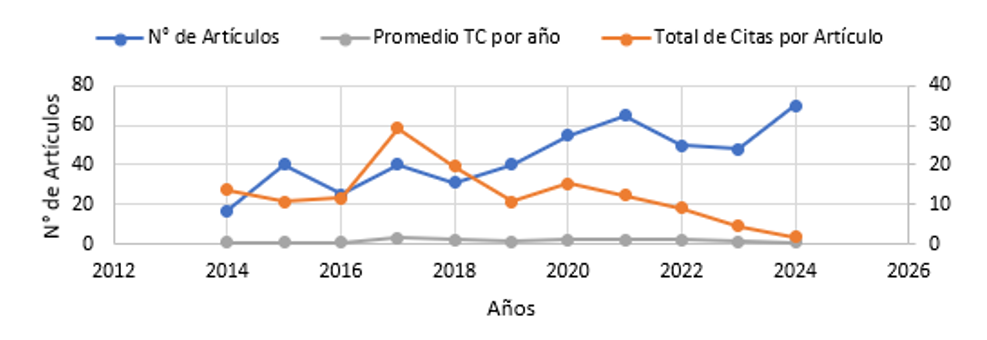
The descriptive analysis revealed that the annual scientific production during the study period (2014-2024) shows an irregular rise in the number of papers, with significant decreases in the years 2016, 2018 and 2023, reaching the maximum number of papers in 2024, with 70; on the other hand, 2017 stands out in the number of citations obtained, reaching a total of 29.3 for 40 papers. In the end, the number of citations decreases since articles do not always generate an immediate impact on the scientific community (Figure 1).
According to the results obtained from Bibliometrix, of the 1 156 authors who contributed to the papers in question, 10% appear as sole authors; there is an average of three co-authors per document and 26% of international co-authorships.
It is also noted that Deale (2014) of East Carolina University, Greenville, USA, tops the list for the number of publications (11); however, the paper by D’amato et al. (2017) has the highest number of citations (594), where they address the green economy and its application at the local level in activities such as ecotourism and education.
As mentioned, Lotka’s Law is applied because scientific production is concentrated among a few highly productive authors, whereas the majority produce only one contribution in the field to be studied (Lotka, 1926).
This is a basic principle of bibliometrics formulated by Lotka (1926); Mora et al. (2023); Hernández et al. (2023), it shows that 88% of the authors have a written document related to the tourism-education binomial; otherwise, 0.1% corresponds to one author with 11 papers. This suggests a degree of maturity or specialization in the field of study.
Therefore, there is an inverse relationship in which the bulk of the authors have published only one paper, while the greatest scientific production is in the hands of a few, as is the case of Deale (2014); D’amato et al. (2017).
The largest scientific production on the selected topic comes from China, specifically from Hong Kong Polytechnic University, followed by the State University System of Florida and the University of North Carolina, both in the United States of America and the University of Queensland in Australia (Table 1). It should be noted that research works from countries such as the United Kingdom, Turkey, India and New Zealand develop research that is being widely cited.
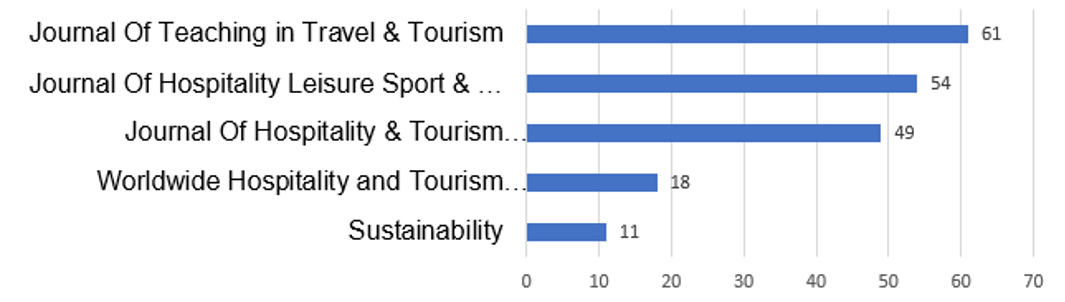
The 490 articles related to the tourism-education binomial were published in 199 journals dependent on universities, research centers, and official bodies. The ranking of the 20 most productive and influential journals represents 56% of the total papers and 10% of the total journals.
The first five in the ranking are journals specialized in tourism issues and with a strong tradition in the academic field. Research is published in the field of travel and tourism education, including advances in pedagogy, technology and curriculum, among others (Figure 2).
The number of citations is an indicator that shows the popularity, influence and importance that a topic/paper has for the scientific community. In this regard, the most-cited paper (594 citations) is that of D’Amato et al. (2017), titled ‘Green, circular, bio economy: a comparative analysis of sustainability avenues’.
Another paper is that of Higgins (2020) with 230 citations, in which the author develops a discussion between a dichotomy of schools of thought, divided between those who are in favor of the tourism industry and those who are not after COVID-19 and how this may have repercussions on the development of academia, the way in which students are taught and the future of tourism.
It should be noted that neither paper is published in journals that are considered top within the scientific community.
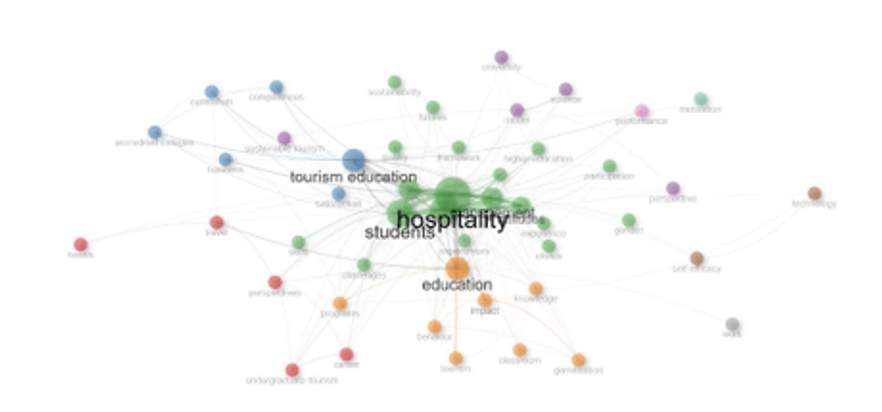
The co-occurrence network analyzes the conceptual structure of a field of study through a network of keywords (Mendoza et al., 2021); therefore, Figure 3 shows the centrality of nodes such as hospitality, students and management, which indicates that the main conceptual axis is related to the formation of human capital for the tourism and hotel industry.
Close to this cluster are the nodes of education and tourism education; which, according to the links they present, reflect a concern to investigate the structure of the programs, the competencies demanded by the industry, the curriculum, and the ways in which tourism is taught; given these connections, they can also facilitate the integration of new lines of research.
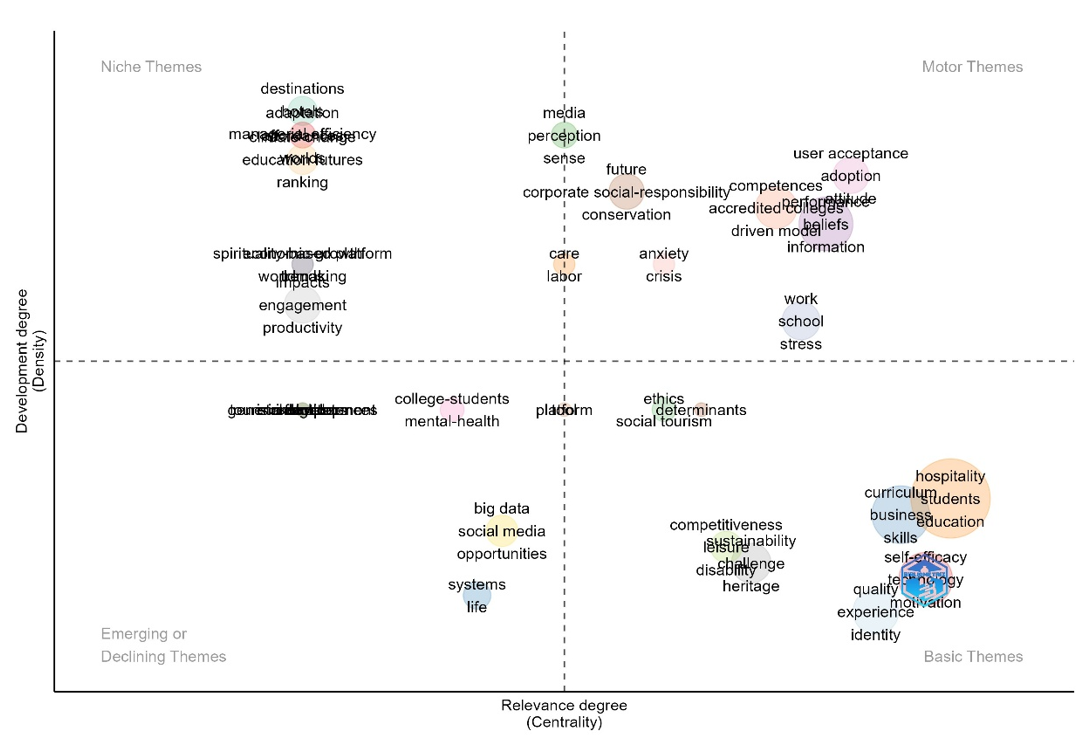
The thematic map is interpreted based on the proximity and position of each cluster in the quadrants (Hernández et al., 2021), so in Figure 4, motor themes such as performance, model driven, and competences are observed, while the quadrant of basic themes plays a key role in the generation of interdisciplinary knowledge, since on the one hand, the conceptual bases that sustain the field, such as hospitality, students and education, are identified, and on the other, it locates the lines of research in growth and future consolidation.
Close to this is the cluster that addresses sustainability, heritage and leisure as cross-cutting issues in which tourism is studied outside the industrial and labor vision.
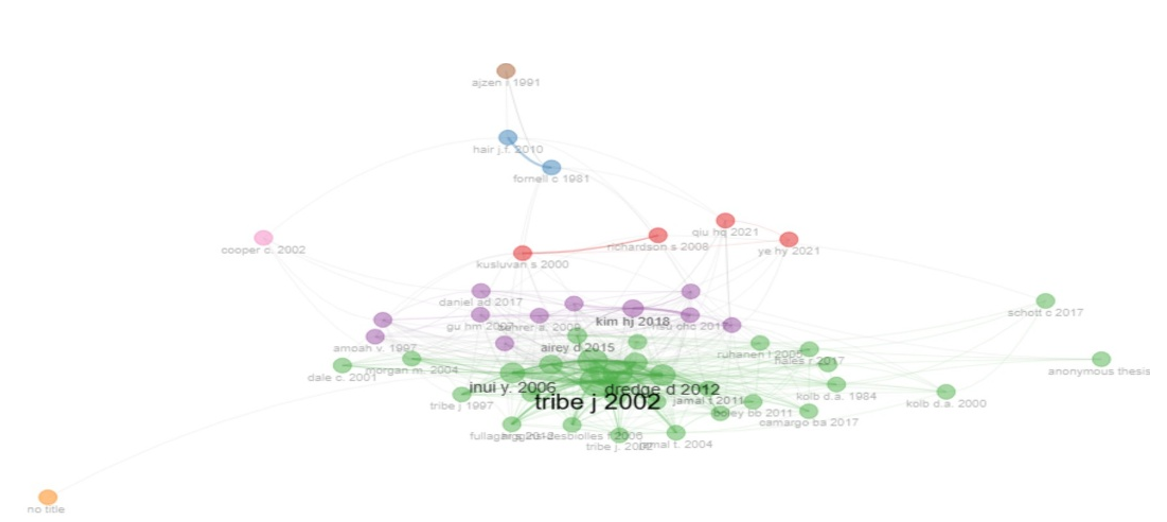
Figure 5 shows authors such as Airey (1999); Hsu (2018), who develop a vocational-humanistic paradigm in their research, prioritizing topics such as labor skills, employability, and needs of the industry. Nevertheless, in a larger cluster, authors such as Tribe (2002); Inui (2006) stand out with the Philosophic Practitioner model and with constructivism and liberal education, respectively, which criticize the excessive vocational orientation of tourism programs and the need for global citizenship.
On the other hand, Sheldon (2011); Dredge (2012); Edelheim (2020) work within a transformative critical paradigm aimed at sustainability, critical reflection and social transformation. Finally, Ayikoru (2009) questions the influence of neoliberalism and the commodification of higher education.
In short, the authors cited above reflect a transition from vocational models focused on employability to topics that transform tourism education and make it an instrument for building sustainable and socially responsible societies.
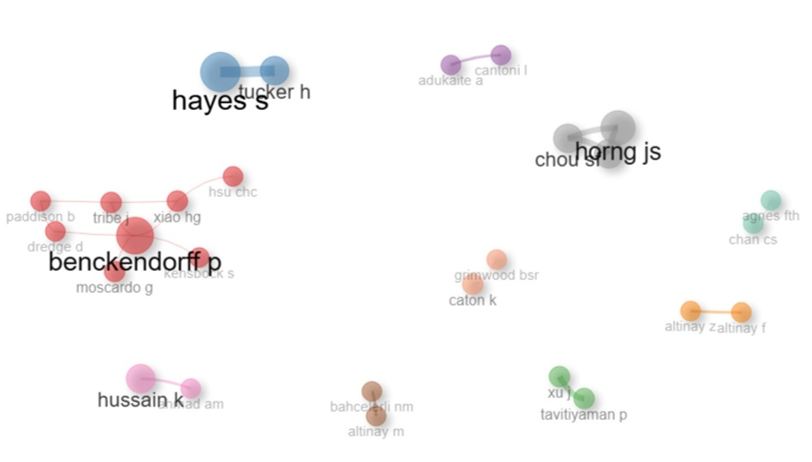
The grouping of people specialized in a topic or area of research contributes to the increase in scientific production and consolidation (Urbizagástegui and Restrepo, 2018). In this study, Benckendorff P. of the University of Queensland, Australia, is identified as the author with the most collaborations generated from co-authorship in scientific publications. Small groups of 2 or 3 authors indicate concentrated bilateral collaborations or limited joint publications (Figure 6).
A preference was observed for motor themes related to performance, result-oriented models and competencies with particular emphasis on educating students in tourism. Nonetheless, researchers such as Tribe and Inui criticize the excessive vocational orientation of tourism programs and defend critical education oriented towards human development and social responsibility.
On the other hand, this research identifies a notable scarcity of papers that address basic issues related to the tourism-education binomial from alternative approaches, not from the perspective of the student in tourism and its education, but from a more local perspective, so it is recommended to return to basic topics such as sustainability, heritage, leisure and identity, which, although they are less central, tourism can be analyzed outside the industrial and labor vision.
This opens the possibility for tourism-education binomial to be a new line of research that views tourism as an educational tool aimed at social transformation.
D’ Amato, D.; Droste, N.; Allen, B.; Kettunen, M.; Lähtinen, K.; Korhonen, J.; Leskinen, P.; Matthies, B. D. and Toppinen, A. 2017. Green, circular, bio economy: a comparative analysis of sustainability avenues. Journal of Cleaner Production. 168:716-734. https://doi.org/10.1016/j.jclepro.2017.09.053.
De Lima, F.; Cappellano, M. M. y Köche, J. C. 2020. Turismo pedagógico ou Atividade pedagógica pelo turismo? O binômio ‘turismo pedagógico’: concepções de turismo e pressupostos epistemológico-pedagógicos subjacentes. Investigaciones Turísticas. 19:139-162. https://doi.org/10.14198/inturi2020.19.07.
Hernández, A. L.; Hernández, J. R. y López, J. R. 2021. Análisis temático de la investigación, desarrollo e innovación dentro de la gestión empresarial y administración de empresas desde 2015 a 2019. Revista de Estudios Empresariales. Segunda Época. 1:89-106. https://doi.org/10.17561/ree.n1.2021.5602.
Mendoza, F. A. y Quintero, J. W. 2021. Nuevos campos de enseñanza e investigación en ciencias económicas: una aplicación bibliométrica. En: Pico, C. M.; Pérez, O. E.; Ramos, M. G.; Bello, S. P.; Mendoza, F. A. y Quintero, J. W. (Coord.). La formación de pensamiento crítico: reflexiones y métodos de confianza en economía. Catálogo Editorial. 1(152):1-137. https://doi.org/10.15765/poli.v1i152.2219.