elocation-id: elocation-id: e4211
The objective was to conduct a comparative analysis of the Sowing Life program along an altitudinal gradient in the central region of the state of Veracruz, using a socioecological approach. The research was carried out from January 2023 to November 2025; the sample comprised 90 structured questionnaires and 30 semi-structured interviews administered to active legal subjects in three municipalities (Puente Nacional, Chocamán, and Atlahuilco). The research method was a survey with a comparative and diachronic multiple case study design. Data collection combined quantitative and qualitative techniques. Qualitative information was analyzed using the socioecological systems framework (SES Framework), and quantitative data were analyzed using nonparametric descriptive and inferential statistics (Kruskal-Wallis test). The results indicate that the program consolidated a circular and agroecological management model based on technological sovereignty, which articulates three dimensions (natural, social, and economic) through six operational axes. The impact of the model is heterogeneous according to the altitudinal gradient: the middle zone achieved the highest socioecological performance (89.3%) due to coffee social capital; the upper zone, 85.7%; and the lower zone, 75%, due to risks of economic dependence. The role of the woman planter emerges as the key driving force of the system, whose leadership transforms government subsidies into resilience and community autonomy. It is concluded that the Sowing Life program consolidated a circular, agroecological management model based on technological sovereignty and the self-management of bioinputs. The impact is heterogeneous according to the altitudinal gradient, with the middle zone standing out for its social capital and low risk of economic dependence.
dimensions of socioecological analysis, gender perspective, socioecological system, Sowing Life.
The Sowing Life Program (SLP), implemented in 2019, is a government strategy to address rural poverty and deforestation (Coneval, 2024). It seeks to generate economic, social, and environmental benefits, although there is debate about its sustainability (Cortez-Egremy et al., 2022).
Through the milpa system interspersed with fruit trees (MIFT) and agroforestry systems (AFSs), efforts are made to increase local biodiversity, strengthen food security and contribute to social well-being in vulnerable regions. However, the program’s effectiveness depends largely on the social cohesion of the peasant learning communities (PLCs), their organization, and solidarity work that allows knowledge exchange and strengthens the social fabric in the communities where it operates.
The SLP is aligned with the socioecological approach (SEA), which conceives of human and natural systems as an integrated unit (Marín and Heredia-Cortes, 2024). Socioecological systems (SESs) postulate that ecosystem resilience is linked to social and political structures (Cerón-Hernández et al., 2019), where agroecological thinking seeks approaches to integrating nature and society and to understand human-nature relationships (Toledo et al., 2002).
Socioecological systems (SESs) theory draws on the complexity sciences to understand the intricate, dynamic interactions between humans and nature (Altieri et al., 2015). Operating in contexts of marginalization, the SLP seeks to reverse ecosystem degradation and social vulnerability by providing training that fosters the transition to more resilient agroecological production models (Toledo and Barrera-Bassols, 2021).
Under this premise, it is essential to analyze how environmental characteristics and PLCs shape the socioenvironmental response in specific territories. Therefore, this study aims to conduct a comparative analysis of the Sowing Life Program along an altitudinal gradient in the central region of Veracruz, using the socioecological approach.
The research design was cross-sectional, mixed (quantitative and qualitative), and empirical and comparative in scope. This design allowed data to be collected, analyzed, and integrated simultaneously to contrast localities. The research was organized into four phases: 1) biophysical and altitudinal characterization of the study units; 2) design and validation of data collection instruments; 3) fieldwork and information collection; and 4) systematic analysis and integration of socioecological dimensions.
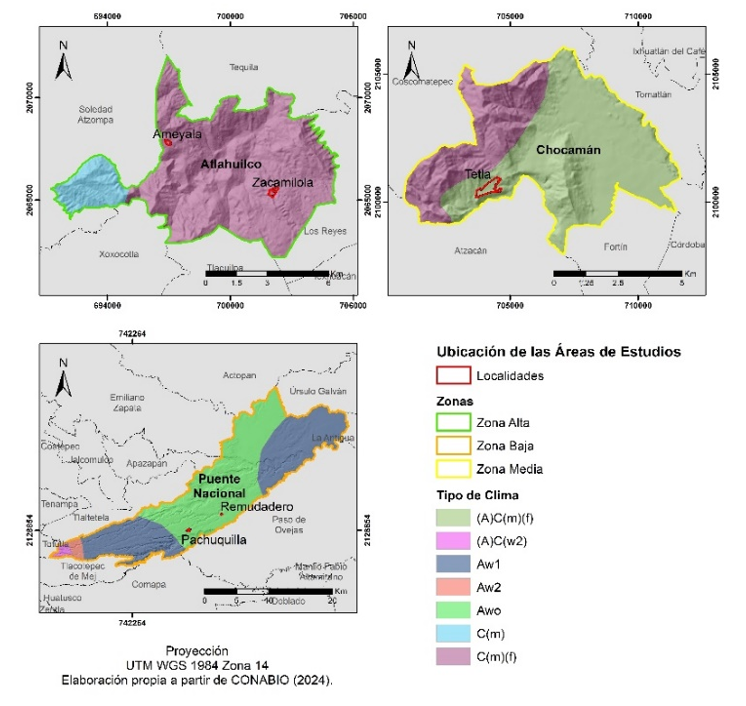
The study was carried out in three municipalities selected based on the scientific criterion of altitudinal contrast in the central region of the state of Veracruz. Each municipality was represented by two communities or PLCs. The three areas show differences in their edaphoclimatic characteristics, in terms of climate, vegetation, and soils.
The Atlahuilco region has coniferous vegetation, a cold climate, and chromic Luvisols; Chocamán has a temperate climate, cloud forest vegetation, and humic Andosols; finally, Puente Nacional has low deciduous tropical forest, a subhumid tropical climate, and alluvial soils (Figure 1). This is in order to examine how communities adapt their life strategies across different environments in the socioecological context.
The study subjects were the producers (planters) and their respective plots, where they had the MIFT systems and AFSs as spaces of socioecological interaction. Non-probabilistic purposive or convenience sampling was used (Hernández-Sampieri and Mendoza, 2018). The inclusion criteria were: a) to be an active legal subject enrolled in the SLP; b) to have 2.5 ha, 1.5 established with MIFT and 1 with AFS; and c) to express voluntary willingness to participate in this research.
To address the complexity, a mixed-methods ethnographic methodology was adopted (Guber, 2021), developed from fieldwork that included participant observation. A total of 90 structured questionnaires (30 in each of the three municipalities) were administered for the quantitative phase, and 30 semi-structured interviews (10 in each municipality) were conducted for the qualitative in-depth phase.
The research integrated a gender perspective through an inclusive design that ensured the equal participation of women planters and heads of households, adapting spaces and schedules to their care activities. Likewise, the methodological tools captured, in a differentiated way, the division of labor, the control of the SLP’s financial resources, and women’s participation in community decisions of the PLC.
To process the information, it was divided based on the three axes of the SLP (environmental, social, and productive).
Quantitative phase: the questionnaire data were tabulated in an Excel matrix. Descriptive statistics (means, standard deviations and percentage frequencies) were applied to describe the planters’ sociodemographic profile. Given the sample size and the non-compliance with the assumptions of statistical normality, the Kruskal-Wallis test, a nonparametric test, was used to check for statistical differences (p< 0.05).
Qualitative phase: the recorded interviews were transcribed and subjected to thematic analysis based on the SES framework (Ostrom, 2009). Inductive and deductive coding were used to structure the findings (Creswell and Poth, 2023) of the SES framework’s categories: resource system (agroecosystem characteristics by altitude), resource units (milpa biological diversity and income), actors (structure of planters and sex), and governance system (governance dynamics, interactions among users and compliance with PLCs’ rules of operation).
Finally, the codes were grouped into meaning nuclei to qualitatively interpret the level of community resilience and female empowerment generated by this public policy.
The SLP components are articulated as a whole, including the social, productive, environmental, and economic dimensions, which, under the socioecological approach, transcend the traditional model of production to become an engine of territorial regeneration. The analysis shows that, although the program’s structure seeks to mitigate rural poverty and environmental degradation through local governance, the results vary with the altitudinal gradient and the rules of operation.
Specifically, in Puente Nacional, the productive dimension is limited by drought, whereas in Atlahuilco, indigenous social cohesion strengthens the organizational axis, even when geographical isolation hinders its economic insertion.
This structure establishes an interrelationship between ecosystem restoration and the well-being of planters, who act as an axis of transformation of diverse environments. It was found that the average age of producers in the communities was 52.6 years with a standard deviation (σ) of 7.1 years in the Sierra of Zongolica, 59.4 years (σ= 4.8 years) in Chocamán and 51.4 years (σ= 6.9 years) in Puente Nacional, showing that the legal subjects are older people with traditional knowledge and extensive experience in the field.
Regarding women owners of their land, the percentages are as follows: 86% in the Sierra of Zongolica, 17% in Chocamán and 35% in Puente Nacional.
The level of schooling is very similar across communities. In the Sierra of Zongolica, 70% have primary education, 24% have secondary education, and 20% have no schooling; in Chocamán, 63% have primary education, 17% have secondary education and 20% have no schooling; finally, in Puente Nacional, 68% have primary education, 20% have secondary education, and 18% have no schooling.
Even so, they have achieved excellent results in their nurseries, plots and home improvements, and are satisfied with the integration of the family into the activities and opportunities provided by the SLP.
This shows an organizational base that seeks to mitigate rural vulnerability through productive diversification and the strengthening of social capital. Where social capital is the engine of ecological restoration, transforming plot work into a community strategy of environmental mitigation.
By integrating collective organization with crop diversification along the altitudinal gradient, the SLP not only seeks food security but also strengthens the resilience of local systems and economic development, grounded in the protection of biocultural heritage and the social cohesion of rural communities.
In this way, altitudinal variations determine not only biological diversity but also the dynamics of producers’ socioeconomic adaptation. The SLP components are articulated in a natural resource management model that strengthens ecosystem regeneration with social welfare, making visible the rules of internal organization and the adoption of agroforestry practices (Figure 2).
The articulation of the SLP components generates complex dynamics that oscillate between adaptive success and structural limitations: 1) environmental and productive dimensions: evidence shows an increase in agrobiodiversity through the MIFT system and AFSs as a buffer against climate change. Nonetheless, in Puente Nacional, reforestation is compromised by prolonged droughts and lack of irrigation infrastructure.
The findings reveal a critical technical limitation in the rules of operation for the 2.5 ha: the rigidity in planting density and planting frames does not consider rugged topography or edaphic features, causing excessive competition for nutrients, water, and sunlight, which limits productive development and long-term yield of agroforestry arrangements (CONABIO, 2024; Linares-Gabriel et al., 2024).
2) Social and organizational dimensions: PLCs have emerged as vital spaces for the exchange of knowledge (‘Planter-Planter’), where the mechanism that triggers this cohesion is collective work, consistent with studies that highlight its role in the reconstruction of the rural social fabric.
Nevertheless, this study identifies a fundamental methodological and epistemological limitation: the adoption of rigid criteria based on preconceived ideological and political stances that tends to cloud the objective analysis of local governance, forcing narratives that distort the operational reality and legitimate achievements of PLCs.
In this regard, it is noted that the intrusion of political-ideological biases into evaluation frameworks hinders the real understanding of community assimilation processes, compromising the methodological neutrality essential to assess the program’s social sustainability (López-García and Martínez, 2025).
3) Economic dimension: the productive surplus and its marketing in the tianguis (open-air market) have begun to dynamize the short marketing channels, which points to less dependence on local intermediaries. It is confirmed that community markets are a key pillar in strengthening the solidarity economy of self-consumption; however, their financial viability is compromised by the geographical isolation of mountain communities such as Atlahuilco, a factor that acts as a logistical bottleneck.
Given this scenario, the need to constitute solid solidarity cooperatives for the strategic marketing of local production was identified, integrating logistical schemes that allow surpluses to be placed in the national and international markets.
This vision of business integration aligns with proposals by authors such as Hernández-Ortiz (2022); CEDRSSA (2024), who point out that for the program to have a high economic impact, it is essential to move from local exchange to associative figures capable of certifying quality and marketing products in highly demanding markets.
The management of biodiversity within the SLP is positioned as the technical axis enabling the transition from subsistence agriculture to the functional restoration of the territory. From the socioecological approach, this management is not limited to the accumulation of species but represents a complex system of interactions in which the ‘Planter’ participates in selecting and conserving local and forest varieties and in designing the elements in their plot to achieve food sovereignty.
This relationship is dynamic and is reflected in the biotic diversity managed in accordance with the constraints and potentialities of each altitudinal gradient (Table 1), ensuring the provision of ecosystem services and the preservation of the biocultural heritage that sustains the social and environmental stability of the communities. Planters have transitioned from generic species to selecting species for local use (Pretty et al., 2020).
Living pharmacies constitute a strategic pillar of the SLP by serving as nodes for the interaction of knowledge, culture, and traditional medicine with local biodiversity to strengthen community health. Under the socioecological approach, these spaces operate as a complex system of adaptation whose management and floristic inventory are dynamically redefined according to the altitudinal gradient and local traditional knowledge.
This variability allows communities to manage specific therapeutic resources for health ailments according to the geographical-cultural context. In this way, the relationship between the planter and their medicinal flora transcends from the productive sphere to a cultural practice of family care, where the community preservation of medicinal species and rituals safeguards the biocultural heritage and underpins the cohesion of social systems.
In this sense, the ‘living pharmacy’ reflects the importance of traditional medicine (Guzmán and Zúñiga, 2022) with significant differences in the composition and relative importance of the species according to the altitudinal gradient (Table 2).
Biofactories are units of technological sovereignty, understood as local spaces that promote operational autonomy and decolonization of the matrix of conventional inputs (Sevilla Guzmán, 2006; Altieri and Nicholls, 2020), where the management of bioinputs responds to a logic of soil conservation and agroecological transition (Table 3).
The production of bioinputs uses local resources, reduces production costs, and reduces dependence on agrochemicals. The raw material comes from harvest, cooking, nursery, and livestock farm (manure) residues in their respective communities, which reduces production costs (Ferguson et al., 2022) and improves soil quality.
The analysis of the program from a socioecological perspective reveals that planters are the driving force that energizes the transformation of local systems. Their capacity for social response is redefined according to the altitudinal gradient: in lower-elevation communities, productive work is oriented toward immediate utility and the market, whereas in higher-altitude communities, practices amalgamate forest knowledge and a culture of care for the environment (López-Gómez et al., 2008).
Thus, the configuration of agroforestry systems directly influences the species cultivated and the transition from a logic of immediate profitability to the conservation of biodiversity and community cohesion (Table 4). In this context, MIFT systems and AFSs act as a society-nature interface, where, in highlands with indigenous prevalence, an ethic of environmental care, defined as biocultural resistance, is institutionalized (Wezel et al., 2023).
The impact of the society-nature relationship within the altitudinal gradient manifested differentiated dynamics according to the biophysical and organizational particularities of each region (Martínez-Borrego et al., 2025). Table 5 presents a multivariate analysis in which Atlahuilco stands out for an effective reforestation that reaches 92%, indicating a notable commitment to restoring vegetation cover and ecosystem connectivity.
Puente Nacional shows a more vulnerable scenario, where productive success is conditioned by risks of drought and lower income diversification, factors that compromise resilience (Table 5); for its part, Chocaman stands out for greater socioecological robustness (89.3%), due to the consolidation of its social capital and the effectiveness of local governance rules in the management of common resources (Ostrom, 2015).
Women’s participation in PLCs was high in Atlahuilco (20), low in Chocamán (5) and medium in Puente Nacional (15). In other words, the adaptive capacity of SES provides a differentiated view in the performance of each PLC according to the gender distinctions. It was found that women beneficiaries of the program act as the integrating nucleus of PLCs, establishing a dynamic, transformative relationship and leadership that transcends primary production.
Their work includes the holistic management of natural components, such as soil, water, and biodiversity, playing an important role in conserving local germplasm, including the selection and safeguarding of native corn varieties and food sovereignty (García-López et al., 2023). This shows that women’s empowerment translates into greater productive diversification on the plots, mitigating the risk of monoculture and promoting more agroecological practices.
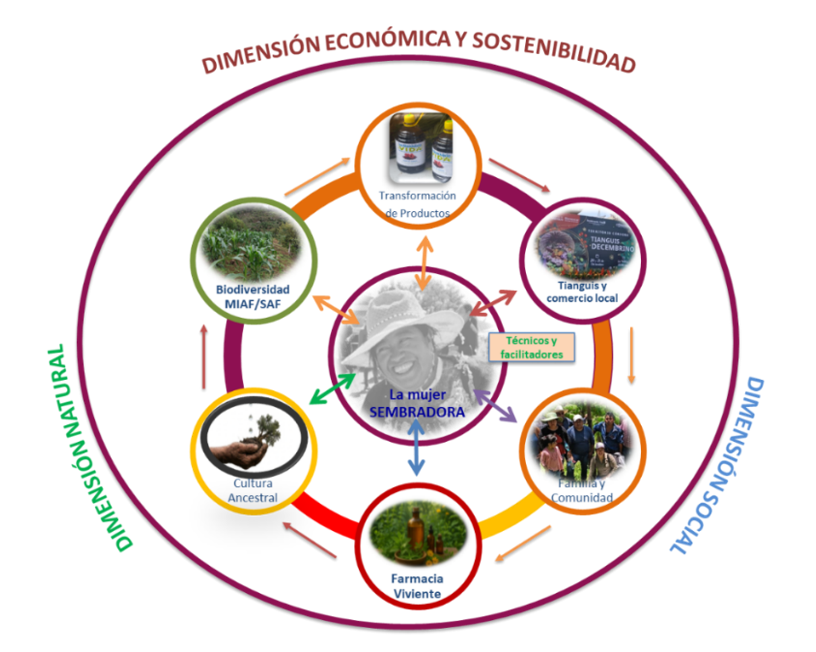
The ‘Woman Planter’ acts as the central axis and operational engine of the system, supported by the accompaniment of technicians and facilitators. Through a cyclical, interdependent flow, six practical components are articulated-including agricultural biodiversity (MIFT/AFS) and ancestral culture, community health (living pharmacy), and marketing (tianguis)-managing to harmoniously balance the natural, social and economic dimensions to ensure the resilience and sustainability of their territory (Figure 3).
The capacity for agency and social response is redefined as the altitudinal gradient changes, a critical distinction that allows the system’s resilience to adapt to the social and biotic conditions imposed by each gradient, consolidating the planter not only as a beneficiary but also as a guardian of the stability of their territory.
The analysis of the program from the socioecological perspective reveals that planters are a key component of local system dynamics, acting as articulators in the agroecological transition through community management and knowledge exchange. Their capacity for agency and social response is redefined as the altitudinal gradient changes.
The SLP has consolidated a circular management model that integrates the social, productive, and environmental components, achieving technological sovereignty in bioinput biofactories and the rescue and promotion of local biodiversity.
The impact of the SLP varies with the altitudinal gradient: the middle zone stands out for its coffee social capital, whereas the lower zone presents risks of economic dependence and drought that compromise sustainability.
The woman planter is the driving force of the program due to her leadership in the agroecological transition and food security.
Pretty, J.; Benton, T. G.; Bharucha, Z. P.; Dicks, L. V.; Flora, C. B.; Godfray, H. C. J.; Goulson, D.; Hartley, S.; Sotherton, N. G. and Williams, C. 2020. Global assessment of agricultural intensification and sustainability. Nature Sustainability. 1(8):437-446. https://doi.org/10.1038/s41893-018-0114-0.