elocation-id: elocation-id: e4207
Cassava (Manihot esculenta Crantz) is a strategically important crop in Mexico; however, germplasm characterization has been based mainly on fresh root yield, which limits the physiological interpretation of its production. This study aimed to analyze dry matter yield and harvest index as indicators of productive variability among Mexican cassava accessions. A total of 14 accessions were evaluated under field conditions using a completely randomized design, determining root yield, root dry matter content and yield (DM, DMY), starch content and yield (SC, SY) and harvest index. The nonparametric analysis showed highly significant differences among accessions for all variables evaluated (p< 0.01). Accession MMCOT07 presented the most outstanding performance, with the highest values of RY (88.01 t ha-1), DMY (34.37 t ha-1) and SY (30.08 t ha-1), associated with high DM (39.39%) and SC (34.46%) contents. Other accessions showed contrasting combinations of yield and quality, reflecting differential biomass partitioning strategies. The correlation analysis confirmed strong associations among RY, DMY and SY (p≥ 0.98), whereas the harvest index provided complementary information on physiological efficiency. These results demonstrate that DMY and harvest index are key variables for a more accurate functional characterization of Mexican cassava germplasm.
adaptability, biomass production, mycorrhizal fungi, specific gravity, starch.
Cassava (Manihot esculenta Crantz) is a strategic crop for food security and tropical production systems due to its ability to adapt to marginal environments and its efficiency in carbohydrate production (De Souza et al., 2017).
In recent years, its evaluation has shifted from focusing exclusively on fresh root yield (RY) to incorporating more comprehensive indicators of productive performance and the agro-industrial potential of genotypes (Perez-Fons et al., 2023; Phanthanong et al., 2025).
In this respect, dry matter yield (DMY) and harvest index (HI) allow for a more comprehensive assessment of the crop. DMY combines yield and root carbohydrate concentration, offering a more robust basis for comparing genotypic performance than RY alone (De Souza et al., 2017; Adiele et al., 2020; Silva et al., 2023).
For its part, HI estimates the efficiency with which the plant allocates biomass to reserve roots and constitutes a functional indicator of productivity (Enesi et al., 2022; Menegucci et al., 2023).
Nonetheless, many studies continue to use RY as the primary criterion for comparison, limiting a more complete understanding of productive variability among accessions (Onyenali et al., 2025).
In Mexico, cassava remains underexploited despite its productive and agro-industrial potential (Del Rosario-Arellano et al., 2025; Rebolledo-García et al., 2025). Although studies on Mexican germplasm have focused on root dry matter (DM) and RY (Meneses-Márquez et al., 2014; González-Valdivia et al., 2023), information on the relationship among DMY, HI, and variability among accessions from an ecophysiological perspective remains scarce.
This gap is relevant because this germplasm is part of the Mesoamerican diversity center of the genus Manihot and comprises accessions with high DM content and potential yields exceeding 40 t ha-1 (Meneses-Márquez et al., 2014; Rosas-González et al., 2014).
Therefore, this study aimed to analyze DMY and HI as indicators of production variability among Mexican cassava accessions, in order to provide elements to understand the allocation of biomass to reserve roots and to strengthen the characterization of germplasm.
The study was conducted at the Cotaxtla Experimental Field of the National Institute of Forestry, Agricultural and Livestock Research (INIFAP, for its Spanish acronym), located in the municipality of Medellín de Bravo, Veracruz, Mexico, at 18° 56’ 12” north latitude and 96° 11’ 32” west longitude, at an approximate altitude of 20 m.
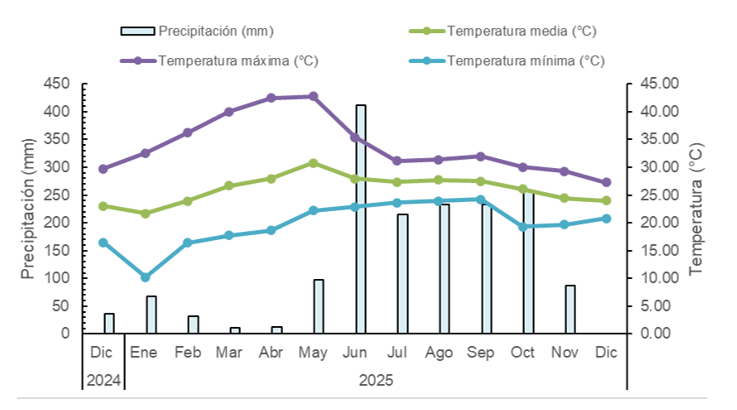
The climate of the experimental site is warm subhumid (Aw₀). During the evaluation period, the average monthly temperature was 26.34 °C, and the accumulated rainfall was 1 656.58 mm, with 81.4% falling between June and October (Figure 1).
The soil was a Vertisol of alluvial origin; its physical and chemical characteristics were described and interpreted based on the Official Mexican Standard NOM-021-RECNAT-2000 (2002) and are shown in Table 1.
A total of 14 Mexican accessions of sweet cassava from the INIFAP-Cotaxtla Germplasm Bank (MMCOT01 to MMCOT14) were evaluated using 20 cm cuttings from physiologically mature plants with eight to ten viable buds (Muktar et al., 2024).
The soil was mechanically prepared by brush clearing, plowing, double cross-harrowing, and furrowing at a height of 0.4 m, with furrows spaced 1 m apart. Before planting, the cuttings were inoculated with the INIFAP® biofertilizer (Glomus intraradices) at a dose of 3 kg ha-1, following the recommendations of Durán-Prado et al. (2023) as a uniform agronomic management practice rather than as an experimental factor.
Planting was conducted on December 24, 2024, at a 45° angle (Rosas-González et al., 2014). Each experimental plot consisted of four rows with nine plants per row, with a spacing of 1 m between rows and 1 m between plants, which resulted in a useful area of 24 m².
Fertilization consisted of 146-46-60 units of N-P₂O₅-K₂O, equivalent to 50% of the conventional recommended dose for the crop; this dose was split into two applications: at the time of planting and 30 days after planting (DAP) (Durán-Prado et al., 2023). Weed management included Bentazon at 1.5 L ha-1 and two manual and mechanical controls. No insect control was required during the crop cycle.
Harvesting was carried out 12 months after planting (MAP). The variables were evaluated on five plants from the central rows of each accession. In each plant, the fresh weights of roots (kg) and aboveground biomass (kg) were recorded.
These measurements were used to estimate RY (t ha-1), DM (%) and HI; in turn, the latter were used to calculate the DM yield (DMY), starch content (SC), and starch yield (SY) using equations 1, 2 and 3, based on Meneses-Márquez et al. (2014); Phun-iam et al. (2018); Adjebeng-Danquah et al. (2020); Rebolledo-García et al. (2025):
Data was analyzed under a completely randomized design with five replications per accession. Normality and homoscedasticity were assessed using Shapiro-Wilk and Levene tests. As the variables did not meet these assumptions, differences among accessions were determined with the Kruskal-Wallis test and the multiple comparison of medians with the Dunn test adjusted by Benjamini-Hochberg (α= 0.05).
Associations between variables were analyzed using Spearman correlations. Analyses were performed in RStudio® 4.4.3 (R Core Team, 2020) with the stats, car, FSA, dunn.test, ggplot2 and corrplot packages.
The analysis of the productive and physiological parameters showed wide variability among the 14 accessions evaluated (Table 2). MMCOT07 stood out by presenting the highest values of RY (88.01), DMY (34.37), and SY (30.08), associated with high DM (39.39) and SC (34.46) contents. In contrast, accession MMCOT11 had the lowest values for most of the variables evaluated.
The marked productive heterogeneity among accessions reveals contrasting genotypic strategies of growth, RY, and biomass partitioning between aboveground and underground organs, linked to differences in the efficiency of photoassimilate use and allocation (Burbano-Figueroa et al., 2022; Gili et al., 2025; Okoma et al., 2025).
The nonparametric Kruskal-Wallis analysis confirmed highly significant differences (p< 0.01) among accessions for all evaluated parameters (Figure 1), with the greatest contrasts in DM and SC (χ²= 40.32, p< 0.001), traits closely linked to the industrial quality of the root and with high utility for genetic selection (Sampaio-Filho et al., 2024; Olayinka et al., 2025).
The comparison of means tests corroborated that MMCOT07 was the accession with the greatest agro-industrial potential, given its high performance in yield and root quality (Figure 2). MMCOT05 and MMCOT13 showed HIs greater than 0.50 (Table 2, Figure 2), indicating a preferential allocation of photoassimilates to reserve roots, even without presenting the highest absolute yields, a desirable condition in materials with agro-industrial aptitude (Chaiprasert et al., 2022; Gili et al., 2025).
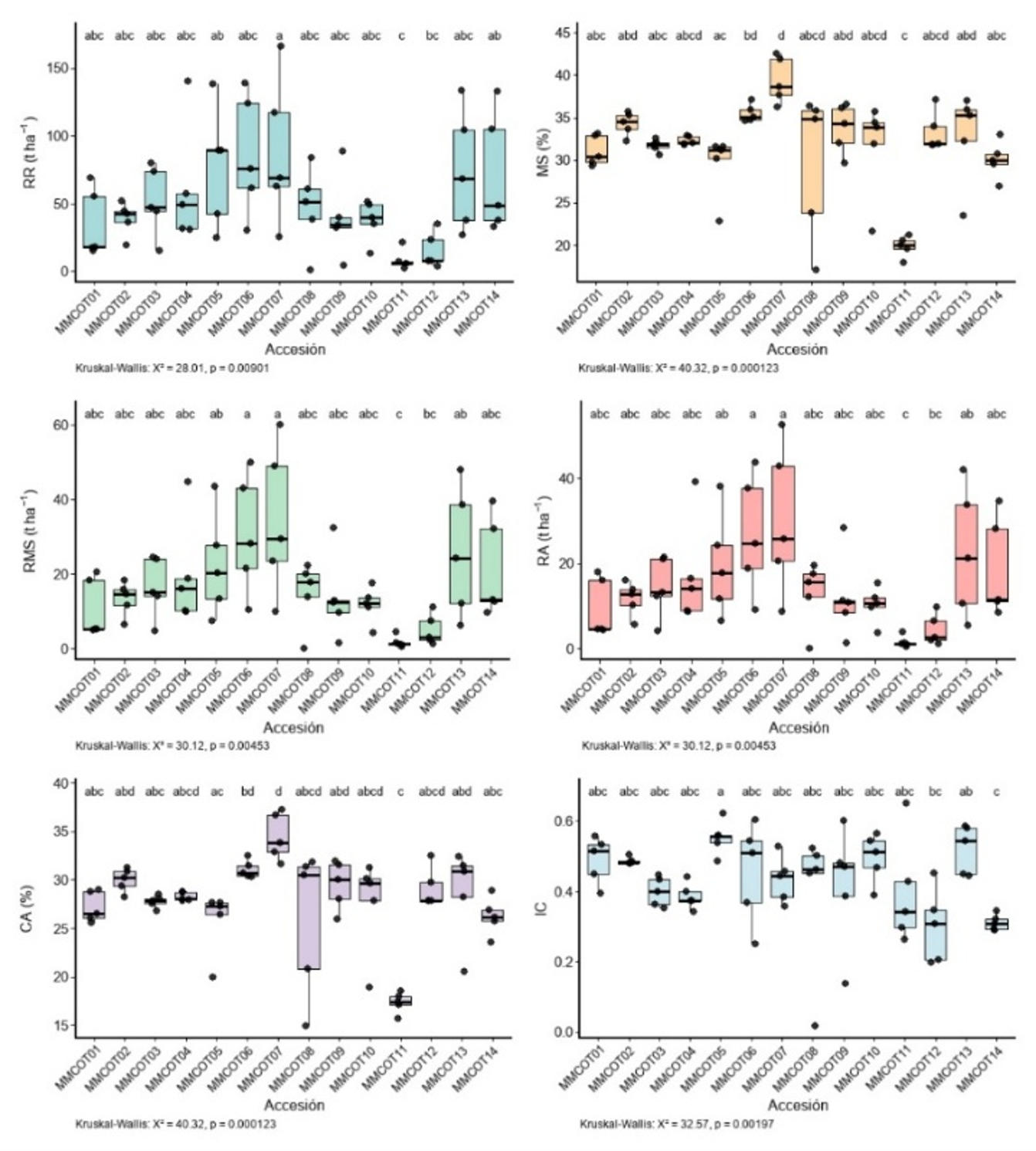
In contrast, MMCOT12 and MMCOT14 showed lower biomass allocation to reserve roots, as indicated by their HI values (0.3 and 0.31), suggesting a strategy more oriented toward aboveground development than toward harvestable organ yield (Table 2, Figure 2). This pattern suggests greater potential for propagation material production or forage use.
Spearman correlation analysis (ρ) confirmed that yield is intrinsically linked to efficiency in assimilate accumulation (Figure 3). The HI showed a moderate positive correlation with RY (ρ= 0.5), which supports its usefulness as a complementary physiological indicator of yield. In turn, DM and SC showed a direct functional relationship (ρ= 1), whereas RY and SY showed a very high positive correlation (ρ= 0.98), indicating that agro-industrial performance depends on the interaction between root biomass and carbohydrate concentration.
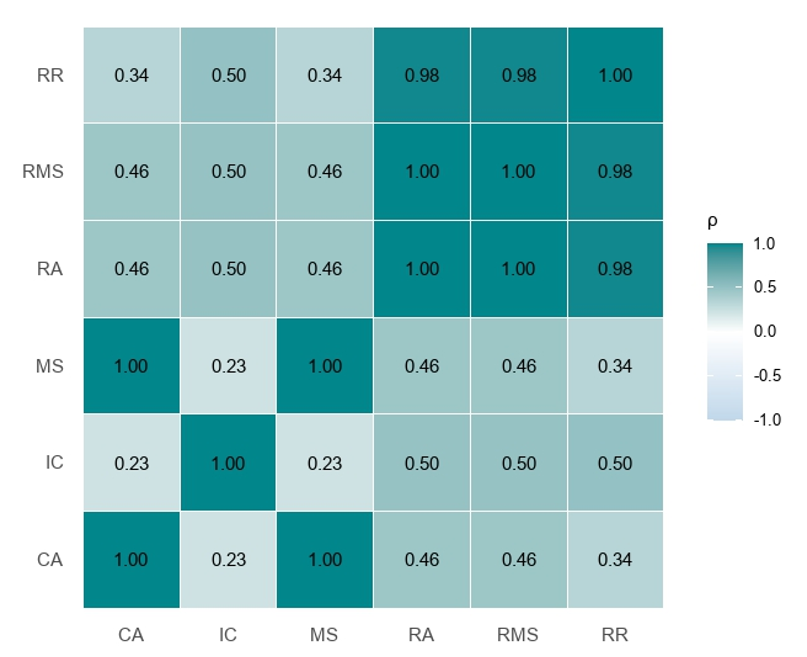
The identified associations confirm that cassava yield depends not only on the volume of roots produced but also on the functional integration among DM, DMY and HI. In this context, DMY acts as an integrative variable of productive performance, while HI remains useful for discriminating contrasting biomass allocation strategies among genotypes (Adjebeng-Danquah et al., 2020; Adiele et al., 2020; Enesi et al., 2022; Menegucci et al., 2023; Silva et al., 2023; Codjia et al., 2025; Onyenali et al., 2025).
Consistent differences were identified between Mexican cassava accessions in RY, DM, SC, and HI. DMY integrated RY with the accumulation of DM in roots, while HI enabled the description of differences in the allocation of biomass to the reserve roots.
These results show that DMY and HI complement RY and strengthen the productive characterization of cassava accessions with differences in root quality.
Adiele, J. G.; Schut, A. G. T.; Van Den Beuken, R. P. M.; Ezui, K. S.; Pypers, P.; Ano, A. O. and Giller, K. E. 2020. Towards closing cassava yield gap in West Africa: agronomic efficiency and storage root yield responses to NPK fertilizers. Field Crops Research. 253:107820. https://doi.org/10.1016/j.fcr.2020.107820.
Adjebeng-Danquah, J.; Asante, I. K.; Manu-Aduening, J.; Agyare, R. Y.; Gracen, V. E. and Offei, S. K. 2020. Genotypic variability in some morpho‐physiological traits in different environments and their relationship with cassava (Manihot esculenta Crantz) root yield. International Journal of Agronomy. 2020:5871351. https://doi.org/10.1155/2020/5871351.
Burbano-Figueroa, O.; Pérez-Pazos, J. V. and Moreno-Moran, M. 2022. Assessing NPK use efficiency of commercial inoculants in cassava (Manihot esculenta Crantz): an application of data envelopment analysis. Journal of Crop Science and Biotechnology. 25(3):253-267. https://doi.org/10.1007/s12892-021-00128-y.
Chaiprasert, P.; Sdoodee, S.; Kaveeta, L.; Kulrut, N.; Sansayawichai, T.; Sanitchon, J. and Whankaew, S. 2022. Effective metabolic carbon utilization and shoot-to-root partitioning modulate distinctive yield in high yielding cassava variety. Frontiers in Plant Science. 13:832304. https://doi.org/10.3390/fpls.2022.832304.
Del Rosario-Arellano, J. L.; Meneses-Márquez, I.; Cruz-Moreno, F. Z.; Serna-Lagunes, R.; Leyva-Ovalle, O. R.; Andrés-Meza, P.; Verdejo-Lara, R. A.; Llarena-Hernández, C. R. and Diaz-José, J. 2025. Morpho-agronomic diversity of Manihot esculenta Crantz accessions: implications for conservation and genetic management. Revista Bio Ciencias. 12:e1719. https://doi.org/10.15741/revbio.12.e1719.
Durán-Prado, A.; Vásquez-Hernández, A.; Meneses-Márquez, I.; Rodríguez-Cuevas, M.; Ramírez-Guillermo, M. Á. y Martínez-Herrera, J. 2023. Impacto económico del biofertilizante micorrízico INIFAPMR en el cultivo de yuca (Manihot esculenta Crantz) en Veracruz. In: López-Vázquez, M. E.; Tosquy-Valle, O. H.; Peralta-Antonio, N.; Rebolledo-García, R. L.; Capetillo-Burela, Á. y Perdomo-Montes, C. (Comps.). XXXV Reunión Científica-Tecnológica, Forestal y Agropecuaria Veracruz. Año 5, Núm. 1. INIFAP. Ciudad de México, México. 23 p. https://rctveracruz.org/assets/img/publicaciones/publicacion_2023/publicacion/publicacion-2023.pdf.
Enesi, R. O.; Hauser, S.; Pypers, P.; Kreye, C.; Tariku, M. and Six, J. 2022. Understanding changes in cassava root dry matter yield by different planting dates, crop ages at harvest, fertilizer application and varieties. European Journal of Agronomy. 133:126448. https://doi.org/10.1016/j.eja.2021.126448.
González-Valdivia, N. A.; Matos-Pech, G.; García-Acedo, C.; Arcocha-Gómez, E.; López-Hernández, M. y Puertovannetti-Arroyo, A. 2023. Estimación del rendimiento de harina seca de yuca (Manihot esculenta Crantz) en un luvisol férrico de Campeche, México. Journal of the Selva Andina Biosphere. 11(1):3-19. https://doi.org/10.36610/j.jsab.2023.110100073.
Okoma, P. M.; Kayondo, S. I.; Rabbi, I. Y.; Moreno-Cadena, P. L.; Hoogenboom, G. and Jannink, J. L. 2025. Evaluating a cassava crop growth model by optimizing genotype-specific parameters using multienvironment trial breeding data. Frontiers in Plant Science. 16:1535058. https://doi.org/10.3389/fpls.2025.1535058.
Olayinka, A. F.; Dzidzienyo, D. K.; Mbanjo, E. G. N.; Offei, S. K.; Tongoona, P. B.; Danquah, E. Y. and Rabbi, I. Y. 2025. Genome-wide association study identifies novel genes for plant architecture and yield traits in cassava (Manihot esculenta Crantz). Frontiers in Plant Science. 16:1660789. https://doi.org/10.3389/fpls.2025.1660789.
Onyenali, T. C.; Ogwuche, T. O.; Onyeka, J.; Diebiru-Ojo, E. M.; Ikechukwu, I.; Abah, S. P.; Okwuonu, I.; Ameh, E. A.; Sanni, L.; Kulakow, A. P. and Egesi, C. N. 2025. Evaluation of improved cassava genotypes for fresh root yield and yield components in demand creation trial. Frontiers in Plant Science. 16:1564393. https://doi.org/10.3389/fpls.2025.1564393.
Pérez-Fons, L.; Ovalle, T. M.; Drapal, M.; Ospina, M. A.; Gkanogiannis, A.; Bohorquez-Chaux, López-Lavalle, L. A. B. and Fraser, P. D. 2023. Integrated genetic and metabolic characterization of Latin American cassava (Manihot esculenta) germplasm. Plant Physiology. 192(4):2672-2686. https://doi.org/10.1093/plphys/kiad269.
Rebolledo-García, R. L.; Rebolledo-Martínez, A.; López-Vázquez, M. E.; Peralta-Antonio, N. and Ramírez-García, R. 2025. Production and quality of cassava (Manihot esculenta Crantz) organically and chemically fertilized and intercropped with sapodilla. Agroproductividad. 18(2):233-240. https://doi.org/10.32854/agrop.v18i2.3259.
Rosas-González, X.; Meneses-Márquez, I.; Becerra-Leor, E. N. y Vásquez Hernández, A. 2014. Efecto de la posición de estacas sobre el rendimiento de raíz de yuca (Manihot esculenta Crantz.) en Veracruz. Revista Biológico Agropecuaria Tuxpan. 2(1):172-177. https://doi.org/10.47808/revistabioagro.v2i1.283.
Silva, R. M. D.; Fernandes, A. M.; Leonel, M.; Pelvine, R. A.; Figueiredo, R. T. D.; Rangel, M. A. S.; Ringenberg, R.; Oliveira, L. A. D.; Santos, V. D. S. and Vieira, E. A. 2023. Measurement of dry matter and starch in modern cassava genotypes during long harvest cycles. Horticulturae. 9(7):733. https://doi.org/10.3390/horticulturae9070733.