elocation-id: elocation-id: e4204
The temperature values at which seeds germinate can serve as a reference for proposing planting or establishment sites. This research evaluated the effect of eight temperatures on the germination of Dahlia coccinea Lehm. and Dahlia campanulata Saar, P. D. Sørensen and Hjert. The hypothesis was that, because the Dahlia species studied have contrasting distributions, it is expected that one of them will show the widest temperature range for the germination of its seeds. The collection was carried out in the Tlalpuente Ecological Reserve, Tlalpan, Mexico City, in 2023. The experimental units were Petri dishes containing two absorbent paper discs moistened with distilled water and 25 seeds of D. coccinea or D. campanulata. The treatments were incubation temperatures (5, 10, 15, 20, 25, 30, 35 and 40 ±2 °C). The number of germinated seeds was recorded for 15 days. D. coccinea had the highest germination percentage (93.6%) and speed (4 seeds day-1) at 25 °C, with cardinal temperatures of 3.3, 24.1 and 35.3 °C. In contrast, D. campanulata had a wider range, as it had an average germination of 90% from 10 to 25 °C, with 8 seeds day-1 and cardinal temperatures of 2.3, 22.5 and 38.4 °C. D. campanulata seeds were the ones that germinated over a wider range of temperatures, so this species has a better chance of success when grown outside its natural habitat.
Dahlia campanulata, Dahlia coccinea, cardinal temperatures, germination speed.
The genus Dahlia Cav. (Asteraceae Bercht. and J. Presl) has 41 species, 38 of which are endemic to Mexico, which is also considered to be its center of origin and diversification (Carrasco-Ortiz, 2019; Mejía-Muñoz et al., 2020).
Dahlia plants have fistulous internodes, tuberous roots, and flowerheads with disk flowers in the center and ray flowers on the periphery, with white, yellow, orange, red or purple colors that give them unique beauty to be used as ornamental plants (Carrasco-Ortiz, 2019; Mejía-Muñoz et al., 2020; Sánchez-Chávez et al., 2025).
Dahlia coccinea Lehm. and Dahlia campanulata Saar, P.D. Sørensen and Hjert. are two species that are propagated by seed for marketing as garden or pot plants (Chaudhary et al., 2020; Dastvan et al., 2022). Therefore, research on the effect of temperature on the germination of these species is relevant, as the results can be used to infer establishment sites outside their natural habitat (Singh et al., 2008; Ghío et al., 2021).
In this case, D. coccinea can be found from northern Mexico to Guatemala at altitudes ranging from 0 to 3 033 masl and temperatures ranging from 3 to 30 °C; by contrast, D. campanulata is endemic to the state of Oaxaca, developing at altitudes close to 2 000 masl and temperatures ranging from 8 to 15 °C (Garzón-Solis et al., 2009; Castro-Castro et al., 2012).
Temperature decreases as the altitude of the sites where the species develop increases, and this can affect their germination differently under conditions of heat stress (García-Diaz et al., 2025).
This is one of the reasons why each species or cultivar has its own temperature range for optimal germination. For example, in Baccharis dracunculifolia (Asteraceae Bercht. and J. Presl.), which is used for ornamental or medicinal purposes, the temperature range for optimal germination is 20-28 °C; outside this range, germination declines, and above 35 °C, it is inhibited (Manfreda et al., 2020). For Dahlia in its seedling stage, the cardinal temperatures Tb (base or minimum), To (optimal) and Tc (maximum or threshold) are 5.5, 24.6, and 34.9 °C, respectively (Brondum and Heins, 1993).
The cardinal temperatures recorded during seed germination can be taken as a reference for proposing planting dates and sites outside the collection sites (Windauer et al., 2007; Calzada-López et al., 2014). In this regard, Caroca et al. (2016) indicate that seeds germinated between 0 and 35 °C will thrive in temperate zones, but those germinated between 10 and 45 °C will develop better in tropical areas.
For Dahlia coccinea and D. campanulata, knowledge of their cardinal temperatures can be used to suggest establishment sites, since they may be more successful if environmental temperatures are similar to those of their site of origin. Therefore, this research aimed to evaluate the effect of eight temperatures (5, 10, 15, 20, 25, 30, 35 and 40 °C) on total germination, median germination (T50), germination speed and cardinal temperatures of D. coccinea and D. campanulata.
The hypothesis supporting this research is that because the Dahlia species studied have contrasting distributions, it is expected that one of them will show the widest temperature interval for the germination of its seeds.
Three hundred seeds of Dahlia coccinea and Dahlia campanulata were collected in the Tlalpuente Ecological Reserve, Tlalpan, Mexico City, in 2023. First, seed viability was corroborated using the protocols described by ISTA (2005), and germination in both species was found to be 95.8 ±2.5%.
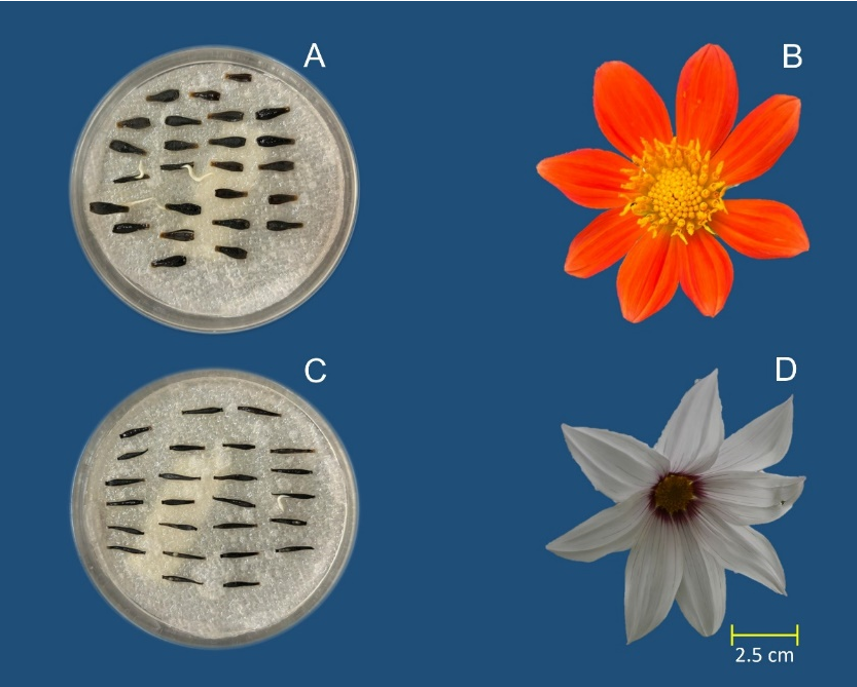
The experimental units consisted of 80 Petri dishes (100 x 15 mm), each containing two double disks of absorbent paper at their base, moistened with 8 ml of distilled water and 25 seeds of D. coccinea or D. campanulata (Figure 1).
For each species, 40 experimental units were placed in groups of five in incubators set to the temperatures of each treatment; that is, 5, 10, 15, 20, 25, 30, 35 and 40 ±2 °C. The following variables were assessed in each Petri dish.
Total germination: the number of seeds germinated daily was recorded for 15 days, and the results in percentage were calculated using the equation proposed by Sampayo-Maldonado et al. (2017).
Median germination (T50): for each treatment, the days required to reach 50% seed germination were counted, and models were obtained to calculate T50 values (Ordoñez-Salanueva et al., 2015).
Germination speed: the number of germinated seeds was used to determine germination speed by applying the equation reported by Calzada-López et al. (2014).
Base temperature (Tb): germination time for D. coccinea and D. campanulata was calculated in percentiles using TableCurve 2D v.3, and the value of Tb was obtained using the procedure described by Ellis et al. (1986).
Maximum temperature (Tc) and optimal temperature (To): the above software and the procedures described by Hardegree (2006) were used to obtain the values of Tc and To.
Statistical analysis: A one-factor analysis of variance and mean comparison tests (Tukey, p≤ 0.05) were performed on the values of total germination and germination speed using SAS® v. 9.0 for Windows. The percentage data were transformed to arcsine for analysis and restored for interpretation.
Total germination: in Dahlia coccinea, the best treatment for germination was 25 °C, as 93.6% seed germination was obtained, but this level decreased to 83% when temperatures were 20 or 15 °C. For its part, Dahlia campanulata had four treatments (10, 15, 20 and 25 °C) that produced the highest germination percentage, which fluctuated between 86 and 92%. Outside these intervals, the number of germinated seeds declined in both species (Table 1).
For each species or variety, there are temperatures or temperature ranges that result in the highest germination values (≥ 80%) and represent the best treatments. For instance, in Physalis philadelphica, the highest germination occurs between 15 and 35 °C, while in Baccharis dracunculifolia, an ornamental plant endemic to South America, the highest percentages occur at temperatures of 20 to 28 °C (Calzada-López et al., 2014; Manfreda et al., 2020).
In D. campanulata, the highest germination percentages were obtained at temperatures of 10, 15, 20 or 25 °C, which may relate to the temperatures of the environment where it develops, which fluctuate from 8 to 15 °C. Meanwhile, the highest germination of D. coccinea occurred at 25 °C, which may also relate to its habitat temperature, which ranges between 3 and 30 °C (Garzón-Solis et al., 2009; Castro-Castro et al., 2012).
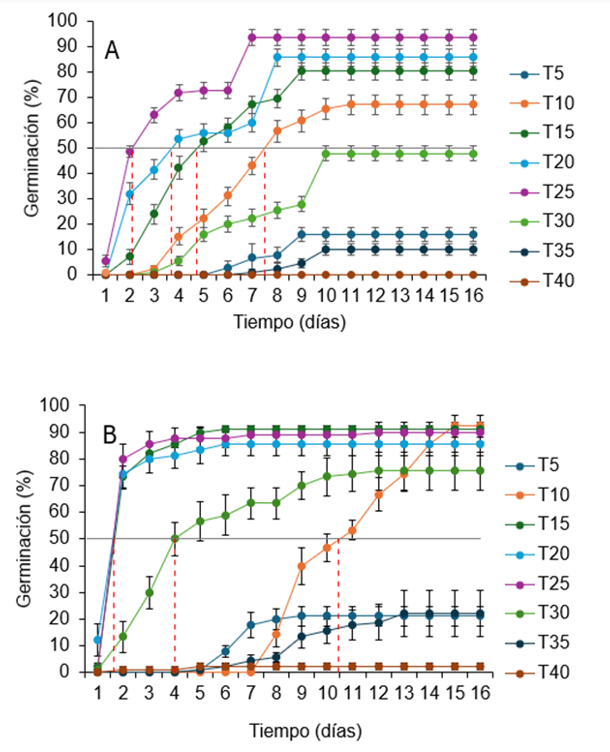
Median germination (T50): in D. coccinea, the fastest T50 value (2 days) occurred at 25 °C, while at 20, 15 or 10 °C, median germination occurred at 3.7, 4.8 and 7.6 days, respectively. At 5, 30, 35, 40 or 45 °C, this species did not reach T50. In D. campanulata, T50 was obtained at 1.35 days for seeds germinating at 15, 20 or 25 °C, while at 5, 35 or 40 °C, the median germination was not reached (Figure 2).
During imbibition and reactivation of cell metabolism, exposure to low (≤ 5 °C) or high (≥ 30 °C) temperatures can lead to embryo death, as processes such as gibberellin synthesis, mRNA formation or degradation of enzymes involved in the translocation of energy to the embryo are affected (Rosa et al., 2004; Taiz and Zeiger, 2010).
In this research, before applying the treatments, seed viability was 95.8 ± 2.5%. This rules out the possibility that the median germination in the 5, 35 or 40 °C treatments occurred due to empty seeds and strengthened the hypothesis of embryo death due to extreme temperatures.
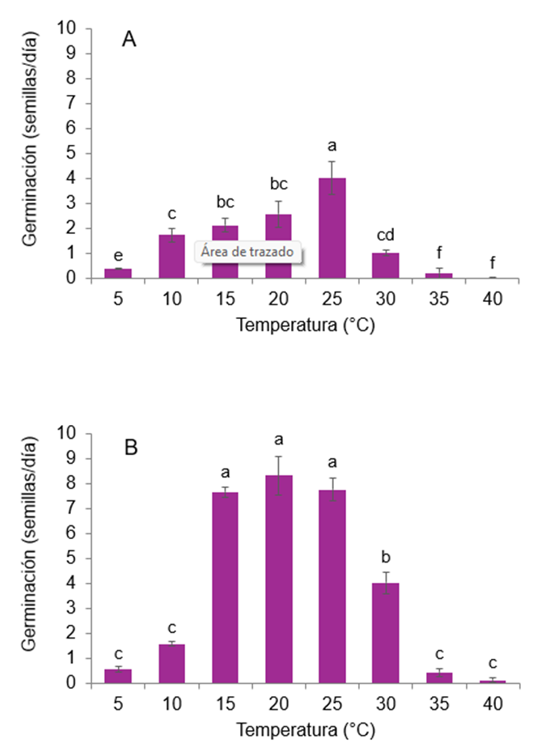
Germination speed: in D. coccinea, germination speed was highest (4.01 seeds day-1) at 25 °C and decreased at temperatures below or above this value. For example, at 5 or 35 °C, germination was 0.4 and 0.2 seeds day-1. In contrast, D. campanulata doubled its germination speed (8 seeds day-1) compared to D. coccinea and occurred from 15 to 25 °C (Figure 3).
Imbibition temperatures can affect germination speed. For example, in Physalis philadelphica, 17.3 to 21.6 seeds germinate h-1 when imbibed at 20-35 °C. In contrast, in Chenopodium quinoa var. Suyana, the highest speed (7.4 seeds h-1) occurs at 30 °C, but in ‘Tunkahuan’, the range with the highest germination speed (6.6 seeds h-1) is wider, ranging from 30 to 40 °C (Calzada-López et al., 2014; Ramírez-Santiago et al., 2020).
Compared to D. coccinea or D. campanulata, these speeds could be too fast. However, the seeds of P. philadelphica and C. quinoa are 50 to 100 times smaller than those of the two Dahlia species, which would mean less endosperm area to hydrate and restart cell metabolism (Taiz and Zeiger, 2010).
The cardinal temperatures (Tb, To and Tc) for germination of D. coccinea were: 3.3 ±2.7, 24.1 ±1.1 and 35.3 ±1. For suboptimal and supraoptimal temperatures, the following equations were obtained:
, respectively, which explain 98 and 86% of the variation in germination rate.In D. campanulata, Tb, To and Tc were 2.3 ±0.5, 22.5 ±0.5 and 38.4 ±0.5, respectively. For suboptimal and supraoptimal temperatures, the equations were
which explain 73 and 99% of the variation in germination rate in this species (Figure 4).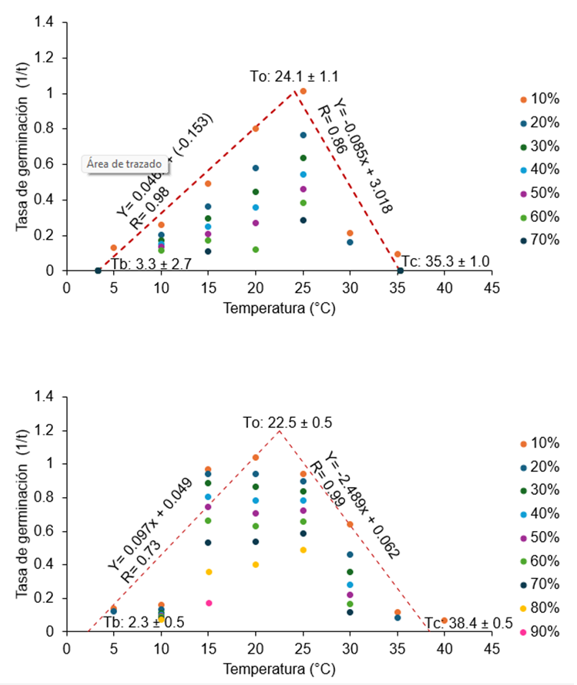
Cardinal temperature values are important because they can serve as a reference for inferring planting or establishment sites outside the collection sites (Singh et al., 2008). In this regard, Cave et al. (2011) mention that the cardinal temperatures of Brunonia australis Sm. ex R. Br. and Calandrinia sp. are 5.2, 21.6 and 35.9, and 6.8, 22.5, and 42.7 °C, which correspond to Tb, To and Tc, respectively.
They add that, based on the minimum temperature values (5.2 and 6.8 °C), it can be said that both species have the potential to germinate in environments with cold temperatures. A similar response was observed in D. coccinea and D. campanulata. Nonetheless, they can also germinate at temperatures close to 30 °C.
The optimal germination interval is unique for each species, and seed exposure to suboptimal or supraoptimal temperatures negatively affects radicle emergence. Nevertheless, seeds that maintain high values of sub- or supraoptimal germination will contribute to more individuals, and their genetic variability would increase the chances of seedlings establishing themselves in cold or warm environments (Mamedi et al., 2017).
In this case, the cardinal temperatures (Tb, To and Tc) of the two species differ by 1 or 3 °C, which indicates that both D. coccinea and D. campanulata can germinate at sub- or supraoptimal temperatures. D. campanulata holds an advantage at low temperatures, thereby corroborating the hypothesis initially raised; that is, one of the two species has better germination under temperature stress.
Dahlia coccinea seeds have a high germination percentage (94%), with a T50 value reached two days after incubation and an emergence speed of 4 seeds day-1 only at 25 °C. However, Dahlia campanulata seeds have a high germination percentage (90%) from 10 to 25 °C, with T50 reached in only 1 day and germination speeds of 8 seeds day-1 from 15 to 25 °C.
The optimal temperature for germination of Dahlia coccinea is 24.1 °C, but its seeds can germinate from 3.3 to 35.3 °C. In contrast, Dahlia campanulata has an optimum of 22.5 and can germinate from 2.3 to 38.4 °C. Outside these intervals, germination will not occur in either species.
Growing these species as ornamental plants outside their natural habitat can be successful if done within the temperature ranges described here and success will be greater the closer the cultivation conditions are to their optimal temperatures.
We thank the Iztacala Faculty of Higher Studies (FES-Iztacala) for the annual funding it provides to execute projects in the research units.
Calzada-López, S. G.; Kohashi-Shibata, J.; Uscanga-Mortera, E.; García-Esteva, A. and Yáñez-Jiménez, P. 2014. Cardinal temperatures and germination rate in husk tomato cultivars. Revista Mexicana de Ciencias Agrícolas. 8:1451-1458. https://www.scielo.org.mx/pdf/remexca/v5nspe8/2007-0934-remexca-5-spe8-1451-en.pdf.
Ellis, R. H.; Covell, S.; Roberts, E. H. and Summerfield, R. J. 1986. The influence of temperature on seed germination rate in grain legumes. II. Intraspecific variation in chickpea (Cicer arietinum L.) at constant temperatures. Journal of Experimental Botany. 37(10):1503-1515. https://doi.org/10.1093/jxb/37.10.1503.
Garzón-Solis, C.; Mejía-Muñoz, J. M.; Trejo-Calzada, R.; Gómez-Lorence, F.; Espinosa-Flores, A. y Sánchez-Abarca, C. 2009. Fenología de la dalia campanulata (Dahlia campanulata Saar.): nueva especie para la horticultura ornamental. Revista Chapingo Serie Zonas Áridas. 8(1):19-24. https://www.redalyc.org/articulo.oa?id=455545064003.
Ghío, N.; Marinoni, L.; Castro, D.; Zabala, M.; Micheloud, N. G. y Buyatti, M. 2021. Evaluación del comportamiento germinativo de tres especies vegetales nativas con potencial ornamental del centro-norte santafesino. Fave. Sección Ciencias Agrarias. 20(1):175-188. https://www.scielo.org.ar/pdf/fave/v20n1/1666-7719-fave-20-01-175.pdf.
Ordoñez-Salanueva, C. A.; Seal, C. E.; Pritchard, H. W.; Orozco-Segovia, A.; Canales-Martínez, M. and Flores-Ortíz, C. M. 2015. Cardinal temperatures and thermal time in Polaskia Beckeb (Cactaceae) species: effect of projected soil temperature increase and nurse interaction on germination timing. Journal of Arid Environments. 115:73-80. https://doi.org/10.1016/j.jaridenv.2015.01.006.
Rosa, M.; Hilal, M.; González, J. A. and Prado, F. E. 2004. Changes in soluble carbohydrates and related enzymes induced by low temperature during early developmental stages of quinoa (Chenopodium quinoa) seedlings. Journal of Plant Physiology. 161(6):683-689. https://doi.org/10.1078/0176-1617-01257.
Salinas-Rodríguez, M. M.; Hernández-Sandoval, L.; Carrillo-Reyes, P.; Castillo-Gómez, H. A.; Castro-Castro, A.; Estrada-Castillón, E.; Figueroa-Martínez, D. S.; Gómez-Escamilla, I. N.; González-Elizondo, M; Gutiérrez-Ortega, J. S.; Hernández-Rendón, J.; Munguía-Lino, G.; De- Nova, J. A.; Ortiz-Brunel J. P.; Rubio-Méndez, G.; Ruiz-Sánchez, E.; Sánchez-Sánchez, C.; Sandoval-Mata, T. N.; Soltero-Quintana, R.; Steinmann, V.; Valencia A. S. y Zamudio-Ruíz, S. 2022. Diversidad de plantas vasculares de la provincia fisiográfica de la Sierra Madre Oriental, México. Botanical Sciences. 100(2):469-492. https://doi.org/10.17129/botsci.2864.
Sampayo-Maldonado, S.; Castillo-Martínez, C. R.; Jiménez-Casas, M.; Sánchez-Monsalvo, V.; Jasso-Mata, J. y López-Upton, J. 2017. Germinación in vitro de semillas de Cedrela odorata L. de genotipos extintos. Agro Productividad. 10(8):53-58. https://revista-agroproductividad.org/index.php/agroproductividad/es/article/view/1075/921.