elocation-id: e4202
The physical quality of coffee seeds is key to producing seedlings, especially under uncontrolled edaphoclimatic conditions, where the endocarp acts as a barrier that delays emergence and makes it irregular. This study aimed to evaluate the effect of the endocarp on the emergence kinetics and uniformity of seedlings of six coffee genotypes under seedbed conditions in Oxapampa, Pasco, Peru, between May and August 2025. Six coffee genotypes and two conditions (with and without endocarp) were evaluated. The design was completely randomized with a 6 × 2 factorial arrangement and two blocks. Seedling emergence percentage, time, speed and index were evaluated. Data were analyzed with analysis of variance, simple effects and Tukey’s test (p≤ 0.05). The genotype × endocarp interaction was significant for PE, MET, MES and ESI. Endocarp removal increased the percentage and speed of emergence and reduced the mean emergence time in all genotypes. Obata Amarillo, Marsellesa, Cuscatleco and Catigua recorded the highest percentages of emergence (92.19-96.88%), while Marsellesa exhibited the fastest emergence (87.2 days) and the highest speed of emergence (1.29 seedlings day-1). ESI showed a differential response according to genotype. The research revealed that removing the endocarp improves kinetics by reducing emergence time and enhances seedling emergence uniformity.
genotype, germination, parchment, seed, seedling
The coffee tree (Coffea arabica L.) is the main species cultivated in Oxapampa, a district located in the central rainforest of Peru (Acosta and Acosta, 2025). Its cultivation is the livelihood of small farmers (Acosta et al., 2022). However, there is a context of limited information on varietal identity (Acosta et al., 2022) and on the specific emergence kinetics of each nanobasin.
The renovation and establishment of new coffee plantations face limitations in obtaining quality seedlings, given that germination is slow and uneven under conventional management (Nápoles-Vinent et al., 2022), which prolongs the time spent in the seedbed, extends associated cultural management, and increases heterogeneity among seedling batches. In addition, commercial coffee cultivars are self-pollinated and seed-propagated (Gebreselassie et al., 2010).
Coffee seeds can germinate after harvest, but they lose viability quickly (Coste, 1992). In addition, the endocarp acts as a physical barrier that limits germination by hindering radicle protrusion; therefore, the need to evaluate seeds without the endocarp arises (Eira et al., 2006).
Seed analysis provides fundamental information and allows us to establish standards for determining seed quality (Morejón and Díaz, 2023), and that genotype and the absence of endocarps influence seedling emergence and growth (Acosta et al., 2022). In contrast, removing the endocarp tends to accelerate emergence and improve uniformity (Gebreselassie et al., 2010; Coa et al., 2014).
Given this background, the objective of this research was to evaluate the effect of the endocarp on the emergence kinetics and uniformity of seedlings of six genotypes of coffee (Coffea arabica L.) under seedbed conditions in Oxapampa, Pasco, Peru, in order to contribute to the selection of genotypes with seedling uniformity and to generate knowledge about the efficiency of their emergence.
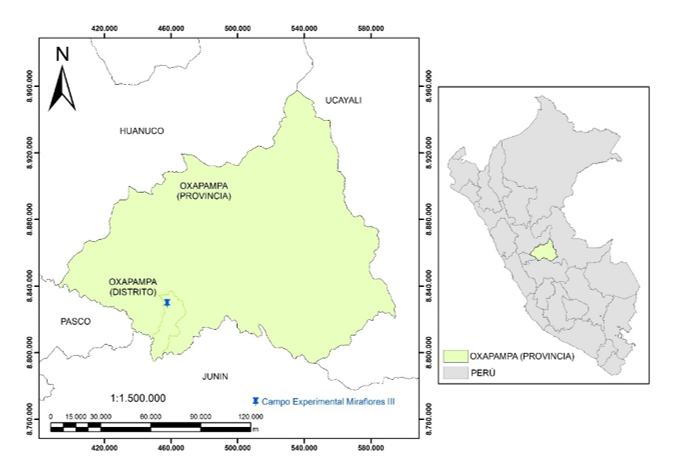
The research was conducted from May to August 2025 at the Miraflores III Experimental Field of the Daniel Alcides Carrión National University, Oxapampa, Pasco, Peru, located in zone 18 L, at 45.7615o east and 88.29303o north, at an altitude of 1 835 m (Figure 1).
During the experimental period, the average environmental temperature was 17.37 °C, the relative humidity was 84.5%, and the accumulated rainfall was 312.3 mm (SENAMHI, 2025).
The coffee seeds came from non-certified seed multiplication plots of the Aroma de Montaña farm in the district of Villa Rica.
The design used was a completely randomized block design with a 6 × 2 factorial arrangements, for genotype (Obata Rojo, Obata Amarillo, Cuscatleco, Castillo, Marsellesa and Catigua) and endocarp [with endocarp (WE) and without endocarp (NE)], distributed across 12 treatments, with two blocks and experimental units (EUs) consisting of 32 seeds.
The substrate used was river sand, previously sifted through a 0.5 cm mesh sieve and disinfected (Julca et al., 2015; Caballero-Salas et al., 2021). The seedbed measured 2.22 m long (4 rows of EUs), 1.94 m wide (6 rows of EUs), and 0.3 m deep (Valarezo et al., 2021) and had wooden edges. Endocarp removal was performed manually (Escobedo et al., 2025).
To select the seeds, they were placed in a 500 ml beaker with distilled water and separated by flotation and decantation, discarding impurities and floating seeds (Carrasco et al., 2025). The planting frame was 6 x 6 cm and each experimental unit was kept 10 cm apart from the next. The seeds were buried at a depth of 1.5 cm (Coa et al., 2014). An irrigation regime was maintained with a frequency of two days, and the experimental units were kept under nursery conditions.
The percentage of emergence (equation 1), the mean emergence time (equation 2), the mean emergence speed (equation 3) and the emergence synchrony index (equations 4 and 5) were evaluated.
(equation 1, Morejón and Díaz, 2023);
(equation 2, Maqueira et al., 2023);
(equation 3, Vieira et al., 2016);
(equation 4, Ranal and García, 2006);
(equation 5, Ranal and García, 2006). Where: is the number of seedlings that emerged at the i-th data collection; is the day of the i-th data collection.
Data were collected at 70, 75, 80, 85, 90 and 95 days after sowing (das). Percentage values were transformed using the arcsine function (Martínez et al., 2012). Data were subjected to an analysis of variance (Anova) at a 95% confidence level, followed by analysis of simple effects (95% confidence level) and Tukey’s test; means with equal letters do not differ statistically (p≤ 0.05). For this purpose, the InfoStat program (version 2020e) was used.
The emergence of seedlings of the six coffee genotypes was affected by the presence or absence of the endocarp. It was observed that in seeds sown with endocarp, emergence was late, starting at 75 das, confirming the endocarp’s retarding effect; in this group, Cuscatleco was the earliest and had the highest average number of seedlings emerged (24.5 ±0.5), reaching the highest value at 95 das, followed by Castillo (12.5 ±2.5) and Obata Amarillo (9 ±1), whereas Marsellesa showed the lowest (3.5 ±0.5) and late emergence (Figure 2A).

In contrast, in seeds without endocarp, emergence began earlier and increased rapidly in all genotypes, indicating that its absence leads to a faster and more uniform emergence; under this condition, Obata Amarillo and Marsellesa recorded the highest number of emerged seedlings, averaging 31 seedlings at the end of the evaluation period, while Castillo presented the least emergence level, with 25 ±1 seedlings (Figure 2B).
The results confirm genetic differences in both speed and emergence, as well as a clear influence of the endocarp on this process. Considering the emergence period in this research, Diaz et al. (2023) report that seedling emergence can occur within an interval of 50 to 90 das at an approximate altitude of 10 m.
For PE, the ANOVASE determined that the genotype factor presented highly significant statistical differences (p< 0.01) both in the presence and absence of the endocarp; likewise, the endocarp factor showed highly significant statistical differences (p< 0.01) among the genotypes evaluated (Table 1).
For MET, the Anovase determined that the genotype factor showed statistically significant differences (p< 0.05) in the presence and absence of the endocarp; the endocarp factor also showed statistically significant differences (p< 0.05) among the genotypes evaluated (Table 1).
For MES, the Anovase determined that the genotype factor presented highly significant statistical differences (p< 0.01) both in the presence and absence of the endocarp; likewise, the endocarp factor showed highly significant statistical differences (p< 0.01) among the genotypes evaluated (Table 1).
For ESI, the Anovase indicated that the genotype factor presented highly significant statistical differences (p< 0.01) in the presence of the endocarp, whereas no statistically significant differences (p> 0.05) were observed in its absence (Table 1).
The findings of González et al. (2015) highlight that seedling emergence is directly related to seed vigor, which depends on seed quality and the efficiency of the metabolic processes that occur during germination. Initial vigor is essential because it determines seedling growth (Moreno-Peña et al., 2025) and development before transplantation.
In the presence of the endocarp, the Cuscatleco genotype registered the highest PE (76.56%), significantly exceeding the other genotypes, whose value ranged from 10.94 to 39.06%. In the absence of the endocarp, Obata Amarillo, Marsellesa, Cuscatleco, and Catigua formed the statistically superior group, with percentages of emergence ranging from 92.19 to 96.88% and no significant differences among them. Obata Rojo presented intermediate behavior (90.63%), while Castillo exhibited the lowest PE (78.13%) (Table 2).
The endocarp constitutes a physical barrier that limits imbibition and gas exchange, thereby delaying the activation of metabolic processes associated with germination (Bewley et al., 2013). Accordingly, Gebreselassie et al. (2010); Carvalho and Nakagawa (2012) reported that endocarp removal favors seedling emergence by reducing the physical restrictions imposed on the embryo.
This effect may be due to greater ease of imbibition, which favors the reactivation of cell metabolism and consequently, the processes of germination and seedling emergence (González et al., 2015).
Tukey’s mean comparison test (α= 0.05) for the simple effects of the genotype × endocarp condition interaction showed that, in the presence of the endocarp, there were no significant differences in MET between the genotypes evaluated, whose values ranged from 91.54 to 94.58 days.
In the absence of the endocarp, significant differences were observed among genotypes, with Castillo showing the highest MET (90.44 days) and not differing statistically from Obata Rojo, Cuscatleco, Obata Amarillo, and Catigua. By contrast, Marsellesa exhibited the lowest MET (87.2 days) and differed significantly from Castillo (Table 3), showing a faster emergence.
The high MET values observed reflect a slow emergence process of coffee seeds, which may potentially be associated with genetic traits related to seed vigor (Filho, 2015). Nonetheless, the reduction in MET in the absence of the endocarp shows the restrictive effect of this physical structure on emergence. These results align with Acosta et al. (2022), who reported improved seedling emergence after endocarp removal.
In the presence of the endocarp, Cuscatleco had the highest MES (0.49 seedlings day-1), significantly outperforming the other genotypes, whose values ranged from 0.04 to 0.2 seedlings day-1. In the absence of the endocarp, Marsellesa, Catigua and Obata Amarillo formed the statistically superior group, with emergence speeds of 1.29, 1.2 and 1.16 seedlings day-1, respectively, with no significant differences among them. Cuscatleco and Obata Rojo showed intermediate values (1.09 and 0.89 seedlings day-1), while Castillo recorded the lowest MES (0.73 seedlings day-1) (Table 4).
The endocarp factor significantly affected the ESI of Obata rojo (p< 0.05) and had a highly significant effect on the ESI of Obata Amarillo, Marsellesa and Catigua (p< 0.01). However, in the presence of the endocarp, Tukey’s test (α= 0.05) did not show significant differences among the evaluated genotypes, whose ESI values ranged from 0.33 to 1.11 (Table 5).
| Genotype (WE) | ESI |
|---|---|
| Obata Amarillo | 0.33a |
| Marsellesa | 0.41a |
| Catigua | 1.04a |
| Obata Rojo | 1.11a |
The absence of significant differences in ESI among genotypes indicates a similar temporal distribution of emergence under the endocarp condition. Likewise, the values obtained suggest a comparable behavior in the uniformity of seedling emergence, considering that lower ESI values reflect greater synchrony in the emergence process (Narváez et al., 2022).
Removing the endocarp significantly improved coffee seedling emergence by increasing both the percentage and speed of emergence and reducing the mean emergence time.
The magnitude of this response depended on the genotype, with Obata Amarillo, Marsellesa, Cuscatleco and Catigua standing out for their high performance.
Overall, the results demonstrate that removing the endocarp leads to faster, more efficient emergence of coffee seedlings.
Carrasco-Cruzado, A. Y.; Villegas-Herrera, N. A.; López-Medina, S. E.; Mostacero-León, J.; Rodríguez-Soto, J. C.; Gil-Rivero, A. E.; De La Cruz-Castillo, A. J. y Gonzales-Velasquez, C. L. Y. 2025. Influencia del ácido giberélico en la germinación de Physalis peruviana ‘aguaymanto’. Manglar. 22(1):61-66. https://doi.org/10.57188/manglar.2025.007.
Coa-Urbaez, M.; Mendez-Natera, J. R.; Silva-Acuña, R. y Mundarain-Padilla, S. 2014. Evaluación de métodos químicos y mecánicos para promover la germinación de semillas y producción de fosforitos en café (Coffea arábica) var. Catuaí Rojo. Idesia Arica. 32(1):43-53. https://doi.org/10.4067/S0718-34292014000100006.
Escobedo-Baylon, J. J.; Charcape-Méndez, A. S.; López-Medina, S. E.; Mostacero-León, J.; Rodríguez-Soto, J. C.; Gil-Rivero, A. E.; De La Cruz-Castillo, A. J. y Villena-Zapata, L. I. 2025. Influencia de ácido giberélico y tiempo de remojo sobre la germinación de semillas de Coffea arabica L. var. Catimor ‘café’. Manglar. 22(3):339-346. https://doi.org/10.57188/manglar.2025.034.
Moreno-Peña, L.; Hidalgo-Escobar, K.; Cevallos-Cevallos, J. M. and Sánchez-Timm, E. 2025. An effective disinfection protocol for contamination control in vitro establishment of Mortiño (Vaccinium floribundum Kunth) and identification of endogenous microbes. Scientia Agropecuaria. 16(3):375-384. https://doi.org/10.17268/sci.agropecu.2025.028.
Nápoles-Vinent, S.; Milanés-Riquene, S.; Hernández-Forte, I.; Morales-Mena, B. y Nápoles-Garcias, M. C. 2022. Los rizobios incrementan la germinación de las semillas de Coffea arabica y Coffea canephora. Segunda evidencia en Cuba. Agronomía Mesoamericana. 33(1):1-13. https://doi.org/10.15517/am.v33i1.45719.
Valarezo-Rivera, N. Y.; Quevedo-Guerrero, J. N.; Ajila-Gia, L. G.; García-Batista, R. M. y Chabla-Carrillo, J. E. 2021. Evaluación del porcentaje de germinación de cinco cultivares de café (Coffea arabica L.) empleando cuatro tratamientos en vivero. Revista Científica Agroecosistemas. 9(1):68-75. https://aes.ucf.edu.cu/index.php/aes/article/view/446.