elocation-id: elocation-id: e4188
In vitro propagation of Fragaria × ananassa via organogenic calluses is an efficient method for regenerating shoots and whole plants. This study evaluated the effects of distinct combinations of growth regulators, water-soluble polysaccharides and phosphoproteins on the induction of calluses from leaf explants of the Festival and CP-Jacona cultivars. Six treatments were tested with varying concentrations of NAA, 2,4-D, BA, TDZ, MET, GA and CS. After 150 days, survival, induction percentage, diameter, weight, texture and degree of development of calluses were measured. In the Festival cultivar, treatment T3 (3 mg L-¹ 2,4-D + 0.5 mg L-¹ BA) was the most effective, achieving 96.3% survival, 92.6% induction, friable calluses, and good development (61-80%). For the CP-Jacona cultivar, treatment T2 (0.2 mg L-¹ 2,4-D + 1 mg L-¹ TDZ) showed the best yield, with 96.3% survival and induction, friable calluses and development in the same interval (61-80%). In both cultivars, calluses differentiated into shoots using specific media: in Festival, MS + 1.5 mg L-¹ 2,4-D + 0.25 mg L-¹ BA and in CP-Jacona, MS + 0.1 mg L-¹ 2,4-D + 0.5 mg L-¹ TDZ + 1 mg L-¹ BA. The specific protocols applied enabled successful induction and differentiation of organogenic calluses in strawberries, representing a viable alternative for their propagation and genetic improvement.
auxin, callogenesis, cytokinin, indirect organogenesis, TDZ, 2,4 D.
Strawberries (Fragaria × ananassa Duch.) are a crop of high commercial, industrial, and nutraceutical value. In 2023, 15 267 ha were harvested in Mexico, yielding 641 552 t and placing the country among the largest producers and exporters; Michoacán, Guanajuato, and Baja California stand out.
Fresh fruit exports exceeded 184 000 t and 748 000 000 USD, with the United States of America as the main destination and growing demand in Europe (USDA ERS, 2023; SIAP, 2025). Traditional stolon propagation, although common, is slow, expensive and prone to transmitting pathogens, affecting plant uniformity and vigor (Gaston et al., 2020).
In contrast, in vitro culture enables rapid micropropagation, large-scale production and obtaining pathogen-free material (Thorpe, 2007). De novo organogenesis depends on exogenous phytohormones (Duclercq et al., 2011; Ikeuchi et al., 2019). In Arabidopsis thaliana, the callus is induced in a callus induction medium (CIM) with a high auxin/cytokinin ratio, and the shoots are induced in a shoot induction medium (SIM) with an inverse ratio of these regulators (Skoog and Miller, 1957).
In strawberry, indirect organogenesis via callus has been widely documented across different cultivars and explant types, with the auxin-cytokinin ratio being key: high auxin ratios favor callogenesis, whereas higher cytokinin ratios promote shoot formation (Palei et al., 2017; Liu et al., 2022). Combinations such as 2,4-D + BA and NAA + BA, as well as regulators of strong cytokinin activity, such as TDZ, have shown high rates of shoot induction (Haddadi et al., 2013; Kaur et al., 2021; Suminar et al., 2024).
In parallel, epigenetic mechanisms such as DNA methylation and chromatin remodeling regulate dedifferentiation and the acquisition of cellular competence; inhibitors such as 5-azacitidine reduce callogenesis and regeneration, evidencing that more open chromatin is necessary for reprogramming (Lee et al., 2018; Liu et al., 2022).
In Arabidopsis, pluripotency during dedifferentiation arises from the interaction among auxin, transcriptional reprogramming, and chromatin remodeling. Auxin, via ARF-LBD, activates genes such as PLT and WOX, establishing regenerative competence (Sugimoto et al., 2010; Kareem et al., 2015; Lee and Seo, 2018). This process is consolidated by dynamic epigenetic regulation (Ikeuchi et al., 2016; Ikeuchi et al., 2018).
In strawberry, callogenesis depends on the auxin/cytokinin ratio and the explant state (Passey et al., 2003; Debnath, 2006). The study evaluates how CIM modulates these hormonal and epigenetic networks by varying concentrations of growth regulators, water-soluble polysaccharides, and phosphoproteins in the medium to induce calluses from young leaves of in vitro shoots of the Festival and CP-Jacona cultivars.
The study was conducted in the laboratory of biotechnology and fruit crop structure of the College of Postgraduates, Montecillo Campus, Texcoco, State of Mexico, 2023-2025; 19.4605° north latitude, 98.9030° west longitude, 2 250 masl.
The material used consisted of in vitro seedlings of Fragaria × ananassa, cultivars Festival and CP-Jacona, obtained from meristematic apices (~400 μm) of crowns of greenhouse daughter plants. Explants were established in MS medium (Murashige and Skoog, 1962) with 0.5 mg L-¹ BA + 0.5 mg L-¹ IBA at 25 ± 2 °C under a 16 h light/8 h dark photoperiod for 30 days. Shoot multiplication was performed in MS with 1 mg L-¹ BA + 0.1 mg L-¹ IBA, with monthly subcultures for eight months.
Leaf segments (~1 cm2) placed with the abaxial surface in MS medium (100%) with combinations of auxins (NAA, 2,4-D), cytokinins (BA, TDZ, meta-topolin [MET]), arabinogalactan (GA), and hydrolyzed casein (CS) were used to induce calluses.
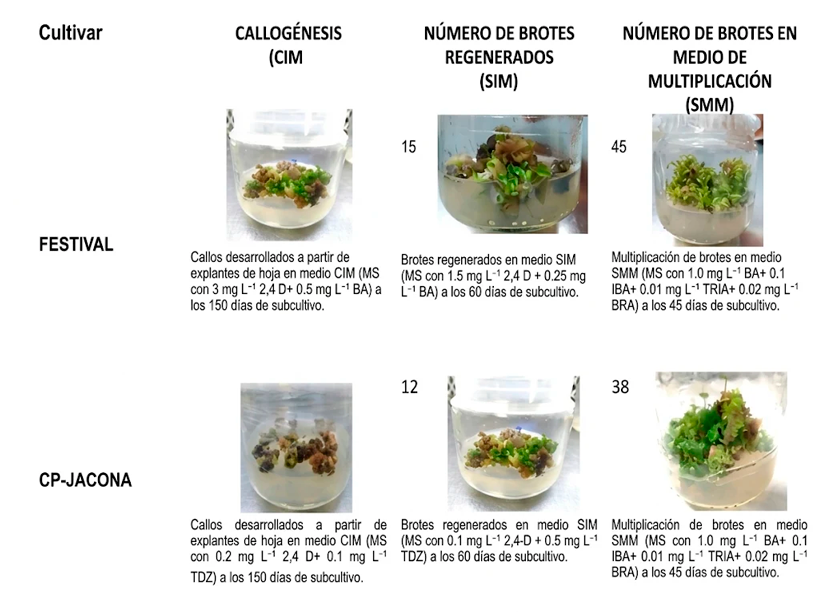
The formed calluses were transferred to shoot induction media (SIM). For Festival, MS (100%) with 1.5 mg L-¹ of 2,4-D and 0.25 mg L-¹ of BA was used; for CP-Jacona, MS (100%) with 0.1 mg L-¹ of 2,4-D, 0.25 mg L-¹ of TDZ and 1 mg L-¹ of BA was used.
To induce organogenic calluses in two strawberry cultivars, six treatments were evaluated: T1 (4 mg L-¹ NAA + 0.4 mg L-¹ MET + 1 mg L-¹ GA + 50 mg L-¹ CS), T2 (0.2 mg L-¹ 2,4-D + 1 mg L-¹ TDZ), T3 (3 mg L-¹ 2,4-D + 0.5 mg L-¹ BA), T4 (1 mg L-¹ 2,4-D + 0.1 mg L-¹ BA), T5 (2 mg L-¹ NAA + 0.5 mg L-¹ BA) and T6 (4 mg L-¹ NAA + 0.4 mg L-¹ BA + 1 mg L-¹ GA + 50 mg L-¹ CS) (Karim et al., 2011; Palei et al., 2017; Roy et al., 2018).
The culture medium was solidified with agar (5 g L-¹) and 3% sucrose as a carbon source; pH was adjusted to 5.7 before autoclaving at 120 °C and 15 psi for 20 min. Under sterile conditions, four leaf segments (1 cm2) were placed per Petri dish, with the abaxial surface in contact with the medium. Explants were incubated in darkness at 25 ±2 °C for 120 days, with monthly subcultures; subsequently, they were maintained under a 16 h light/ 8 h dark photoperiod with LED lighting (92.1 μmol m-² s-¹) for 30 days.
Independent experiments were performed by cultivar. The experimental design was a completely randomized design (CRD) with six treatments and 27 replications, evaluating a total of 162 experimental units; each experimental unit corresponded to a Petri dish with four leaf explants (~1 cm2).
After 150 days in the culture media, the following variables were evaluated: survival (%), callus induction (%), callus texture (friable or compact, %), degree of development (%) using a five-level ordinal scale (1-20, 21-40, 41-60, 61-80 and 81-100%), callus diameter (cm) measured with a 150 mm vernier (Adir®, model 11684), and fresh callus weight (g) measured with an analytical balance (ADAM®, model PW 254).
It was evaluated how different growth regulators, with or without GA and CS, influence the induction and development of organogenic calluses from leaves of the strawberry cultivars Festival and CP-Jacona. The results are presented by a variable response, with physiological and molecular interpretations.
Treatments T2 to T6 presented the highest percentages of survival (81.5-96.3%) and callus induction (77.7-96.3%) in both cultivars, with no significant differences between them (Figures 1 and 2). In contrast, T1 exhibited the lowest values for both variables.
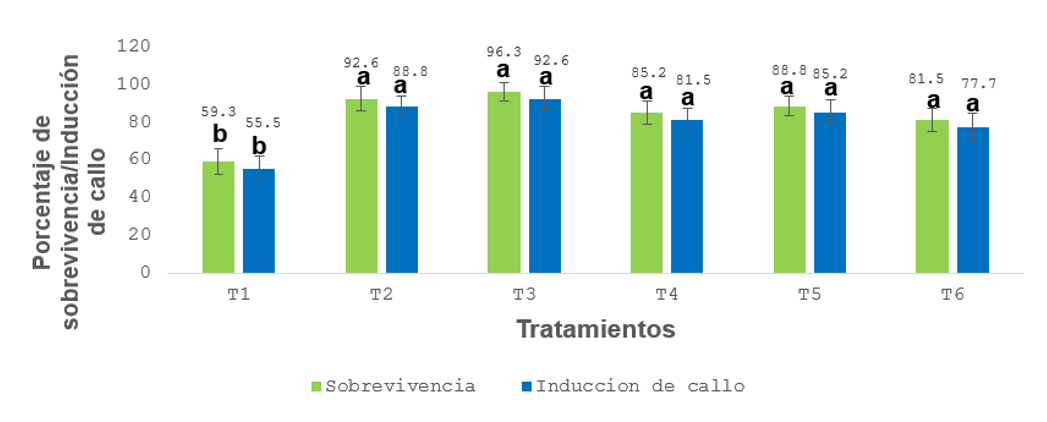
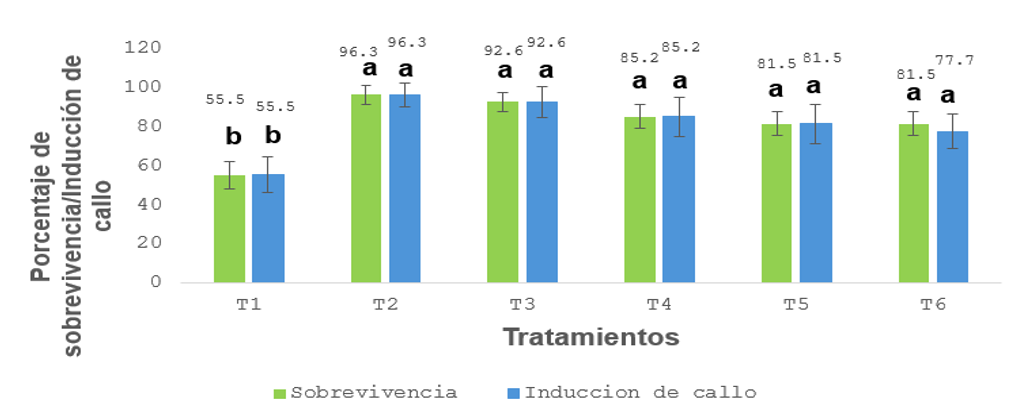
These results suggest that different combinations of auxins (2,4-D or NAA) and cytokinins (BA or TDZ) can promote similar morphogenic responses, as long as an adequate hormonal balance is maintained to promote cell dedifferentiation and callus formation.
The absence of differences among T2, T3, T4, T5 and T6 indicates that the evaluated concentrations of auxins and cytokinins were sufficient to induce an efficient callogenic response in strawberry leaf explants.
Although the treatments differed in the type and concentration of growth regulators, they all maintained a favorable auxin-cytokinin interaction to stimulate cell division and callogenic tissue proliferation.
Similar results have been reported in strawberry, where the morphogenic response is attributed to the high hormonal sensitivity associated with its octoploid nature (Infante et al., 1998).
Similar results have been reported, where different combinations of auxins and cytokinins, such as BAP and IBA, favored callus induction and shoot regeneration in strawberry leaf explants (Yeasmin et al., 2022).
Likewise, it has been reported that combinations of 2,4-D with BA induce compact callus formation and promote the regeneration of adventitious shoots in strawberries (Chomboon and Lohasupthawee, 2022), whereas the combination of 2,4-D and TDZ can achieve callus induction rates close to 100% in leaf explants of Fragaria vesca (Chung and Ouyang, 2021).
In addition to hormonal control, dedifferentiation into callus requires epigenetic modifications, such as H3K27me3 reprogramming and changes in DNA methylation, which are essential for acquiring cellular competence (Ishihara et al., 2019). In this study, hydrolyzed casein and arabinogalactan proteins did not show significant effects, indicating that, under the evaluated conditions, the auxin-cytokinin axis is the primary regulator of callus induction.
The largest callus diameter was obtained in Festival with T3 and in CP-Jacona with T2, a response attributed to differences in genotypes (Table 1). Similar results in Fragaria indicate that combinations of auxin and cytokinin, especially those including TDZ, increase growth due to their high morphogenic activity (Landi and Mezzetti, 2006; Chung and Ouyang, 2021).
These patterns are consistent with reports that indicate the efficacy of 2,4-D + BA mixtures in biomass accumulation (Ara et al., 2012). In this study, no positive effects of hydrolyzed casein, gum arabic, or MET were detected under the conditions evaluated.
Fresh weight was higher with T3 in the Festival cultivar and with T2 in CP-Jacona (Table 1), indicating that there is a differential response to hormonal sensitivity due to the genetic constitution of the varieties. Previous results in strawberries show increases in biomass with combinations of auxin and TDZ, attributable to their genotype-dependent proliferative stimulus (Cappelletti et al., 2016).
The texture was friable in both cultivars and in all treatments, a trait associated with high organogenic potential (Table 1). In strawberries, Biswas et al. (2007) observed friable calluses with 1 mg L-¹ 2,4 D + 0.5 mg L-¹ BA, highlighting that regulator concentration and the explant’s organ of origin affect cell division and dedifferentiation that lead to friability.
Figure 3A and 3B shows that, in both cultivars, T2 and T3 achieved the highest callus development; that is, more than 40% was reached in Festival and up to 88% in CP-Jacona. In other systems, 2,4-D + BA combinations promote this development by reducing cell wall lignification and enabling greater tissue expansion (Riaz et al., 2016; Bollati et al., 2025).
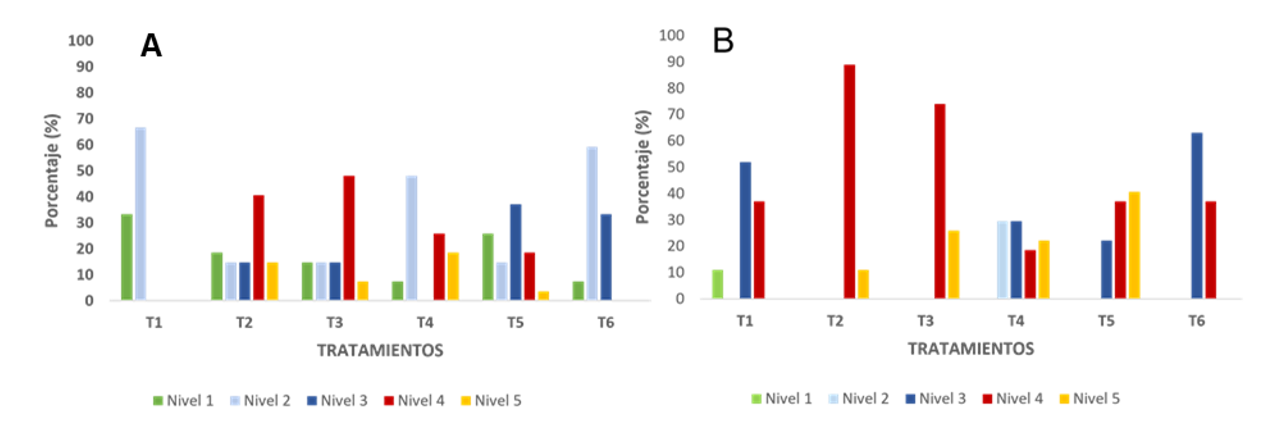
In this study, the strong cytokinin activity of TDZ in T2 probably contributed to the maximum development obtained, indicating that the 2,4-D + TDZ/BA synergy was decisive under the conditions evaluated.
The results show that the morphogenic response in strawberries depends on the interaction among auxins, cytokinins, and genotype (Figure 4). The combinations 2,4-D + TDZ (T2) and 2,4-D + BA (T3) were the most efficient at achieving high survival, induction, development, and biomass of friable calluses, establishing themselves as robust strategies for in vitro regeneration.
CS and AGP showed no effects under these conditions, indicating that hormonal control is the predominant factor. Mechanistically, auxin drives dedifferentiation, while cytokinin maintains organogenic competence through the accessibility of shoot identity genes, in coordination with epigenetic adjustments such as H3K27me3 and DNA methylation (Ishihara et al., 2019).
The differences between cultivars suggest that CP-Jacona responds better to a high cytokinin tone, whereas Festival benefits from higher auxin + BA, consistent with the hormonal plasticity previously described in strawberry (Haddadi et al., 2013; Palei et al., 2017; Liu et al., 2022).
T2 (2,4-D + TDZ) and T3 (2,4-D + BA) were the most effective treatments, yielding high survival, strong induction and greater biomass, indicating a genotype-dependent response: Festival responded best to T3 and CP-Jacona to T2. Auxin drives dedifferentiation and cytokinin maintains organogenic competence, with epigenetic reprogramming supporting the restoration of cellular pluripotency. GA and CS had no effect under these conditions.
Bollati, S. A.; Pérez-da Graça, J.; Silvente, S. T. and Conci, V. C. 2025. Optimization of culture media and environmental conditions for somatic embryogenesis in olive (Olea europaea L.) cultivars ‘Arbequina’ and ‘Picual’. Journal of the Saudi Society of Agricultural Sciences. 24(4):1-14. https://doi.org/10.1007/s44447-025-00037-4.
Infante, R.; Mazzara, M. and Rosati, P. 1998. Growth estimation of in vitro cultured callus and plant regeneration from leaf disk and petiole callus of musk strawberry (Fragaria moschata Duch.) Journal of the Japanese Society for Horticultural Science. 67(1):39-43. https://doi.org/10.2503/jjshs.67.39.
Kareem, A.; Durgaprasad, K.; Sugimoto, K.; Du, Y.; Pulianmackal, A. J.; Trivedi, Z. B.; Abhayadev, P. V.; Pinon, V.; Meyerowitz, E. M.; Scheres, B. and Prasad, K. 2015. Plethora genes control regeneration by a two-step mechanism. Current Biology. 25(8):1017-1030. https://doi.org/10.1016/j.cub.2015.02.022.
Karim, M. R.; Aziz, M. A.; Roy, U. K.; Hoque, M. A. and Hossain, M. M. 2011. In vitro response of strawberry (Fragaria × ananassa Duch.) for callus induction and shoot regeneration. International Journal of Agronomy and Agricultural Research. 1(1):29-36. https://api.semanticscholar.org/CorpusID:86188503.