elocation-id: elocation-id: e4153
Soil is an essential and strategic resource for the sustainability of agricultural production on the planet; however, it faces progressive degradation derived from unsustainable management practices and the effects of climate change. Within this context, climate-smart agriculture emerges as an approach to try to increase productivity by strengthening the resilience of agricultural systems. The research aimed to evaluate the physical and chemical properties of the soil at two sites: 1) where an agropastoral system has been implemented as a CSA practice; and 2) where unsustainable agricultural techniques have been maintained. Soil sampling followed NOM-021-SEMARNAT-2000, dividing the soil into six 25 m2 plots, from which characteristics such as soil texture, structure, pH, real and bulk density, porosity, organic matter, total carbonates, and hydraulic conductivity were determined. It was concluded that implementing climate-smart agriculture practices through agropastoral systems improves soil physical properties early, with increases of 1% in organic matter and 1.64% in new pore space; by contrast, changes in chemical properties require longer time scales. These results highlight the potential of climate-smart agriculture as a viable strategy for the restoration and sustainable management of agricultural soils in arid and semiarid regions of Mexico.
agricultural systems, climate resilience, soil quality, sustainable soil management.
Soil is an extremely valuable natural resource for food production; nevertheless, it constantly faces many pressures, ranging from anthropogenic activities to the effects of climate change. Activities such as the unsustainable use of agricultural land, intensive cropping, overgrazing, and the indiscriminate use of agrochemicals have led to widespread soil degradation (Negera et al., 2022; Kumar et al., 2025).
This leads to problems such as erosion, nutrient loss, salinization, compaction, loss of organic matter, and soil pollution (Lal, 2012). As a result, the soil’s physical and chemical properties change over time, reducing its fertility and water retention capacity, weakening its structure, and increasing the vulnerability of agricultural systems to climatic stresses such as droughts and floods (Oliveira et al., 2023; Monjardin-Armenta, 2026).
Climate-smart agriculture (CSA) is an integrated approach proposed by the Food and Agriculture Organization of the United Nations (FAO, 2010); it proposes the management of agricultural land, livestock, forests and fisheries to address the interrelated challenges of food security and climate change (Scherr et al., 2012; Dubey et al., 2025; Kabato et al., 2025).
Today, global agricultural production systems emit about one-third of all methane emissions, cause large biodiversity losses, and use about 70% of the planet’s freshwater. In addition, by 2050, food demand is expected to increase, necessitating the production of enough food for a population of 9.7 billion people (World Bank, 2025).
This situation of degradation caused by agricultural systems has been observed to be on the rise, especially in developing countries such as Mexico, a worrying situation that must be addressed. The three main objectives of CSA are: 1) to sustainably increase farmers’ productivity and incomes; 2) to strengthen adaptation and resilience to climate variability; and 3) to reduce or eliminate greenhouse gas emissions whenever possible.
In this framework, agropastoral systems represent an effective strategy for achieving these objectives. They combine crop cultivation with livestock management, integrating both activities to improve soil health and make resources more efficient and resilient. By integrating crops and animals into a single production system, ejidatarios (shareholders of common land) can ensure the incorporation of nutrients into the soil, diversify production, and reduce environmental pressures.
For example, crop residues can serve as livestock fodder, and animal manure can enrich the soil with organic matter, thereby improving fertility, structure, and water retention capacity. Agropastoral systems, as a comprehensive alternative within CSA, contribute to food security and income generation, thereby strengthening the adaptive capacity of rural communities in the face of climate change and promoting the conservation of natural resources (Ortiz et al., 2023; Brunetti et al., 2025; Tyagi and Haritash, 2025).
This research aimed to evaluate the physical and chemical properties of the soil in two scenarios: 1) where an agropastoral system has been implemented; and 2) where unsustainable agricultural techniques have been maintained. It is hypothesized that the agropastoral system improves soil properties after three years of use as a climate-smart agriculture tool.
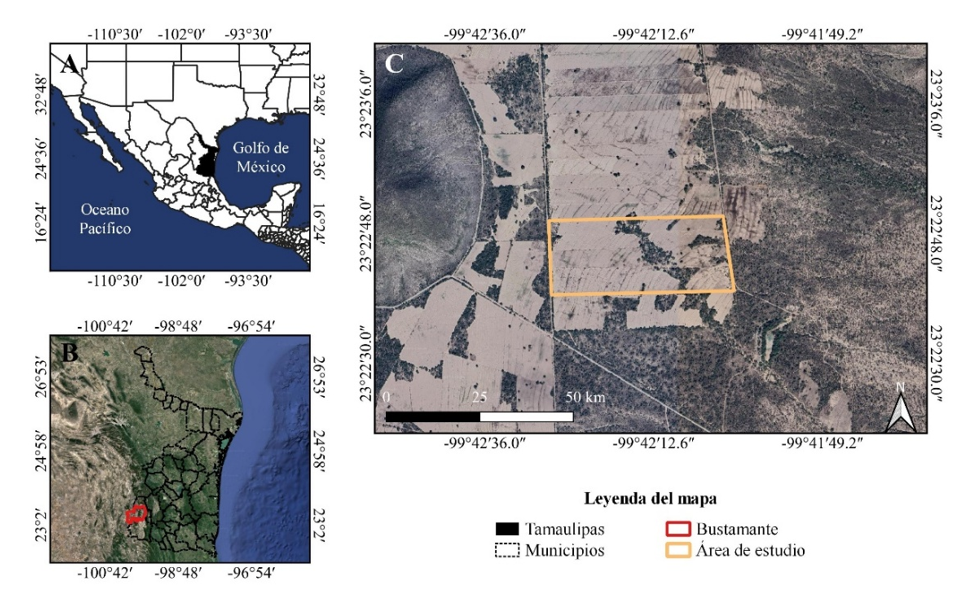
The study area is located in the state of Tamaulipas, Mexico. The soil of Tamaulipas is suitable for a great diversity of agricultural activities; approximately 21% of the state’s territory is used for agriculture and 58% for livestock. Specifically, the study site is located in the municipality of Bustamante at coordinates 23° 22’ 45.876” north latitude, 99° 42’ 19.735” west longitude, and 23° 23’ 16.112” north latitude, 99° 42’ 18.813’ west longitude (Figure 1). The municipality has a harvested area of 650 ha, with production of 375 t valued at 1.08 million pesos, mostly corn and prickly pear crops.
The characteristic soil in the area is Leptosol, predominantly black and gray, rich in organic matter and free of salinity problems; it is susceptible to erosion, with values ranging from high to very high. The climate is subhumid and humid, with summer rainfall, according to the Köppen classification (Cantú-Medina, 2018). The average annual temperature is 18 °C, with a minimum of 0 °C and a maximum of 36 °C and the average annual rainfall is 470 mm.
The sampling sites were located on agricultural land with more than 20 years of history of intensive corn cultivation. After a generational change in 2022, climate-smart agriculture (CSA) activities began to be introduced. Initially, an agropastoral system (a combination of crops and livestock) was introduced as an activity to increase household income; this was followed by other practices, such as using agricultural residues to feed livestock, using manure to enrich the soil, and harvesting rainwater for watering troughs and irrigation.
Nonetheless, CSA practices did not cover the entire area, and remnants of intensive corn cultivation persisted in the area. To determine the effect of the CSA practices, the study area was divided into six 25 m2 plots. Three plots represented the CSA practice area, and three plots represented the area where unsustainable agriculture was maintained.
Soil sampling was conducted three years after the start of CSA practices. Soil properties were evaluated using the methodology established in the Official Mexican Standard (NOM-021-SEMARNAT-2000), which establishes the technical specifications for soil sampling and analysis.
Diagonals were used to form a six-point cross, from which composite soil samples were collected. The composite samples were placed in plastic bags, labeled, homogenized and transferred to the central laboratory of the Faculty of Engineering and Sciences of the Autonomous University of Tamaulipas (UAT), by its Spanish acronym for analysis.
The following soil properties were determined for each sampling: soil texture, soil structure, bulk and real density, porosity, organic matter content, total carbonates and hydraulic conductivity. Soil texture was determined using the AS-09 method with a Bouyoucos hydrometer.
This method is based on Stokes’ law, which states that particles suspended in water settle at different rates depending on their size, shape, and density; thus, the relative proportions of sand, silt and clay can be determined, and the textural class can then be established using the texture triangle.
The soil structure was measured using the wet sieving method, in which samples of soil aggregates are immersed in water and the fraction of the soil that resists disintegration indicates the resistance of the soil structure to erosion. The pH of the soil was determined using the AS-23 method with a Thermo Scientific Orion Star A211 potentiometer.
As for the real density, it was determined using the AS-04 method, known as the pycnometer method; the bulk density, for its part, was measured following the displacement method. The results from these two properties were used to determine the sample’s porosity. The sample’s organic matter was calculated using the AS-07 method by Walkley and Black.
The total carbonates in the sample were calculated using the volumetric method. The hydraulic conductivity of the soil was determined using unaltered samples collected with Daiki cylinders, following the methodology of Sánchez-Castillo (2015).
A descriptive statistical analysis was performed for each variable evaluated in the laboratory; likewise, the presence of statistically significant differences between sites was analyzed using two-sample t-tests. All data analysis was performed in PAST 5 (Hammer et al., 2025).
Previous studies on soil behavior in areas of agricultural production systems show that as activities intensify, soil quality declines. The results of the soil parameters evaluated in this study are shown in Table 1.
The texture of the soil directly influences the physical, chemical, and biological behavior of intensive agricultural systems; in this type of environment, soil is continuously altered by the application of inorganic fertilizers, mechanization and frequent irrigation, which modify its overall physicochemical properties.
According to the analysis using the triangle texture, the soil texture at all sampling points in the study area was silty clay loam, consistent with reports from other studies in the area (Andrade-Limas et al., 2012; Hoz-Zavala et al., 2015).
The performance of this textural class of soils is considered optimal for agricultural use; its intermediate-high proportion of silt, accompanied by clay and a lower proportion of sand, confers beneficial physical and chemical characteristics important for the annual cultivation of corn, wheator sorghum; however, these soils are highly susceptible to waterlogging or water stress, compaction and structural degradation.
This makes it an exceptional candidate for CSA practices, which seek to mitigate these adverse effects. The soil structure in the study area was found to be medium before CSA and very high after CSA, which may be the result of reduced soil tillage and evidence of the establishment of a gradual change in structural stability over three years of activities, which would lead to greater biological activity, aggregate stability and resilience of the soil system (Six et al., 2000).
In CSA, soil pH can serve as an integrative indicator that would optimize crop productivity and improve nutrient efficiency and availability, thereby reducing fertilizer use. The pH found in the study area is alkaline, with maximum values of 8.4 before CSA and 8.7 after CSA.
Although a minimal increase in pH was observed, no statistically significant differences were found between samplings after three years of CSA; this is confirmed by studies in other parts of the world (Tadesse et al., 2021; Bufebo et al., 2025).
The real density, bulk density and porosity of the soil are key variables for evaluating the effect of CSA on the soil, as they describe the organization of solid space and its empty spaces (pores), which contain water and air. Therefore, their quantification could serve as an indicator of productivity, adaptation and mitigation, which are necessary pillars of CSA. Bulk density is known as the mass of dry soil per unit of total volume, including pores; in contrast, real density is the mass of solid particles per unit of solid volume, excluding pores.
The mean real density found in the initial soil was 2.88 g cm-3, whereas the value found after CSA was 2.81 g cm-3, with no significant change. In contrast, the mean bulk density decreased from 1.57 g cm-3 to 1.47 g cm-3. For its part, the total porosity changed from 45.48% to 47.12% after CSA (Figure 2).
This indicates a positive change in climate-smart agricultural practices, with a 1.64% increase in new pore space. These changes suggest the incorporation of young and low-density organic matter. Although this change is still developing toward optimal values for a silty clay loam soil, it is an encouraging sign of the consolidation of the soil’s resilience and adaptation to the impacts of climate change (Brady and Weil, 2017; Hillel, 2003).
As for the organic matter and carbonates contained in the soil, they also showed no significant differences between samplings. The maximum values of organic matter were 3.6% before CSA and 4.6% after CSA, and the carbonate values were 31.03% before CSA and 31.85% after CSA. This is consistent with the behavior of the silty clay loam textural class, since both organic matter and carbonates contained in the soil are typically a fraction that is not very sensitive to management changes on short time scales (Rumpel and Koegel-Knabner, 2011).
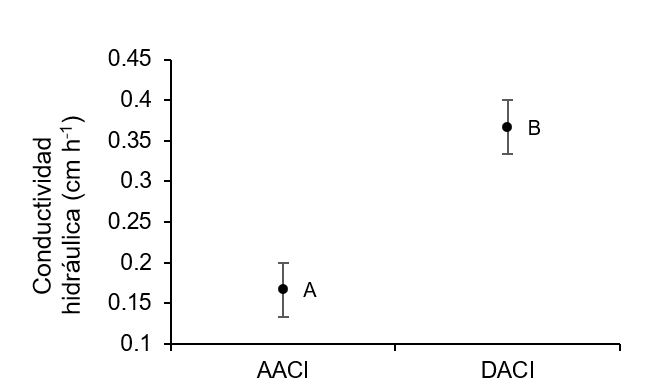
Hydraulic conductivity showed significant differences between samplings, with maximum values of 0.4 cm s-1 before CSA and 0.2 cm s-1 after CSA. Hydraulic conductivity is a key indicator to measure changes in soil structure and porosity (Figure 3).
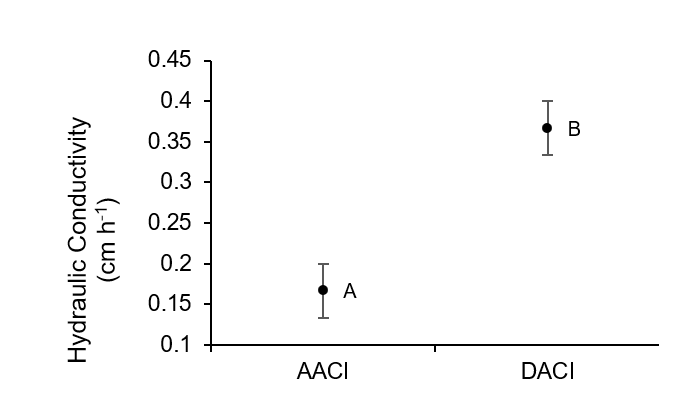
In the soil of our study area, the results obtained reflect an internal reorganization of the pore space, which could affect other values, such as soil compaction or aggregation, thereby favoring the efficiency of water use and resistance to adverse climatic conditions or arid environments (Azooz and Arshad, 1996; Eze et al., 2020).
The research indicates that, after three years, implementing climate-smart agriculture practices in a silty clay loam soil improved the soil’s physical properties, evidencing a positive internal change in pore space and stability in the soil-water-air system.
Nevertheless, the evaluated chemical properties pH, carbonates and organic matter did not show statistically significant differences, indicating the soil’s buffering capacity and its slow response to changes on short time scales.
Therefore, the application of climate-smart agriculture techniques manifests in the short term in the soil’s physical properties; in contrast, improvements in chemical properties could take much longer to become apparent. These results highlight the potential of climate-smart agriculture as a key strategy to form a much more resilient soil in arid and semiarid regions of Mexico.
Brunetti, H. B.; Oliveira, P. P.; Pezzopane, J. R.; Bernardi, A. C. D. C.; Garcia, A. R.; Berndt, A. Pedroso, A. F.; Lelis, A. L. J. y Medeiros, S. R. 2025. Silvopastoral system as a climate-smart alternative for beef production: Enteric methane emission neutralization and animal thermal comfort increase. Agricultural Systems. 225:104277.
Hoz-Zavala, M. E. E.; Calderón-Salas, C.; Nava-Diguero, P.; Pérez-Álvarez, R.; Vázquez-Montoya, M. A. y Rodríguez-Briseño, P. 2015. Tipos de suelos caracterizados por pH y textura en la zona sur de Tamaulipas. In: Memorias del 26° Encuentro Nacional de Investigación Científica y Tecnológica del Golfo de México. Tampico, Tamaulipas, México. 41 p.
Oliveira, D. M. D. S.; Tavares, R. L. M.; Loss, A.; Madari, B. E.; Cerri, C. E. P.; Alves, B. J. R. and Cherubin, M. R. 2023. Climate-smart agriculture and soil C sequestration in Brazilian Cerrado: A systematic review. Revista Brasileira de Ciência do Solo. 47(spe):e0220055. https://doi.org/10.36783/18069657rbcs20220055.
Pérez-Aguilar, L. Y.; Lopez-Osorio, R. F.; Zambrano-Medina, Y. G.; Avila-Aceves, E.; Monjardín-Armenta, S.A.; Plata-Rocha, W.; Quintero-Morales, M. A.; Mora-Ramirez, M. A. and Bernal-Guadiana, R. 2026. Soil degradation: causes, impacts, and mitigation strategies in the context. Climate change, land degradation, and sustainability: insight towards innovative solutions, 1.
Tadesse, M.; Simane, B.; Abera, W.; Tamene, L.; Ambaw, G.; Recha, J. W.; Mekonnen, K.; Demeke, G.; Nigussie, A. and Solomon, D. 2021. The effect of climate-smart agriculture on soil fertility, crop yield and soil carbon in Southern Ethiopia. Sustainability. 13(8):4515. https://doi.org/10.3390/su13084515.