elocation-id: elocation-id: e4129
This work aimed to evaluate different combinations of oils and mineral salts for controlling Podosphaera xanthii in squash ( Cucurbita pepo ) under field conditions. A squash crop of the Rocío variety was established. The treatments consisted of the combined application of salts (Potassium Bicarbonate-Boron) and oils (Orange, Orange-Soybean and Orange-Olive) at doses of 2 g L-1for salts and 10 ml L-1for oils, with five replications, evaluated under a randomized complete block design. The variables evaluated were severity, phytotoxicity, number of fruits and yield. The results showed that treatments based on orange-orange and soybean-orange oils presented the lowest severity percentages, with 8.57% and 9.14%, respectively. The phytotoxicity variable showed no differences between treatments, as none caused toxicity in plants. Regarding the number of fruits and total yield, the orange-orange treatment had the highest averages, followed by the fungicide treatment. It is concluded that oil-based treatments may represent a viable alternative for managing P. xanthii , with the orange-orange combination at 10 ml L-1standing out as an effective option in the Tehuacán Valley, Puebla, Mexico.
phytotoxicity, powdery mildew, severity, yield.
Squash ( Cucurbita pepo ) is one of the vegetables within the cucurbit family that stands out for its high nutritional value, as it provides protein when consuming both the fruit and other parts of the plant ( Castellanos et al ., 2018 ). Globally, China is the largest producer of squash, while Mexico ranks seventh, with an average production of 551 000 t in 2022 and 553 059 t in 2023 ( SIAP, 2023 ).
Squash is susceptible to various phytosanitary problems, among which powdery mildew, caused by Podosphaera xanthii , stands out for the losses it can cause in cucurbits. Previous research reports that crop losses can exceed 50% ( Keinath et al ., 2023 ; León-De la Rocha et al ., 2023 ).
Worldwide, various strategies have been used to manage P. xanthii and other foliar diseases, the most common of which is pesticide use. However, their use has negative environmental effects, increases production costs, and promotes pathogen resistance ( Domínguez et al ., 2016 ).
To reduce the impacts indicated, it is important to integrate practices that are less aggressive to the environment, such as the application of mineral salts; results obtained by Yáñez et al . (2014) demonstrated the effectiveness of potassium silicate, potassium bicarbonate, potassium phosphite, and calcium nitrate against foliar diseases; for their part, Domínguez et al . (2016) reported that the application of silicon and potassium phosphite significantly reduced the incidence and severity of P. pannosa in rose bushes.
In recent years, the use of essential and plant oils has emerged as a viable alternative in modern agriculture for managing phytopathological diseases ( Santiago-Santiago et al ., 2024 ). Authors such as Pérez et al . (2010) identified that olive ( Olea europaea L.), jojoba ( Simmondsia chinensis Schneider), soybean ( Glycine max L.), sunflower ( Helianthus annuus L.), and neem ( Azadirachta indica L.) oils are highly effective against powdery mildew ( Mannes and Zubov, 2019 ).
The study identified natural strategies for managing powdery mildew in squash under field conditions in Tehuacán, Puebla. This approach will not only help reduce the use of chemical pesticides but also strengthen organic agricultural production, thereby mitigating negative impacts on the environment.
By applying alternatives such as mineral salts and essential oils, it is intended to offer effective, ecological solutions that enable producers to improve the yield of their crops without compromising environmental safety.
The work was conducted in the experimental field of the Technological University of Tehuacán (UTT, by its Spanish initialism), located in the locality of San Pablo Tepetzingo, in the municipality of Tehuacán, Puebla, Mexico, which is geographically located at 18° 25’ 32” north latitude and 97° 20’ 24” west longitude, at an altitude of 1 409 m. Tehuacán has a dry climate with an average annual temperature between 18 °C and 27 °C.
Annual rainfall is greater than 400 mm, but less than 600 mm, with intra-summer drought (dog days). The temperature oscillation between the warmest and coldest months is greater than 7 °C but less than 14 °C; the warmest month occurs before the summer solstice, this being April ( García, 2005 ).
The plant material was squash seed of the Rocío variety, and seedling production was carried out under greenhouse conditions. The seeds were sown in sterile substrate (SUST-100) in 200-cavity trays, with a single seed per cavity, without prior treatments; once the seedlings germinated, they were irrigated manually every 48 h until they were transplanted into the field.
Transplantation in the open field was performed 15 days after sowing, in rows spaced 1 m apart, with plastic mulch, 1 m corridors, and a plant spacing of 0.3 m in a staggered arrangement, covering a total area of 1 500 m2.
The cultivation cycle was 120 days. Weed control in the corridors was carried out manually, and for the phytosanitary management of vector insects, a commercial insecticide containing the active ingredient imidacloprid was applied at a rate of 60 ml 100 L-1of water.
Fertilization was performed by fertigation from the time of transplantation on a weekly basis using a Steiner (1998) solution. Irrigation was provided at two-day intervals, with a duration of 15 min during the flowering period, increasing to 30 min during fruiting.
A completely randomized block design was used, with plots of 300 m2per block, six treatments and five replications as indicated in Table 1 . Each experimental plot had a 45 m2area, with a useful area of 28 m2. To record data on the evaluated variables, five plants were selected per experimental unit.
Using the records of severity and phytotoxicity, the dynamics of the disease under the different treatments were graphed from the first symptoms to the last evaluation. The statistical analysis was performed using the last two evaluations independently, with the aim of defining the best treatments in terms of effectiveness at 7 and 15 days after the last application (daa).
The first application was made after the onset of powdery mildew symptoms, at 14 days after transplanting, during the plant development stage, with 5 L applied per treatment, as indicated in Table 1 . For the second and third stages, which were 21 and 28 days after transplantation, 7 L were applied per treatment, whereas the fourth application was 35 days after transplantation and 10 L were used per treatment.
To determine severity, sampling was carried out on 21, 28 and 35 days after the first application of the treatments in different leaves of plants selected by treatment. Phytotoxicity was assessed using the subjective scoring scale proposed by EPPO (1987) .
Disease severity: this characteristic was assessed using a seven-degree scale, based on the percentage of leaf area affected ( Domínguez et al ., 2016 ). 0= no symptoms; 1= 1-2.5%; 2= 2.6-5%; 3= 6-10%; 4= 11-25%; 5= 26-50%; 6=51-75%, and 7= 76-100% severity. Equation 1 ( McKiney, 1923 ) was applied to calculate the percentage of severity
Where: a= degree of the scale; b= number of leaves per plant in each degree of the scale; N= total number of leaves evaluated per plant; and K= higher degree of the scale.
The phytotoxicity of oils and salts in the squash crop was assessed according to the subjective scoring scale proposed by EPPO (1987) . This scale classifies the damage observed in the plant according to the following criteria: 1= no damage; 2= very mild symptoms; 3= mild symptoms; 4= symptoms that do not affect yield; 5= moderate damage; 6= high damage; 7= very high damage; 8= severe damage; and 9= complete death. This evaluation system considers the percentage of chlorosis, necrosis, decreased growth, and malformations in the plant as indicators of impact.
To evaluate yield, the average and total number of fruits per cut were quantified. The first cut was made 55 days after transplantation, with subsequent cuts every three days.
The harvested fruits were separated by treatment and replication, and then the weight was recorded using a digital scale (LCD-ASG Multiservices LLC). This value was recorded for each treatment based on the cut number. At the end of the fifth cut, the total yield of the harvested fruits was calculated per treatment and expressed in t ha-1.
The data were transformed using the following expression ( Lerch, 1977 ) to stabilize the variance and approximate them to a normal distribution.
For all variables evaluated, a double-classification analysis was performed, and the means were compared using Tukey’s test at 5% probability, using InfoStat version 2016 ( Di Rienzo et al ., 2016 ).
The first symptoms of the disease appeared 14 days after transplantation, with severity percentages of less than 10%. The severity values from the onset of the first symptoms to the last evaluation, conducted 51 days after transplantation, showed that all oil- and salt-based treatments had a significantly lower severity than the control, although slightly higher than the fungicide azoxystrobin, as shown in Figure 1 .
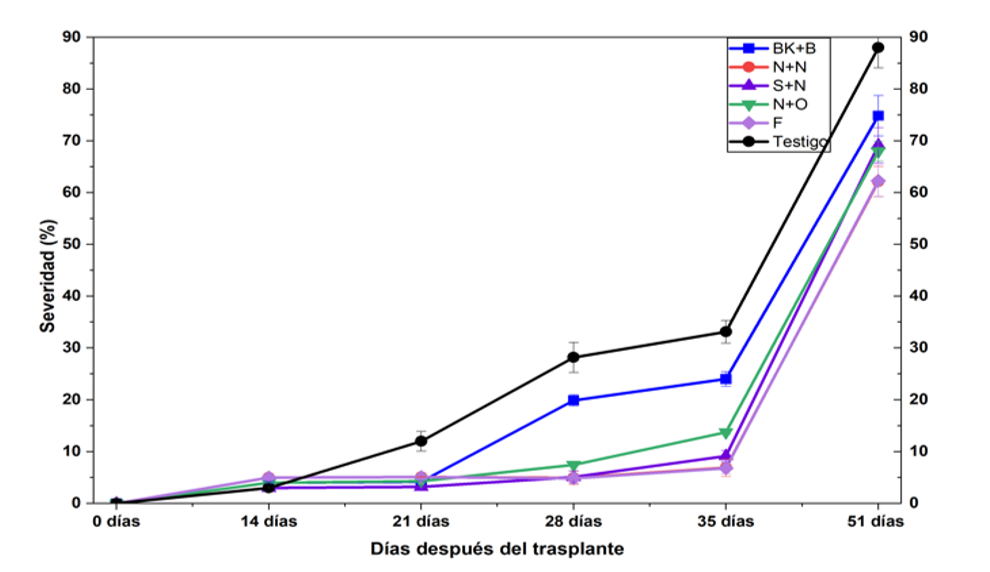
The characteristics of the salts and oils allowed for low severity percentages during the evaluation time, which favored the development of the crop. It was observed that the N+N, S+N and N+O treatments exhibited control levels that did not differ statistically from the fungicide. Nonetheless, the BK+B treatment showed a line of evolution closer to the control treatment.
The effectiveness of the treatments seven days after the last application is shown in Figure 2 ; the salt and oil treatments reached the lowest severity values, with no significant differences compared to the fungicide for the N+N and S+N treatments, with percentages of affected leaf area that did not exceed 10%.
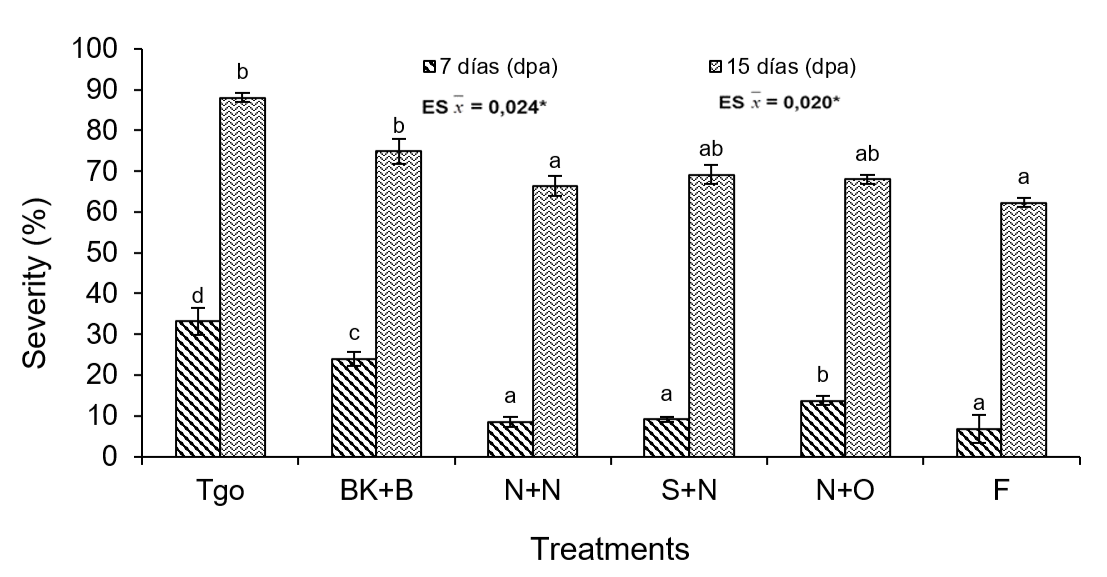
On the other hand, the N+O and BK+B treatments showed higher values (14 and 24%, respectively); however, they were significantly lower than the control (33.14%), which registered the highest severity.
Despite the increase in the severity of the disease across all treatments, the oils, in general, and the fungicide azoxystrobin maintained the lowest severity values, with no statistically significant differences between them. The S+N and N+O combinations did not show statistical differences compared to the control; by contrast, the orange + orange combination, with 66.28% of severity, stood out for its sustained effectiveness over the course of the experimentation time.
These results do not rule out the efficacy of soybean and olive oils as alternatives for disease management, as they showed greater effectiveness compared to chemical treatment.
Phytotoxicity, assessed after each application and up to 15 days after the last application, was not recorded with adverse effects. All treatments were within degree 1 (without damage) of the scale proposed by EPPO (1987) .
This result favors the use of essential oils because one of the limiting factors in their application is possible leaf necrosis, possibly induced by solar radiation. Therefore, it is essential to apply these products at times with cool temperatures, preferably in the afternoon, to minimize any risk of damage to the leaves.
During the first two cuts, no significant differences were observed among the treatments or compared to the control, except in the case of BK+B, which presented greater significant differences in the first and second cuts compared to the control ( Figure 3 ).
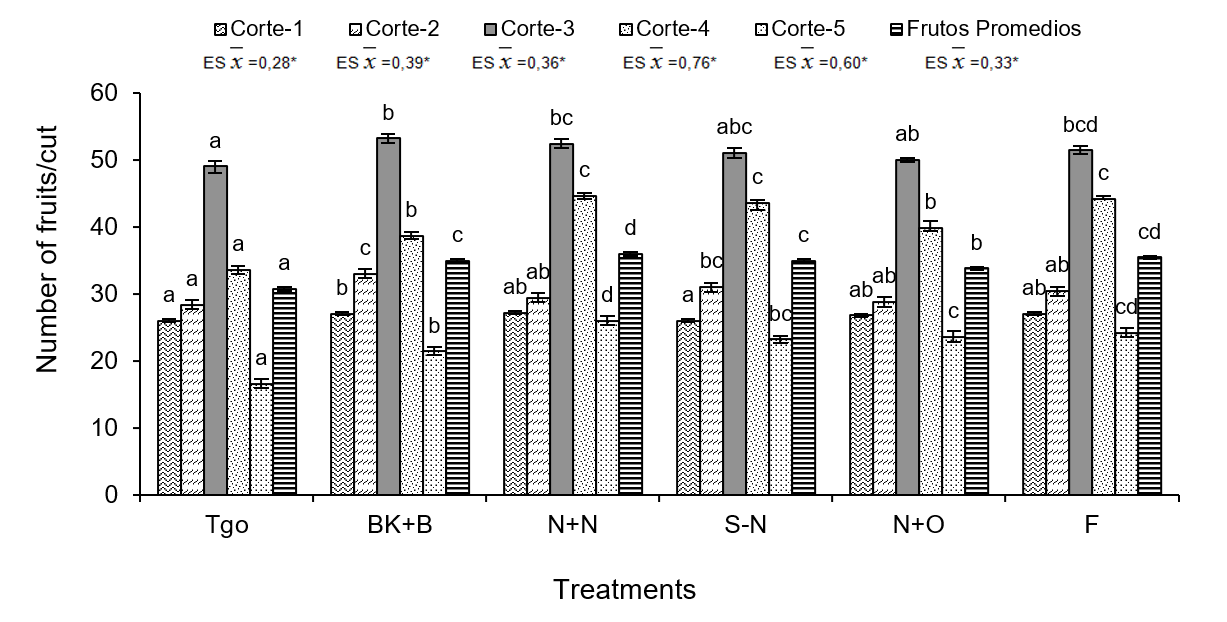
From the third cut, which coincides with the production peak, highly significant differences were observed in the number of fruits per cut, particularly in the treatments with N+N and BK+B, which did not differ from the fungicide azoxystrobin.
In the last two cuts, all treatments outperformed the control by more than 10 fruits, indicating a positive impact on crop productivity. The average values of fruits obtained in all treatments were higher than in the control. In accordance with the results of the number of cuts, the N+N and BK treatments showed the best results, with no statistically significant differences compared with azoxystrobin, exceeding 35 fruits per cut.
The total yield of the squash crop was favored by all oil and salt treatments, as presented in Figure 4 , increasing from 1.359 to 2.791 t ha-1, higher values that differ statistically from the control in all cases.
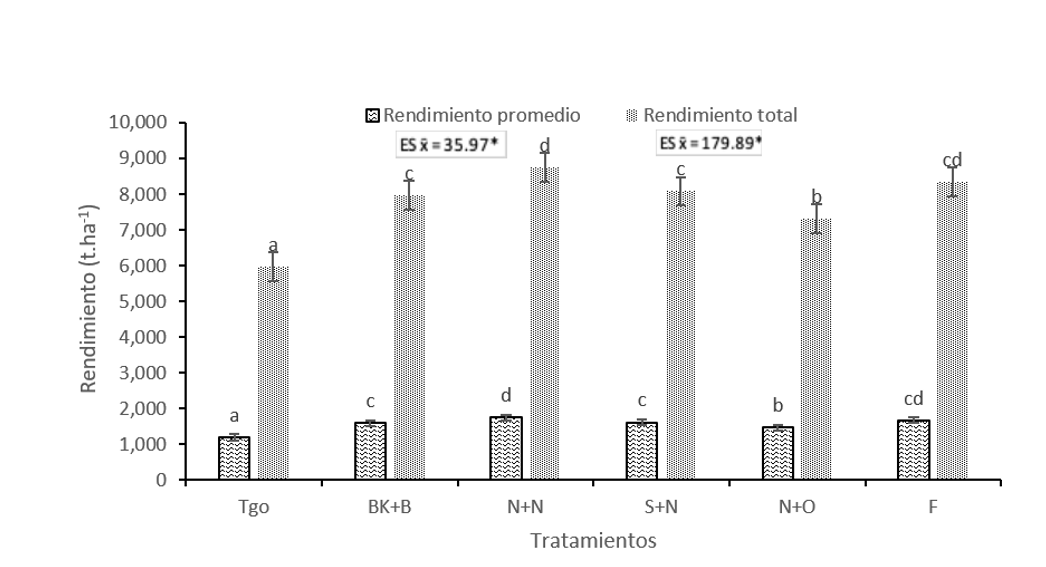
The highest yield was obtained with orange oil in the first and second applications, with a value of 8.749 t ha-1, a result similar to that obtained with the fungicide azoxystrobin, which had a yield of 8.344 t ha-1, with yields being statistically equal between the two treatments.
The S+N, N+O, and BK+B treatments also recorded yields more than 1 t ha-1higher than the control, representing a significant increase in squash production. The results obtained for the yield indicators, such as the number of fruits per cut and total, as well as the estimation of the yield per hectare, show the effectiveness of salt and oil treatments in the control of the disease.
With the most effective treatments, it is possible to reduce the affected leaf area by 20%, which contributes to the crop’s final yield. It should be noted that both salts and oils showed control levels similar to those of the fungicide azoxystrobin, which is relevant considering that the Environmental Protection Agency (EPA) reported that azoxystrobin is very toxic to freshwater fish, lethal to bees, and causes histopathological damage to the digestive tract ( Serra et al ., 2023 ).
It is important to note that cucurbits depend on bees for the pollination of their flowers ( Lescay and Orasma, 2015 ), so the use of alternatives that are less aggressive to pollinators represents a significant advantage for the sustainability of agricultural production.
The results obtained using essential oils represent a significant advance in crop management; since, in addition to their proven effectiveness (superior to the control and equal to the fungicide in most cases), they constitute an ecologically favorable alternative for the environment and agricultural production.
The data presented highlight oil treatments as a promising option for controlling powdery mildew, in accordance with the findings of Novak and Pavela (2026), who pointed out that orange oil applied in field treatments turned out to be an effective alternative, as it inhibited the growth of Alternaria tenuissima (Kunse & Wiltshire) at a maximum dose of 8 ml L-1, which coincides with the dose used in the present study, which was 10 ml L-1.
The results of this work coincide with those of Guédez et al . (2014) , who reported that the use of orange oil allowed the inhibition of the mycelial growth of postharvest fungi due to its protective action when papaya ( Carica papaya L.) fruits were coated with this compound.
The effectiveness of orange oil against fungi is largely due to the presence of limonene, a cyclic monoterpene that constitutes the main component of the essential oil extracted from citrus peels and has fungicidal properties ( Cai et al ., 2019 ). In this regard, Liu et al . (2023) confirms that monoterpenes, such as thymol, carvacrol and geraniol, act as key enzyme inhibitors, including pectinmethylesterase (PME), and simultaneously disrupt the fungal membrane.
The results obtained show that the use of essential oils and mineral salts represents an effective and sustainable alternative for managing powdery mildew in squash.
Combinations of citrus oils, especially orange + orange and soybean + orange, showed control levels similar to those of the chemical fungicide azoxystrobin, confirming their potential for phytosanitary protection and yield without compromising environmental health.
Castellanos, G.; Paredes, L.; Gámez, N.; Hernández, R. H. S.; Sánchez, V. G.; Barrera, R. J.; Aguirre, P. E.; Vázquez, L. A.; Montes, H. S.; Lira, S. R. and Eguiarte, L. E. 2018. Historical biogeography and phylogeny of Cucurbita: Insights from ancestral area reconstruction and niche evolution. Molecular Phylogenetics and Evolution. 128:38-54. https://doi.org/10.1016/j.ympev.2018.07.016.
Guédez, C.; Cañizalez, L.; Avendaño, L.; Scorza, J.; Castillo, C.; Olivar, R.; Méndez, Y. and Sánchez, L. 2014. Actividad antifúngica del aceite esencial de naranja (Citrus sinensis L.) sobre hongos postcosecha en frutos de lechosa (Carica papaya L.). Revista de la Sociedad Venezolana de Microbiología. 34(2):81-85. http://ve.scielo.org/scielo.php?script=sci-arttext&pid=S1315-.25562014000200007&lng=es&nrm=iso.
Pérez, A. R.; García, E. R. S.; Carrillo, F. J. A.; Angulo, E. M. A.; Valdez, T. J. B.; Muy, R. M. D.; García, L. A. M. y Villareal, R. M. 2010. Control de cenicilla (Sphaerotheca fuliginea Schlechtend.:fr, Pollaci) con aceites vegetales y sales minerales en pepino de invernadero en Sinaloa, México. Revista Mexicana de Fitopatología. 28(1):17-24.
Santiago-Santiago, M.; Sánchez-Viveros, G.; Pariona, N.; Hernández-Montiel, L. G. y Chiquito-Contreras, R. G. 2024. ¿La nueva terapia para las plantas? Los aceites esenciales para control de enfermedades en agricultura. ITEA-Información Técnica Económica Agraria. 120(2):116-132. https://doi.org/10.12706/itea.2024.005.
Serra, R. S.; Martínez, L. C.; Cossolin, J. F. S.; Santos de Resende, M. T.; Carneiro, L. S.; Fiaz, M. and Serrão, J. E. 2023. The fungicide azoxystrobin causes histopathological and cytotoxic changes in the midgut of the honeybee Apis mellifera (Hymenoptera: Apidae). Ecotoxicology. 32(2):234-242. https://doi.org/10.1007/s10646-023-02633-y.
Yáñez, J. M. G.; Ayala, T. F.; Partida, R. L.; Velázquez, A. T.; Godoy, A. T. P. y Díaz, V. T. 2014. Efecto de bicarbonatos en el control de cenicilla (Oidium sp.) en pepino (Cucumis sativus L.). Revista Mexicana de Ciencias Agrícolas. 5(6):991-1000. http://www.scielo.org.mx/scielo.php?script=sci-arttext&pid=S2007-09342014000600007&lng=es&tlng=es.