elocation-id: elocation-id: e4123
Sugarcane is an important grass because it produces sucrose, which is used as a raw material in numerous industrial and agrifood processes. Gamma-ray-induced mutagenesis has proven to be an efficient alternative method for obtaining plant varieties with desirable characteristics in a short time, so knowing the radiosensitivity of genotypes is a crucial step. The objective was to determine the radiosensitivity curve in sugarcane buds and plants of the Mayarí 55-14 variety with gamma radiation to induce variation. A total of 10 radiation treatments, ranging from 0 to 90 Gy, were established, with 100 buds per treatment. The buds were irradiated at the National Institute for Nuclear Research during 2022. Later, the buds were planted at the Higher Technological Institute of Los Reyes. The median lethal dose and the median growth reduction were analyzed by regression, yielding 50.16 and 51.25 Gy, respectively. Starting at 60 Gy, radiation significantly reduced shoot emergence and survival. In variables such as stem thickness, plant height, number of leaves, and number of tillers, there was a reduction between 30 and 70 Gy, according to the analysis of variance and Tukey’s test (p≤ 0.05). It is suggested to irradiate buds of the Mayarí 55-14 variety with doses between 40 and 60 Gy to cause variation and detect possible outstanding mutants with traits of interest.
Saccharum officinarum, induced mutagenesis, genetic variation.
Sugarcane ( Saccharum spp. ) is the raw material of the sugar industry, with an average annual per capita consumption of 36.7 kg of sugar. The Sustainable Rural Development Law identifies sugarcane as a staple crop in Mexico. Currently, Mexico is the world’s sixth-largest producer of sugarcane, with 854 301.43 ha planted and 55 589 515.48 tonnes, according to data reported by SIAP in 2025 (https://nube.agricultura.gob.mx/cierre-agricola/).
Sugarcane varieties and research carried out by the now-defunct Institute for the Improvement of Sugar Production (IMPA), in 1990 by its Spanish acronym and continued by the Center for Research and Development of Sugarcane (CIDCA), AC by its Spanish acronym, created in 2011, are based on conventional genetic breeding through sexual hybridization ( Valdez-Balero, 2023 ). Worldwide, sexual hybridization is the most widely used method for obtaining new sugarcane varieties, a process that can last up to 15 years.
At the Sugarcane Research Institute of Yunnan, a province of the People’s Republic of China, the YZ08-1609 variety was developed through hybridizations. This variety contains 20.3% sucrose, setting an international record and earning the designation of the ‘King of Sugar’ ( Wu et al ., 2024 ). Nevertheless, in Mexico, sugarcane varieties have been developed in experimental fields and registered, such as EMex 01-323, ColMexCC 05-47 and MotzMex 02-511, which can have between 17 and 18% sucrose, according to the catalog of varieties registered by CIDCA (2025).
The two main varieties, CP 72-2086 and MEX 69-290 (containing 11.4 and 16.1% sucrose, respectively), together with MEX 79-431 and ITV 92-1424, cover about 70% of the Mexican sugarcane field ( Reyes-Hernández et al ., 2022 ; Preciado et al ., 2022 ; Valdez-Balero, 2023 ).
The low genotypic variability resulting from the predominance of the aforementioned varieties considerably reduces genetic diversity, making crops susceptible to environmental stress, diseases and pests, and adaptation to infertile or shallow soils; likewise, it does not address food security ( Lamichhane and Thapa, 2022 ). Therefore, it faces the problem of renewing varieties to invigorate them and the need to standardize an alternative methodology to hybridization to generate new varieties more quickly.
The genetic breeding method, through the use of gamma radiation as an alternative to obtain genetic variation via induced mutations, is a technique used in the genetic breeding of plants of agronomic and food importance that allows the obtaining of highly profitable cultivars in various species, since superior genotypes are obtained in a short time ( Rubio-Ochoa et al ., 2024 ).
More than 2 500 plant varieties obtained through gamma radiation have been reported, making this technology an alternative for efficient plant breeding ( Patade and Suprasanna et al ., 2008 ; Barrientos-Alfaro et al ., 2025 ). Various studies on radiosensitivity in sugarcane have been reported.
In this sense, Díaz-Juárez et al . (2022) irradiated buds (agronomic seeds) of the varieties CP 72-2086 and MEX 69-290 with gamma rays (Co60) at six doses (0, 50, 70, 80, 90 and 100 Gray, Gy) and observed that, depending on the variety, each trait evaluated had a different response to radiation doses.
On the other hand, Suhesti et al . (2021) used embryogenic calluses of the Kidang Kencana variety to irradiate them with gamma rays at different doses (between 10 and 50 Gy) and found that, at high doses of radiation applied, the ability of the calluses to regenerate and generate shoots decreased. Notably, at 10 and 20 Gy, they generated a mutant with high genetic variability, so gamma radiation can be used to increase the genetic variability of sugarcane.
In addition, mutations induced by gamma radiation in the range of 20-300 Gy in the Co 99004 variety produced albino sugarcane mutants, which presented mutations in the FAR1-related sequence 5-like gene, which is involved in chlorophyll biosynthesis ( Ariharasutharsan et al ., 2025 ).
The use of cobalt60induced mutations represents an alternative for genetic breeding in polyploid plants, for the discovery of genes with agronomically important traits, or for increasing the understanding of the role of mutations in the genetic breeding of sugarcane. This type of technique must be based on tests that allow the appropriate dosimetry to be determined.
The optimal dose is associated with the median lethal dose (LD50) and the median growth reduction dose (GR50), both of which are used to establish the radiosensitivity curve, which determines the radiation level used in the breeding program ( Riviello-Flores et al ., 2022 ). In this area of interest, the Valley of Los Reyes, Michoacán, sugarcane is being displaced by strawberry production, which has forced sugarcane to be planted in colder areas.
Sugarcane, being a tropical crop, has difficulty adapting to cold climates. The Mayarí 55-14 variety was used as a model because it is grown in this area and was used to establish an alternative method for obtaining new varieties based on mutations generated by the gamma radiation emitted from cobalt60.
Nonetheless, before establishing a genetic breeding program through mutagenesis, it is important to conduct a radiosensitivity study for each variety or genotype, as each material responds differently to radiation. The objective was to determine the radiosensitivity curve of different morphological characteristics of the Mayarí 55-14 sugarcane variety to lay the foundations of a genetic breeding program.
The experiment was conducted in 2022. Sugarcane buds of the Mayarí 55-14 variety, collected from a 14-month-old first ratoon field in the community of Santa Clara, Tocumbo, in the state of Michoacán, Mexico, were used. It is located at an altitude of 1 299 m, at coordinates 19° 37’ 31” north latitude and 102° 29’ 47” west longitude.
Cuts were made in the stems to leave a single bud (including node and bud); mature buds were selected, eliminating the basal and apical buds. The irradiation was carried out at the National Institute for Nuclear Research (ININ), by its Spanish acronym, located in Ocoyoacac, State of Mexico, using the Transelektro LGI-01 irradiator, which has a source of cobalt60(Co60).
The buds were placed in transparent bags, and 100 buds were irradiated per treatment at different doses of radiation (0, 10, 20, 30, 40, 50, 60, 70, 80 and 90 Gy). After irradiation, the buds were planted at the Higher Technological Institute of Los Reyes, located in the municipality of Los Reyes de Salgado, Michoacán. The average temperature was 25 °C, and rainfall was approximately 190-274 mm in June 2022. One-liter transparent plastic containers (Reyma, Mexico) were used.
The substrate used was peat (Promix, Premier Tech Horticulture, Missouri, USA). The containers were placed under shade netting. The plants that survived the radiation doses were transplanted to the field three months after being planted in containers. They were taken to the field in the town of San Sebastián, belonging to the municipality of Los Reyes, Michoacán. The plants were sown in rows for each treatment.
A randomized complete block design (RCBD) with four replications (blocks) was employed. In each block, the 10 treatments (doses from 0 to 90 Gy) were randomly assigned. The experimental unit consisted of 25 buds, 100 buds per treatment, and 1 000 buds in the experiment.
To determine the impact of radiation on sugarcane, the following variables were evaluated after planting: percentage of emergence at three months (%), percentage of survival at four months (%), plant height at five months (cm), stem thickness (mm) and number of leaves at five months and number of tillers at six months.
The data on the variables emergence and survival were gathered in an Excel table, averaged and graphed. For the remaining variables, the assumptions of normality and homogeneity of variance were verified using the Kolmogorov-Smirnov and Levene tests, respectively. The one-way Anova statistical analysis was performed for plant height, number of leaves and number of tillers; finally, the comparison of means was performed using Tukey’s test in Minitab 19.
Determination of LD50and GR50: the variables of survival and plant height were used to calculate the median lethal dose (LD50) and the median growth reduction (GR50), respectively; two regression models were used, which were chosen according to the result of the coefficient of variation R2proposed in the Excel graph.
Linear regression model: if the data fits a linear regression model, the solution to the equation in the graph is obtained by simply isolating the variable X, which represents radiation or dose and establishing a value of 50 for Y, which represents survival.
Quadratic regression model: the data that fitted a second-degree polynomial (quadratic) model were solved using the quadratic formula
In this case, 50 will be subtracted from the independent term.
The loss of apical dominance in sugarcane, caused by some biotic or abiotic stress, causes the axillary lateral buds to germinate without being planted and to produce lateral shoots with adventitious roots. The process of formation of the sugarcane vegetative bud is divided into three stages: bud formation from the axillary meristem, bud growth or swelling and bud germination; that is, the emergence of the new plant shoot ( Madala et al ., 2023 ).
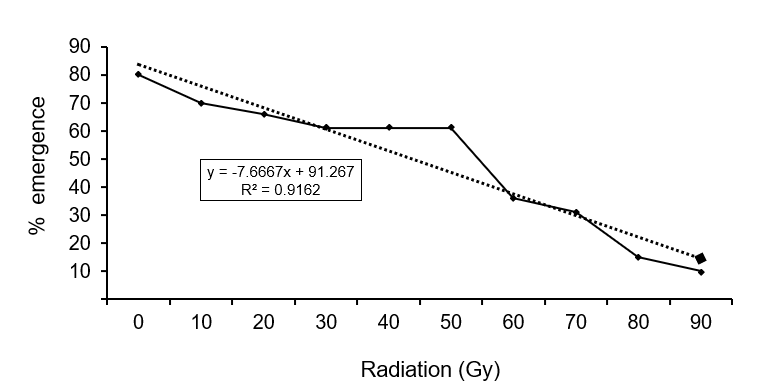
Therefore, the success of bud germination initially reflects the damage or effect that the radiation had on the tissue. The results shown in Figure 1 indicate that treatments between 10 and 90 Gy reduce shoot emergence in a radiation dose-dependent manner. Thus, at 50 and 60 Gy, there was a 50% decrease compared with the control.
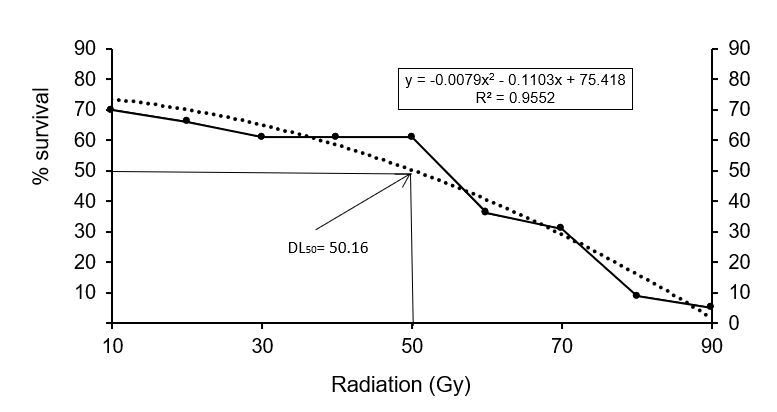
After bud break and seedling emergence, survival is essential for seedlings to grow and develop. Plant survival was affected proportionally to the level of radiation received ( Figure 2 ). The R2value of 0.9552 suggests that there is a strong correlation between the level of survival and the level of radiation received.
The bud is a lignified tissue that can withstand direct physical damage from gamma-ray radiation. In many cases, emergence occurs normally; however, the plant soon dies due to indirect chemical damage from gamma rays to genes encoding elemental proteins of the plant’s primary metabolism ( Rubio-Ochoa et al ., 2024 ).
Therefore, seedling survival after sprouting is a reference to determining the median lethal dose. The regression equation indicates that survival decreases by 1.1% per 1 Gy increase in gamma radiation with Co60, with an LD50of 50.16 Gy ( Figure 2 ).
In the variable of stem thickness, there were no significant differences among treatments from 0 to 60 Gy. In the 70 Gy treatment, there was a significant reduction in stem thickness ( Figure 3 ). Stem thickness is a very important trait because it is the support of the plant and prevents lodging.
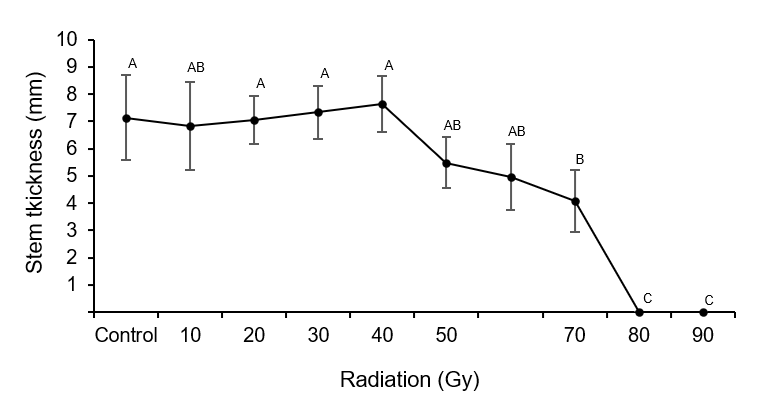
Typically, in the sugarcane stem, the proportion of juice and fibers is 86-92% to 8-14%, respectively ( Pires et al ., 2024 ). Therefore, sugar production can be reduced if the caliber of the sugarcane decreases, reducing cane yield. In the Mayarí 55-14 variety, the results for 80 and 90 Gy radiation are zero because none of the emerged shoots survived.
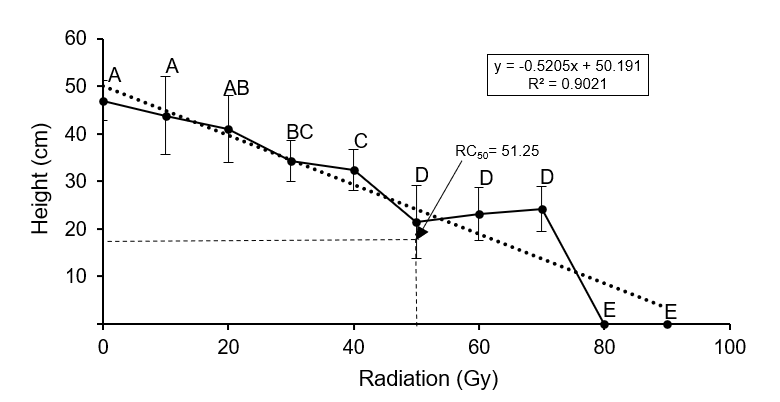
Another outstanding variable is the height of the sugarcane plant; along with thickness and weight, it is related to the amount of sugar produced. In addition, height shows the ability to develop and reflects a healthy plant. A sugarcane plant with a large diameter and height has higher sugar production and profitability ( Djumali et al ., 2024 ).
The results show that starting at 30 Gy, the height of the emerged shoots decreases significantly compared with the control ( Figure 4 ). The lower the height, the smaller the size of the milling stalk, which will lead to lower sugar production. This variable is important because sucrose is mainly stored in the stem; therefore, it is necessary to have large internodes to have greater storage of sucrose. The results for this height variable and its gamma radiosensitivity curve were used to obtain the GR50, which resulted in 51.25 Gy ( Figure 4 ).
Photosynthesis and gas exchange are processes that take place in sugarcane leaves, where carbohydrates are produced, differentially distributed and used for growth in height and stem thickness, as well as for sugar production, depending on the variety ( De Souza et al ., 2018 ; Leanasawat et al ., 2021 ; Djumali et al ., 2024 ). The leaf anatomy of plants from buds treated with gamma radiation (cobalt60) was examined in two varieties.
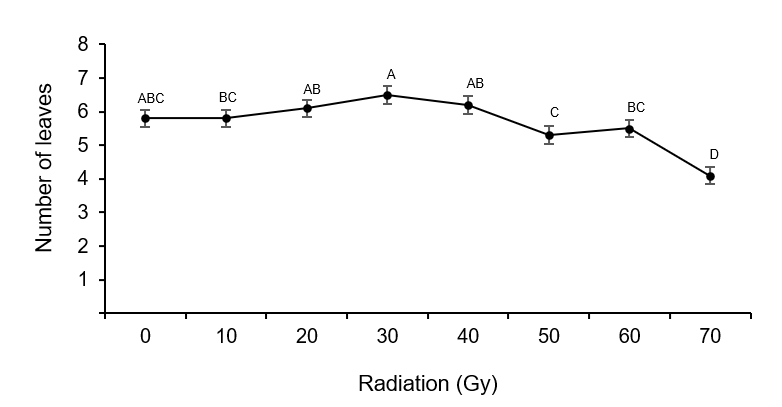
The MEX 69-290 variety showed a decrease in leaf width and leaf area starting at 70 Gy; in contrast, the CP 72-2086 variety showed such negative effects at 90 and 100 Gy ( Díaz-Juárez et al ., 2022 ). Similarly, our results show that the trend of reduction in the number of leaves begins at 50 Gy and at 70 Gy, decreases by up to 30% compared to the control.
This reinforces the idea that the radiosensitivity curve is different for each variety or genotype. The number of leaves did not present a significant difference compared with the control, as shown in Figure 5 .
Tillering is an important trait for sugarcane productivity and yield and is related to the capacity for environmental adaptation, which is regulated by the interaction of its genetic factors with the environment ( Riaz et al ., 2023 ). Compared with the control, the number of tillers decreases at 20 Gy and from 40 to 70 Gy ( Figure 6 ).
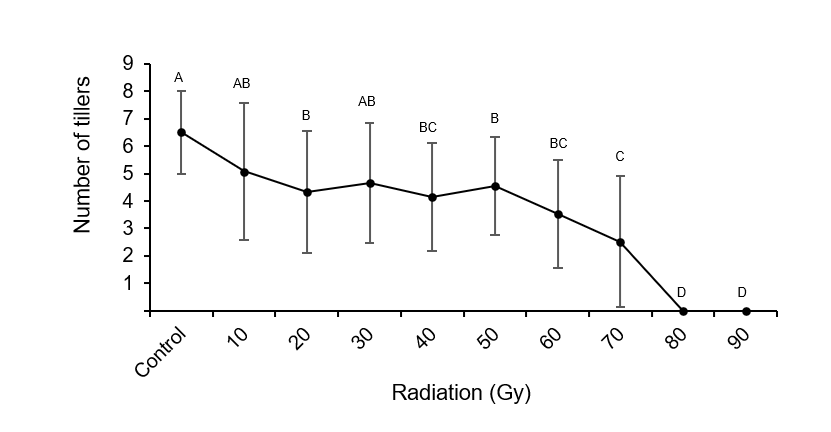
Tillering production was significantly affected starting at 40 Gy. These results coincide with those reported by Díaz-Juárez et al . (2022) for the varieties CP 72-2086 and MEX 69-290, who found that high doses of gamma radiation (80, 90 and 100 Gy) reduce phenotypic expression of traits and retard plant growth.
The Mayarí 55-14 sugarcane variety exhibits radiosensitivity characterized by a median lethal dose (LD50) of 50.16 Gy and a median growth reduction dose (GR50) of 51.25 Gy. These values define the critical range in which gamma radiation (cobalt60) exerts a significant effect on bud survival and development.
The phenotypic evaluation showed that radiation induced morphological changes in the variables evaluated, confirming its efficacy as a mutagenic agent. Therefore, it is recommended to irradiate the buds of this variety with doses of between 40 and 60 Gy.
The application of these doses will enable the selection of mutants with desirable agronomic traits, thereby contributing to the genetic breeding of the crop.
Ariharasutharsan, G.; Negi, P.; Vinoth, P.; Malarvizhi, A.; Senthilrajan, P.; Appunu, C.; Srivastava, A. K. and Valarmathi, R. 2025. Gamma ray induced significant phenotypic and metabolite changes in sugarcane variants derived through in vitro mutagenesis. Applied Radiation and Isotopes. 217(3):111597. https://doi.org/10.1016/j.apradiso.2024.111597.
Barrientos-Alfaro, F. C.; Echeverría-Beirute, F.; Hernández-Soto, A.; Gatica-Arias, A.; Hernández-García, C. M.; Carvajal-Quesada, P.; Rodríguez-Morales, A. and Pérez, J. 2025. Mutation breeding strategies and advances for sugarcane (Saccharum spp.) improvement. Plant Cell, Tissue and Organ Culture. 162(66):3-8. https://doi.org/10.1007/s11240-025-03188-y.
Díaz-Juárez, R. de la C.; Hernández-Arenas, M.; Santacruz-Varela, A.; Silva-Cifuentes, E. G.; De la Cruz-Torres, E.; Barrios-Gómez, E. J.; Trejo-Pastor, V. y Muñoz-Orozco, A. 2022. Dosis altas de radiación gamma (Cobalto60) disminuyen la expresión fenotípica de caracteres en caña de azúcar (Saccharum officinarum L.). Brazilian Journal of Animal and Environmental Research. 5(4):3694-3709. https://doi.org/10.34188/bjaerv5n4-021.
Pires, W. M.; Teixeira, M. B.; Soares, F. A. L.; Morais, W. A.; Costa, A. C.; Filho, L. C. L. and de Moura, J. B. 2024. Agronomic performance and technological quality of sugarcane submitted to different poultry litter dosages. Scientific Reports. 14(1):15435. https://doi.org/10.1038/s41598-024-66340-2.
Preciado, J. F. C.; Ruíz, A. E. C.; Mexicano, M. M. y Burela, A. C. 2022. Evaluación agroindustrial de ocho híbridos de caña de azúcar (Saccharum spp.) cultivados en la zona de abastos del ingenio quesería, Colima, México. Studies in Environmental and Animal Science. 3(4):818-831. https://doi.org/10.54020/seasv3n4-001.
Reyes-Hernández, J.; Torres-de los Santos, R.; Hernández-Torres, H.; Hernández-Robledo, V.; Alvarado-Ramírez, E. y Joaquín-Cancino, S. 2022. Rendimiento y calidad de siete variedades de caña de azúcar en El Mante, Tamaulipas. Revista Mexicana de Ciencias Agrícolas. 13(5):883-892. https://doi.org/10.29312/remexca.v13i5.3232.
Riviello-Flores, M. de la L.; Cadena-Iñiguez, J.; Ruiz-Posadas, L. del. M.; Arévalo-Galarza, M. de L.; Castillo-Juárez, I.; Soto-Hernández, M. and Castillo-Martínez, C. R. 2022. Use of gamma radiation for the genetic improvement of underutilized plant varieties. Plants. 11(9):1161-1169. https://doi.org/10.3390/plants11091161.
Rubio-Ochoa, E.; De la Cruz-Torres, E.; Olalde-Portugal, V.; Pérez-Sánchez, R. E.; Gómez-Leyva, J. F. y García-Saucedo, P. A. 2024. Mutagénesis por radiación gamma para mejora genética de plantas de importancia alimentaria. Revista Mexicana de Ciencias Agrícolas. 15(5):e3747. https://doi.org/10.29312/remexca.v15i5.3747.